
Quick answer: U.S. taxes work in layers. Federal income tax takes 10% to 37% of each slice of taxable income, and payroll taxes take another 7.65% of most wages. States and cities add income, sales, and property taxes, and each spring you file a return that settles what you owe against what you’ve paid.
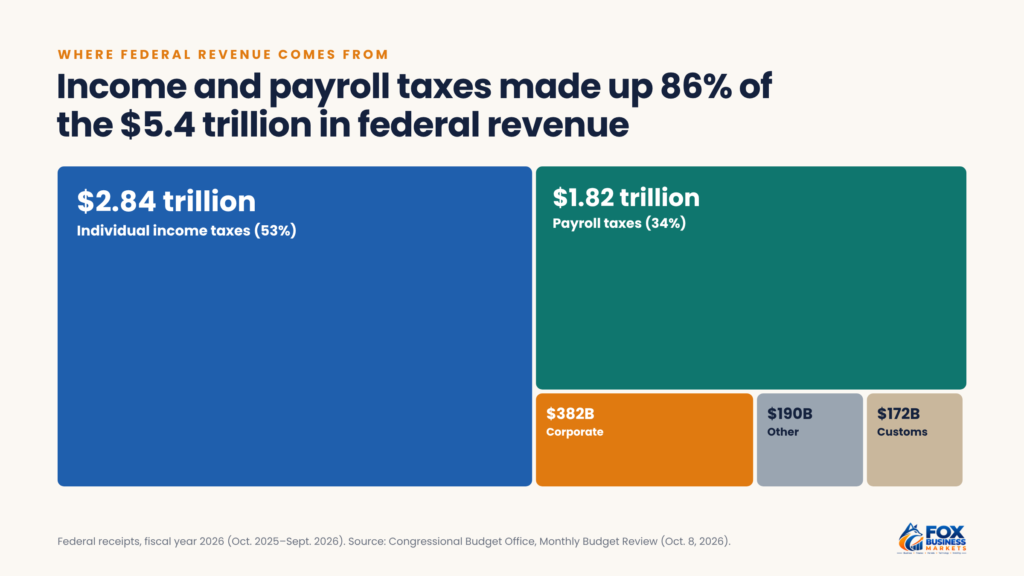
The federal government collected $5.4 trillion in fiscal year 2026, and more than half of it, $2.84 trillion, came from individual income taxes, according to the Congressional Budget Office. Another $1.82 trillion came from payroll taxes paid by workers and employers.
Most people pay those taxes without ever seeing the whole system. Money comes out of each paycheck, a refund or bill shows up in the spring, and few people see how one leads to the other. A handful of rules explain most of it.
This guide explains how taxes work in the U.S.: the main types of tax, how tax brackets and deductions shape your bill, what withholding does, and how filing and refunds work, with 2026 numbers throughout.
What Taxes Do Americans Pay?
Most households pay several kinds of tax to several levels of government.
Tax | Who collects it | What it’s based on |
| Federal income tax | IRS | Wages, self-employment income, interest, dividends, capital gains, and other income |
| Payroll taxes (FICA) | IRS, through your employer | Wages and self-employment earnings |
| State income tax | Most states | Income, with rules that vary by state |
| Local income tax | Some cities and counties | Income, often wages |
| Sales tax | States and localities | Purchases of many goods and some services |
| Property tax | Local governments | The assessed value of homes and land |
| Excise taxes | Federal and state governments | Specific goods, such as gasoline, alcohol, and tobacco |
Federal income and payroll taxes are the biggest for most workers. Sales and property taxes depend heavily on where you live.
How Does Federal Income Tax Work?
Federal income tax follows a basic formula:
- Add up your income. Wages, tips, freelance income, interest, dividends, retirement withdrawals, and most other income count.
- Subtract adjustments. Contributions to a traditional IRA or a health savings account, for example, reduce your income before anything else. The result is your adjusted gross income (AGI).
- Subtract deductions. You take either the standard deduction or itemized deductions, whichever is larger. The result is your taxable income.
- Apply the tax brackets. Different slices of taxable income are taxed at different rates.
- Subtract tax credits. Credits, like the child tax credit, cut your tax bill dollar for dollar.
- Compare with what you’ve paid. If your withholding and estimated payments are more than your tax, you get a refund. If they’re less, you owe the difference.
What Is Your Filing Status?
Your filing status sets your tax brackets and your standard deduction. There are five: single, married filing jointly, married filing separately, head of household, and qualifying surviving spouse. Head of household generally applies to unmarried people who pay more than half the cost of keeping up a home for a qualifying person, and it comes with a larger standard deduction and wider brackets than single. Most married couples pay less by filing jointly.
How Do Tax Brackets Work?
The U.S. uses a progressive system with seven federal rates: 10%, 12%, 22%, 24%, 32%, 35%, and 37%. The One Big Beautiful Bill Act, signed in July 2025, made these rates permanent.
Each rate applies only to the income inside its bracket, not to all of your income. These are the 2026 brackets for taxable income, set in IRS Revenue Procedure 2025-32:
Rate | Single | Married filing jointly |
| 10% | Up to $12,400 | Up to $24,800 |
| 12% | $12,401 to $50,400 | $24,801 to $100,800 |
| 22% | $50,401 to $105,700 | $100,801 to $211,400 |
| 24% | $105,701 to $201,775 | $211,401 to $403,550 |
| 32% | $201,776 to $256,225 | $403,551 to $512,450 |
| 35% | $256,226 to $640,600 | $512,451 to $768,700 |
| 37% | Over $640,600 | Over $768,700 |
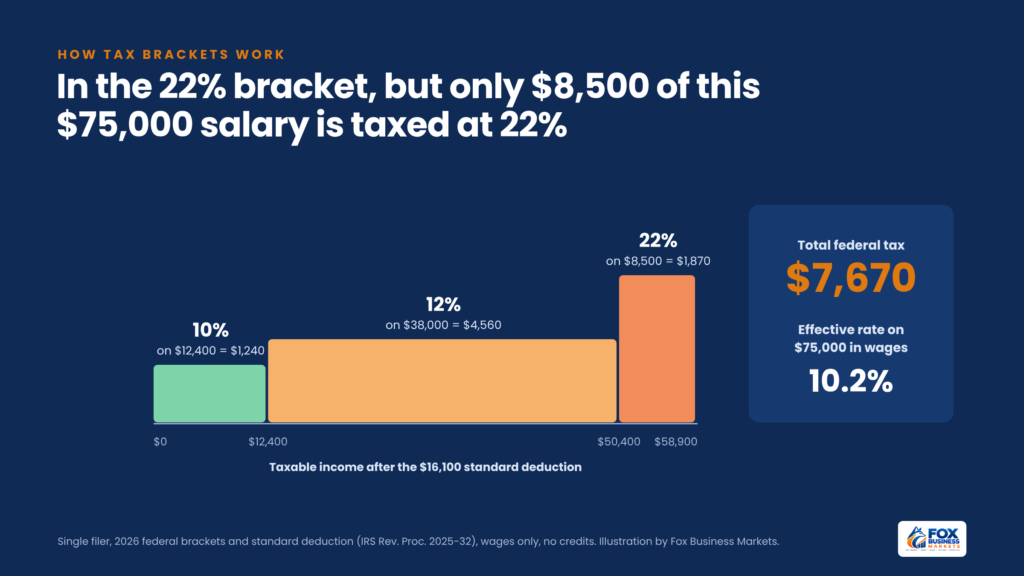
An example. A single filer earns $75,000 in wages in 2026 and takes the $16,100 standard deduction, leaving $58,900 of taxable income:
- The first $12,400 is taxed at 10%: $1,240.
- The next $38,000, up to $50,400, is taxed at 12%: $4,560.
- The last $8,500 is taxed at 22%: $1,870.
The total is $7,670. This person is “in the 22% bracket,” but only $8,500 of their income is taxed at that rate. Their tax equals about 10.2% of their $75,000 in wages, which is their effective rate.
Moving into a higher bracket doesn’t raise the tax on the income you already had. Only the extra dollars are taxed at the higher rate.
These 2026 figures apply to the return you’ll file in early 2027. The IRS usually announces the next year’s inflation adjustments in October or November. Our guide to tax brackets has the full tables for every filing status.
What’s the Difference Between Deductions and Credits?
Both lower your taxes, but in different ways.
Deductions reduce the income that gets taxed. A $1,000 deduction saves you $220 if your top rate is 22%. Most people take the standard deduction, which for 2026 is:
- $16,100 for single filers
- $32,200 for married couples filing jointly
- $24,150 for heads of household
You can itemize instead if your deductible expenses, such as mortgage interest, state and local taxes, and charitable gifts, add up to more. For 2026, the deduction for state and local taxes is capped at $40,400 for most filers, and the cap shrinks for incomes above $505,000. Our comparison of the standard deduction vs. itemized deductions shows which saves you more.
Credits reduce the tax itself. A $1,000 credit saves you $1,000, whatever your bracket. Common credits include:
- Child tax credit: up to $2,200 per qualifying child for 2026.
- Earned income tax credit (EITC): for low- and moderate-income workers, up to $8,231 for 2026 with three or more qualifying children.
- Education credits: for college tuition and related costs.
- Saver’s Credit: for lower-income workers who contribute to retirement accounts.
Some credits are refundable, meaning you can get money back even if you owe no tax.
New temporary deductions. From 2025 through 2028, workers can deduct some tip and overtime pay, people 65 and older get an extra $6,000 deduction, and buyers of new U.S.-assembled cars can deduct some loan interest. Income limits apply, and you can claim these whether you itemize or not.
How Do Payroll Taxes Work?
Payroll taxes fund Social Security and Medicare, and they’re separate from income tax. They’re often listed on your pay stub as FICA.
Tax | You pay | Your employer pays | Limit |
| Social Security | 6.2% | 6.2% | Wages up to $184,500 in 2026 ($192,300 in 2027) |
| Medicare | 1.45% | 1.45% | No limit |
| Additional Medicare tax | 0.9% | None | Wages above $200,000 (single) or $250,000 (joint) |
Together, most workers pay 7.65% of each paycheck in payroll taxes. Unlike income tax, payroll tax starts with your first dollar of wages, with no standard deduction.
Self-employed? You pay both halves, for a combined 15.3% self-employment tax on most net earnings, though you can deduct half of it from your income.
What Is Withholding, and Why Do You Get a Refund?
The U.S. collects income tax as you earn it. Your employer withholds federal income tax from each paycheck based on the Form W-4 you fill out. Self-employed people and others without withholding make quarterly estimated tax payments instead.
At filing time, you compare the tax you actually owe with what’s already been paid:
- Paid too much? You get a refund of the difference.
- Paid too little? You owe the rest, and you may owe a penalty if you underpaid by too much during the year.
During the 2026 filing season, the average refund was $3,276 through early May, up 11.5% from a year earlier, according to IRS filing season statistics.
If you’d rather have more in each paycheck, you can adjust your W-4.
How Are Investments Taxed?
Investment income has its own rules:
- Interest from savings accounts, CDs, and bonds is generally taxed as ordinary income, at your regular rates. Interest on Treasury securities is exempt from state and local income tax.
- Qualified dividends (most dividends from U.S. stocks) and long-term capital gains, on investments held more than a year, get lower rates of 0%, 15%, or 20%. For 2026, a single filer pays 0% on these gains up to $49,450 of taxable income ($98,900 for joint filers), and the 20% rate applies only to very high incomes.
- Short-term capital gains, on investments held a year or less, are taxed as ordinary income.
Tax-advantaged accounts change the picture. A 401(k) or traditional IRA can lower your taxable income now, while a Roth account lets qualified withdrawals come out tax-free later. Our comparison of a Roth IRA vs. traditional IRA explains which may fit. For a regular brokerage account, our guide on how to start investing covers the first steps.
How Are Retirement Income and Social Security Taxed?
Taxes don’t stop when you retire, but the rules change:
- Traditional 401(k) and IRA withdrawals are taxed as ordinary income, because the money went in before tax. You generally must start required minimum distributions at age 73 (75 if you were born in 1960 or later).
- Roth withdrawals are tax-free if you’re 59½ or older and it’s been at least five years since your first Roth contribution.
- Social Security benefits may be partly taxable. Depending on your other income, up to 85% of your benefits can be taxed, and those income thresholds aren’t adjusted for inflation.
- Pensions are generally taxed as ordinary income, minus any part you paid in with after-tax money.
Many states don’t tax Social Security, and some exempt part of pension or retirement-account income too.
Which Tax Forms Will You See?
A handful of forms show up for most households:
Form | What it is | Who sends or files it |
| W-4 | Tells your employer how much income tax to withhold | You give it to your employer |
| W-2 | Shows your wages and the taxes withheld for the year | Your employer, by Jan. 31 |
| 1099-NEC | Reports freelance or contract pay | Clients who paid you $2,000 or more in 2026 ($600 before 2026) |
| 1099-INT / 1099-DIV | Reports interest and dividends | Banks and brokerages |
| 1099-B | Reports investment sales | Brokerages |
| 1040 | Your federal income tax return | You file it with the IRS |
How Do State and Local Taxes Work?
State taxes vary more than federal ones:
- State income tax. Most states tax income, some at a flat rate and others with brackets. Nine states don’t tax wages: Alaska, Florida, Nevada, New Hampshire, South Dakota, Tennessee, Texas, Washington, and Wyoming. Washington does tax some large capital gains and has enacted a tax on income over $1 million starting in 2028.
- Sales tax. Five states, Alaska, Delaware, Montana, New Hampshire, and Oregon, have no statewide sales tax, though Alaska allows local ones. The population-weighted average combined state and local rate was 7.53% as of July 1, 2026, according to the Tax Foundation. Louisiana had the highest average combined rate, at 10.13%.
- Property tax. Local governments set property taxes to fund schools and services. Homeowners pay them directly or through a mortgage escrow account, and renters pay them indirectly through rent.
If your state has an income tax, you’ll usually file a separate state return, and you may need to file in more than one state if you moved or worked across state lines. A state with no income tax isn’t automatically cheaper. It may rely more on sales or property taxes, so look at the total when comparing places to live.
Who Pays the Most in Federal Income Tax?
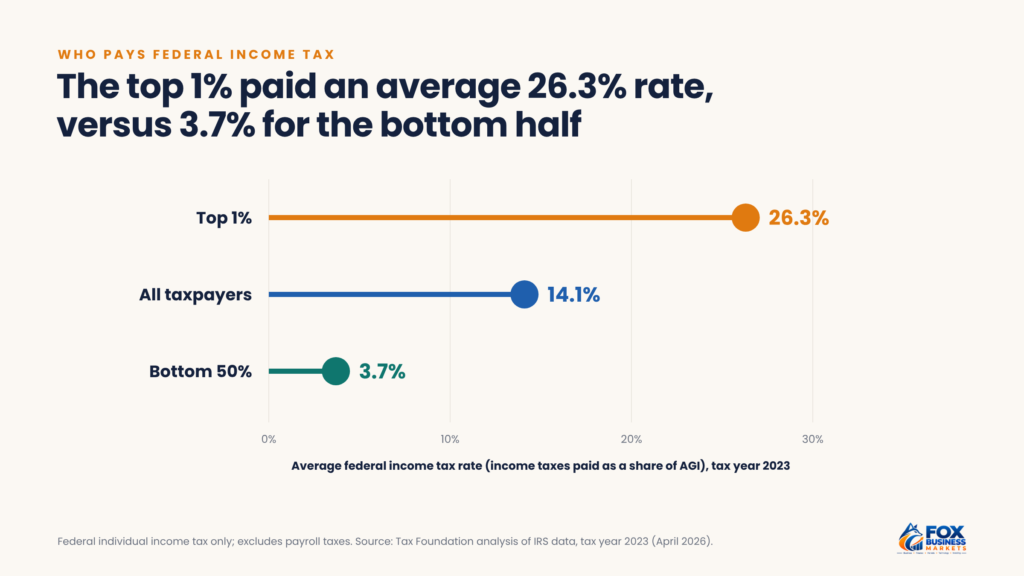
Federal income tax is concentrated at the top. In tax year 2023, the latest IRS data available, the top 1% of earners paid 38.4% of all federal individual income taxes while earning 20.6% of income, according to a Tax Foundation analysis of IRS data. The top half of earners paid about 97%.
Average tax rates show the same pattern:
- Top 1%:3% of income
- All taxpayers:1%
- Bottom 50%:7%
Those figures cover federal income tax only. Payroll taxes take a larger share of income for many lower- and middle-income workers, because they apply from the first dollar and stop at the Social Security wage base. See our tax statistics for 2026 for the full breakdown.
Is a Bigger Refund Better?
Not necessarily. A large refund means you overpaid during the year and gave the government an interest-free loan. The same money could have paid down debt or earned interest in a high-yield savings account.
A small refund, or owing a little, often means your withholding was close to right. The goal is to be near zero without owing a penalty.
There are exceptions. If you qualify for refundable credits like the EITC, a large refund may come from credits rather than overpayment. And some people prefer a refund as a once-a-year lump sum they won’t spend. Either way, plan for the money in your budget instead of treating it as a windfall.
How Do You File Taxes?
Filing means reporting your income on Form 1040, figuring your tax, and then paying any balance or claiming your refund. You’ll need your W-2s, 1099s, and records for any deductions and credits. You can use tax software, IRS Free File if you qualify, free volunteer help through VITA or TCE, or a paid preparer.
Returns for tax year 2026 are due April 15, 2027. An extension gives you until October to file, but not more time to pay. Choose direct deposit for the fastest refund. Our step-by-step guide on how to file taxes covers each stage.
You generally must file if your income is above the standard deduction for your filing status, and in some other cases, such as having self-employment income of $400 or more. Even if you aren’t required to file, filing may get you a refund of withheld tax or refundable credits.
Frequently Asked Questions
What happens if I can’t pay my taxes on time?
File on time anyway, because the penalty for not filing is usually much larger than the penalty for not paying. The IRS offers payment plans, and many people can set one up online. Interest and a smaller late-payment penalty still apply, so pay as much as you can by the deadline.
How long should I keep my tax records?
The IRS generally has three years from the date you filed or the filing deadline, whichever is later, to audit a return, and longer in some cases, such as substantially underreported income. Keep returns and supporting documents for at least three years, and keep records for property and investments until the audit window closes for the year you sell them. A scanned copy in cloud storage protects you if paper records are lost.
Do I have to pay taxes on money I receive as a gift?
Generally, no. The person who gives the gift is responsible for any gift tax, and in 2026 they can give up to $19,000 per person without even filing a gift tax return. Large lifetime gifts count against a $15 million exemption. If you receive a large gift of property, keep a record of the giver’s original cost, since you’ll need it if you sell.
What should I do if I get a letter from the IRS?
Read it carefully and respond by the date it gives. Most letters ask for information or explain a change to your return, and you can check that a notice is real through your IRS online account or by calling the number listed on IRS.gov, not the one in the letter. Never pay anyone who demands payment by gift card or wire transfer, since the IRS doesn’t ask for those.
Check Your Own Numbers Before Tax Season Starts
Pull up last year’s return and find four numbers: your total income, your taxable income, your total tax, and what you paid through withholding. Together, they show where your money went and why you got a refund or a bill. Then check your W-4 before the year ends, so next spring’s refund or bill is the size you expect.
This article is for general information only and isn’t financial, tax, legal, or investment advice. Consider your own situation or talk to a qualified professional before making decisions.