
Entrepreneur Salary Calculator: Free & Easy Tool
The Entrepreneur Salary Calculator shows how much you can pay yourself from your business. Enter your yearly revenue and expenses, choose how much to keep in the business and set aside for taxes, and see your take-home pay per year, per month, and per hour. Results update as you type.
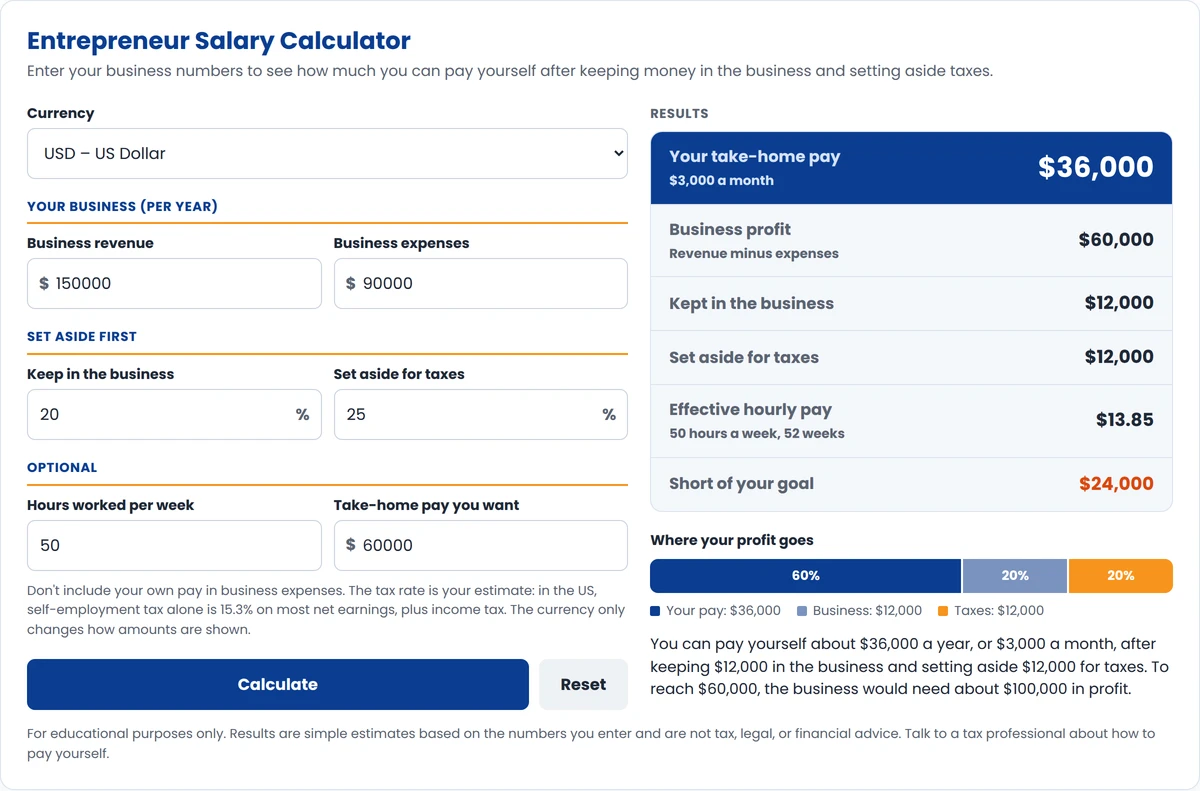
Enter your business numbers to see how much you can pay yourself after keeping money in the business and setting aside taxes.
Don't include your own pay in business expenses. The tax rate is your estimate: in the US, self-employment tax alone is 15.3% on most net earnings, plus income tax. The currency only changes how amounts are shown.
Results
For educational purposes only. Results are simple estimates based on the numbers you enter and are not tax, legal, or financial advice. Talk to a tax professional about how to pay yourself.
How to Use the Entrepreneur Salary Calculator
- Currency: Pick the currency your numbers are in. It only changes how amounts are shown; it does not convert them.
- Business revenue: Enter your total yearly sales.
- Business expenses: Enter your yearly costs, such as rent, supplies, software, and staff. Don't include your own pay.
- Keep in the business: Choose how much of your profit to leave in the business for growth and emergencies. The default is 20%.
- Set aside for taxes: Enter your estimated tax rate. The default is 25%; change it to match your situation.
- Hours and target pay (optional): Add your weekly hours to see your hourly pay, and the take-home pay you want to see how far you are from it.
Results update as you type.
How Is Entrepreneur Salary Calculated?
Business profit = Revenue − Business expenses
Kept in the business = Profit × Keep %
Set aside for taxes = (Profit − Kept in the business) × Tax %
Take-home pay = Profit − Kept in the business − Taxes
Hourly pay = Take-home pay ÷ (Hours per week × 52)
Example: Your business brings in $150,000 a year and spends $90,000, leaving $60,000 in profit.
- Keeping 20% in the business leaves $12,000 for growth and emergencies.
- Setting aside 25% of the remaining $48,000 for taxes is $12,000.
- Your take-home pay is $36,000 a year, or $3,000 a month.
- At 50 hours a week, that's about $13.85 an hour.
- To take home $60,000, the business would need about $100,000 in profit.
How Do Business Owners Pay Themselves?
How you pay yourself depends on how your business is set up:
| Business type | How owners usually get paid | What to know |
|---|---|---|
| Sole proprietor or single-member LLC | Owner's draw: you take money out of the business | You pay income tax and self-employment tax on the business's profit, not on what you draw |
| Partnership | Share of profits and guaranteed payments | The IRS says "partners are not employees and should not be issued a Form W-2" (IRS) |
| S corporation | A salary plus distributions | S corporations "must pay reasonable compensation to a shareholder-employee" before making non-wage distributions (IRS) |
| C corporation | A salary as an employee, and sometimes dividends | Officers are generally employees, and their pay should match their duties (IRS) |
Real Example: What Taxes Mean for Your Pay
Taxes are why the calculator asks you to set money aside. For self-employed people in the US:
- Self-employment tax is 15.3%: 12.4% for Social Security and 2.9% for Medicare, generally on net earnings of $400 or more (IRS).
- The Social Security part has a cap: in 2026, it applies to the first $184,500 of combined earnings (Social Security Administration).
- Income tax comes on top, at your federal rate plus any state tax.
- You may need to pay during the year: sole proprietors, partners, and S corporation shareholders generally must make estimated tax payments if they expect to owe $1,000 or more (IRS).
On $60,000 of profit, self-employment tax alone could take up to about $9,180 before income tax. That's why setting aside 25% or more is a common starting point, though your real rate depends on your income, deductions, and state.
Where Can You Find Your Numbers?
- Revenue and expenses: Your profit and loss statement in your accounting software, or last year's tax return (Schedule C for sole proprietors).
- Tax rate: Last year's return, or a tax professional. The IRS Form 1040-ES worksheet also helps estimate it.
- Starting a new business? Estimate your numbers with our business idea profit calculator and startup cost calculator.
What the Entrepreneur Salary Calculator Can and Cannot Tell You
It can show how much you could pay yourself from your profit, how much to leave in the business, and whether your business earns enough to meet your income goal.
It cannot:
- Calculate your exact taxes. Your tax rate is an estimate you enter.
- Decide the right business structure for you or what counts as reasonable compensation for an S corporation.
- Account for cash timing. A profitable business can still be short of cash in some months.
- Replace advice from an accountant or tax professional.
Frequently Asked Questions
How much should I pay myself as a business owner?
Start with your profit, not your revenue. Keep part of it in the business for growth and emergencies, set aside money for taxes, and pay yourself from what's left. Many owners start small and raise their pay as profit grows.
What percentage of profit should I pay myself?
There's no single rule. Using the calculator's defaults, keeping 20% in the business and setting aside 25% for taxes leaves 60% of profit as take-home pay. A growing or seasonal business may need to keep more.
Do I pay taxes on an owner's draw?
A draw itself isn't a separate taxable event for sole proprietors. You pay income tax and self-employment tax on the business's profit, whether you draw it or leave it in the business.
What is reasonable compensation for an S corporation?
It's the salary an S corporation must pay a shareholder who works in the business before taking other distributions. The IRS says officer pay should generally match the person's duties. A tax professional can help you set the amount.
How much should I set aside for taxes as a self-employed person?
Self-employment tax alone is 15.3% in the US, plus federal and state income tax. Many owners set aside 25% to 30% of profit as a starting point, then adjust once they know their actual rate.
Final Takeaway
Paying yourself starts with profit, not revenue. Use the calculator above to see what's left after you keep money in the business and set aside taxes, then check whether your business earns enough to support the pay you need. If it doesn't, our guide on why small businesses fail explains the warning signs to watch for.