
Young entrepreneurs who become billionaires before 30 are rarer than headlines suggest, but there have never been more of them. Forbes’ 2026 World’s Billionaires list counted a record 35 billionaires under 30. Only 12 of them built their own fortunes; the other 23 inherited theirs (Forbes). The youngest self-made billionaire on the list, Mercor cofounder Surya Midha, was just 22.
Below are six of the best-known young entrepreneurs who made their first billion before turning 30, from Facebook in 2008 to the AI startups minting billionaires today. Each story covers how they started, when they crossed $1 billion, and where they are now.
Key Takeaways
- Forbes’ 2026 list includes 35 billionaires under 30, but only 12 are self-made.
- Mark Zuckerberg became a billionaire at 23. In 2025, the three Mercor founders broke his record at 22.
- Most young billionaires built software or internet companies that grew fast with relatively few employees.
- Young billionaires are the exception. Research shows the average founder of a fast-growing startup is 45.
Young Billionaires at a Glance
| Founder | Company | Founded | Age at first $1 billion | Latest |
| Mark Zuckerberg | Facebook (Meta) | 2004 | 23 (2008) | $257.5 billion (Sept. 2026) |
| Evan Spiegel | Snap | 2011 | 24 (2015) | $2.3 billion (Oct. 2026) |
| John and Patrick Collison | Stripe | 2010 | 26 and 28 (2016) | John: $17.5 billion (Oct. 2026) |
| Alexandr Wang | Scale AI | 2016 | 25 (2022) | $3.2 billion (Oct. 2026) |
| Cursor’s founders | Cursor | 2022 | 25 to 26 (2025) | Sold to SpaceX for $60 billion (2026) |
| Mercor’s founders | Mercor | 2023 | 22 (2025) | About $2.2 billion each (Oct. 2026) |
Net worths are Forbes estimates and change daily.
How We Chose These Young Entrepreneurs
We included founders who became self-made billionaires before age 30, according to Forbes, and who are based in or built their companies for the US market. We left out heirs and founders already covered in our other success stories. Net worths and company values come from Forbes, company announcements, and major news outlets, with dates noted because they change often.
1. Mark Zuckerberg: The Original 23-Year-Old Billionaire
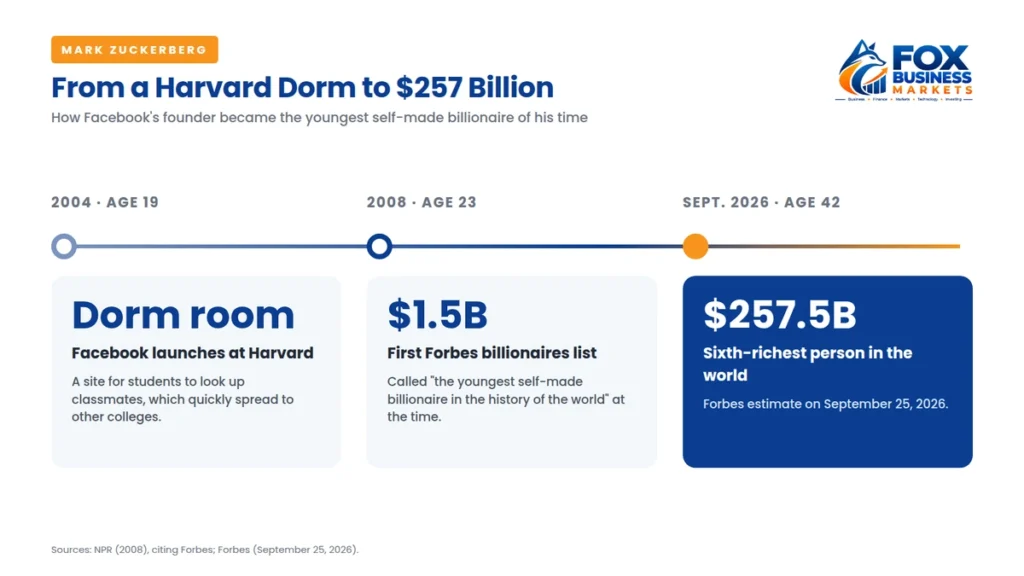
How he started: Zuckerberg founded Facebook in 2004 at 19, from his Harvard dorm room. It began as a site for students to look up classmates and quickly spread to other colleges.
His first billion: Forbes added him to its 2008 billionaires list at 23, with an estimated $1.5 billion. At the time, a Forbes editor called him “the youngest self-made billionaire in the history of the world” (NPR).
Where he is now: Forbes estimated his fortune at $257.5 billion on September 25, 2026, making him the sixth-richest person in the world (Forbes).
In his words: “Ideas don’t come out fully formed,” he told Harvard graduates in 2017 (Harvard Gazette).
The lesson: You don’t need the complete plan to start. Facebook’s first version was a campus website.
2. Evan Spiegel: The Snapchat Founder Who Said No
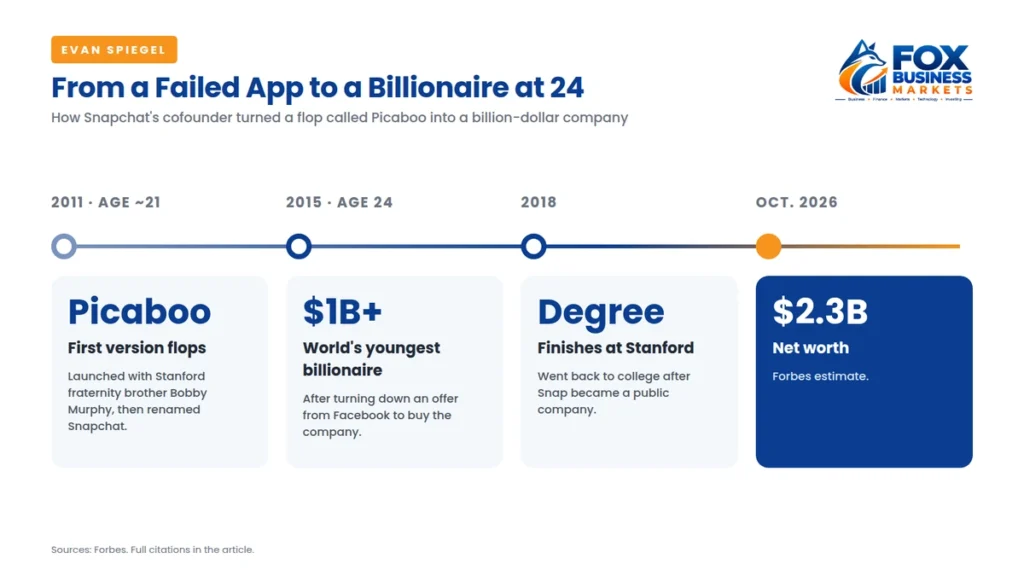
How he started: Spiegel launched the app with Stanford fraternity brother Bobby Murphy in 2011, when he was about 21. Its first version, called Picaboo, flopped. Renamed Snapchat, it took off as a photo-messaging app whose messages disappeared (Forbes).
His first billion: Spiegel turned down an offer from Facebook to buy the company. According to Forbes, he became the world’s youngest billionaire at 24, in 2015 (Forbes).
Where he is now: Forbes estimated his net worth at $2.3 billion in October 2026 (Forbes).
Myth vs. fact: Spiegel is often called a dropout, but he went back and finished his Stanford degree in 2018, after Snap went public.
The lesson: Turning down an early buyout is a big risk, but it can pay off if the product keeps growing.
3. John and Patrick Collison: Two Brothers and Stripe
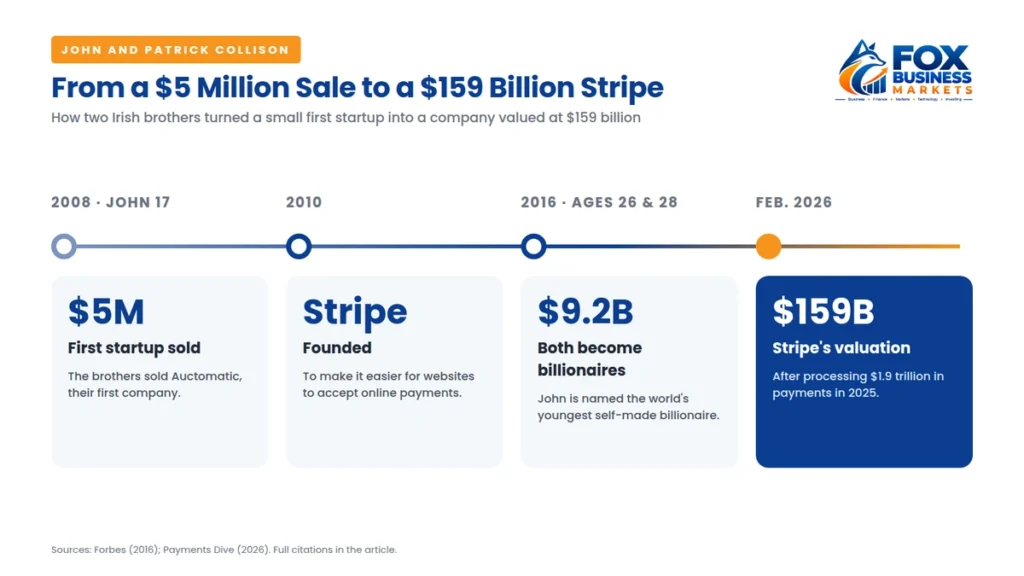
How they started: The Irish brothers sold their first startup, Auctomatic, for $5 million in 2008, when John was 17. In 2010, they founded Stripe to make it easier for websites to accept online payments (Forbes).
Their first billion: In November 2016, an investment valued Stripe at $9.2 billion, making each brother worth at least $1.1 billion. John, then 26, became the world’s youngest self-made billionaire. Patrick was 28 (Forbes).
Where they are now: Stripe was valued at $159 billion in a February 2026 share sale and processed $1.9 trillion in payments in 2025 (Payments Dive). Forbes estimated John’s fortune at $17.5 billion in October 2026 (Forbes).
In their words: “If anyone here believes that Stripe has already made it, that would be hugely problematic for us,” Patrick said in 2016.
The lesson: A small first win can fund and teach you for the big one.
4. Alexandr Wang: From MIT Dropout to Meta’s AI Chief
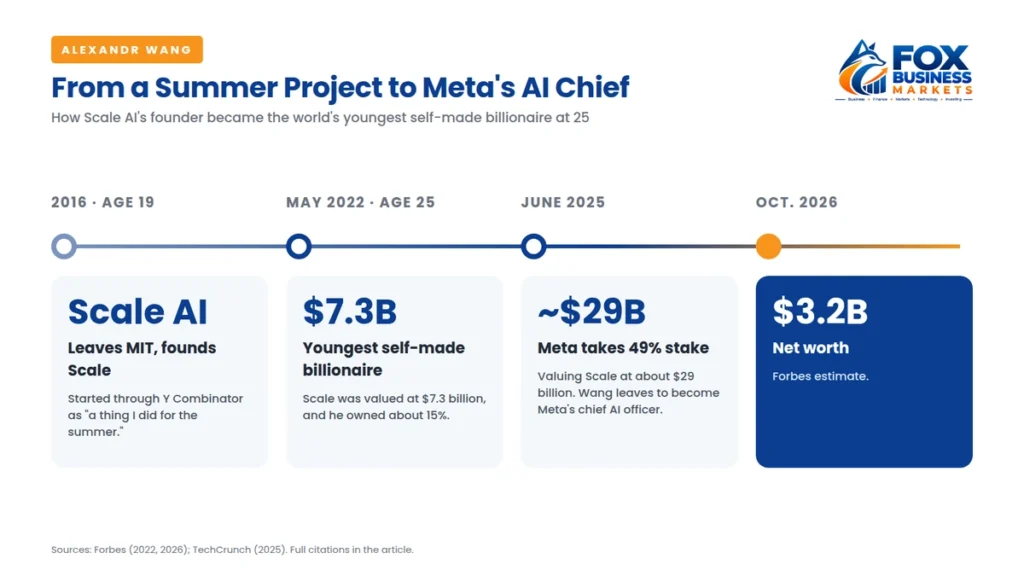
How he started: Wang left MIT at 19 and founded Scale AI in 2016 through the startup program Y Combinator. Scale prepares the data that companies use to train artificial intelligence. “I told my parents it was just going to be a thing I did for the summer,” he later said. “Obviously, I never went back to school” (Forbes).
His first billion: In May 2022, Forbes named him the world’s youngest self-made billionaire at 25, based on his 15% stake in a company valued at $7.3 billion.
Where he is now: In June 2025, Meta took a 49% stake in Scale that valued it at about $29 billion, and Wang left to become Meta’s chief AI officer (TechCrunch). Forbes put his net worth at $3.2 billion in October 2026 (Forbes).
The lesson: Serving a fast-growing industry, rather than competing in it, can be its own path to the top.
5. Cursor’s Founders: Four MIT Friends and a $60 Billion Exit
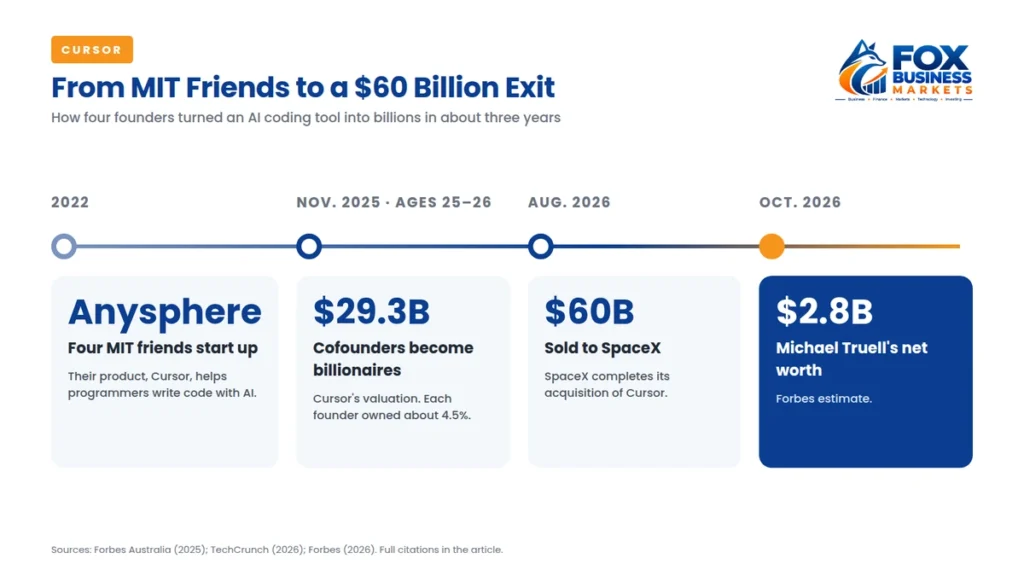
How they started: Michael Truell, Aman Sanger, Sualeh Asif, and Arvid Lunnemark met at MIT and founded Anysphere in 2022. Its product, Cursor, is an AI-powered tool that helps programmers write code. Truell once described it as “Google Docs for programmers.”
Their first billion: In November 2025, a funding round valued Cursor at $29.3 billion. Each founder held about 4.5% of the company, worth at least $1.3 billion, at ages 25 and 26 (Forbes Australia).
Where they are now: SpaceX completed its $60 billion acquisition of Cursor in August 2026 (TechCrunch). Forbes estimated Truell’s fortune at $2.8 billion in October 2026 (Forbes).
The lesson: In a hot market, a useful product can grow from idea to billions in about three years.
6. Mercor’s Founders: The Youngest Self-Made Billionaires Ever
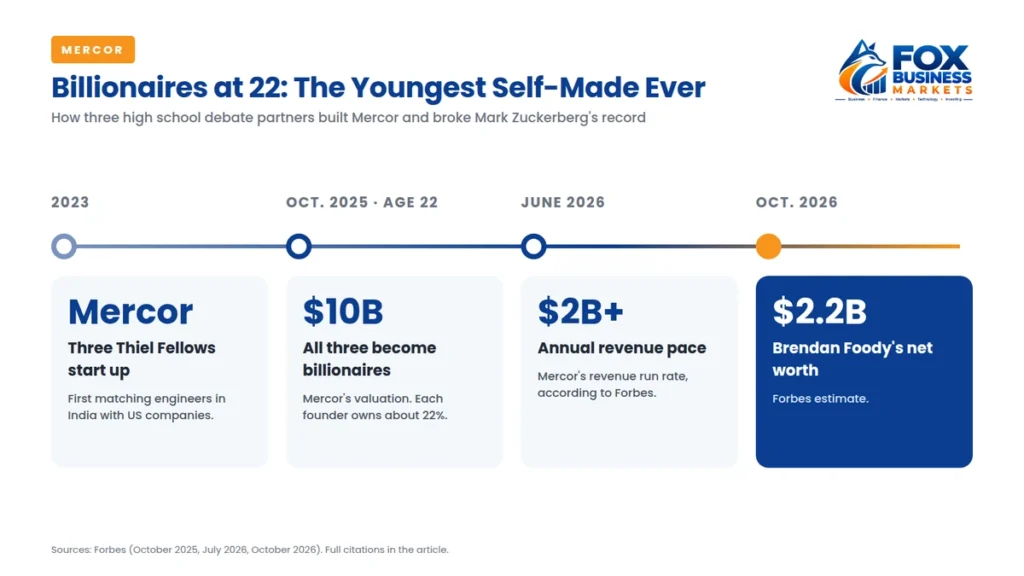
How they started: Brendan Foody, Adarsh Hiremath, and Surya Midha met on high school debate teams in the Bay Area. They founded Mercor in 2023 to match engineers in India with US companies, and it grew into a platform that hires experts to help train AI models. All three are Thiel Fellows, a program that pays young people $100,000 to skip or leave college (Forbes).
Their first billion: In October 2025, a $350 million funding round valued Mercor at $10 billion. Each founder owns about 22%, which made all three billionaires at 22, younger than Zuckerberg was. “If I weren’t working on Mercor, I would have just graduated college a couple months ago,” Hiremath told Forbes.
Where they are now: Mercor’s revenue passed a $2 billion annual pace in June 2026, according to Forbes (Forbes). Forbes estimated Foody’s net worth at $2.2 billion in October 2026 (Forbes).
The lesson: Timing matters. All three founders started at the right moment in a fast-growing industry.
Other young entrepreneurs have joined them recently. Polymarket founder Shayne Coplan became a billionaire at 27 in October 2025 (Fortune), and Kalshi cofounders Luana Lopes Lara and Tarek Mansour did so at 29 that December (Forbes Australia).
What Did These Young Entrepreneurs Have in Common?
- They built software. Every company on this list runs on software or an online platform that can serve millions of users without a matching rise in costs.
- They started early, but not alone. Most had cofounders. Only Zuckerberg is usually remembered as a solo founder, and even he had a team.
- They rode a big wave. Social media in the 2000s, online payments in the 2010s, and artificial intelligence in the 2020s.
- Their wealth is mostly on paper. A young founder’s fortune is usually their share of a private company, which can rise or fall with the next funding round.
- Many left school. Wang, Zuckerberg, and the Mercor founders left college, though Spiegel later went back and finished.
4 Lessons Any Entrepreneur Can Use
You don’t need to become a billionaire to learn from these founders. Their stories point to a few habits that work at any age and any size:
- Solve a problem you understand. Zuckerberg built for his classmates, and the Cursor founders built a tool they wanted as programmers.
- Find the right partner. Every company on this list had cofounders who split the work and the risk.
- Test before you scale. Snapchat’s first version failed. Spiegel and Murphy changed it instead of giving up.
- Know your numbers. Before you spend money, check what it will cost to start with our startup cost calculator.
Myth vs. Fact: Do You Have to Be Young to Succeed?
Myth: Most successful founders are in their 20s.
Fact: A study of more than 2.7 million US founders, using Census Bureau data, found that the average age of founders of the fastest-growing startups was 45. A 50-year-old founder was 1.8 times as likely as a 30-year-old to build one of those companies (National Bureau of Economic Research).
Young billionaires stand out precisely because they’re rare. The average billionaire is 67, according to Forbes (Forbes). Many successful founders start later, with more experience, savings, and contacts. Our entrepreneur success stories include founders who built billion-dollar companies at every age.
Frequently Asked Questions
Who is the youngest self-made billionaire in 2026?
Surya Midha, a cofounder of the AI hiring company Mercor, was the youngest self-made billionaire on Forbes’ 2026 World’s Billionaires list, at 22. His cofounders Brendan Foody and Adarsh Hiremath became billionaires at the same age.
How many billionaires are under 30?
Forbes counted a record 35 billionaires under 30 on its 2026 list. Only 12 of them are self-made; the other 23 inherited their wealth.
Who was the youngest billionaire before Mercor’s founders?
Mark Zuckerberg became a billionaire at 23 in 2008, a record for a self-made billionaire that stood until Mercor’s three founders became billionaires at 22 in 2025.
Do you need to drop out of college to become a successful entrepreneur?
No. Several founders on this list left college, but most successful founders don’t. Research shows the average founder of a fast-growing startup is 45, usually with years of work experience.
Final Takeaway
The young entrepreneurs on this list became billionaires by building software at the right moment, with cofounders, and by holding on to large stakes in fast-growing companies. Their stories are inspiring, but they’re the exception, not the rule. If you’re planning your own business, start with the numbers: our business idea profit calculator can show whether an idea makes money before you invest in it.