
The best entrepreneur success stories are rarely overnight wins. Nike began as a man selling imported running shoes from his car. Spanx started with $5,000 in savings. Nvidia was weeks from running out of money before becoming the first company worth $5 trillion. Airbnb’s founders kept going by selling $40 boxes of cereal. What these stories share isn’t luck or a perfect idea. It’s founders who survived a moment when the business almost ended, and who kept going long enough to reach the turning point.
Most new businesses never get that far. About 78.7% of new US businesses survive their first full year, and only around half are still open by year six, according to the Bureau of Labor Statistics (BLS via NABE). Yet Americans keep trying: about 5.6 million applications to start new businesses were filed in 2025, according to Census data compiled by Finder (Finder).
Entrepreneur Success Stories: Founders Who Built Giants From Almost Nothing
- Nike’s first year: Blue Ribbon Sports, the company that became Nike, sold 1,300 pairs of shoes for $8,000 in its first year.
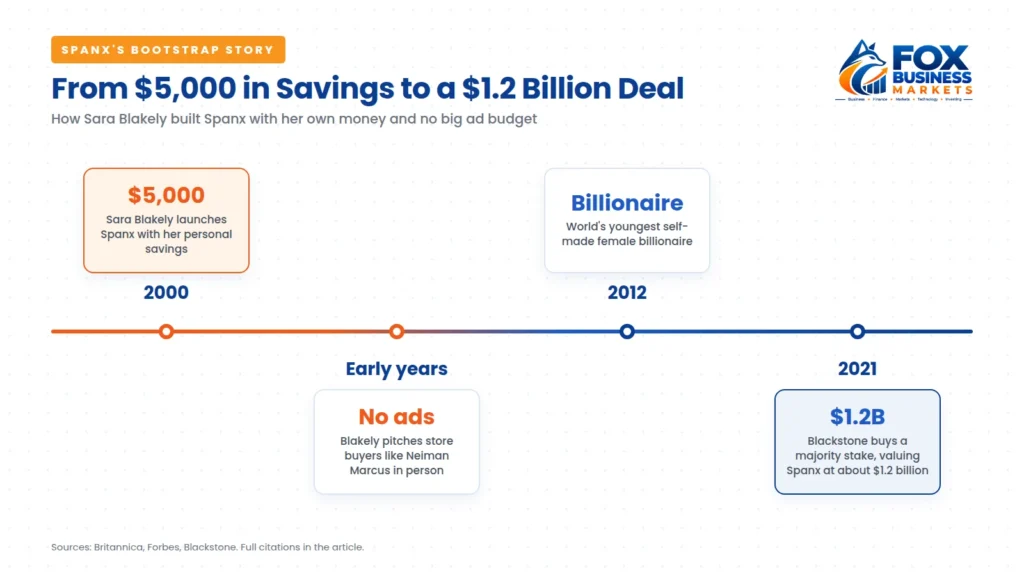
- Spanx’s starting budget: Sara Blakely launched Spanx in 2000 with $5,000 in personal savings and became the world’s youngest self-made female billionaire in 2012.
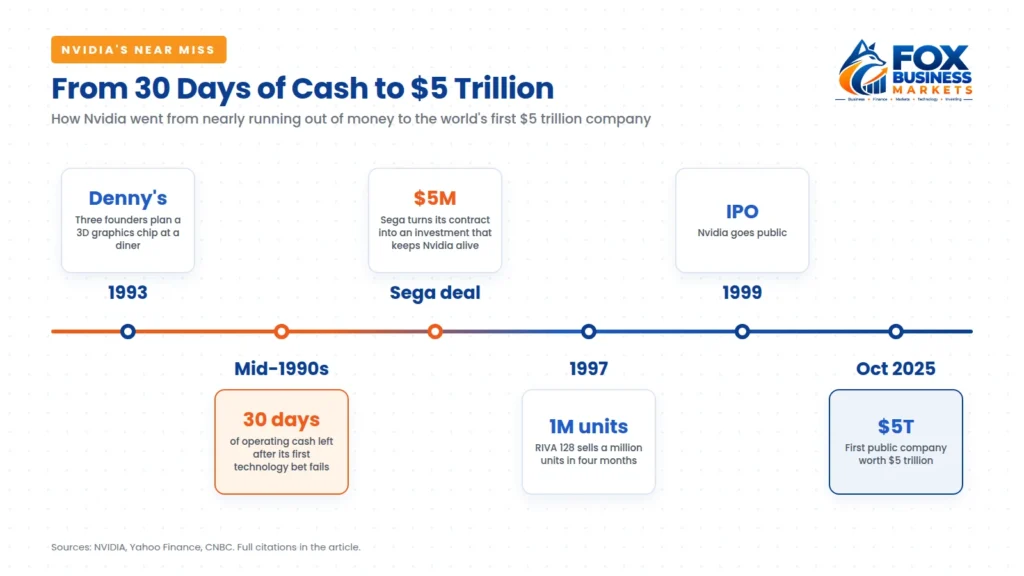
- Nvidia’s near miss: In the mid-1990s, Nvidia had about 30 days of operating cash left. A $5 million investment from Sega kept it alive. In October 2025, it became the first public company worth $5 trillion.
- Amazon’s funding reality: Jeff Bezos took 60 meetings to raise $1 million in seed money, and 40 investors said no.
- WhatsApp’s rejection: Co-founder Brian Acton was turned down for jobs at Twitter and Facebook in 2009. Five years later, Facebook bought WhatsApp for $19 billion.
- The garage myth: Steve Wozniak has said Apple’s famous garage “is a bit of a myth.”
8 Entrepreneur Success Stories at a Glance
| Company | Founded | How it started | The low point | The turning point |
| Nike | 1964 | Selling imported shoes from a car | A small distributor dependent on one supplier | Launching its own brand in 1971 |
| Apple | 1976 | Two friends working from home | No money for a real office | The Apple I and Apple II |
| Nvidia | 1993 | A meeting at a Denny’s | About 30 days from running out of cash | A $5 million Sega investment and the RIVA 128 chip |
| Amazon | 1994 | An online bookstore run from a garage | 40 of 60 potential investors said no | Raising $1 million in seed capital |
| Spanx | 2000 | $5,000 in personal savings | Getting into stores without a big marketing budget | Personally pitching store buyers |
| Airbnb | 2008 | Renting air mattresses | Rejected by investors | Selling $40 cereal boxes and joining Y Combinator |
| 2009 | A messaging app built after two job rejections | Turned down by Twitter and Facebook | Explosive user growth, then a $19 billion sale | |
| Zoom | 2011 | An engineer who left Cisco to start over | Visa refused eight times years earlier | A 2019 IPO, before the pandemic |
The 8 Entrepreneur Success Stories in Detail
1. Nike: From a Car Trunk to a Global Brand
How it started: On January 25, 1964, Phil Knight and his former track coach, Bill Bowerman, sealed a partnership with a handshake and founded Blue Ribbon Sports. Knight’s first sales were made out of his green Plymouth Valiant at track meets across the Pacific Northwest (Wikipedia). In its first year, the company sold 1,300 pairs of Japanese running shoes for $8,000 (Wikipedia).
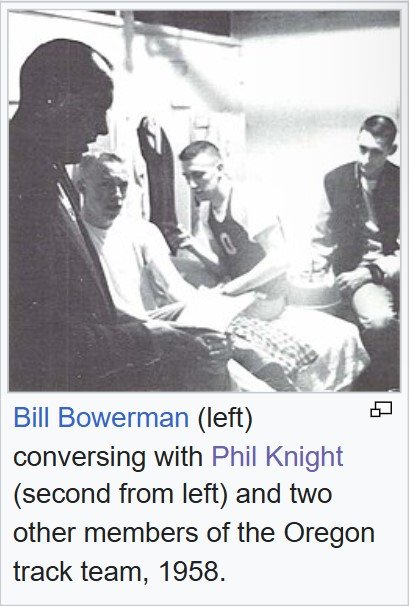
The turning point: In 1971, the company launched its own brand, Nike. Its logo, the Swoosh, was designed by graphic designer Carolyn Davidson, who was paid $35. Knight’s first reaction: “Well, I don’t love it, but maybe it will grow on me” (CNBC).
Myth vs. fact: Nike didn’t start as Nike. For its first seven years, it sold another company’s shoes.
The lesson: Selling someone else’s product taught Knight the market before he risked his own brand. Many lasting companies start as middlemen.
2. Apple: The Garage That Wasn’t
How it started: Steve Jobs and Steve Wozniak founded Apple in 1976, and the Jobs family garage in Los Altos became one of the most famous symbols in business.
Myth vs. fact: Wozniak has called the garage “a bit of a myth.” In a 2014 interview, he said: “We did no designs there, no breadboarding, no prototyping, no planning of products. We did no manufacturing there.” The garage, he said, “was something for us to feel was our home,” and they used it because “we had no money” (Engadget).

The lesson: The real story isn’t about a magical room. It’s about two founders with almost no money working wherever they could.
3. Nvidia: 30 Days From Going Out of Business
How it started: In 1993, Jensen Huang, Chris Malachowsky, and Curtis Priem met at a Denny’s in Silicon Valley and planned a chip that would bring realistic 3D graphics to personal computers (Nvidia).

The low point: Nvidia’s first chip used a graphics approach that the industry abandoned. When a planned graphics chip for Sega was canceled, the company had about 30 days of operating capital left (Yahoo Finance).
The turning point: Huang flew to Japan and asked Sega to turn its contract into a $5 million investment, warning it would “most likely be lost.” Sega agreed. The extra months let Nvidia build the RIVA 128, which launched in 1997 and sold 1 million units in four months. Huang later said: “If not for what Sega did for Nvidia … Nvidia would not be here today.”
Where it is now: Nvidia went public in 1999, and on October 29, 2025, it became the first public company worth $5 trillion (CNBC).
Myth vs. fact: Nvidia is often described as an overnight AI success. It took more than 30 years, and the company nearly failed in its first few years.
The lesson: Admitting a wrong bet early, and asking a partner for help, can buy the time a company needs to get the next product right.
4. Amazon: 60 Meetings for $1 Million
How it started: Jeff Bezos incorporated the company on July 5, 1994, originally as Cadabra, and ran it from his garage in Bellevue, Washington. Amazon.com opened as an online bookstore on July 16, 1995 (Wikipedia).
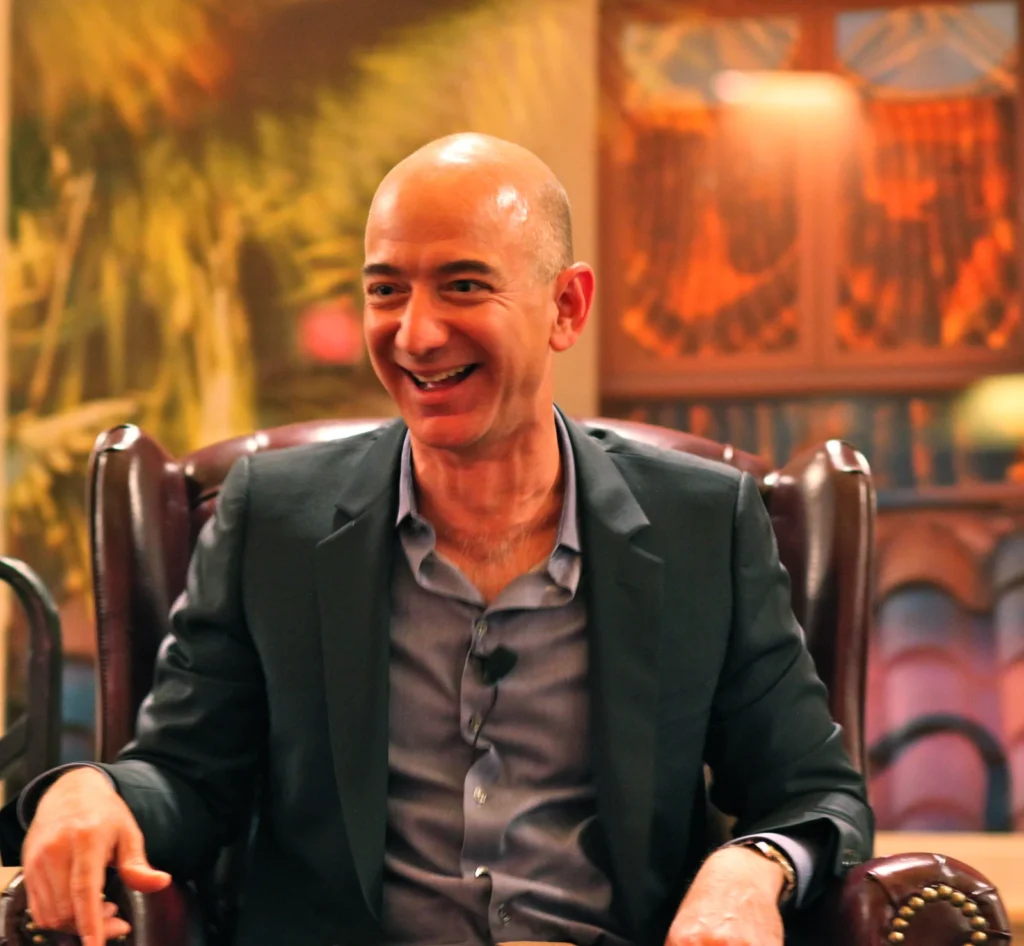
The low point: Raising money was, in Bezos’s words, among the hardest things he’s done. “I had to take 60 meetings,” he said, and 40 potential investors turned him down. He told investors he thought there was “a 70% chance they would lose their investment” (Fortune).
The turning point: About 20 investors put in roughly $50,000 each, for $1 million in seed capital. His parents had already invested $245,573 in 1995, according to a 1997 SEC filing (CNBC).
Myth vs. fact: Amazon did start in a garage, but it wasn’t built on nothing. Early family money and $1 million from outside investors carried it through its first years.
The lesson: Honesty about risk didn’t scare off every investor. Bezos told backers the odds were against them, and 20 of them invested anyway.
5. Spanx: $5,000 in Savings
How it started: Sara Blakely launched Spanx in 2000 using $5,000 in personal savings (Britannica).
The challenge: She had to get a brand-new product into major stores without a big marketing budget.
The turning point: Instead of advertising, Blakely traveled across the US, meeting buyers at stores such as Neiman Marcus and personally showing them the product.
Where it is now: In 2012, Blakely became the world’s youngest self-made female billionaire. In 2021, Blackstone bought a majority stake in a deal that valued Spanx at about $1.2 billion.
Myth vs. fact: This one holds up. The $5,000 figure is real, and so is the self-funding.
The lesson: When you can’t afford to advertise, the founder can be the sales team. Blakely’s in-person pitches did what a marketing budget couldn’t.
6. Airbnb: The Cereal That Saved a Startup
How it started: Airbnb launched in 2008, growing out of its founders, Brian Chesky, Joe Gebbia, and Nathan Blecharczyk, renting air mattresses to travelers.
The low point: Investors rejected the idea of strangers sleeping in each other’s homes.
The turning point: To keep going, the founders designed cereal boxes themed on the 2008 presidential candidates, “Obama O’s” and “Cap’n McCain’s.” They cost $4 to make and sold for $40, and the founders sold more than 1,000 boxes for about $30,000. Y Combinator’s Paul Graham then invested $20,000 for 6%. His reasoning: “If you can convince people to pay $40 for $4 boxes of cereal, maybe, just maybe, you can convince strangers to live with each other” (CNBC).
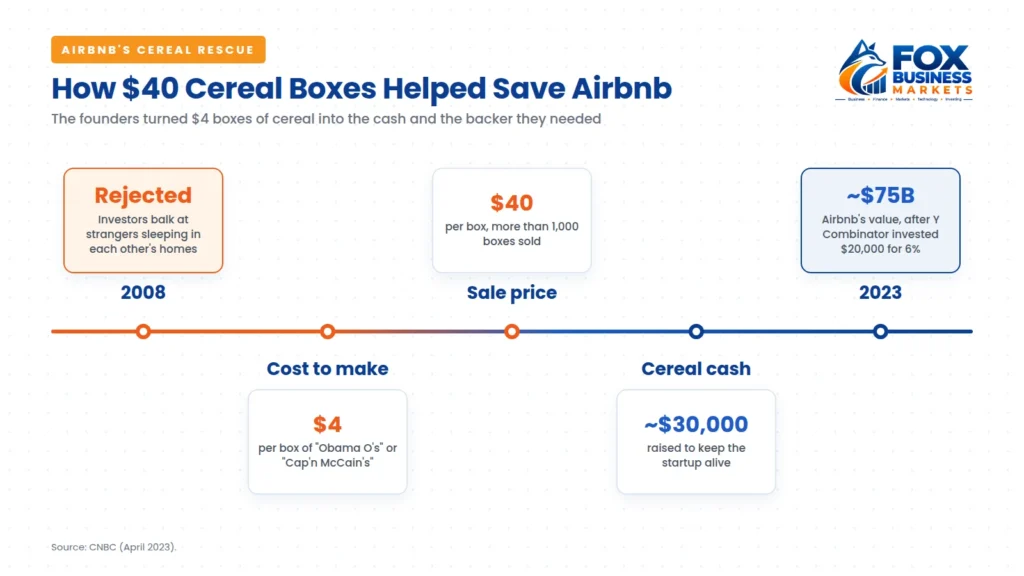
Where it is now: By 2023, Airbnb was worth about $75 billion.
The lesson: The cereal didn’t prove the business model. It proved the founders could sell, and that was enough to win their first serious backer.
7. WhatsApp: Rejected by Twitter and Facebook
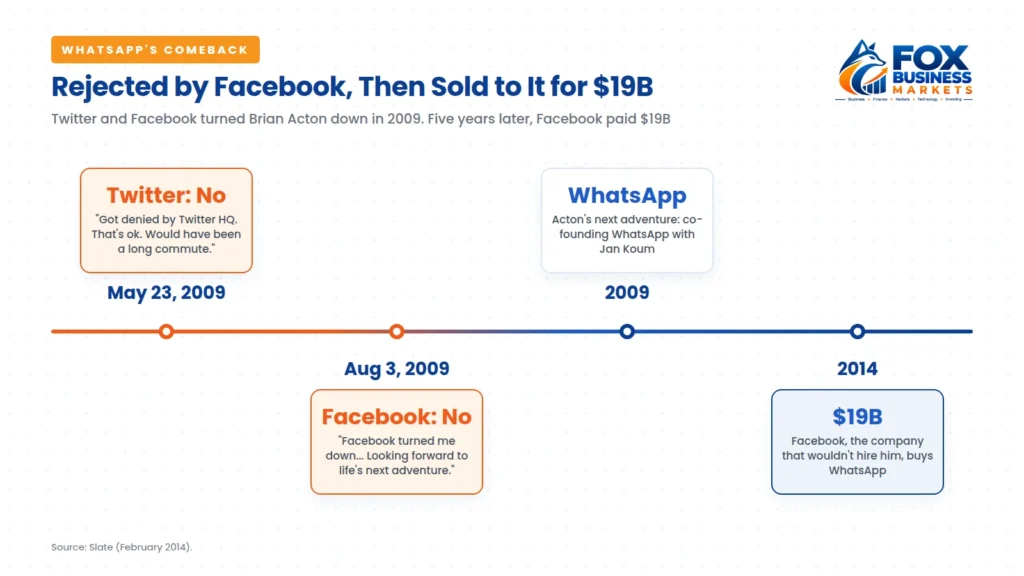
How it started: In 2009, Brian Acton applied for jobs at two of Silicon Valley’s hottest companies, and didn’t get either.
The low point: On May 23, 2009, he tweeted: “Got denied by Twitter HQ. That’s ok. Would have been a long commute.” On August 3, he added: “Facebook turned me down. It was a great opportunity to connect with some fantastic people. Looking forward to life’s next adventure” (Slate).
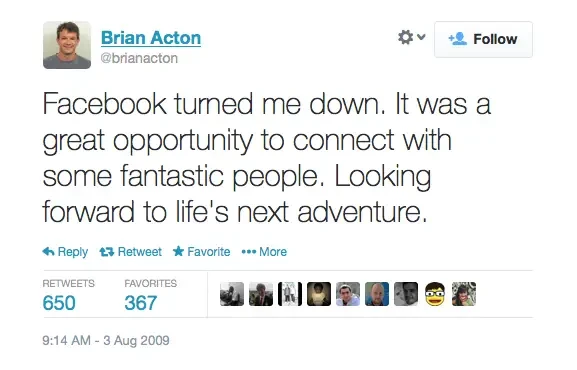
The turning point: That next adventure was WhatsApp, co-founded with Jan Koum.
Where it is now: In 2014, Facebook, the company that wouldn’t hire him, bought WhatsApp for $19 billion.
The lesson: A rejection is a judgment about one moment, not a verdict on a career. Acton’s public, good-natured tweets also show how he treated setbacks as a step, not an ending.
8. Zoom: Eight Visa Rejections, Then a Billion-Dollar IPO
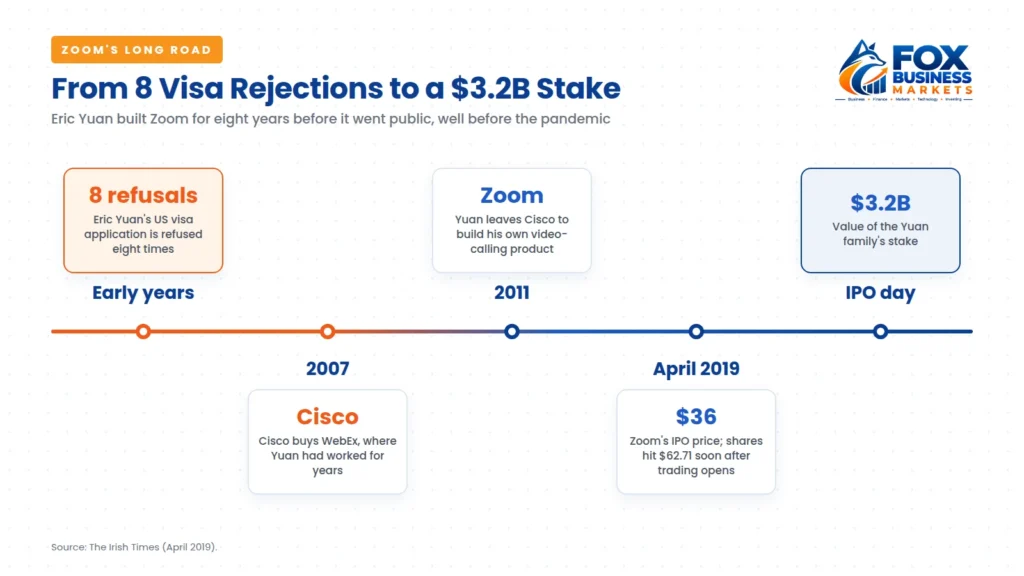
How it started: Eric Yuan’s US visa application was refused eight times before he was finally approved. He went on to work at WebEx and then at Cisco, which bought WebEx in 2007 (Irish Times).

The turning point: In 2011, he left Cisco to start Zoom, building a video-calling product he believed customers wanted.
Where it is now: Zoom went public in April 2019, priced at $36 a share. The stock reached $62.71 shortly after trading began, and Yuan’s family stake was valued at about $3.2 billion.
Myth vs. fact: Zoom is often called a pandemic success story. In fact, it was founded eight years earlier and was already a public company before COVID-19.
The lesson: Being ready matters. When demand for video calls exploded in 2020, Zoom had already spent nearly a decade building the product.
What Do These Entrepreneur Success Stories Have in Common?
| Pattern | Examples | What it shows |
| A near-failure moment | Nvidia’s 30 days of cash, Airbnb’s rejections | The low point often comes before the breakthrough |
| Rejection | Amazon’s 40 “no’s,” Acton’s job rejections, Yuan’s visa refusals | Early “no” answers didn’t predict the outcome |
| Starting small | Nike’s car trunk, Spanx’s $5,000 | Small starts aren’t the same as no help |
| Years, not months | Nike’s seven years before its own brand, Zoom’s eight years before IPO | Real success usually takes a long time |
| A creative fix | Airbnb’s cereal, Sega’s equity deal | Founders found unusual ways to buy time |
Entrepreneur Success Story Myths vs. Facts
| Popular version | What the record shows |
| “Apple was built in a garage.” | Wozniak says no design or manufacturing happened there |
| “Amazon started with nothing.” | It had family money and $1 million from about 20 investors |
| “Nvidia is an overnight AI success.” | It nearly went bankrupt in the 1990s and took 30 years to reach $5 trillion |
| “Zoom was a pandemic success.” | It was founded in 2011 and went public in 2019 |
| “Nike was always Nike.” | It spent seven years selling another company’s shoes |
These details matter because a story that sounds simpler than it really was can teach the wrong lesson. Checking a famous story against the record is the same habit we recommend for any business claim in our guide on how to analyze business news.
What These Success Stories Can and Cannot Tell You
They can show how real founders handled rejection, near-failure, and long waits, and how small decisions at the worst moment shaped everything after.
They cannot show:
- How likely success is. These are the companies that made it. Thousands of others with the same grit failed, and we rarely hear their stories. That’s called survivorship bias.
- A formula. Selling cereal saved Airbnb, but it wouldn’t save most startups. What worked depended on timing, markets, and luck.
- The full picture of help. Many famous founders had family money, mentors, or early investors that the popular version leaves out.
Read these entrepreneur success stories as evidence that setbacks aren’t the end, not as proof that persistence alone guarantees success.
Frequently Asked Questions
What are some of the best entrepreneur success stories?
Well-known examples include Nike, which began with shoes sold from a car; Spanx, launched with $5,000 in savings; Nvidia, which survived with 30 days of cash left; Airbnb, which sold cereal to stay alive; and WhatsApp, founded after its co-founder was rejected by Twitter and Facebook.
Which famous companies almost failed?
Nvidia had about 30 days of operating cash left in the mid-1990s before a $5 million Sega investment saved it. Airbnb was rejected by investors and survived by selling themed cereal boxes. Both went on to become some of the most valuable companies of their eras.
Did Apple really start in a garage?
Partly. Steve Wozniak has said the garage “is a bit of a myth,” explaining that no design, prototyping, or manufacturing happened there. The founders used the Jobs family home because they had no money for an office.
How much money did famous entrepreneurs start with?
It varies widely. Sara Blakely started Spanx with $5,000 in savings. Jeff Bezos’s parents invested $245,573 in Amazon, and he raised $1 million from about 20 outside investors. Airbnb raised about $30,000 by selling cereal boxes before getting $20,000 from Y Combinator.
What is survivorship bias in entrepreneur success stories?
Survivorship bias means drawing lessons only from the companies that succeeded while ignoring the many that tried the same things and failed. Famous founders were persistent, but so were countless founders whose businesses closed. That’s why success stories show what’s possible, not what’s likely.
Do most new businesses succeed?
No. According to the Bureau of Labor Statistics, about 78.7% of new businesses survive their first full year, and only around half are still operating by year six. Famous success stories are the exceptions, which is why they’re worth studying carefully.
What do successful entrepreneurs have in common?
In these stories, founders survived at least one near-failure, faced repeated rejection, started small, and kept going for years before their breakthrough. Many also had help, from family money to early investors, that the popular versions of their stories often leave out.
Final Takeaway
The real lesson of these entrepreneur success stories isn’t “never give up.” It’s more specific: every one of these companies hit a moment when it almost ended, from Nvidia’s last 30 days of cash to Airbnb’s cereal boxes, and the founders found a way to buy time until the business worked. The garages, the $5,000, and the rejection letters make great headlines. The years of work between them are the part worth remembering.