
Business Ownership Calculator: Free & Easy Tool
Starting a business with a partner, or bringing in an investor? This business ownership calculator shows how to split ownership fairly based on the cash, work, and assets each owner puts in. You can also see how much of the business you'll keep after an investment, and what your stake will be worth.
Split ownership between partners, or see how much of the business you keep after an investor buys in.
Enter at least two owners. "Value of work or assets" is what you agree an owner's time, skills, equipment, or ideas are worth. Leave unused owners blank.
Results
For educational purposes only. Results are simple estimates based on the numbers you enter and are not legal, tax, or financial advice. Put any ownership agreement in writing with help from a lawyer.
How to Use the Business Ownership Calculator
The calculator has two tabs. Pick the one that matches your situation.
Split ownership
- Currency: Pick the currency your numbers are in. It only changes how amounts are shown; it does not convert them.
- Name: Add each owner's name (optional), so the results are easy to read.
- Cash invested: Enter the money each owner puts into the business.
- Value of work or assets: Enter what you agree an owner's time, skills, equipment, or ideas are worth. This is often called sweat equity.
- Fill in two to four owners and leave the rest blank.
After an investment
- Your ownership now: Enter the percentage of the business you own today.
- Business value before investment: Enter what the business is worth before the new money comes in (the pre-money valuation).
- Investment amount: Enter how much the investor is putting in.
Results update as you type.
How Is Business Ownership Calculated?
Owner's contribution = Cash invested + Value of work or assets
Ownership % = Owner's contribution ÷ Total contributions × 100
Post-money valuation = Pre-money valuation + Investment
Investor's ownership % = Investment ÷ Post-money valuation × 100
Your new ownership % = Your ownership now × Pre-money valuation ÷ Post-money valuation
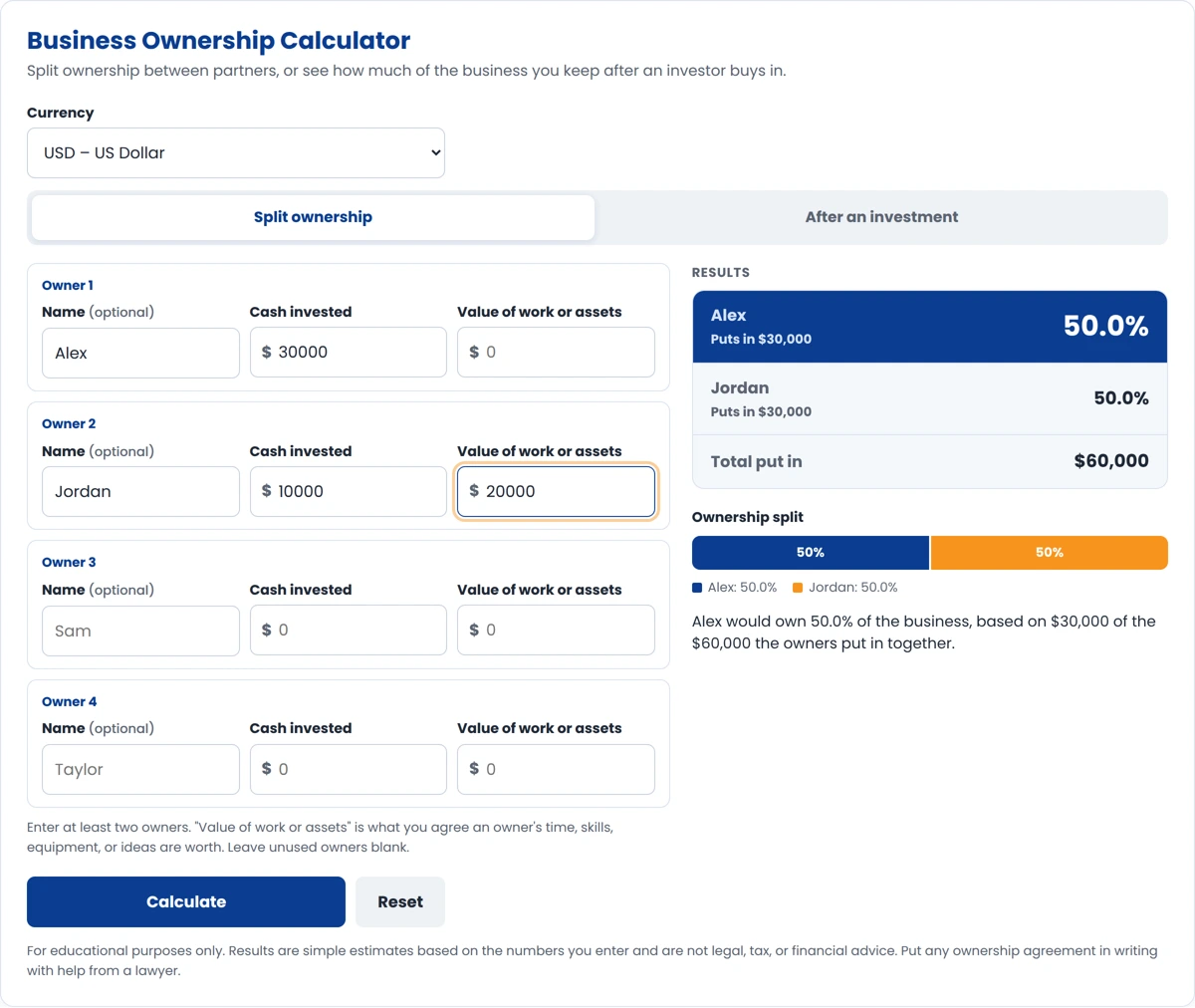
Example 1 (Split ownership): Alex puts in $30,000 in cash. Jordan puts in $10,000 in cash and builds the website and product, which the two agree is worth $20,000.
- Alex contributes $30,000 and Jordan contributes $30,000, for a total of $60,000.
- Each owns $30,000 ÷ $60,000 = 50% of the business.
Example 2 (After an investment): You own 100% of a business valued at $400,000, and an investor puts in $100,000.
- The business is now worth $400,000 + $100,000 = $500,000.
- The investor owns $100,000 ÷ $500,000 = 20%.
- You own 100% × $400,000 ÷ $500,000 = 80%.
- Your 80% is still worth $400,000. You own a smaller slice of a bigger business.
Ways to Split Ownership Between Partners
| Method | How it works | Best for |
|---|---|---|
| Equal split | Every owner gets the same share | Partners who put in similar money, time, and skills |
| By cash invested | Shares match the money each owner puts in | Owners who are mainly investors, not working in the business |
| By cash plus work | Time, skills, and assets are given a dollar value and added to cash | Partnerships where one owner brings money and another brings work |
| With vesting | Owners earn their shares over time, often over several years | Any team where an owner might leave early |
This calculator uses the cash-plus-work method. If you all contribute the same amount, it gives you an equal split.
Real Example: What Y Combinator Takes
Y Combinator, one of the best-known startup accelerators, invests $500,000 in each company it accepts. Of that, it invests "$125,000 on a post-money SAFE in return for 7% of your company" and $375,000 on an uncapped SAFE whose ownership is fixed later, when the company raises money from other investors (Y Combinator).
The fixed part is easy to check with the calculator. $125,000 for 7% implies a post-money valuation of about $1.79 million, or a pre-money valuation of about $1.66 million. Founders who owned 100% would own 93% after that first $125,000, before the second SAFE converts. Founders who split the business 50/50 would each go from 50% to 46.5%.
What Happens If You Don't Agree on a Split?
If partners never put their split in writing, state law may decide for them. In states that follow the Revised Uniform Partnership Act, such as Iowa, the default rule is that "each partner is entitled to an equal share of the partnership profits," no matter who put in more money (Iowa Code §486A.401). That's why a written partnership or operating agreement matters, even for a small business between friends.
Where Can You Find Your Numbers?
- Cash invested: Bank transfers and receipts for money each owner put into the business.
- Value of work or assets: Agree on a fair value together. A common starting point is what you would pay someone else to do the same work, or the market price of the equipment.
- Current ownership: Your operating agreement, partnership agreement, or cap table.
- Business value: The valuation in your investor's term sheet, or a recent professional valuation of the business.
- Still planning? Work out how much cash you'll need with our startup cost calculator.
What the Business Ownership Calculator Can and Cannot Tell You
It can show a fair starting split based on what each owner contributes, and how much of the business you keep after an investor buys in.
It cannot:
- Decide what someone's work or ideas are worth. That value is something the owners must agree on.
- Handle convertible notes, uncapped SAFEs, option pools, or several funding rounds at once.
- Account for vesting, voting rights, or different classes of shares.
- Replace a written agreement or advice from a lawyer or accountant.
Frequently Asked Questions
How do you calculate ownership percentage in a business?
Add up what each owner contributes, in cash and in agreed-upon work or assets. Divide each owner's contribution by the total and multiply by 100. The result is each owner's ownership percentage.
Should business partners always split 50/50?
Not always. A 50/50 split is simple and works when partners contribute about the same. But with two equal owners, nobody can break a tie, so many partners add a tie-breaking rule to their agreement.
What is sweat equity?
Sweat equity is ownership earned through work instead of cash, such as building the product, running operations, or bringing in customers. In the calculator, you enter its agreed value under "Value of work or assets."
What is dilution?
Dilution is the drop in your ownership percentage when a business issues new shares, for example to an investor. Your percentage falls, but if the business is worth more after the investment, your stake can keep the same value.
What is the difference between pre-money and post-money valuation?
Pre-money valuation is what a business is worth before new investment. Post-money valuation is the pre-money value plus the new investment. A $100,000 investment at a $400,000 pre-money valuation gives a $500,000 post-money valuation.
Final Takeaway
Ownership is easier to agree on before the business makes money than after. Use the business ownership calculator above to find a fair starting split, see how investment would change it, and then put the final numbers in a written agreement.