
Startup Cost Calculator: Free & Easy Business Budget Tool
The Startup Cost Calculator shows how much money you need before opening a business. Enter your one-time costs, like registration and equipment, and your monthly costs, like rent and insurance. The calculator adds a cash cushion and a buffer for surprises, then shows your total. Results update as you type.
Add your one-time and monthly costs to see how much money you need before you open.
Leave any cost you don't have blank. The currency only changes how amounts are shown; it does not convert them.
Results
For educational purposes only. Results are simple estimates based on the numbers you enter and are not financial, legal, or tax advice.
How to Use the Startup Cost Calculator
- Currency: Pick the currency your numbers are in. It only changes how amounts are shown; it does not convert them.
- One-time costs: Enter what you'll pay once before opening, such as registration, equipment, inventory, and a website.
- Monthly costs: Enter what you'll pay every month, such as rent, wages, insurance, and marketing.
- Cash cushion: Choose how many months of costs to keep in reserve. The default is 12.
- Buffer for surprises: Add 10% to 20% for costs you didn't plan for.
- Money you have (optional): Enter your savings to see if you're short or have money left over.
Leave any cost you don't have blank. Results update as you type.
How Is Startup Cost Calculated?
Cash cushion = Monthly costs × Number of months
Buffer = (One-time costs + Cash cushion) × Buffer %
Total cash needed = One-time costs + Cash cushion + Buffer
Shortfall or money left over = Money you have − Total cash needed
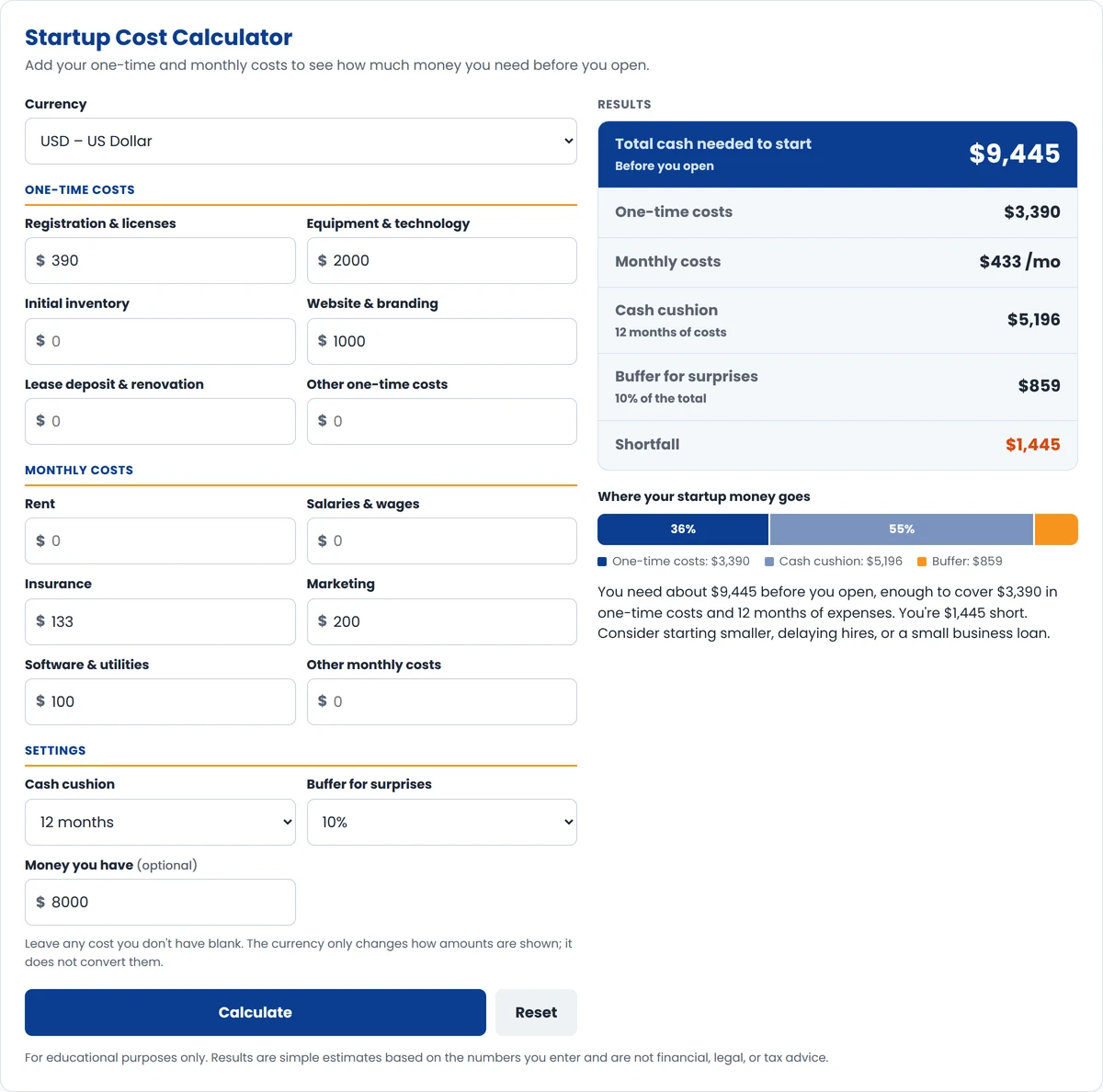
Example: A one-person service business has $3,390 in one-time costs ($390 for registration, $2,000 for equipment, and $1,000 for a website) and $433 in monthly costs ($133 for insurance, $200 for marketing, and $100 for software).
- A 12-month cash cushion is $433 × 12 = $5,196.
- One-time costs plus the cushion come to $8,586. A 10% buffer adds $859.
- The total cash needed is $9,445.
- With $8,000 in savings, the owner is $1,445 short.
One-Time vs. Monthly Startup Costs
| Type | Examples | Why it matters |
|---|---|---|
| One-time costs | LLC filing fee, licenses, trademark, equipment, first inventory, website, lease deposit, renovation | You pay these before you open, so they decide how much you need on day one |
| Monthly costs | Rent, wages, insurance, marketing, software, utilities, loan payments | They keep coming even before sales do, so they decide how long your money lasts |
| Cash cushion | Several months of monthly costs, kept in reserve | It keeps the business open while you find customers |
| Buffer | An extra 10% to 20% | Almost every new business runs into costs it didn't expect |
The SBA advises planning for at least one year of monthly expenses, ideally five (SBA). That's why the calculator's default cushion is 12 months.
Real Example: A Home-Based Business in Kentucky
Here's what the calculator shows using real 2026 costs for a one-person consulting or bookkeeping business in Kentucky:
- One-time costs: $390. That's a $40 LLC filing fee (Kentucky Secretary of State) and a $350 trademark application for one class (USPTO).
- Monthly costs: $133. That's the median cost of general liability ($45) and professional liability ($88) insurance for small businesses (Insureon).
- With a 12-month cushion of $1,596 and a 10% buffer of $199, the total is about $2,185, before equipment and a website.
The same business in California would also owe an $800 LLC tax every year (California Franchise Tax Board). For a full breakdown of these costs, see our guide on how much it costs to start a business.
Where Can You Find Your Startup Costs?
- Registration and licenses: Your state's secretary of state website, plus your city and county websites.
- Tax ID: An EIN is free from the IRS.
- Insurance: Get quotes from at least two or three insurers.
- Rent, equipment, and inventory: Ask landlords and suppliers for written quotes.
- Wages: Include taxes and benefits, not just pay.
What the Startup Cost Calculator Can and Cannot Tell You
It can show how much money you need before opening, how much of it goes to one-time costs versus your safety cushion, and whether your savings cover it.
It cannot:
- Predict your sales or when you'll become profitable. Once you're open, our business KPI calculator can show your break-even revenue.
- Include taxes on profit or interest on loans, unless you add them as costs.
- Tell you which costs are right for your industry. Use real quotes, not guesses.
- Replace advice from an accountant or a small business advisor.
Frequently Asked Questions
How much money do I need to start a business?
Add your one-time costs, then add several months of monthly costs as a cushion and 10% to 20% for surprises. A home-based service business may need a few thousand dollars, while a store or restaurant can need hundreds of thousands.
How many months of expenses should I save before starting?
The SBA suggests planning for at least one year of monthly expenses. If your business will take longer to find customers, a longer cushion is safer.
What is the difference between one-time and monthly startup costs?
One-time costs are paid once before opening, such as registration and equipment. Monthly costs repeat, such as rent, insurance, and wages, and keep going whether or not you have sales.
Should I include my own salary in startup costs?
Yes, if you need the business to pay your living expenses. Add the amount you need each month to "Other monthly costs" so your cushion covers it.
What is a buffer for surprises?
It's an extra amount, usually 10% to 20% of your total, set aside for costs you didn't plan for. It's a common planning rule of thumb, not an official requirement.
Final Takeaway
A business can have a good idea and still close if it runs out of cash before customers arrive. Use the calculator above to count every one-time and monthly cost, keep a cushion, and check whether your savings cover it before you open.