


The cost to start a business in 2026 can be as little as a few hundred dollars or well over $1 million. A one-person online business might need only a state filing fee and an insurance policy. A restaurant or a fast-food franchise can cost hundreds of thousands of dollars before the first customer walks in. The good news: most businesses start small. About half of US employer businesses began with less than $25,000, according to the latest Census Bureau data on startup capital, from 2017 (SBA Office of Advocacy).
Americans are starting businesses at a fast pace. They filed about 5.6 million applications for new businesses in 2025, up from about 5.2 million in 2024 (Census Bureau via FRED). Here’s what those founders actually pay for, with current 2026 figures, and how to estimate your own startup costs.
Key Takeaways
- The cost to start a business ranges from a few hundred dollars for a home-based business to $1 million or more for a large franchise.
- Forming an LLC costs $35 in Montana but $500 in Massachusetts, and California charges an $800 tax every year.
- Insurance, space, and employees are usually the biggest ongoing costs.
- Most founders pay with their own savings. SBA microloans average about $13,000.
Startup Costs at a Glance
| Cost | Typical 2026 amount | Source |
| LLC filing fee | $35 (Montana) to $500 (Massachusetts) | State filing offices |
| Yearly state fees | $0 to $800+ (California’s minimum LLC tax) | State filing offices |
| Employer Identification Number (EIN) | Free | IRS |
| Trademark | $350 per class of goods or services | USPTO |
| General liability insurance | About $45 a month (median) | Insureon |
| Retail space | About $24.79 per square foot a year | CBRE |
| One employee | About $37.64 an hour, including benefits | BLS |
| Cash reserve | At least one year of monthly expenses | SBA |
How We Researched These Costs
We used official sources wherever possible: state filing offices, the IRS, the US Patent and Trademark Office, the Small Business Administration, the Census Bureau, and the Bureau of Labor Statistics. For insurance, rent, and franchise costs, we used the latest published data from industry sources and company disclosures, and we note the year when a figure is older.
9 Startup Costs to Plan For
1. Registering Your Business
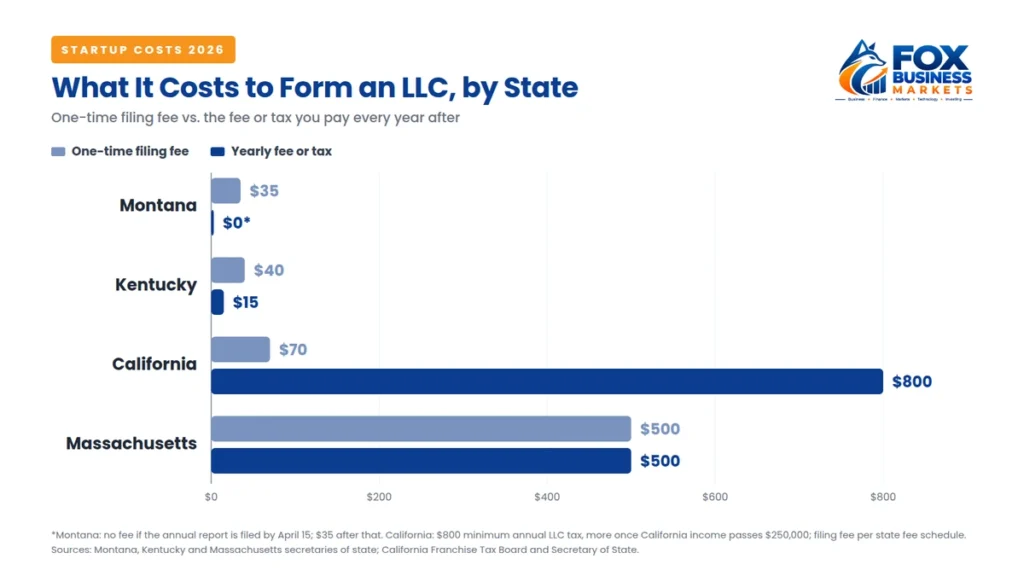
Most new owners form a limited liability company (LLC) to separate business and personal finances. The state filing fee varies widely. It’s $35 in Montana (Montana Secretary of State) and $40 in Kentucky (Kentucky Secretary of State), but $500 in Massachusetts, which also charges $500 for each annual report (Massachusetts Secretary of the Commonwealth).
Watch for yearly fees, too. Every California LLC pays an $800 annual tax, even in its first year, and more once its California income passes $250,000 (California Franchise Tax Board).
2. Getting an EIN
An Employer Identification Number is your business’s tax ID. You need one to hire employees and, in most cases, to open a business bank account. It costs nothing. As the IRS puts it: “You never have to pay a fee for an EIN” (IRS). Be careful with websites that charge to file for you.
3. Licenses and Permits
Depending on your business and location, you may need a city or county business license, a sales tax permit, a health permit, or a professional license. There’s no single national price, but the SBA notes that “permits and licenses tend to have clear, published costs” (SBA). Check your city, county, and state websites before you open.
4. Protecting Your Brand
A federal trademark is optional, but it protects your business name or logo nationwide. Since January 18, 2025, the US Patent and Trademark Office charges a $350 base application fee for each class of goods or services, with extra charges if the application is incomplete or uses a custom description (USPTO).
5. Business Insurance
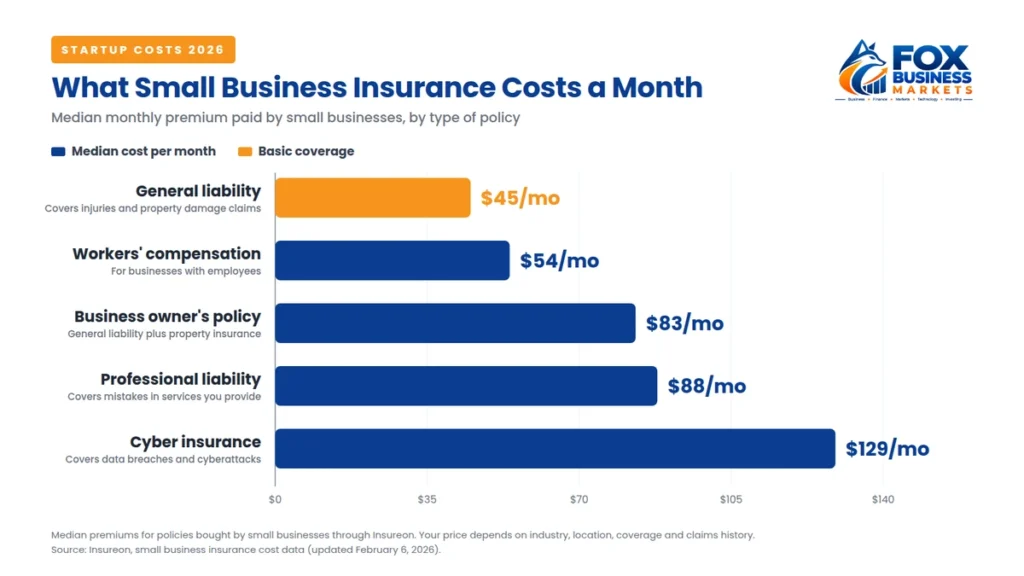
Insurance protects you if a customer is hurt or sues. Among small businesses that bought policies through the insurance marketplace Insureon, the median cost was about $45 a month for general liability, $83 for a business owner’s policy, and $88 for professional liability (Insureon). Your price depends on your industry, location, and coverage.
6. Office or Retail Space
Working from home keeps this cost at zero. If you need a storefront, the average US retail asking rent was $24.79 per square foot a year in the second quarter of 2026, up 2.4% from a year earlier (CBRE). At that rate, a 1,000-square-foot shop would cost about $24,790 a year before utilities and other charges.
7. Employees
Staff is often the biggest expense once a business grows. At private businesses with fewer than 50 workers, employers spent an average of $37.64 an hour per employee in June 2026: $27.88 in wages and $9.76 in benefits (BLS). For one full-time worker, that’s roughly $78,000 a year. Many founders delay hiring and work alone at first for this reason.
8. Equipment, Inventory, and a Website
This is the category that varies most. A consultant may need only a laptop, software, and a simple website. A retailer needs inventory before opening, and a bakery needs ovens and display cases. Get real quotes for every item instead of guessing, and list them in your budget one by one.
9. A Cash Cushion
New businesses rarely earn enough to cover their costs right away. The SBA advises adding up your monthly expenses and planning for at least one year of them, ideally five (SBA). This cushion is what keeps a slow first year from becoming a closed business.
Cost to Start a Business by Type
| Business type | Example startup costs |
| Online or home-based | Can start for a few hundred dollars: a state filing fee, insurance, and a website |
| Service business | Adds professional liability insurance (about $88 a month) and equipment |
| Retail store | Adds rent, at about $24.79 per square foot a year, plus inventory and fixtures |
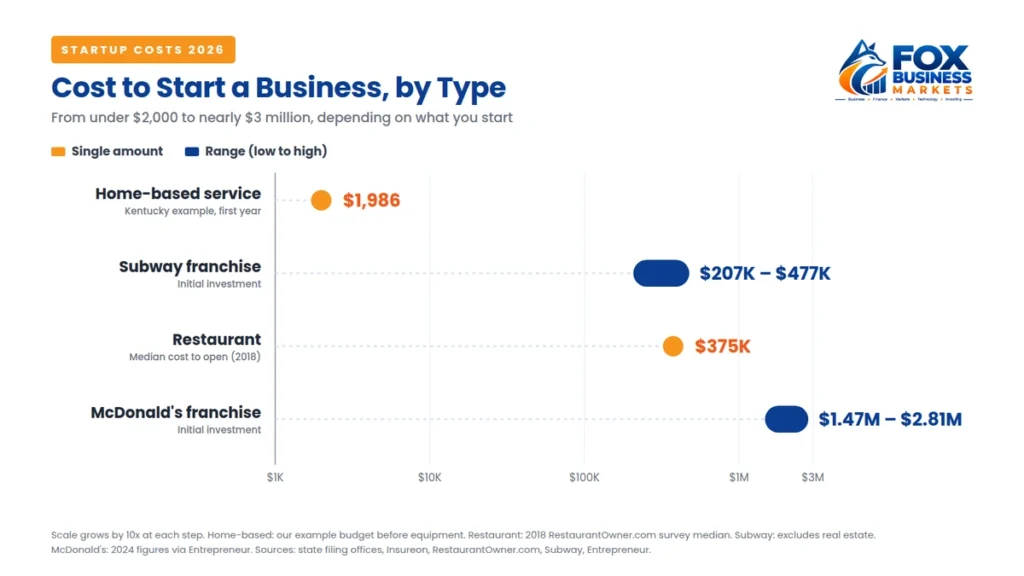
| Restaurant | Median of $375,000 to open, in a 2018 survey of 350+ operators (RestaurantOwner.com via AZ Big Media) |
| Franchise | Subway: $207,050 to $476,900, not counting real estate (Subway). McDonald’s: $1.47 million to $2.81 million, based on 2024 figures (Entrepreneur) |
Chick-fil-A is a well-known exception. Its operators pay a $10,000 initial franchise fee from their own funds, far less than most fast-food franchises (Chick-fil-A). Weighing a franchise against building your own brand? Our guide to franchise vs. startup compares the two.
Example: A Home-Based Service Business
Here’s what the sourced costs above add up to for a one-person consulting or bookkeeping business in Kentucky, in its first year:
| Item | First-year cost |
| LLC filing fee (Kentucky) | $40 |
| EIN | $0 |
| General liability insurance ($45 a month) | $540 |
| Professional liability insurance ($88 a month) | $1,056 |
| Trademark, one class (optional) | $350 |
| Total before equipment and website | $1,986 |
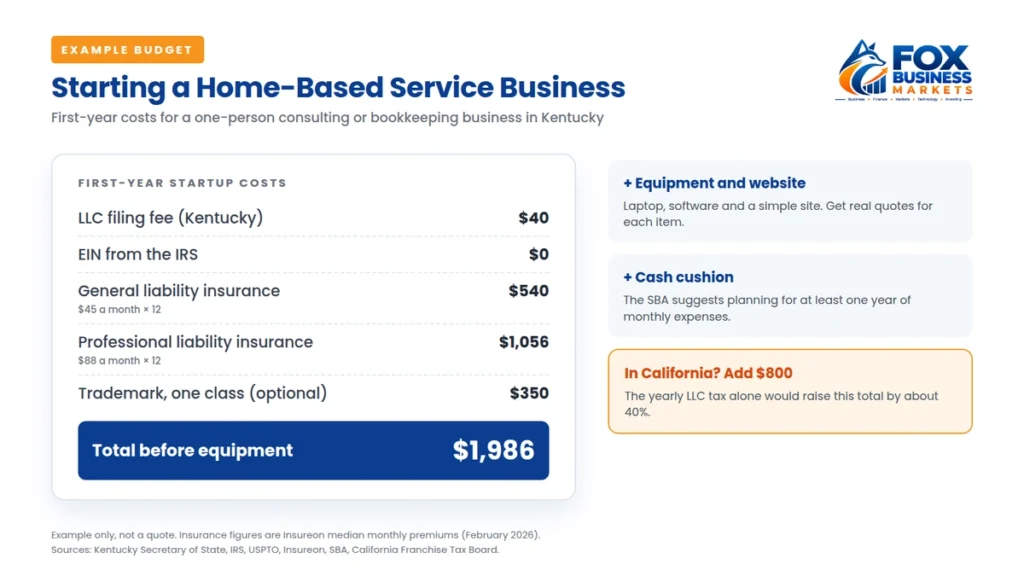
Add your own quotes for a laptop, software, and a website, plus a cash cushion. In California, the $800 yearly LLC tax alone would raise the total by about 40%. This is an example, not a quote. Your costs will depend on your state, industry, and coverage.
How to Estimate Your Own Startup Costs in 5 Steps
- List one-time costs. Include registration, licenses, equipment, a website, initial inventory, and any deposit on a lease.
- List monthly costs. Include rent, insurance, software, utilities, marketing, loan payments, and wages, including your own if you need to live on the business.
- Get real quotes. Call insurers, landlords, and suppliers instead of using national averages for the biggest items.
- Add a cushion. Multiply your monthly costs by 12, as the SBA suggests, and add the total to your one-time costs.
- Add 10% to 20% for surprises. This is a common planning rule of thumb, not an official figure, but almost every new business runs into costs it didn’t expect.
Your total is how much money you need before opening. If it’s more than you have, you can start smaller, delay hiring, or look at the funding options below.
How Do Founders Pay for Startup Costs?
Personal savings: “Nearly two-thirds of new businesses will rely on personal or family savings” for at least some startup costs, according to the Kauffman Foundation (Kauffman Foundation).
SBA microloans: Loans of up to $50,000 through nonprofit lenders. The average is about $13,000, with terms of up to seven years (SBA).
SBA 7(a) loans: The SBA’s main loan program, for up to $5 million (SBA).
Your own assets: Many owners pledge personal property to borrow. In the Federal Reserve’s latest survey, 38% of small employer firms with debt used the owner’s personal assets as collateral, up from 31% in 2019 (Federal Reserve Small Business Credit Survey).
Some of today’s biggest companies started this way. See how founders grew without outside money in our list of bootstrapped companies.
Why Your Budget Needs Room for Error
Underestimating costs is one of the easiest ways to run out of money early. About 77.9% of new US business locations survive their first year, but only 51.4% are still open after five years (BLS). A realistic budget with a cash cushion gives you time to find customers before the money runs out. Once you’re open, our business KPI calculator can show how much revenue you need to break even.
Frequently Asked Questions
How much does it cost to start a small business?
It depends on the type of business. A home-based or online business can start for a few hundred dollars in filing fees and insurance. A store, restaurant, or franchise can cost tens of thousands to over $1 million.
What is the cheapest state to form an LLC?
Among the states we checked, Montana has one of the lowest filing fees at $35, followed by Kentucky at $40. Massachusetts charges $500. Also check yearly fees, such as California’s $800 annual LLC tax.
Can I start a business with no money?
You can start some service businesses for very little, but not for nothing. You’ll usually need at least a state filing fee and insurance. The EIN from the IRS is free.
What is the biggest startup cost for most businesses?
For businesses with a physical location, it’s usually rent and employees. One employee at a small business costs about $37.64 an hour in wages and benefits, or roughly $78,000 a year full time.
How much does it cost to start an LLC?
The one-time state filing fee ranges from $35 in Montana to $500 in Massachusetts. Many states also charge a yearly report fee or tax, so check both before you choose where to register.
Final Takeaway
The cost to start a business in 2026 depends far more on what kind of business you start than on any average. List every cost, get real quotes, and keep at least a year of expenses in reserve. Starting small, as many of the founders in our entrepreneur success stories did, is often the safest way to begin.