Quick answer: To start a startup from scratch, pick one problem you understand and test it with real customers before you spend much money. Build the smallest version by hand, keep your income while you test, and fund it yourself at first, as most founders do. Form the company and seek investors after people pay.
Key takeaways:
- Americans filed 501,609 applications to start a business in October 2026 alone, according to the Census Bureau.
- Most owners who needed start-up money (83.1%) used personal or family assets. Only 4.2% received venture capital or angel investment, a 2024 NORC survey funded by the Kauffman Foundation found.
- DoorDash’s co-founders were its only delivery drivers at first, and Gumroad’s founder built the first version in one weekend.
- Of private establishments with employees that opened in the year to March 2016, 34.2% were still open 10 years later, according to Bureau of Labor Statistics data.
- The average founder of the fastest-growing 0.1% of U.S. startups with employees was 45, according to research published in 2020.
To start a startup from scratch, test one problem with real customers by hand before you spend money, hire, or raise funds. Most founders begin this way, with no product, no team, and little money.
Plenty of people are trying. Americans filed 501,609 applications to start a business in October 2026, according to the Census Bureau’s Business Formation Statistics.
Starting is the easy part, though. Few new businesses raise outside money, and many close within a few years. Good habits in the first few months can lower the cost of failing and raise the odds of finding customers.
This guide shows how six real founders started with almost nothing, in their own words. It then turns their habits into steps you can follow, with real numbers on costs, funding, and survival.
What Does Starting a Startup From Scratch Really Mean?
Starting from scratch means beginning without the usual advantages: no proven product, no co-founder, no investor network, and often no industry experience. You build each of those as you go.
A startup is different from a typical small business. A startup is designed to grow fast by finding a new or better way to solve a problem.
A small business, such as a bakery or a consulting firm, often aims for steady local income. If you’re unsure which you’re building, our guide to what a startup is explains the difference.
“From scratch” can describe one or more of these situations:
- No idea yet: You want to build something but haven’t picked a problem.
- No money: You’ll use savings, income from a job, or early sales.
- No team: You’re starting alone and may add partners later.
- No connections: You don’t know investors, mentors, or people in the industry.
None of these stopped the founders below.
How Did Real Founders Start With Almost Nothing?
Most founders below began with a small, cheap version of a bigger idea. The quotes come from their own blog posts or published interviews, linked to the source.
DoorDash: The Founders Were the Only Drivers
DoorDash grew out of a Stanford class project in 2012 and launched in Palo Alto in 2013 with “a couple dozen restaurants.” The company’s first name was Palo Alto Delivery, its office was Stanford student housing, and its marketing was fliers on dorm bulletin boards.
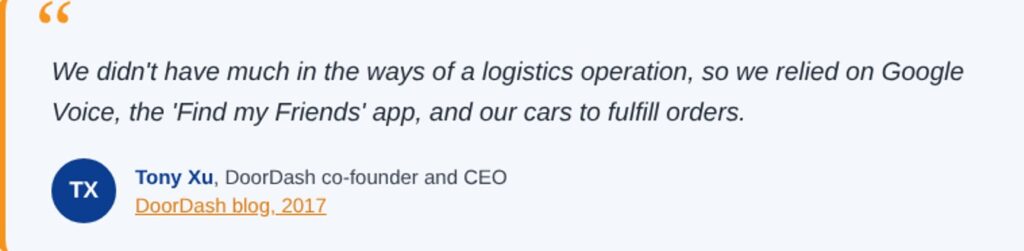
Lesson: You don’t need custom software or staff on day one. Do the work by hand until you understand it.
Gumroad: Built in One Weekend
Sahil Lavingia tweeted his idea for Gumroad, a tool that lets creators sell digital products, on April 2, 2011. He shipped it days later, and more than 52,000 people visited on the first day.
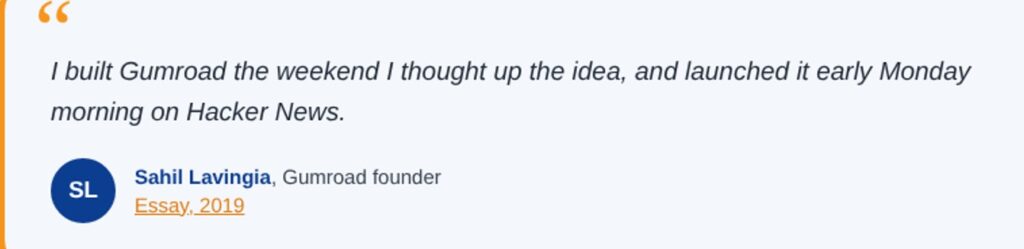
He raised $1.1 million soon after and another $7 million in May 2012. Growth later stalled, and he laid off 75% of the company before making it profitable.
Lesson: Launch fast, but don’t confuse raising money with success.
Canva: A Living Room and a Yearbook Business
Before Canva, Melanie Perkins started Fusion Books, an online yearbook design tool, while studying at university in Perth, Australia, where she taught design programs part-time. Its first customer found it online in March 2008.
“My mum’s living room became our office.”
— Melanie Perkins, Canva co-founder and CEO, in a 2018 post
A planned two-week fundraising trip to San Francisco turned into three months. Canva eventually closed a $1.6 million seed round and reached 1 million users in October 2014.
Lesson: Prove a small version of the big idea first. Yearbooks came before a design platform for everyone.
Nomad List: A Solo Founder and a $40 Server
In March 2014, Pieter Levels set a public goal to launch 12 startups in 12 months. One of them, Nomad List, a site where remote workers compare cities, earned $15,000 to $25,000 a month by 2018. He hosted his early projects on a $40-a-month server.
“And importantly, there’s no VCs involved. No venture capital, just self-funded.”
— Pieter Levels, founder of Nomad List and Remote OK, in a 2018 talk published on his blog
Lesson: Launch several small, cheap projects and keep the ones people pay for.
Zappos: Selling Shoes Before Buying Any
In 1999, Nick Swinmurn tested online shoe sales without owning inventory. He photographed shoes in local stores and offered to buy pairs at full price when someone ordered online.
“I’ll take some pictures, put your shoes online, and if people buy them, I’ll buy them from you at full price.”
— Nick Swinmurn, Zappos founder, in a Fortune interview in 2012
He raised money from friends, co-workers, and even his chiropractor. He quit his job at Silicon Graphics only after raising $150,000.
Lesson: Prove people will buy before you spend money on stock.
Chobani: An Ad in the Junk Mail
Hamdi Ulukaya, who had run a small feta cheese business, bought a closing yogurt factory in upstate New York after spotting a for-sale ad in his junk mail. He borrowed just over $1 million from the Small Business Administration (SBA) and Key Bank, according to Fortune, and sold the first case of Chobani in October 2007.
He told Fox Business that his first meeting, in August 2005, had five workers.
“I saw an ad for a fully-equipped yogurt plant for sale. It came as junk mail to me and I threw it in the garbage can.”
— Hamdi Ulukaya, Chobani founder, in a Fox Business interview in 2014
Lesson: Some ideas need real capital. When they do, government-backed loans can fill the gap without giving up ownership.
What Did These Six Founders Do the Same Way?
All six started smaller than their final company, and most tested demand before spending much money. We compared the founders’ own accounts on five points.
Founder | Started with | First version | Kept a job or school? | Early outside money |
| DoorDash | Class project | Manual deliveries by founders | Yes, students | Not stated |
| Gumroad | One weekend | Simple web app | No, left Pinterest in 2011 | $1.1 million after launch |
| Canva | Yearbook side business | Fusion Books | Yes, part-time teaching | $1.6 million seed, later |
| Nomad List | 12-month goal | Small website | Not stated | None, self-funded |
| Zappos | Photos of store shoes | Online catalog, no stock | Yes, until $150,000 raised | Friends and co-workers |
| Chobani | Factory for sale | Yogurt plant | Not stated | SBA and bank loan |
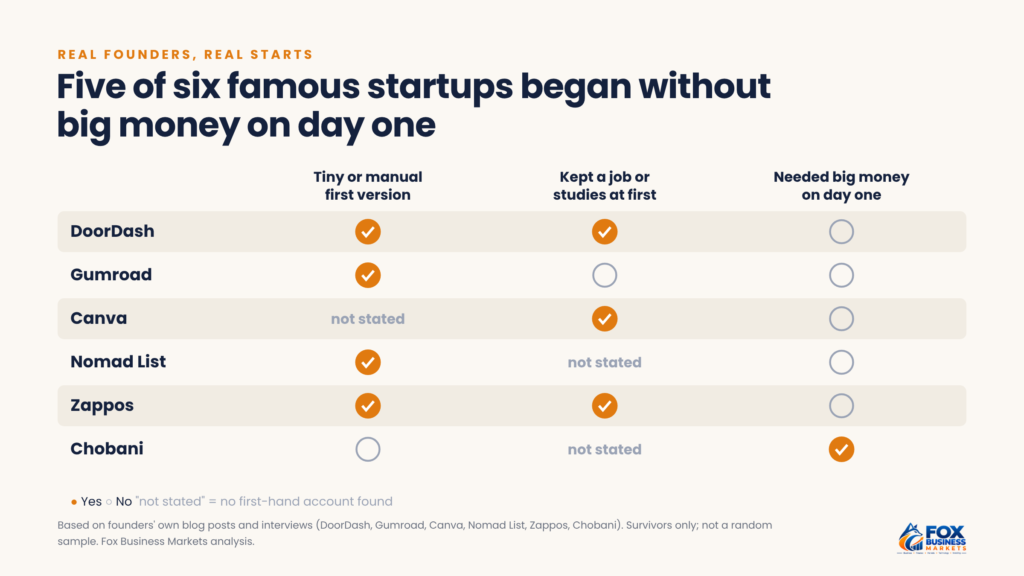
How six founders started a startup from scratch: first version, money, and job status
Three patterns stood out:
- Four of six started with a manual or tiny first version. DoorDash and Zappos ran their first service by hand, and Gumroad and Nomad List launched simple websites.
- Three of six kept working, studying, or teaching while they started. Gumroad’s founder was the exception who left a job first.
- Only one needed large money on day one. Chobani’s factory required a loan. The others spent little before customers showed up.
How we did this: We used only the founders’ own words or interviews with direct quotes, listed in the Sources section. “Not stated” means we found no first-hand account.
Limits: Six famous companies are survivors, so this shows what winners did, not what guarantees a win.
How Do You Find a Startup Idea When You Don’t Have One?
The most reliable ideas come from problems you see up close, at work, in school, or at home. Melanie Perkins found the design tools she was teaching clunky and hard to use, and that became Canva’s starting point.
Try these four sources:
- Your own frustrations: For two weeks, write down every task that annoys you. Repeated annoyances are possible products.
- Your job: Look for slow, manual, or error-prone work your company or customers complain about.
- Paid workarounds: When people pay for a clunky fix, such as a spreadsheet template or a freelancer, a better product may sell.
- Small versions of big trends: Shrink a big shift, such as artificial intelligence (AI) tools or remote work, into one narrow job for one type of customer.
Pick the idea where you can name 10 real people who have the problem. If you can’t name them, keep looking.
How Can You Test Demand Before You Spend Money?
Test demand by asking people to commit something real, such as money, a deposit, or a signup. Kind words from friends don’t count as proof.
Use these four tests, in any order that fits your idea:
- Problem interviews: Ask 10 to 15 people how they solve the problem today and what it costs them. Don’t pitch your idea yet.
- A one-page offer: Build a simple website that explains the solution and collects emails or preorders.
- Manual delivery: Serve two or three customers by hand, as DoorDash and Zappos did.
- A payment ask: Ask for a deposit, preorder, or small fee. Repeat buyers are the strongest signal.
If nobody pays after a fair test, change the offer or the customer before you build more. When you’re ready to build the product properly, our guide to how to build a startup covers minimum viable products and product-market fit.
How Much Money Do You Need to Start From Scratch?
Many startups can test an idea for a few hundred dollars. The bigger costs come later, when you hire, buy inventory, or build complex software.
Some costs are low or zero:
- Employer Identification Number (EIN): free from the Internal Revenue Service (IRS).
- Forming a limited liability company (LLC): state filing fees run from as little as $35 in Montana to $500 in Massachusetts. California also charges LLCs an $800 annual tax.
- Website and tools: a domain, simple site builder, and free software tiers are often enough for a first test.
Most founders pay these costs themselves. NORC at the University of Chicago surveyed about 30,000 U.S. adults in 2024. Among business owners who needed start-up money, 83.1% used personal or family assets, and only 13.5% received a bank business loan.
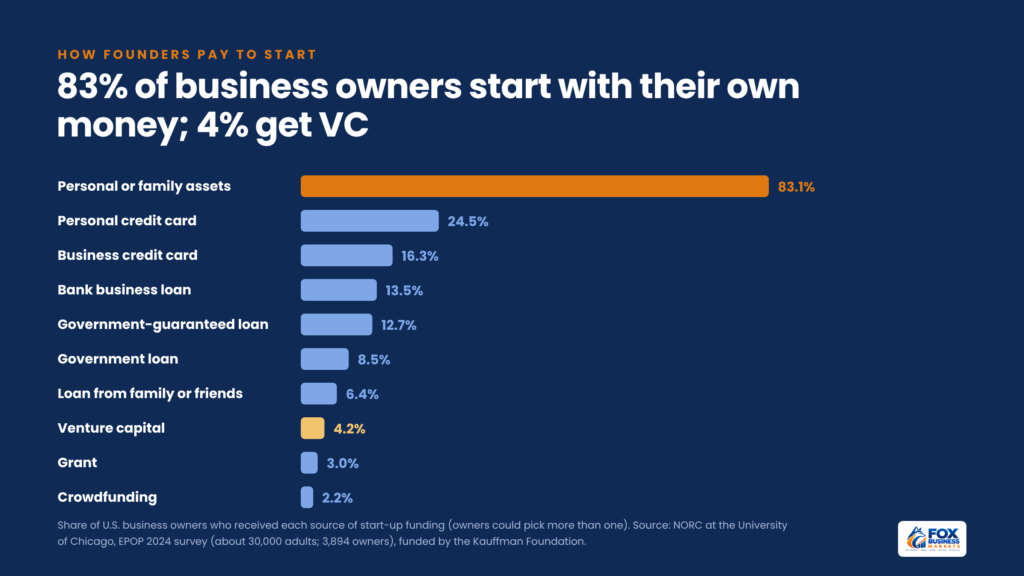
Where founders get money to start a business: personal savings, credit cards, loans, and venture capital
Credit cards were common too. About 24.5% of those owners carried a balance on a personal card to start, which is risky because card interest can grow faster than early revenue.
For a line-by-line budget, see our breakdown of the cost to start a business.
How Do You Find Your First Paying Customers?
Go where your customers already gather and ask them directly. Early customers rarely come from ads; they come from places the founder can reach for free.
The founders in this guide used simple channels:
- Local notice boards: DoorDash’s first marketing was fliers on dorm bulletin boards.
- Online communities: Gumroad launched on Hacker News, a forum for tech workers, and drew more than 52,000 visitors on day one.
- Search and the web: Fusion Books’ first customer found it online in March 2008.
- Existing shops: Zappos’ founder worked with shoe stores that already had the products.
Start with people you can name: former co-workers, local businesses, or members of an online group you already belong to. Offer a discount or a personal setup in exchange for honest feedback.
Track where each paying customer came from. The channel that brings your first 10 buyers is usually the one to grow next.
Should You Keep Your Day Job While You Start?
Usually, yes, until the startup brings in money or funding. Keeping your income gives you time to test without panic.
Research supports the slow start. A 2014 study in the Academy of Management Journal tracked U.S. entrepreneurs. Those who ran a business alongside a job before going full-time had a 33.3% lower rate of leaving self-employment than those who went straight from a job.
Zappos’ founder followed that path, and Canva’s co-founder kept teaching while she built her first company.
Quit when at least one of these is true:
- The startup covers your basic living costs.
- You’ve raised enough money to pay yourself for 12 months or more.
- The job blocks a clear opportunity, such as a paying customer who needs you full-time.
Do You Need Venture Capital to Start a Startup?
No. That’s a myth. Few new businesses take venture capital, and investors tend to arrive after founders show early traction.
In a 2024 NORC survey, 24.3% of owners who needed start-up money sought venture or angel investment, but only 4.2% received it. Venture capital made up just 5% of all start-up dollars.
Investors also expect more before they write a check. Through the third quarter of 2026, the median seed round was $3.0 million, according to the PitchBook-NVCA Venture Monitor. That money goes mostly to companies with users or revenue, not to an idea on paper.
Gumroad’s story shows the trade-off. Raising money early let Sahil Lavingia hire quickly, but it also brought pressure to grow fast. When growth slowed, he rebuilt around profit. Learn more in our guide to startup funding stages.
Are You Too Old or Too Inexperienced to Start?
No on age, and not necessarily on experience. Age counts for less than most people assume.
A study published in 2020 in the American Economic Review: Insights looked at 2.7 million U.S. founders whose firms went on to hire. The average age of founders of the fastest-growing 0.1% of startups was 45. Among people who started a firm, a 50-year-old was 1.8 times more likely than a 30-year-old to build one of those top-growth firms.
Industry experience helps; the same study links it to much higher success rates. It isn’t a requirement, though. Zappos’ founder told Entrepreneur in 2000 that he “didn’t know anything about shoes.”
If you lack industry experience, close the gap on purpose. Interview people who work in the field, or take a job or contract in it while you test.
What Are the Odds a New Business Lasts?
About one in three new businesses with employees is still open after 10 years. Survival falls fastest in the first two years.
Bureau of Labor Statistics (BLS) data track private establishments with employees that opened in the year to March 2016:
- 79.6% were still open after one year.
- 50.7% were open after five years.
- 34.2% were open after 10 years, in March 2026.
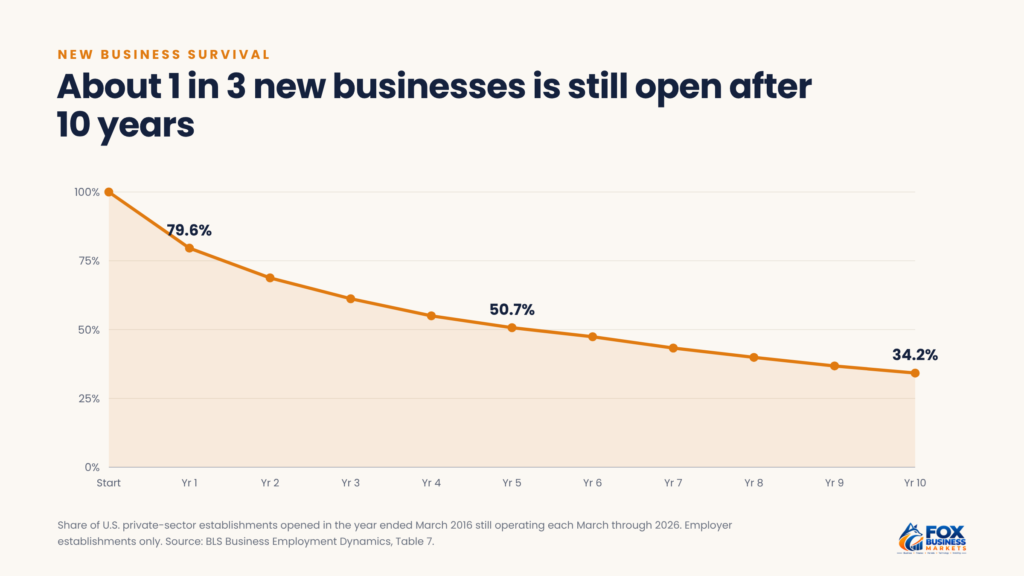
Survival rate of new U.S. business establishments over 10 years, 2016 to 2026
These figures come from the BLS Business Employment Dynamics data and cover only establishments with employees. Solo founders without staff aren’t included.
The odds aren’t a verdict on your idea. Testing small, keeping costs low, and growing from paying customers all lower the amount you can lose while you learn.
What Should Your First 30 Days Look Like?
The first month of a startup from scratch should end with evidence, not a finished product. Use this plan:
Days | Goal | Done when |
| 1–5 | Pick one problem and one customer type | You can name 10 people who have it |
| 6–12 | Interview potential customers | You’ve had 10 or more real conversations |
| 13–18 | Build a one-page offer | Your page explains the fix and takes signups |
| 19–26 | Deliver by hand | Two or three people have used your service |
| 27–30 | Decide | You know whether to continue, change, or stop |
Set a small budget before you start, such as $500, and track every dollar. A simple estimate from our startup cost calculator can help you plan the next stage.
Don’t register an LLC, hire, or raise money in the first month unless a customer requires it. Those steps make more sense once you know people want what you’re selling.
Frequently Asked Questions
Should you start a startup alone or with a co-founder?
Either can work. Solo founders, like Pieter Levels, keep full control and avoid partner disputes. Co-founders split the workload and bring missing skills, as DoorDash’s founders did. Tip: If you add a co-founder, put ownership and vesting terms in writing before you start building together.
How do you protect a startup idea?
You can’t own an idea by itself, since U.S. copyright law protects how you express an idea, not the idea. You can register your startup’s name as a trademark with the U.S. Patent and Trademark Office (USPTO), and inventions may qualify for a patent. Tip: Search the USPTO trademark database before you pay for a domain or logo.
Can you use AI tools to start a startup?
Yes, and many founders do. In a 2026 Gusto survey of 1,051 founders who launched businesses in 2025, 60% said they used AI to help start their business. AI can draft websites, write code, and summarize customer interviews. Tip: Use AI to speed up tasks, but talk to real customers yourself.
When should you give up on a startup?
When you’ve tested fairly, missed your own targets, and no longer want to keep going. ConvertKit founder Nathan Barry wrote in 2016 that revenue had fallen to about half its peak and the company was losing money every month. He asked himself whether he still wanted it and had given his best effort, then doubled down and recovered. Tip: Decide your stop point, such as a revenue or user target by a set date, before you start.
Talk to 10 Potential Customers This Week
None of the founders in this guide started with a finished company. Most started with something small and cheap.
Pick one problem, list 10 people who have it, and talk to them this week. For the full step-by-step process after that, read our guide on how to start a startup. You can also see how other founders grew without investors in our bootstrapped companies stories.
This article is for general information only and isn’t financial, tax, legal, or investment advice. Consider your own situation or talk to a qualified professional before making decisions.
