Quick answer: To build a startup, turn a validated idea into a minimum viable product (MVP), put it in front of real users, and improve it until customers keep coming back and paying. Then hire carefully, track a few core metrics, and raise money only when it will speed up growth you’ve already proven.
AI companies took about 64% of the $159 billion in global venture funding in the third quarter of 2026, according to Crunchbase. For anyone building a startup outside AI, that means a smaller pool of money and less room for mistakes. Carta data shows that the median U.S. startup took 1.9 years to get from a seed round to a Series A in the fourth quarter of 2025.
That gap between starting and scaling is where most young companies stall. Getting a company registered and a first version live takes weeks. Building it into something customers rely on, and investors will back, takes years of testing, hiring, and hard choices about what not to build.
This article picks up where our guide on how to start a startup leaves off. It covers how to build an MVP, how to tell whether you’ve reached product-market fit, who to hire first, which metrics to track, how to fund each stage, when to scale, and a 90-day plan for your first build cycle.
What Does It Take to Build a Startup?
Building a startup begins once the company exists and customers have confirmed the problem. From there, the work is turning a rough first version into a product people pay for, then growing the team and revenue around it.
By the time you’re building, you should already have problem-solution fit: customers who describe the problem in their own words and ask when they can try your fix. If you don’t, begin with our guide on how to start a startup. From there, most startups move through four stages:
Stage | Main goal | Signs you’re ready to move on |
| 1. MVP | Ship the smallest product that tests your core assumption | Real users are using it, not just signing up |
| 2. Product-market fit | Make the product something customers can’t do without | Strong retention, word-of-mouth growth, and paying customers |
| 3. Growth | Find repeatable ways to acquire customers profitably | Predictable acquisition channels and healthy unit economics |
| 4. Scale | Grow the team, markets, and systems | Revenue growth outpaces cost growth |
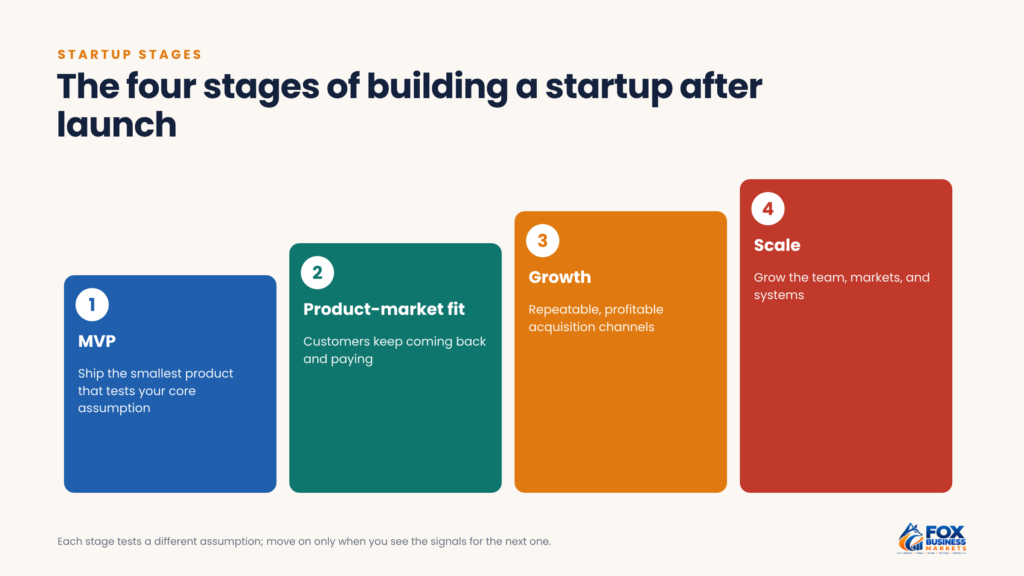
Entrepreneur and educator Steve Blank defines a startup as a temporary organization designed to search for a repeatable and scalable business model. That search is the core of building a startup: each stage tests a guess about customers, pricing, or growth, and the company changes course when the guess turns out wrong. If you’re still unsure whether your venture is a startup or a traditional small business, our explainer on what a startup is breaks down the difference.
How Do You Build an MVP?
A minimum viable product is the simplest version of your product that lets you learn whether customers want it. Eric Ries popularized the term in his book The Lean Startup, describing a build-measure-learn loop: ship something small, watch how people use it, and use what you learn to decide what to build next.
An MVP doesn’t have to be software. Common types include:
- Fake door MVP: a button or menu item for a feature that doesn’t exist yet, which shows how many users click on it before you build it.
- Concierge MVP: you deliver the service by hand to a few customers, then automate only the parts they value.
- “Wizard of Oz” MVP: the product looks automated to the customer, but people run it behind the scenes.
- Single-feature MVP: one core feature built well, with everything else left out.
- No-code MVP: a working app built with no-code or low-code tools, which lets non-technical founders test ideas in days.
To scope your MVP, follow three rules:
- Write down the one assumption that could kill the business, such as “small accounting firms will pay $99 a month to automate client reminders.” Build only what’s needed to test it.
- Set a deadline, usually four to eight weeks. If the MVP will take longer, cut features until it fits.
- Decide in advance what success looks like, such as 20 active users after 30 days or five paying customers. Without a target, every result will look encouraging.
The most common mistake at this stage is building too much. Every feature you add before launch delays the moment you learn whether anyone cares.
How Do You Know You’ve Reached Product-Market Fit?
Product-market fit means your product satisfies a strong demand in a real market. Before it, you push the product onto customers; after it, customers start pulling it from you. There’s no single test, but these signals are the most reliable:
- The 40% test: growth marketer Sean Ellis suggested asking users, “How would you feel if you could no longer use this product?” If at least 40% answer “very disappointed,” you likely have product-market fit.
- Retention flattens: in a cohort chart, the share of users still active after each month drops at first, then levels off instead of falling to zero.
- Organic growth: a meaningful share of new users arrive through referrals or word of mouth rather than paid ads.
- Shorter sales cycles: prospects understand the value quickly and buy with less persuasion.
- Customers complain when it breaks: outages and bugs trigger urgent messages, which shows people depend on the product.
To run the 40% test, survey only people who have used the product at least twice in the past two weeks, and wait for at least 30 responses; with fewer, treat the result as a direction, not a verdict. Ask the “very disappointed” group what they would use instead and which benefit they value most. Their answers show which customer to focus on.
If you don’t see these signals after several months, don’t hire or raise more money to push harder. Go back to customer interviews, narrow your target customer, or test a different use case. Many successful companies found product-market fit only after a pivot, a change in strategy based on what they learned.
Who Should You Hire First When Building a Startup?
Early hires shape a startup’s culture and speed more than any later decision. Hire slowly and only for problems you can’t solve yourself.
Settle founder roles before adding people. Each founder should own clear areas, such as product or sales, so early hires know who decides what. If founder shares aren’t on a vesting schedule yet (four years with a one-year cliff is standard), fix that before your first hire; investors will check.
Then hire for your biggest bottleneck. For most software startups, the first hires are engineers who can ship product. For service or marketplace startups, the first hire may be in sales, operations, or customer success. Before you hire, ask whether a contractor or part-time specialist could cover the need for a few months.
Write a scorecard before every hire. List the three outcomes the person must deliver in their first 90 days, such as “ship the billing integration” or “close 10 new accounts.” Interview against those outcomes rather than a generic job description, and use the same scorecard at day 90 to decide whether the hire is working.
Plan for equity. Startups typically set aside an option pool, often 10% to 20% of the company, to attract early employees who accept lower salaries in exchange for ownership. Our business ownership calculator shows how new shares and option pools change each founder’s stake.
Look for these traits in early employees:
- Comfort with ambiguity and changing priorities
- A track record of shipping work, not just planning it
- Willingness to do work outside their job title
- Genuine interest in the customer problem you’re solving
Which Metrics Should You Track When Building a Startup?
Early on, track a handful of numbers every week rather than dozens every quarter. The right metrics depend on your business model, but these cover most startups:
Metric | What it measures | Rule of thumb |
| Monthly recurring revenue (MRR) | Predictable monthly subscription revenue | Track month-over-month growth rate |
| Retention or churn | Share of customers who stay or leave each month | Retention curves should flatten over time |
| Customer acquisition cost (CAC) | Sales and marketing cost to win one customer | Track by channel; costs often rise as a channel saturates |
| Lifetime value (LTV) | Gross profit a customer brings over the relationship | LTV should be about 3 times CAC or more |
| CAC payback | Months of gross profit needed to recover CAC | Aim for 12 months or less |
| Burn rate | Net cash spent each month | Keep it tied to milestones, not headcount goals |
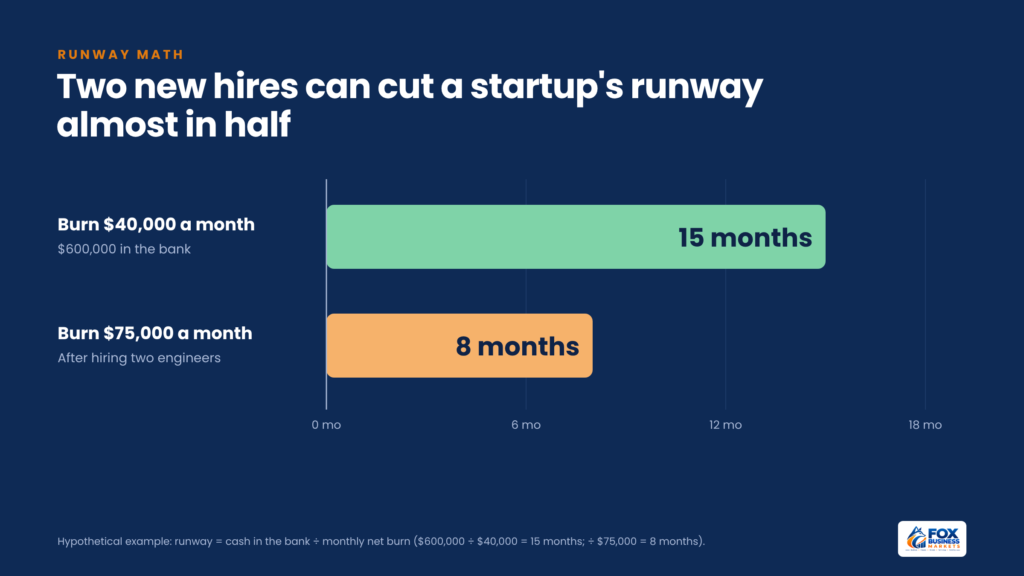
| Runway | Months until cash runs out at the current burn | Start fundraising with at least 9 to 12 months left |
A quick CAC payback example: divide CAC by the monthly gross profit per customer. If you spend $1,200 to win a customer who pays $150 a month at an 80% gross margin, payback is 10 months ($1,200 ÷ $120). Early-stage software companies commonly aim for 12 months or less; much longer means growth uses up cash faster than it returns it.
A quick runway example: a startup with $600,000 in the bank and a net burn of $40,000 a month has 15 months of runway ($600,000 ÷ $40,000). If it hires two engineers and burn rises to $75,000, runway falls to 8 months, already short of the 9 to 12 months it should have when it starts raising. Because Carta data puts the typical gap between seed and Series A at close to two years, runway decisions shape whether you reach the next round. Our startup runway calculator runs these scenarios for you, and our guide to cash flow management covers the day-to-day side.
How Do You Fund Each Stage of Building a Startup?
Match each raise to the build stage you’re in and the milestone the money will buy:
- MVP stage, bootstrapping: founders’ savings and early revenue pay the bills. It keeps full ownership and forces discipline, and many bootstrapped companies grew into large businesses. Keep a record of how much money you’ve invested in your business, because lenders and investors will ask.
- Early traction, friends, family, and angels: small checks that fund the MVP and early traction, often through convertible notes or SAFEs (simple agreements for future equity).
- Product-market fit, pre-seed and seed: institutional money to reach product-market fit. In the second quarter of 2026, the median U.S. seed round was $4.5 million at a $23.9 million post-money valuation, with median dilution of 19.4%, according to Carta.
- Growth and scale, Series A and beyond: money to scale something that already works. Investors at this stage expect clear product-market fit, strong growth, and solid unit economics.
Each round should buy a specific milestone, such as reaching product-market fit or proving a second acquisition channel. If you can’t name the milestone, you’re not ready to raise. Our guide to startup funding stages explains what investors expect at each round, and our startup valuation estimator helps you sanity-check a valuation before you negotiate.
When Should You Start Scaling?
Scale only after the numbers show the product works without your constant attention. Before you add sales reps, open new markets, or raise a large round, check for these signals:
- Retention has flattened for at least three monthly cohorts in a row.
- One acquisition channel is repeatable, meaning more money or effort put into it brings back a predictable number of customers.
- CAC payback is under about 12 months and LTV is at least three times CAC.
- Founders are the bottleneck, with sales, support, or hiring waiting on a founder’s calendar.
Scaling changes the job from doing the work to building systems that do it. Write down the playbooks that already work, such as your sales process and onboarding steps, so new hires can repeat them. Bring in your first managers once a founder has more than six to eight direct reports. Add one new channel or market at a time so you can tell what’s working.
Do You Need a Technical Co-Founder to Build a Startup?
No. It’s a common belief that every startup needs a technical co-founder from day one, but many founders build and validate their first product without one.
A technical co-founder helps most when the product itself is the hard part, such as deep software, hardware, or AI models. For many other startups, the harder problems are finding customers, selling, and operating well. Non-technical founders can:
- Start with a manual version, such as a concierge or Wizard of Oz MVP, and write code only after customers use it.
- Build an early version with no-code tools that’s good enough to test the core assumption.
- Hire a contractor or development agency for a fixed-scope MVP, with clear ownership of the code in the contract.
- Bring on a technical co-founder later, once traction makes the opportunity easier to explain and the equity conversation is grounded in real progress.
The risk is outsourcing the core of the business for too long. If your product is your competitive edge, plan to bring technical leadership in-house once you’ve proven demand.
What Should Your First 90-Day Build Cycle Look Like?
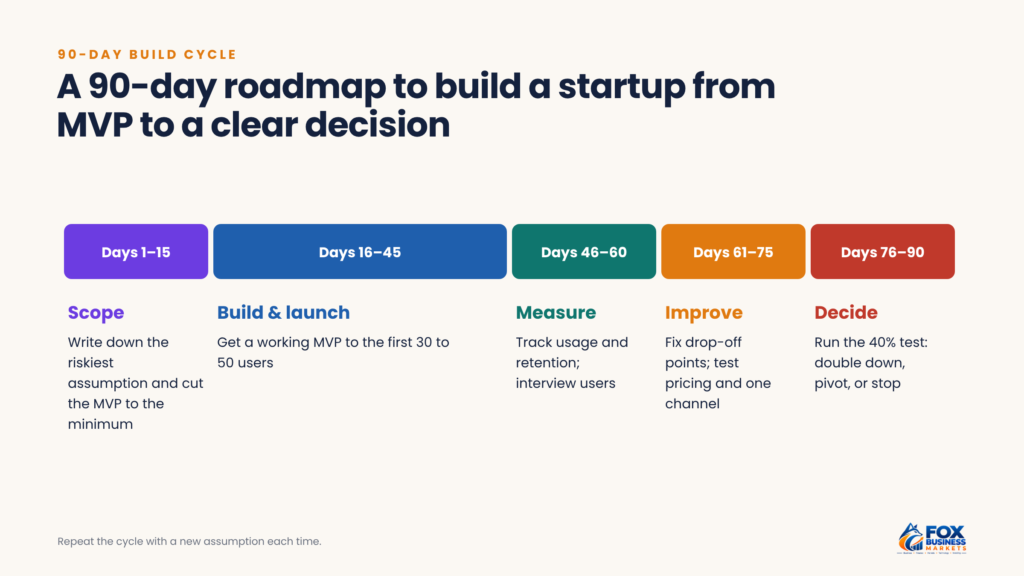
Once your company is set up and the problem is validated, a 90-day build cycle can take you from MVP to a clear decision about what comes next:
Days | Focus | Key outputs |
| 1–15 | Scope | Riskiest assumption written down, MVP feature list cut to the minimum, success targets set |
| 16–45 | Build and launch | Working MVP in the hands of the first 30 to 50 users |
| 46–60 | Measure | Weekly usage and retention data, user interviews, first paid conversions |
| 61–75 | Improve | Fixes for the biggest drop-off points, pricing test, one acquisition channel tested |
| 76–90 | Decide | Product-market fit check (40% test, retention), then double down, pivot, or stop |
Ninety days won’t build a company, but it’s enough to learn whether your MVP deserves the next year of your time and money. Repeat the cycle with a new assumption each time.
Why Do Startups Fail While They’re Building?
Most young companies don’t survive. Of business establishments born in 2016, 34.2% were still operating 10 years later, according to the Bureau of Labor Statistics. Venture-backed startups face their own risks. In CB Insights’ analysis of 431 venture-backed startups that shut down since 2023, running out of capital was a factor in 70% of the cases with identifiable causes, and poor product-market fit in 43%.
Those reasons are linked. Startups that build before confirming demand burn cash on features no one uses, then struggle to raise because they can’t show traction. Watch for these warning signs:
- Building in isolation: months of development without talking to customers.
- Scaling too early: hiring sales teams or buying ads before retention proves the product works.
- Ignoring unit economics: growing revenue while losing more money on every customer.
- Founder conflict: disagreements over roles, equity, or direction that stall decisions.
- Running out of runway: starting to fundraise with only a few months of cash left.
Our guide on why small businesses fail covers the broader patterns, and our startup statistics roundup tracks funding and survival data each quarter.
Frequently Asked Questions
How much does it cost to build a startup?
It ranges from a few thousand dollars for a bootstrapped software MVP built with no-code tools to millions for hardware or biotech startups. The biggest costs are usually people, product development, and customer acquisition. Estimate your first-year burn with our startup cost calculator before deciding how much outside money you need.
Can you build a startup while working a full-time job?
Yes, many founders build and test an MVP on nights and weekends before quitting. Check your employment agreement first, because some contracts give your employer rights to inventions created on company time or equipment. Set a clear milestone, such as a target number of paying customers or monthly revenue, that will tell you when it’s time to go full-time.
Should you build your startup in public?
Building in public means sharing progress, metrics, and lessons openly on social media or a blog. It can attract early users, investors, and hires at little cost, but it also shows competitors what you’re doing. Share lessons and milestones freely, but keep sensitive details such as customer lists and pricing experiments private.
How should you price your product while building a startup?
Charge from your first customer, even if the price is low, because free users can’t tell you whether people will pay. Base the price on the value customers get rather than your costs, and offer two or three tiers to see which one buyers pick. Raise prices for new customers every few months until you start losing deals on price alone.
Launch Your MVP Within 45 Days
Write down the riskiest assumption in your business, cut your feature list to the smallest product that tests it, and put it in front of real users within 45 days. Review retention, revenue, and runway every week. Hire only for your biggest bottleneck, raise only to speed up what already works, and scale once one channel brings in customers predictably. If the data says the product isn’t working, change course while it’s still cheap to do so.
This article is for general information only and isn’t financial, tax, legal, or investment advice. Consider your own situation or talk to a qualified professional before making decisions.


