A candle maker in Ohio signs her first wholesale order, and the buyer’s contract asks for proof of a $1 million liability policy before the pallets ship. She has forty-eight hours, no broker, and no idea whether she is about to be quoted forty dollars a month or four hundred. That is the position most owners are in when they first look up small business insurance cost, and the published figures do not make it much clearer.
How Much Does Small Business Insurance Cost?
The midpoint premium runs from about $45 a month for general liability to about $129 for cyber, depending on which cover you buy. These are central figures rather than ranges: roughly half of buyers paid more than each one, and the source publishes no spread.
Insureon’s table note calls these figures medians excluding outliers, while the page text and headings call them averages. This article follows the table note.
Policy | Midpoint monthly premium (see note) | What it covers |
| General liability | $45 | Injury to others, damage to their property, defence costs |
| Business owner’s policy (BOP) | $83 | General liability plus commercial property, bundled |
| Workers’ compensation | $54 | Employee injury and illness at work |
| Commercial umbrella | $86 | Extra limit above your other policies |
| Professional liability (errors and omissions) | $88 | Mistakes, bad advice, missed deadlines |
| Commercial property | $108 | Your own premises, stock and equipment |
| Cyber | $129 | Breach response, data loss, extortion |
Each line above is a separate policy rather than a tier of one product; our guide to the types of insurance explains how the categories differ. Source: Insureon, updated 6 February 2026 — vendor data. The figures are drawn from policies bought through Insureon by around 100,000 owners since 2011.
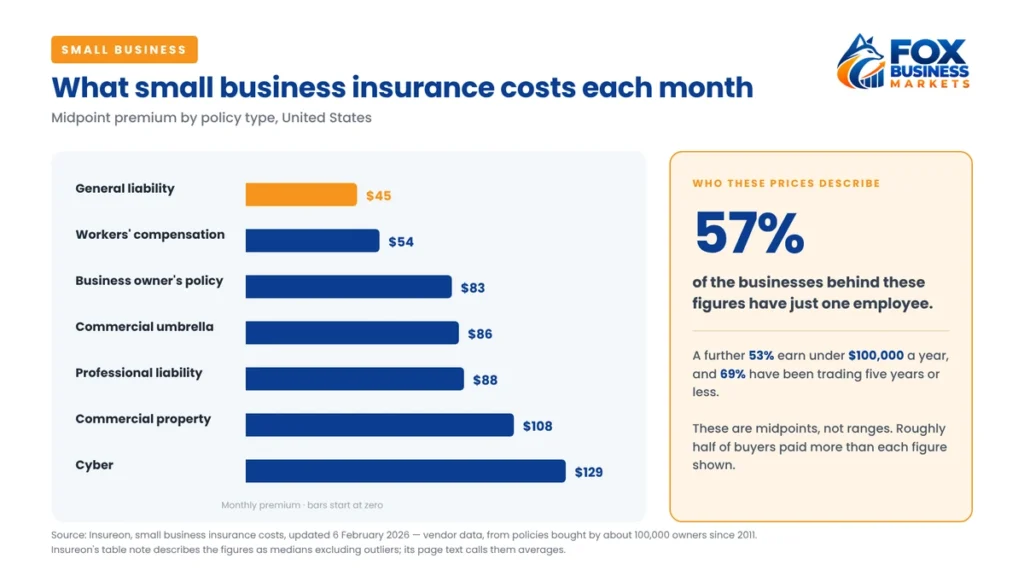
That sample is worth knowing before you plan around it. Insureon states that 57% of its customers have one employee, 53% earn under $100,000 a year, and 69% have been trading five years or less. If you have twelve employees and a leased warehouse, your small business insurance cost will not look like that table.
What Drives the Price Up or Down?
Five things move a small business insurance cost more than anything else: what your business does, where it does it, how big it is, how much cover you buy, and what you have claimed before. Trade is the heaviest of the five, and the one you cannot shop your way out of.
Hiscox, which sells general liability directly, names three of these — industry, location and business size — in its list of cost factors. It treats coverage limits separately, noting that “the higher your limit, the more expensive your general liability insurance policy will be.”
Trade matters most. A bookkeeper working from a spare room and a roofing contractor working at height are not in the same risk class, and no amount of shopping around will close that gap. Insurers price from loss history across thousands of businesses doing what you do.
Coverage limit is the lever owners understand least. A limit is the maximum the insurer will pay. Insureon reports that the most common choice among its customers is $1 million per occurrence and $2 million aggregate, at an average of $45 a month, and that the average rises to $46 a month among customers who buy $2 million and $4 million. Read that carefully: those are two groups of different businesses, not a priced upgrade for the same one, so the dollar gap is not a quote. It is still a reason to ask what the higher limit would add to your own premium, because the increment is often small.
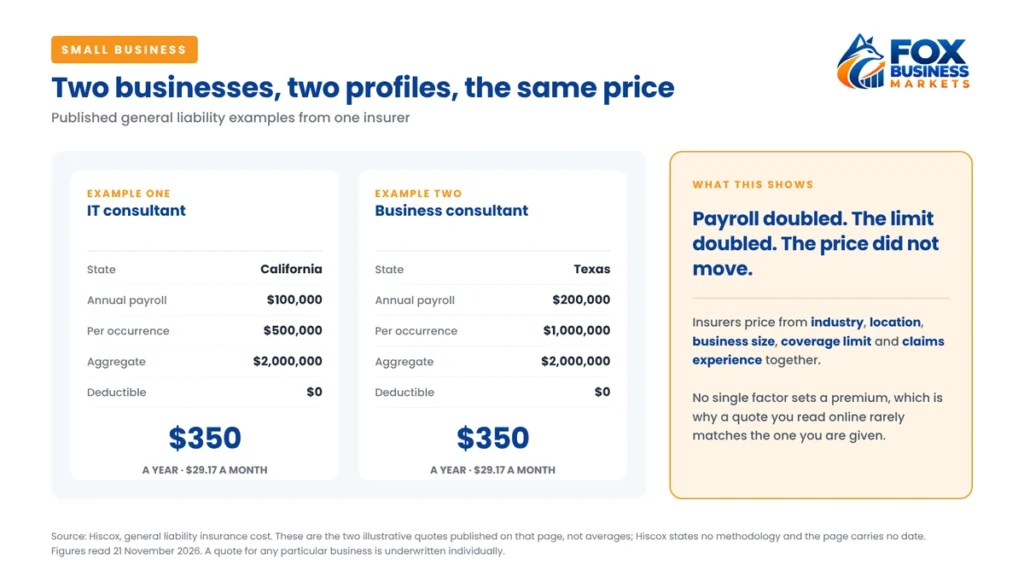
Payroll and revenue drive workers’ compensation and, often, liability — though Hiscox does not list payroll among its own cost factors, and its two published examples make the point awkwardly. An information technology consultant in California with $100,000 of annual payroll and a business consultant in Texas with $200,000 and a higher per-occurrence limit are both shown at $350 a year. Those are illustrative quotes rather than averages, Hiscox publishes no method behind them, and they are a useful reminder that no single factor moves a premium on its own.
Which Policies Does the Law Actually Require?
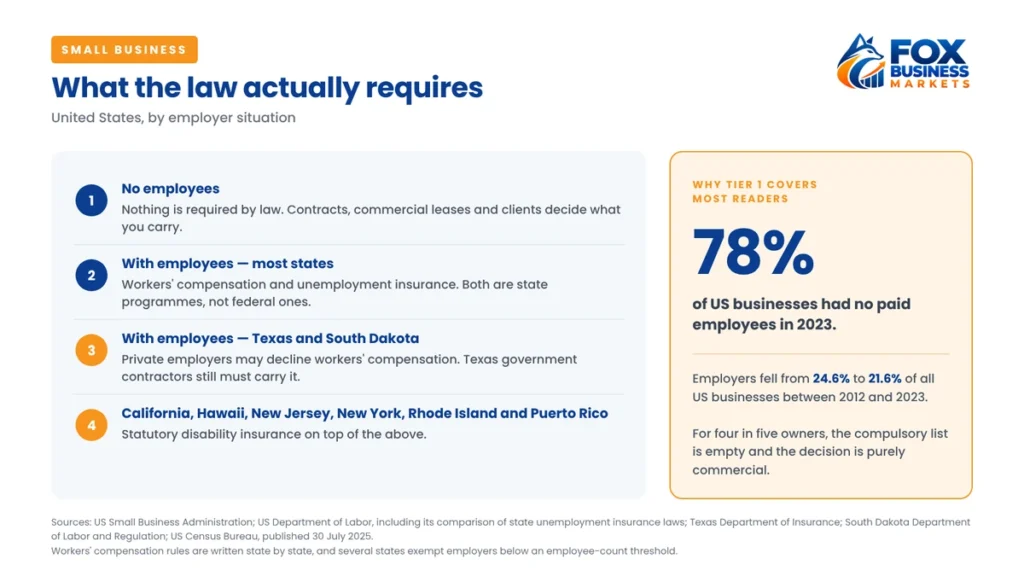
If you have employees, three cover types are generally compulsory: workers’ compensation, unemployment insurance and, in five states plus Puerto Rico, statutory disability insurance. If you have no employees, almost nothing is legally required, and your obligations come from contracts and landlords instead.
Insurance is one of the registration steps worth settling early when you start a small business, alongside your entity and your tax registrations.
The US Small Business Administration states that “the federal government requires every business with employees” to carry workers’ compensation, unemployment and disability insurance, and adds that “some states also require additional insurance. Laws requiring insurance vary by state.”
That wording needs a correction, and it is the most repeated error in articles on this subject. Workers’ compensation for private employers is state law, not federal. The US Department of Labor says plainly that its Office of Workers’ Compensation Programs “does not have a role in the administration or oversight of state workers’ compensation programs,” and directs private-sector workers to their state programme. The federal schemes cover federal employees, certain maritime workers, coal miners and some Department of Energy workers.
The same sentence is wrong about disability insurance in a stronger sense. By the Labor Department’s own comparison of state laws, statutory disability programmes run in six jurisdictions — California, Hawaii, New Jersey, New York, Rhode Island and Puerto Rico — not nationwide. Unemployment sits in between: the federal unemployment tax is federal, but the insurance is a state programme you register with state by state.
So the agency you register with, the penalties for going without, and whether disability cover applies all change when you cross a state line. A nil answer on statutory disability is not a nil answer on state payroll insurance either, because a growing number of states run paid family and medical leave schemes with their own registration and withholding duties.
There is also a reason this section matters less than it appears to. US Census Bureau analysis published on 30 July 2025 found that employer businesses shrank from 24.6% to 21.6% of all US businesses between 2012 and 2023. That leaves roughly four in five American businesses — about 78% as of 2023, on those figures — with no payroll at all, as our small business statistics roundup sets out in more detail. For most readers the compulsory list is empty and the question is purely commercial.
Why Is Workers’ Compensation Different in Texas?
Texas is the best-known state where private employers can decline workers’ compensation, and it is not the only one. South Dakota’s labour department states that “there is no law in South Dakota requiring any employer to carry workers’ compensation insurance.” Several other states exempt employers below an employee-count threshold, so “required” has a different answer in almost every state.
In Texas, the insurance regulator states that “private employers can choose to carry workers’ compensation insurance coverage” and that “it is not required in most cases.” Public bodies get no such choice: the Texas Department of Insurance is explicit that “all Texas governmental entities (public school, utility, city, or county) must have workers’ compensation coverage.”
The choice is also narrower than it sounds, and the exception catches the trades most likely to be reading. Under Texas Labor Code Section 406.096, a contractor on a government building or construction contract must certify in writing that it carries coverage for every employee on that project, and subcontractors must certify to the general contractor. Decline cover and you have also declined public work.
Opting out carries two filing duties: written notice to employees under 28 Texas Administrative Code Section 110.101, and a separate notice of non-coverage to the Division of Workers’ Compensation under Section 110.103, due annually between 1 February and 30 April.
It is not free in the courtroom either. A non-subscriber gives up the liability shield that workers’ compensation provides, so an injured employee can sue for negligence instead of claiming through the state system. South Dakota’s regulator makes the same point: “an uninsured employer may be sued in civil court by an injured worker.” Many such employers buy occupational accident cover instead, and some lean on the group health cover explained in our guide to how health insurance works, which is not a substitute. In either state, treat the saving as a trade rather than a win.
Which Cost Figures Should You Not Trust?
Treat any single national average as a starting point, not a budget. Three specific problems run through the published numbers, and knowing them will save you from planning around a figure that does not describe your business.
The sample is smaller than the label. Headline figures for small business insurance cost almost always trace back to one broker’s own policies. A customer base that is majority single-employee and under $100,000 in revenue produces low midpoints by construction — honest data about that group, and a poor guide to anyone with staff.
Average and median get used interchangeably. The most-cited source page labels the same set of numbers both ways. For premiums the difference is not cosmetic: a few large commercial policies pull an average well above the midpoint, which is exactly why medians are reported.
The time span is rarely stated. Insureon says its data covers policies “purchased from trusted providers since 2011,” but does not say how the figures are weighted across those years or whether they are adjusted for inflation. If older policies carry meaningful weight, the midpoints would sit below current pricing. The page does not disclose enough to say by how much, or whether they do at all.
What would fix this is a regulator-published national average premium by policy type for small businesses. No such series appears to be published free. Regulators release rate filings, profitability-by-line reports and workers’ compensation loss costs, none of which is a small-business premium benchmark. Every usable price figure in this article comes from a company that sells insurance, and both of them have an interest in the number looking affordable.
How Do You Lower the Premium Without Losing Cover?
The reliable ways to bring a small business insurance cost down are bundling, raising your deductible, and getting your trade classification right. The unreliable saving is cutting your limit, which lowers the premium and transfers the risk straight back to you.
- Price a business owner’s policy against separate cover. A BOP combines general liability and commercial property, at a midpoint of $83 a month against $45 and $108 bought separately. Those are three different groups of buyers, and a BOP’s property section is usually narrower, so get both structures quoted rather than assuming the saving.
- Check your classification code. Insurers price from a trade code, and a wrong code can place a desk-based consultant in a contractor class. Ask which code has been applied and whether it matches what you actually do.
- Raise the deductible deliberately. A higher deductible lowers the premium, but only take the saving if you could pay that amount tomorrow without borrowing.
- Ask what the higher limit costs. The gap between Insureon’s $1 million and $2 million cohorts is about a dollar a month. Get your own number rather than that one, but ask, because the increment is frequently modest.
- Keep a claims record worth showing. Hiscox notes that “reducing claims is another good way to keep costs of general liability insurance down.” Documented safety procedures and a clean few years are the slowest and most durable discount available.
What does not work is waiting. Contracts, leases, client onboarding and lenders reviewing small business loans all demand a certificate of insurance at the least convenient moment, and a rushed policy is usually the wrong one.
The Bottom Line
The candle maker’s forty-eight hour problem has an unsatisfying answer: her small business insurance cost is knowable only by asking, because premiums are underwritten one business at a time. What she can do is arrive informed. A single-employee maker in a low-risk trade should expect a general liability quote somewhere near the published midpoints, should ask what the $2 million limit would add rather than assuming it is a dollar, and should have both a bundled policy and separate cover quoted before choosing.
If she had employees, the first question would not be price. It would be which state she is in, because that decides what she must carry — and as Texas and South Dakota show, the answer is not the same everywhere. Get it from your own state’s agency, not from a national summary, including this one.
This article is for general information, not insurance, tax or legal advice. Insurance requirements and premiums depend on your state, trade and circumstances. Confirm obligations with your state’s insurance regulator and a licensed broker before relying on any figure here.
Frequently Asked Questions
Is small business insurance tax deductible?
Premiums for insurance connected to your trade or business are generally deductible as an ordinary and necessary business expense, and the Internal Revenue Service covers the rules in Publication 334, Tax Guide for Small Business. Several policies are treated differently, including self-employed health insurance and life insurance where your business is a beneficiary. Confirm your position with a tax professional.
Do I need business insurance if I work alone from home?
Legally, usually not. Practically, often yes, because a homeowner’s policy generally excludes business activity and business equipment. The Small Business Administration describes a home-based business rider added to homeowner’s insurance as one route, covering some equipment and third-party liability. Clients and contracts are the other reason owners buy it.
How much liability coverage should a small business carry?
The most common choice is $1 million per occurrence with a $2 million aggregate, at an average of $45 a month among Insureon’s customers. Those who bought $2 million averaged about a dollar more. Treat that as a reason to price the higher limit, not as the price of it.
Does a business owner’s policy replace workers’ compensation?
No. A business owner’s policy bundles general liability with commercial property cover and does not include employee injury. Workers’ compensation is a separate policy, and in most states it is compulsory once you have employees. Buying a BOP does not satisfy that obligation.
Why do two similar businesses get very different quotes?
Because a small business insurance cost is built from industry, location, business size, coverage limit and claims experience, and a difference in any one of those moves the premium. Hiscox names industry, location and business size as its cost factors, and addresses limits and claims separately. A misapplied classification code is a common cause of a quote that looks wrong.
Is workers’ compensation required in every state?
No. Texas and South Dakota both leave the decision to private employers, and several other states exempt employers below a headcount threshold. Texas’s regulator states that private employers may choose coverage and that it is not required in most cases, while all Texas governmental entities must carry it. Opting out means giving up your defence against a negligence suit.

