
Quick answer: Health insurance splits medical costs between you and your insurer. You pay a monthly premium, then cover most care yourself until you meet your deductible. After that, you share costs through copays or coinsurance until you reach your out-of-pocket maximum, capped by federal law at $10,600 for one person in 2026 and $12,000 in 2027.
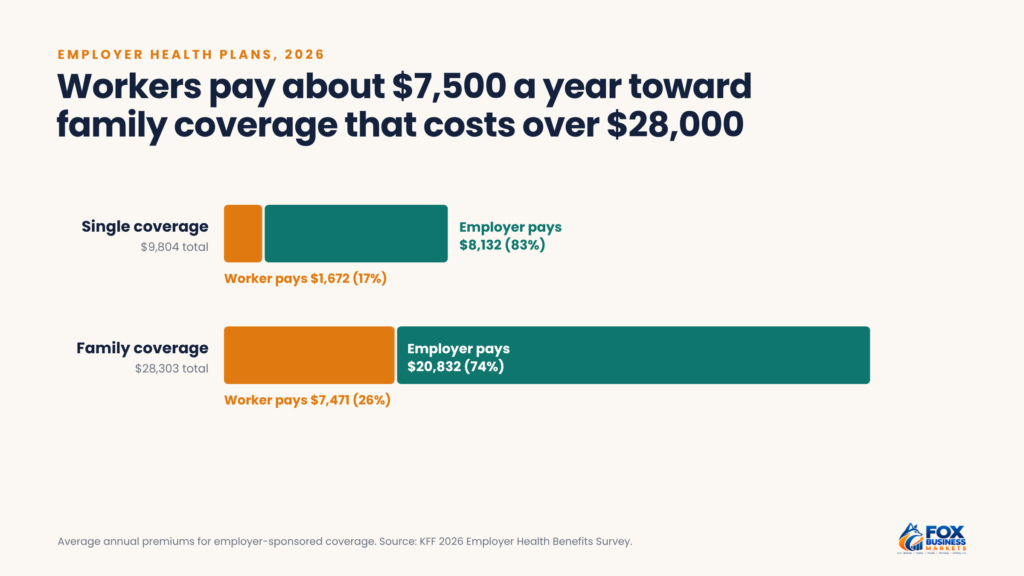
Family health coverage through an employer now costs $28,303 a year on average, and workers pay $7,471 of that out of their paychecks before paying anything for care, according to the KFF 2026 Employer Health Benefits Survey.
The premium is only the price of having a plan. What you pay when you get sick or hurt depends on a handful of other numbers in your policy, and two plans with similar premiums can leave you with very different bills.
This guide explains how health insurance works: the key terms, how a claim gets split, how networks and plan types change your costs, and how to compare plans before open enrollment.
What Are the Main Parts of a Health Insurance Plan?
Every health plan is built from the same five cost pieces.
Term | What it means | Example |
| Premium | What you pay each month to keep coverage, whether or not you use care | $450 a month |
| Deductible | What you pay for covered care each year before the plan starts sharing most costs | $2,000 a year |
| Copay | A flat fee for a specific service | $30 for a doctor visit |
| Coinsurance | Your percentage of the cost after you meet the deductible | 20% of the bill |
| Out-of-pocket maximum | The most you pay for covered, in-network care in a year | $6,000 a year |
A few details trip people up:
- The deductible resets every plan year. For most plans, that’s January 1.
- Copays and the deductible work differently by plan. Some plans charge a copay for doctor visits even before you meet the deductible. Others make you pay the full price of the visit until the deductible is met.
- Family plans often have two deductibles. An individual deductible applies to each person, and a family deductible applies to everyone combined.
How Does a Medical Bill Get Paid, Step by Step?
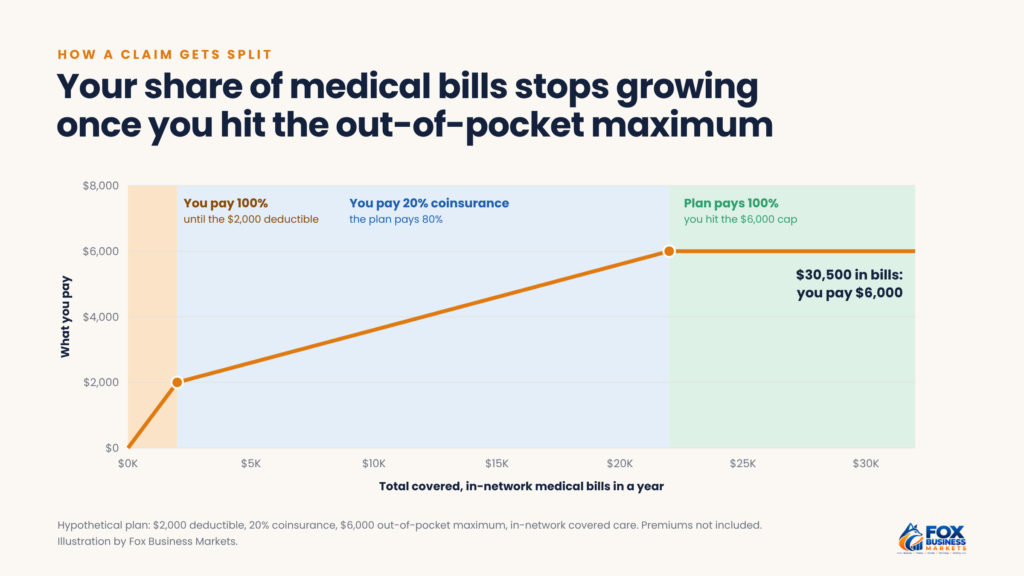
Take a plan with a $2,000 deductible, 20% coinsurance, and a $6,000 out-of-pocket maximum. All care is in-network, and the dollar amounts are the prices your insurer has negotiated (the “allowed amount,” explained below).
- A $500 specialist visit and tests in February. You haven’t met your deductible, so you pay the full $500. You have $1,500 left on the deductible.
- A $10,000 outpatient surgery in May. You pay the remaining $1,500 of your deductible. The other $8,500 is split: you pay 20%, or $1,700, and the plan pays $6,800. Your total so far is $3,700.
- A $20,000 hospital stay in September. Your 20% share would be $4,000, but you only have $2,300 left before you hit the $6,000 out-of-pocket maximum. You pay $2,300, and the plan pays $17,700.
- Anything else covered and in-network for the rest of the year. The plan pays 100%.
Across $30,500 in medical bills, you paid $6,000 and the plan paid $24,500. Your premiums are on top of that, because they never count toward the deductible or the out-of-pocket maximum.
What Counts Toward Your Out-of-Pocket Maximum?
The out-of-pocket maximum is the most useful number in your plan for planning a bad year. HealthCare.gov defines it as “the most you have to pay for covered services in a plan year.”
What counts:
- Deductible payments
- Copays
- Coinsurance
What doesn’t count:
- Your monthly premiums
- Services your plan doesn’t cover
- Out-of-network care, in most plans
- Amounts above what your plan allows for a service
Federal law caps how high the limit can go for most plans. For 2026, the cap is $10,600 for an individual and $21,200 for a family. For 2027, it rises to $12,000 and $24,000. Many plans set their limit lower than the cap.
If your plan’s maximum is $6,000, having that much set aside in an emergency fund means a serious illness won’t push you into debt for covered care.
What Does Health Insurance Cover Before the Deductible?
You don’t always pay full price until the deductible is met. Under the Affordable Care Act, most plans must cover a list of preventive services at no cost to you when you use an in-network provider. That list includes:
- Yearly wellness visits and many routine screenings
- Recommended vaccines
- Many cancer screenings, such as mammograms and colonoscopies, based on age and risk
- Many preventive services for children and for pregnancy
The no-cost rule applies to preventive care, not to treatment. If a screening finds a problem and your doctor starts treating it during the same visit, part of the bill may be billed as diagnostic care and go toward your deductible.
Many plans also cover some services before the deductible with a copay, such as primary care visits, urgent care, or generic drugs. Your plan’s Summary of Benefits and Coverage shows which services work this way.
How Do HMO, PPO, EPO, and POS Plans Differ?
A plan’s type sets the rules for which doctors you can use and whether you need referrals.
Plan type | Out-of-network coverage | Referrals to see specialists | Typical trade-off |
| HMO (health maintenance organization) | Usually none, except emergencies | Usually required | Lower costs, less choice |
| PPO (preferred provider organization) | Yes, at a higher cost | Not required | More choice, higher premiums |
| EPO (exclusive provider organization) | Usually none, except emergencies | Usually not required | No referrals, but in-network only |
| POS (point of service) | Yes, at a higher cost | Usually required | HMO-style rules with some out-of-network coverage |
PPOs are the most common choice at work. Half of covered workers are in a PPO, according to KFF’s 2026 survey, followed by HSA-qualified high-deductible plans (29%), HMOs (12%), and POS plans (8%).
Why Does Your Network Change Your Bill?
Insurers negotiate prices with a group of doctors, hospitals, and pharmacies called a network. The negotiated price is the “allowed amount,” and it’s usually far below the provider’s list price.
When you stay in-network, the provider accepts the allowed amount as full payment. You pay your share, the plan pays the rest, and the provider can’t bill you for the difference.
Out of network, your plan may pay nothing, or it may pay a share of what it considers a fair price. The provider can then bill you for the gap between its charge and what the plan paid. This is called balance billing, and the gap doesn’t count toward your out-of-pocket maximum.
The No Surprises Act, in effect since 2022, limits that risk in situations you can’t control. It protects you from surprise bills for most emergency care, and for many services from out-of-network doctors at an in-network hospital or surgery center, such as an anesthesiologist you didn’t choose. In those cases, you generally pay only your in-network share. The law doesn’t cover ground ambulance rides, though.
Before you book scheduled care, confirm that the facility and the doctors are both in your network. A hospital can be in-network while a specific doctor working there is not.
What Do Bronze, Silver, Gold, and Platinum Mean?
Plans sold on HealthCare.gov and state Marketplaces are grouped into metal tiers. The tier tells you roughly how costs are split for an average group of people, not the quality of care.
- Bronze: The plan pays about 60% of costs and you pay about 40%. Lowest premiums, highest costs when you get care.
- Silver: The plan pays about 70%. Silver is the only tier that comes with extra savings on deductibles and copays, called cost-sharing reductions, if your income qualifies.
- Gold: The plan pays about 80%. Higher premiums, lower costs when you get care.
- Platinum: The plan pays about 90%. Highest premiums, lowest costs at the doctor.
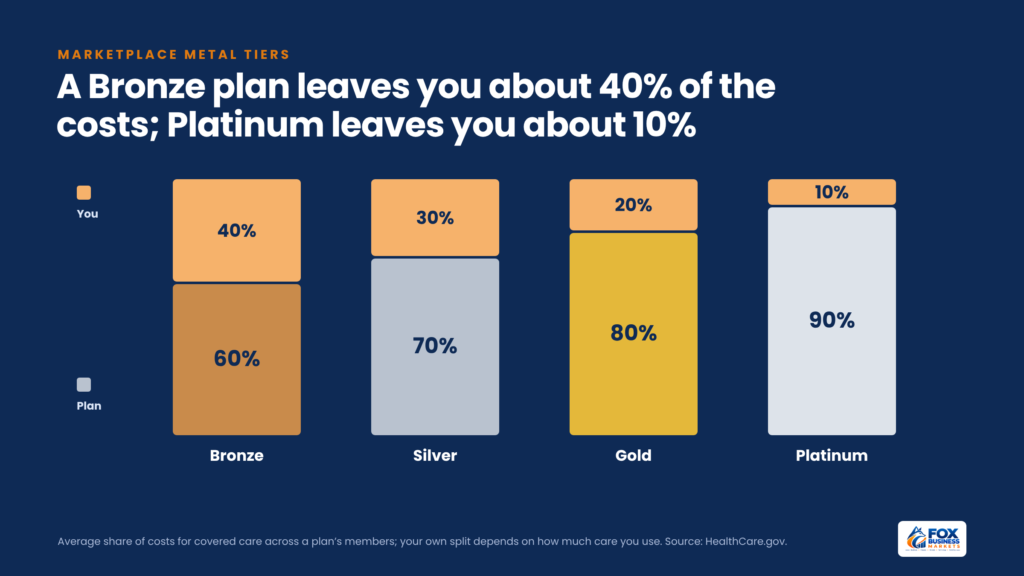
Those percentages are averages across a plan’s members. Your own split depends on how much care you use. A healthy person who only gets preventive care may pay almost nothing beyond premiums on a Bronze plan, while someone with a chronic condition may come out ahead on Gold.
People under 30, and some people who qualify for a hardship exemption, can also buy a catastrophic plan where available. These plans have low premiums and very high deductibles and are meant mainly to protect against a worst-case year.
How Do HSAs and High-Deductible Plans Work?
A high-deductible health plan (HDHP) can be paired with a health savings account (HSA), one of the few accounts with three tax advantages: contributions are tax-deductible or pre-tax, growth is tax-free, and withdrawals for qualified medical expenses are tax-free.
For 2026, an HSA-eligible plan must have a deductible of at least $1,700 for self-only coverage or $3,400 for a family, according to IRS Revenue Procedure 2025-19. You can contribute up to:
- $4,400 with self-only coverage
- $8,750 with family coverage
- $1,000 more if you’re 55 or older
Starting in 2026, the One Big Beautiful Bill Act also treats individual Bronze and catastrophic plans as HSA-eligible, whatever their deductible, as long as the plan is offered through a Marketplace, even if you buy it directly from the insurer.
HSA money rolls over every year and stays yours if you change jobs. Many HSA providers let you invest the balance once it passes a minimum, so some people treat the account as a long-term savings vehicle. If you’re new to that idea, our guide on how to start investing covers the basics.
Many employers offer a flexible spending account (FSA) instead. An FSA doesn’t require a high-deductible plan, but most unused money is lost at year-end beyond a limited carryover or grace period, and you generally can’t contribute to an HSA and a general-purpose FSA in the same year.
The trade-off is the deductible. An HDHP works best if you can afford to pay several thousand dollars of care before the plan starts sharing most costs.
Where Do Americans Get Health Insurance?
Most people get coverage from one of four places, and each works a little differently.
Through an employer. Your employer picks the plans and pays part of the premium. In 2026, workers paid an average of $1,672 a year toward single coverage, according to KFF, and employers covered the rest. Your share usually comes out of your paycheck before taxes.
Through the Marketplace. If you don’t have affordable coverage at work, you can buy a plan on HealthCare.gov or your state’s exchange. Premium tax credits lower the cost for many buyers based on income. With the temporary “enhanced” credits gone after 2025, the credits generally go to households with incomes between 100% and 400% of the federal poverty level. Keeping the same plan would have cost enrollees 114% more on average after tax credits in 2026; on net, premium payments rose 58%. The number of people paying for Marketplace coverage fell from a record 21.8 million in 2025 to 19.2 million, according to KFF. Marketplace plans can’t turn you down or charge you more for a pre-existing condition.
Through Medicaid or CHIP. These state and federal programs cover many people with low incomes and children, with rules that vary by state.
Through Medicare. Medicare covers most people 65 and older and some younger people with disabilities, with its own parts and enrollment periods.
When Can You Sign Up or Change Plans?
You can’t buy or switch health insurance at any time. Most changes happen during set windows.
- Marketplace open enrollment: In most states, it runs from November 1, 2026, through January 15, 2027, for 2027 coverage. Enroll by December 15 for coverage that starts January 1; enroll later and it usually starts February 1. Some state exchanges set different dates.
- Employer open enrollment: Usually once a year, often in the fall, with the dates set by your employer.
- Special enrollment: Certain life events, such as getting married, having a baby, or moving, open a window to enroll or change plans outside open enrollment. For the Marketplace, you generally have 60 days; employer plans generally allow 30 days.
If you miss open enrollment and don’t have a qualifying event, you may have to wait until the next year for coverage. Medicaid and CHIP accept applications year-round.
What Plan Documents Should You Read?
Three documents tell you most of what you need to know about your plan:
- Summary of Benefits and Coverage (SBC). A standard, plain-language summary every plan must provide. It lists the deductible, copays, coinsurance, and out-of-pocket maximum, plus sample costs for common situations like having a baby. Use it to compare plans side by side.
- Explanation of Benefits (EOB). Sent after you get care. It shows what the provider charged, what the plan allowed and paid, and what you owe. An EOB isn’t a bill, but compare it with any bill you receive before paying. If medical bills have already piled up, our guide on how to pay off debt can help you plan a payoff.
- The plan’s list of covered drugs, usually sorted into tiers with different costs. If you take a regular prescription, check that it’s on the list.
Many plans also require prior authorization for some services, such as advanced imaging or certain drugs. Without approval in advance, the plan may refuse to pay. Your doctor’s office usually requests it, but confirm it’s approved before scheduled care.
What Can You Do if Your Insurer Denies a Claim?
A denial isn’t always final. Start with the EOB or denial letter, which must explain the reason. Sometimes the problem is a billing code error that your doctor’s office can fix and resubmit.
If the plan stands by the denial, you can file an internal appeal, generally within 180 days. Ask your doctor for a letter explaining why the care was medically necessary, and keep copies of everything you send.
If the internal appeal fails, you usually have the right to an external review by an independent reviewer, who can overturn the insurer’s decision. For urgent care, both steps can move faster.
Does a Lower Premium Always Mean a Cheaper Plan?
No. The plan with the lowest premium is often the one with the highest deductible and out-of-pocket maximum. If you need little care, that can be the cheapest choice. If you have a costly year, it can be the most expensive.
Compare plans on total cost: a year of premiums plus what you’d likely pay for care. Then check the worst case: a year of premiums plus the out-of-pocket maximum.
Consider two hypothetical plans:
- Plan A: $300 a month in premiums ($3,600 a year) with a $9,000 out-of-pocket maximum. Worst case: $12,600.
- Plan B: $450 a month in premiums ($5,400 a year) with a $4,000 out-of-pocket maximum. Worst case: $9,400.
In a quiet year with only preventive care, Plan A saves $1,800. In a year with surgery or a hospital stay, Plan B saves $3,200. The right choice depends on your health, your savings, and how much risk you can carry. If the higher premium is the hurdle, our guide on how to make a budget can help you find room for it.
How Do You Choose a Health Plan?
- List the care you expect. Count regular doctor visits, prescriptions, therapy, and any planned procedures for the coming year.
- Check the network. Search each plan’s directory for your doctors, nearby hospitals, and your pharmacy.
- Check your drugs. Look up each prescription on the formulary and note its tier and cost.
- Compare total and worst-case costs. Add a year of premiums to your expected costs and to the out-of-pocket maximum.
- Look at the HSA option. If a plan qualifies, an HSA can offset part of a higher deductible.
- Read the SBC before you enroll. Use the sample cost examples to see how each plan handles common events.
Frequently Asked Questions
Can I stay on my parent’s health plan?
Yes, until you turn 26, if the plan offers dependent coverage, which most do. You can stay on even if you’re married, not living with your parent, not a student, or eligible for your own employer plan. Mark the date you turn 26 and look for a new plan about two months before, since losing that coverage opens a special enrollment window.
What happens if I lose my job?
You may be able to keep your employer plan through COBRA, usually for up to 18 months, but you’ll typically pay the full premium plus up to a 2% fee. Losing job-based coverage also qualifies you for a Marketplace special enrollment period, where you may get a tax credit. Compare a Marketplace quote with your COBRA cost before you choose.
What happens if I miss a premium payment?
You usually get a grace period before coverage ends. If you get a premium tax credit on a Marketplace plan, the grace period is three months, though claims in the second and third months may be held until you pay. If you don’t catch up by the end of the three months, coverage ends back to the end of the first month. For other plans, it’s often 30 days. Set up automatic payments so coverage doesn’t lapse by mistake.
Does health insurance cover dental and vision care?
For children, dental and vision are required benefits on Marketplace coverage, though dental is often sold as a separate stand-alone plan. For adults, most medical plans don’t cover routine dental or vision care, so it’s usually sold as a separate policy (see our overview of the types of insurance) or offered as a separate benefit at work. Check whether a separate dental plan’s yearly maximum is worth its premium before you buy.
Read Your Plan’s Key Numbers Before You Need Care
Pull up your Summary of Benefits and Coverage this week and find four figures: the premium, the deductible, your coinsurance or copays, and the out-of-pocket maximum. Together, they tell you what you’d owe in a bad year. With open enrollment starting November 1, use them to compare next year’s plans before you renew.
This article is for general information only and isn’t financial, legal, or insurance advice. Policies and rules vary by insurer and state, so read your policy and talk to a licensed professional before making decisions.