
Mateo is 25, an emergency room nurse in San Antonio, and for three years his savings sat in a checking account earning almost nothing. He kept meaning to invest, but every time he opened an app he froze: stocks or funds, Roth or traditional, how much was enough? Then a coworker showed him one number. If he invested $200 a month starting now and earned 7% a year, he could have about $525,000 by 65. If he waited until 35, it would be about $244,000. That afternoon, on a break outside the hospital, he opened a Roth IRA. (Mateo is a composite example, and the 7% return is an assumption, not a promise.)
This guide explains how to start investing in the U.S. step by step: what to do first, which accounts to use, what to buy, how much it costs, and how to avoid the most common mistakes.
Quick answer: To start investing, first build an emergency fund and pay off high-interest debt. Then take any 401(k) employer match, open a Roth or traditional IRA or a taxable brokerage account, and invest regularly in low-cost, diversified funds such as index funds. In 2026, you can put up to $24,500 into a 401(k) and $7,500 into an IRA. About 56% of U.S. families owned stock directly or indirectly in 2025, according to the Federal Reserve, down from 58% in 2022.
What Does Investing Mean?
Investing means putting money into assets like stocks, bonds, or funds that you expect to grow over time. Saving keeps your money safe and available. Investing accepts some risk in exchange for the chance of higher long-term returns.
Here are the basic building blocks:
Investment | What it is | Risk and return |
| Stocks | Shares of ownership in a company | Highest long-term growth potential, biggest swings |
| Bonds | Loans to governments or companies that pay interest | Lower risk and lower returns than stocks |
| Mutual funds | Pools of many stocks or bonds managed as one fund | Instant diversification; costs vary widely |
| Index funds and ETFs | Funds that track a market index, like the S&P 500 | Low cost, broad diversification |
| Cash and CDs | Savings accounts, money market funds, certificates of deposit | Lowest risk, lowest long-term returns |
When you’re figuring out how to start investing, you don’t need to pick individual stocks. A single diversified index fund can own hundreds or thousands of companies at once.
How Do You Start Investing Step by Step?
Here’s how to start investing in seven steps.
Step 1: Build an Emergency Fund First
Before you invest, set aside enough cash to cover a surprise expense or a job loss. The U.S. Securities and Exchange Commission (SEC) notes in its investor guide that “most smart investors put enough money in a savings product to cover an emergency, like sudden unemployment.”
That way, you won’t have to sell investments at a bad time. Our emergency fund guide shows how much to save, and a high-yield savings account is a good place to keep it.
Step 2: Pay Off High-Interest Debt
Credit card interest often costs more than investments typically earn. About high-interest credit card debt, the SEC says that “the wisest thing you can do under any market conditions is to pay off the balance in full as quickly as possible.” Our guide on how to pay off debt explains the fastest methods.
Low-interest debt, like many federal student loans or a mortgage, usually doesn’t need to be paid off before you start investing.
Step 3: Set Your Goals and Time Horizon
The SEC says “the first step to successful investing is figuring out your goals and risk tolerance.” Ask yourself what the money is for and when you’ll need it.
- Retirement, 20 or more years away: You can usually take more stock market risk, because you have time to recover from downturns.
- A house in five years: You may want a mix of stocks and bonds, or safer options.
- Money you need within a year or two: Keep it in savings or CDs, not stocks.
Step 4: Get Your Employer’s 401(k) Match
If your employer offers a 401(k) or similar plan with a match, contribute at least enough to get the full match. The SEC points out that in many plans “the employer will match some or all of your contributions.” Skipping the match means leaving part of your pay on the table.
In 2026, you can contribute up to $24,500 to a 401(k), plus an $8,000 catch-up contribution if you’re 50 or older, according to the IRS. Workers aged 60 to 63 can add up to $11,250 instead. Starting in 2026, if your Social Security (FICA) wages from that employer topped $150,000 the year before, your catch-up contributions must go in as Roth (after-tax), according to IRS Notice 2025-67.
Step 5: Choose the Right Account
Knowing how to start investing means choosing where your investments will live. The main options are:
Account | Tax treatment | 2026 limit | Best for |
| 401(k) or 403(b) | Traditional: pretax contributions, taxed withdrawals. Roth: after-tax contributions, tax-free qualified withdrawals | $24,500 | Workers with an employer plan, especially with a match |
| Roth IRA | Contribute after tax; qualified withdrawals in retirement are tax-free | $7,500 | Younger savers and those who expect higher taxes later |
| Traditional IRA | Contributions may be tax-deductible; deductible contributions and earnings are taxed when withdrawn | $7,500 | Those who want a tax break now |
| Taxable brokerage account | No special tax breaks; no contribution limits; withdraw anytime | None | Goals before retirement, or after maxing other accounts |
Limits from the IRS for 2026. IRA savers 50 and older can contribute an extra $1,100.
Roth IRA eligibility depends on income. In 2026, the ability to contribute phases out between $153,000 and $168,000 of modified adjusted gross income for single and head-of-household filers and between $242,000 and $252,000 for married couples filing jointly, according to the IRS. Our guide to Roth IRA vs. traditional IRA explains which to pick.
Step 6: Pick Simple, Low-Cost Investments
For most beginners, the simplest way to start investing is with broad, low-cost funds:
- Total stock market or S&P 500 index funds for long-term growth.
- Target-date funds, which automatically shift from stocks to bonds as you near a target year, like 2060.
- Bond index funds to add stability.
Diversification matters. “It’s common sense: don’t put all your eggs in one basket,” the SEC says. A broad index fund spreads your money across many companies, so one company’s collapse won’t sink your portfolio.
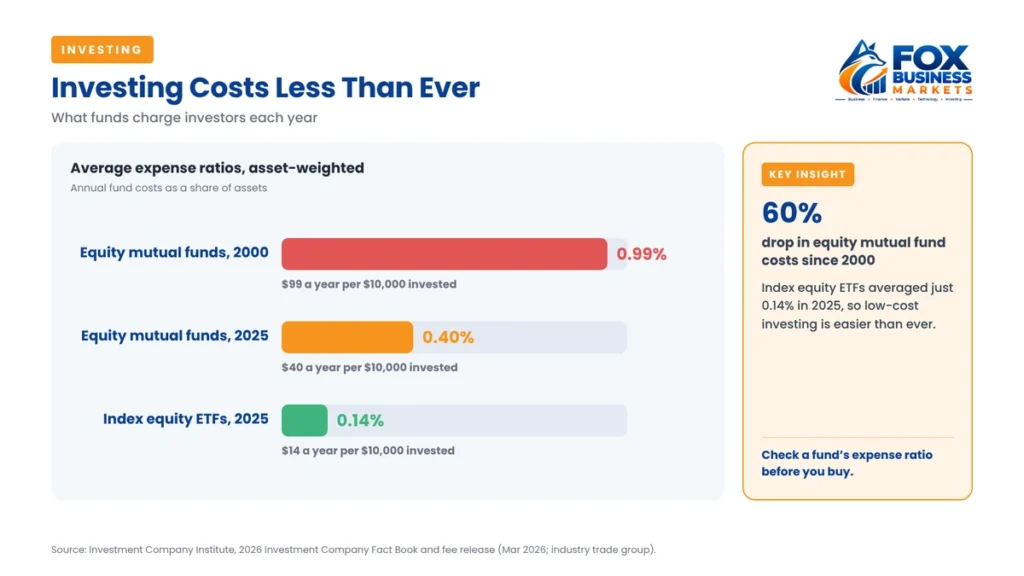
Costs matter too. In 2025, the average expense ratio was 0.40% for equity mutual funds and 0.14% for index equity ETFs, asset-weighted, according to the Investment Company Institute. Equity mutual fund costs have fallen about 60% since 2000, when they averaged 0.99%, according to ICI’s 2026 Fact Book. On a $10,000 investment, 0.40% is $40 a year and 0.14% is $14. Over decades, lower fees can add up to thousands of dollars.
Step 7: Invest Regularly and Automatically
Set up automatic contributions from every paycheck. Investing a fixed amount on a regular schedule is called dollar-cost averaging. The SEC describes it as “a consistent pattern of adding new money to your investment over a long period of time,” which can help you avoid putting all your money in at a market peak.
Then leave it alone. Check your account a few times a year, and rebalance about once a year if your mix of stocks and bonds drifts far from your target.
How Much Money Do You Need to Start Investing?
Less than most people think, which is good news if you’re learning how to start investing on a tight budget. Many brokerages have no account minimums, and many let you buy fractional shares for as little as a few dollars. A 401(k) can start with a small percentage of each paycheck.
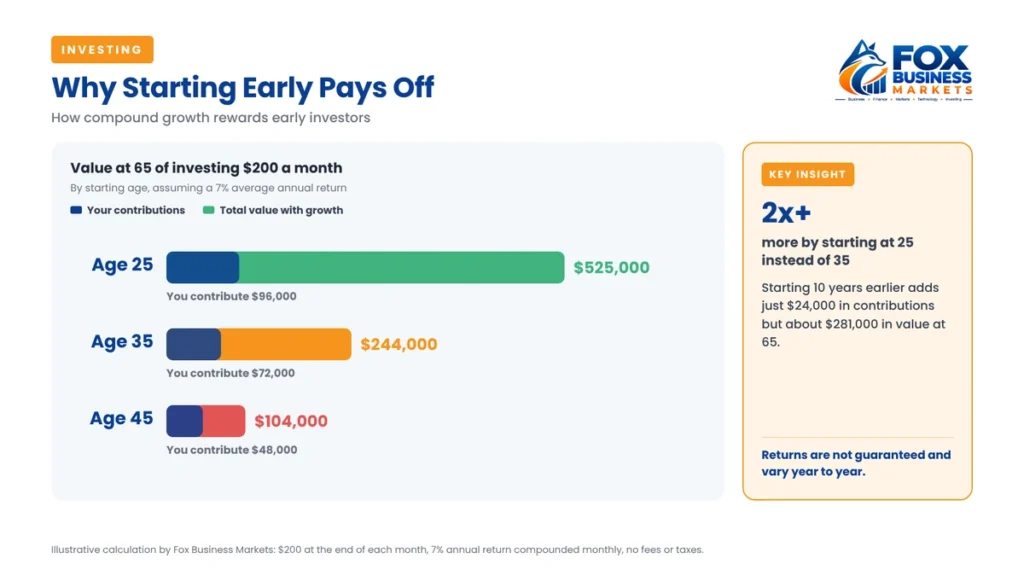
What matters most is starting early and staying consistent, thanks to compound interest, where your returns earn returns of their own. Here’s what $200 a month could grow to by age 65, assuming a 7% average annual return:
Start investing at age | Total contributed | Value at 65 |
| 25 | $96,000 | About $525,000 |
| 35 | $72,000 | About $244,000 |
| 45 | $48,000 | About $104,000 |
Illustrative calculation by Fox Business Markets: $200 invested at the end of each month, 7% average annual return compounded monthly, no fees or taxes. Actual returns vary and can be negative in some years.
Starting 10 years earlier means contributing just $24,000 more, but ending up with more than twice as much.
Who Invests in the U.S.?
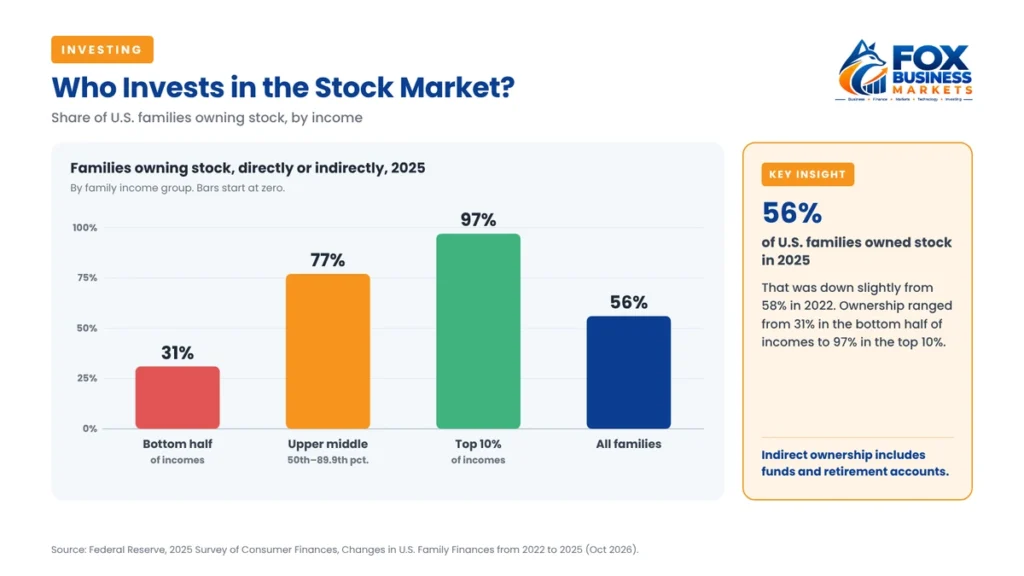
Many Americans still don’t. In 2025, 56% of U.S. families owned stocks directly or indirectly, such as through mutual funds or retirement accounts, down slightly from 58% in 2022, according to the Federal Reserve’s 2025 Survey of Consumer Finances, released in October 2026.
The gap by income is wide. Just 31% of families in the bottom half of the income distribution held stock, compared with 77% of upper-middle-income families and 97% of families in the top 10%, according to the survey report. Only 19% of families owned individual stocks directly.
For families that do invest, the rewards grew. Among families holding stock, median stock holdings rose 36% from 2022 to 2025, to $77,400.
How Do You Keep Your Investments Safe?
Investing always carries market risk, and your investments can lose value. But you can protect yourself from fraud and firm failures:
- Use a SIPC-member brokerage. The Securities Investor Protection Corporation protects up to $500,000 per customer, including $250,000 in cash, if a member brokerage firm fails and assets are missing. “SIPC does not protect against the decline in value of your securities,” according to SIPC.
- Check your broker or adviser on FINRA BrokerCheck or the SEC’s Investor.gov before you hand over money.
- Be wary of guaranteed returns. Any promise of high returns with little or no risk is a red flag. The SEC warns that “scam artists read the headlines, too.”
- Don’t invest in what you don’t understand, including hyped stocks, crypto schemes, or tips from social media.
What Are Common Beginner Investing Mistakes?
Learning how to start investing also means learning what not to do:
- Waiting for the “right time.” No one can reliably predict the market. Time in the market usually matters more than timing.
- Selling in a panic. Markets fall regularly. Selling after a drop locks in losses.
- Paying high fees. A 1% annual fee can quietly eat a large share of your long-term returns.
- Putting everything in one stock. Even well-known companies can fall sharply.
- Investing money you’ll need soon. Short-term money belongs in savings.
Frequently Asked Questions
How do I start investing with little money?
Start with your employer’s 401(k), especially if it offers a match, or open an IRA or brokerage account with no minimum. Many brokerages let you buy fractional shares for a few dollars. Set up automatic contributions, even $25 or $50 a month, and invest in a low-cost index fund or target-date fund.
What should a beginner invest in first?
Most beginners do well with broad, low-cost index funds, such as a total U.S. stock market or S&P 500 fund, or a single target-date fund that handles the mix of stocks and bonds for you. These provide instant diversification. Individual stocks are riskier and better left for later, if at all.
How much should I invest each month?
A common rule of thumb is to save about 15% of your pretax income for retirement, including any employer match, but any amount helps. Start with what you can afford after building an emergency fund and paying off high-interest debt, then increase your contributions each time you get a raise.
Is a Roth IRA good for beginners?
Often, yes. You contribute after-tax money, and qualified withdrawals in retirement are tax-free, which helps younger savers who expect to earn more later. In 2026, you can contribute up to $7,500, but eligibility phases out at higher incomes, starting at $153,000 for single filers, according to the IRS.
Is investing in the stock market safe?
Stock prices can fall, sometimes sharply, so investing is never risk-free. Diversified index funds and a long time horizon reduce risk. Using a SIPC-member brokerage protects up to $500,000 if the firm fails, but not against market losses. Keep money you’ll need soon in savings instead.
How much do I need to start investing?
Very little. Many brokerages have no account minimums and offer fractional shares, so you can start with a few dollars. What matters more is investing regularly over a long period. Starting early gives compound growth more time to work.
The Bottom Line
Mateo didn’t need a finance degree or a big balance to start. He had his emergency fund, he picked a Roth IRA and a target-date fund, and he set up $200 a month on autopilot. Now he checks his account twice a year and leaves it alone.
That’s how to start investing: build a cash cushion, clear high-interest debt, grab your employer match, choose the right account, buy low-cost diversified funds, and invest automatically. The sooner you start, the more time your money has to grow. For the bigger picture, see our personal finance guide and the latest investing statistics.