Hannah is 34, a high school chemistry teacher in Minneapolis, and her school’s 403(b) plan offered her 22 funds. She read the descriptions twice and understood almost none of them. One fund had a manager with a long biography and a fee of 0.85%. Another simply said it “seeks to track the S&P 500” and charged 0.04%. She asked a colleague which one was better. He laughed and said, “The boring one.” (Hannah is a composite example, but her choice is one millions of American savers face.)
This guide explains what an index fund is, how index funds work, what they cost, how they’ve performed against professional fund managers, and how to choose one in the U.S.
Quick answer: An index fund is a mutual fund or exchange-traded fund (ETF) that tries to match the return of a market index, such as the S&P 500, by holding the same stocks or bonds in the same proportions. Index funds are usually cheap: in 2025, index equity mutual funds charged an average of 0.05% a year, versus 0.64% for actively managed equity funds. Over the 20 years through 2025, 92.9% of actively managed U.S. large-cap funds trailed the S&P 500.
What Is an Index Fund?
An index fund is “a type of mutual fund or exchange-traded fund that seeks to track the returns of a market index,” according to the U.S. Securities and Exchange Commission’s Investor.gov.
An index is a list of investments that represents a slice of the market. The S&P 500, for example, tracks about 500 of the largest U.S. companies. An S&P 500 index fund buys those same companies, so when you own one share of the fund, you own a tiny piece of each of them.
Instead of paying a manager to pick winners, an index fund follows its index automatically. This is called passive investing. Because the fund trades less and doesn’t need a research team, it usually costs much less to run.
How Does an Index Fund Work?
When you buy an index fund, your money is pooled with other investors’ money and invested to mirror the index. Some funds hold every security in the index; others invest in only a sample of the securities, the SEC notes.
Most major indexes are weighted by market value. Bigger companies make up a bigger share of the fund. When the index changes, for example when a company is added or removed, the fund adjusts its holdings to match.
Your return roughly equals the index’s return minus the fund’s costs. If the S&P 500 gains 10% in a year and your fund charges 0.05%, you’ll earn about 9.95%, before any small tracking differences.
What Are the Main Types of Index Funds?
You can find an index fund for almost any part of the market:
| Type | What it tracks | Example index |
| Large-cap U.S. stock | About 500 of the biggest U.S. companies | S&P 500 |
| Total U.S. stock market | Nearly every publicly traded U.S. company | CRSP US Total Market or similar |
| International stock | Companies in developed and emerging markets outside the U.S. | MSCI ACWI ex USA, FTSE All-World ex-US |
| Bond | U.S. investment-grade bonds, including Treasuries, mortgage-backed and corporate bonds | Bloomberg U.S. Aggregate Bond |
| Small-cap or mid-cap | Smaller U.S. companies | S&P SmallCap 600, Russell 2000 |
| Sector | One industry, such as technology or health care | Sector indexes |
For most beginners, a broad total-market or S&P 500 fund, possibly paired with a bond index fund, is a simple starting point. Sector funds are much less diversified and riskier.
Index Mutual Funds vs. Index ETFs
An index fund can be a mutual fund or an ETF. Both can track the same index; the difference is mainly how you buy them:
| Feature | Index mutual fund | Index ETF |
| How you buy | Directly from the fund company or through a broker | On a stock exchange through a brokerage account |
| Pricing | Once a day, at the end-of-day price (NAV) | Throughout the trading day at market prices |
| Minimum investment | Some require $1,000 or more; many don’t | Price of one share, or less with fractional shares |
| Automatic investing | Easy to set up fixed-dollar contributions | Depends on your brokerage |
| 2025 average expense ratio (index equity funds) | 0.05% | 0.14% |
Expense ratios are asset-weighted averages from the Investment Company Institute (ICI), an industry trade group, for 2025.
Many 401(k) and 403(b) plans offer index mutual funds. In an IRA or brokerage account, you can choose either.
How Much Do Index Funds Cost?
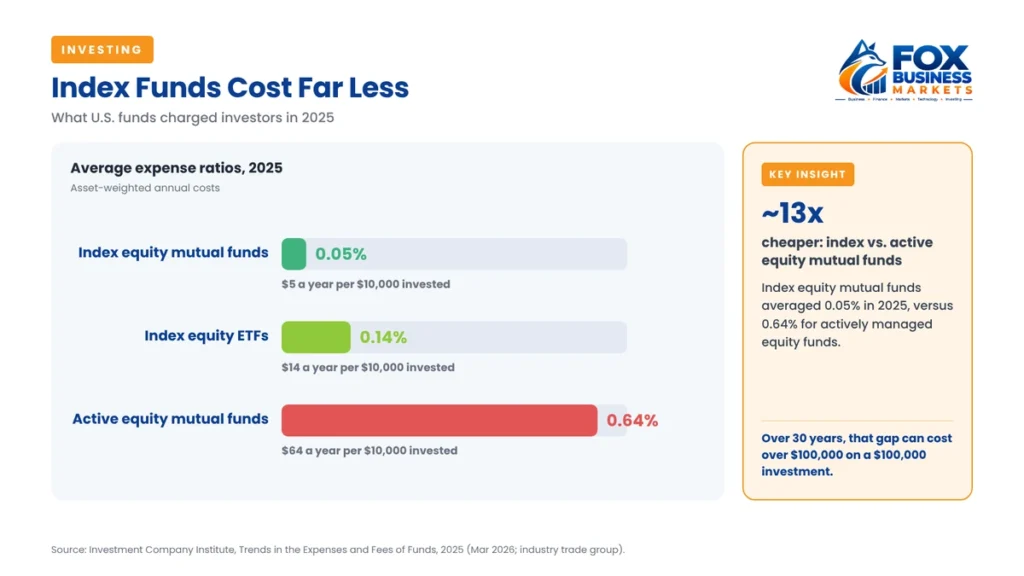
This is where an index fund shines. In 2025, the asset-weighted average expense ratio was 0.05% for index equity mutual funds and 0.14% for index equity ETFs, compared with 0.64% for actively managed equity mutual funds, according to ICI’s report Trends in the Expenses and Fees of Funds, 2025.
That means $5 a year in fees on a $10,000 investment in the average index equity mutual fund, versus $64 in the average actively managed one. The gap compounds over time:
| $100,000 invested for 30 years | Annual fee | Value after 30 years |
| Average index equity mutual fund | 0.05% | About $751,000 |
| Average index equity ETF | 0.14% | About $732,000 |
| Average active equity mutual fund | 0.64% | About $636,000 |
Illustrative calculation by Fox Business Markets, assuming a 7% annual return before fees, with fees subtracted from the return each year. No taxes. Actual returns will vary.
Still, the SEC cautions that “not all index funds have lower costs than actively managed funds.” Always check a fund’s expense ratio in its prospectus.
Do Index Funds Beat Actively Managed Funds?
Over long periods, usually yes. Most professional stock pickers don’t beat the index they’re measured against, especially after fees.
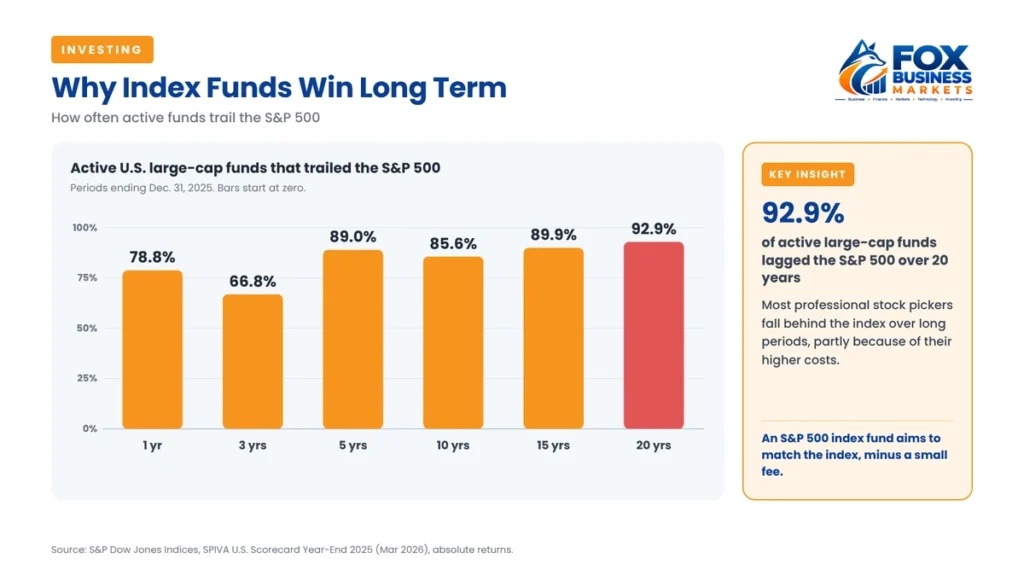
According to S&P Dow Jones Indices’ SPIVA U.S. Scorecard for year-end 2025, 78.8% of actively managed U.S. large-cap funds underperformed the S&P 500 in 2025. Over longer periods, the numbers were even more lopsided:
- 5 years:0% underperformed
- 10 years:6% underperformed
- 15 years:9% underperformed
- 20 years:9% underperformed
Small-cap managers did no better over the long run: 90.3% of small-cap funds trailed the S&P SmallCap 600 over 20 years, according to the full SPIVA report.
Because an index fund simply matches the market minus a small fee, it has historically come out ahead of most active funds over long periods.
How Popular Are Index Funds?
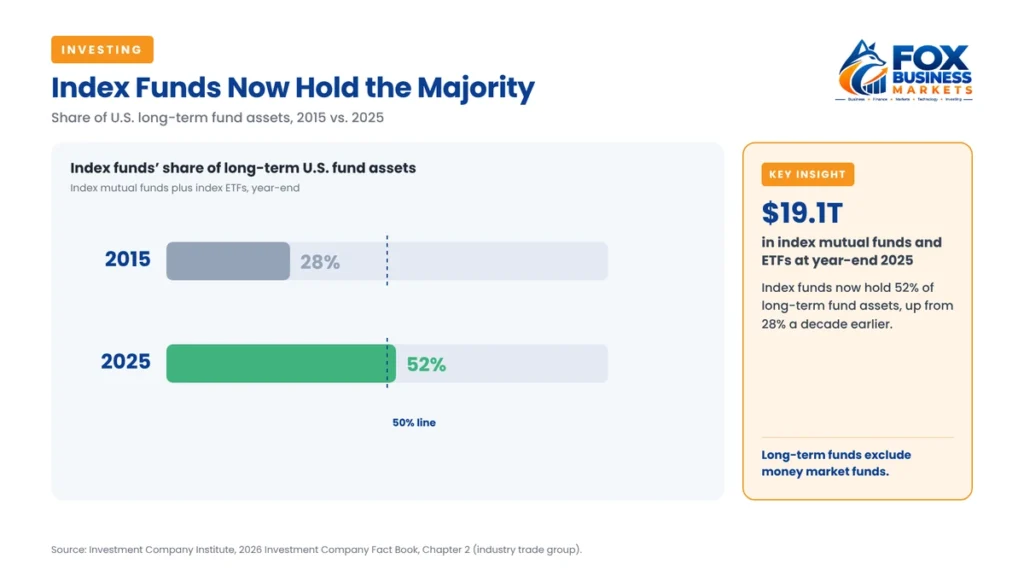
Very. At the end of 2025, index mutual funds and index ETFs held $19.1 trillion and made up 52% of all assets in long-term U.S. funds, up from 28% in 2015, according to ICI’s 2026 Investment Company Fact Book.
What Are the Risks of Index Funds?
An index fund is diversified, but it isn’t risk-free. The SEC notes that “an index fund will be subject to the same general risks as the securities in the index it tracks.” Keep these in mind:
- Market risk: If the whole market falls, your index fund falls with it. Index funds don’t try to dodge downturns.
- Concentration: Market-value weighting means the biggest companies dominate. A handful of large tech stocks make up a large share of the S&P 500.
- Tracking error: “An index fund may not perfectly track its index,” the SEC says, especially if it holds only a sample.
- No upside surprise: You’ll never beat the market, by design. You’ll get the market return minus fees.
- Narrow indexes: Sector or niche index funds can be as risky as individual stocks.
How Do You Choose an Index Fund?
When you compare index funds that track similar markets, look at:
- The index it tracks. Make sure it covers the part of the market you want, such as total U.S. stocks or the S&P 500.
- The expense ratio. For broad stock index funds, look for very low costs, often 0.10% or less.
- Tracking difference. Compare the fund’s return with its index over several years. A small, steady gap is normal.
- Minimums and account type. Check minimum investments and whether the fund is available in your 401(k), IRA, or brokerage account.
- Fund size and provider. Large, established funds from major providers tend to have tight trading spreads and low costs.
Then invest regularly. Our guide on how to start investing walks through the steps, and you can hold index funds inside a Roth or traditional IRA to get tax benefits. Over time, compound interest does the heavy lifting.
Frequently Asked Questions
What is an index fund in simple terms?
An index fund is a mutual fund or ETF that buys all, or a representative sample, of the investments in a market index, such as the S&P 500. Instead of trying to pick winners, it aims to match the index’s return. That makes index funds simple, diversified, and usually low cost.
Are index funds a good investment for beginners?
Often, yes. Broad index funds give you instant diversification across hundreds or thousands of companies at a very low cost. In 2025, index equity mutual funds charged an average of 0.05% a year. They still rise and fall with the market, so they work best for long-term goals.
How much money do I need to invest in an index fund?
Not much. Index ETFs cost the price of one share, and many brokerages let you buy fractional shares for a few dollars. Some index mutual funds have minimums, often $1,000 or more, while others have none. Many 401(k) plans let you contribute a percentage of each paycheck, up to plan and IRS limits.
Is an S&P 500 index fund the same as a total market fund?
Not quite. An S&P 500 fund holds about 500 large U.S. companies. A total U.S. stock market fund adds thousands of mid-size and small companies. Because large companies dominate both by market value, their returns are usually similar, but total market funds are slightly more diversified.
Can you lose money in an index fund?
Yes. An index fund falls when the market it tracks falls, and stock index funds can drop sharply in a downturn. Index funds reduce the risk of any single company hurting you, but not market risk. Holding them for many years and adding bonds can help manage that risk.
Do index funds pay dividends?
Yes. Stock index funds pass along dividends from the companies they hold, and bond index funds pay interest. You can usually choose to take the payments in cash or reinvest them automatically to buy more shares, which helps your investment compound over time.
The Bottom Line
Hannah chose the “boring” S&P 500 index fund at 0.04% and a bond index fund for a small slice of her savings. She doesn’t watch the market every day, and she doesn’t have to wonder whether her fund manager will have a good year.
That’s what an index fund offers: broad diversification, very low costs, and returns that have beaten most professional managers over the long run. Its risks are the market’s risks, so it works best as a long-term investment. For the bigger picture, see our personal finance guide and the latest investing statistics.