
Quick answer: To buy crypto, open an account with a state-licensed exchange, brokerage app, or bank-linked payment app, verify your identity, fund it from your bank account, and place an order. You can also buy a spot crypto exchange-traded fund (ETF) in a regular brokerage account. Compare fees first, and store your coins securely.
Learning how to buy crypto starts with costs, which can be higher than you’d expect. In a NerdWallet test, a $200 debit card purchase of Bitcoin on Coinbase’s main platform netted $189.59 in Bitcoin, a cost of about 5.2%, according to its Coinbase review. By comparison, the cheapest spot Bitcoin ETFs charge an ongoing 0.14% to 0.25% a year, plus any brokerage trading costs.
Where you buy also affects your safety. Americans reported more than $388 million in losses from scams involving crypto ATMs in 2025, up 58% from the year before, according to a Commodity Futures Trading Commission (CFTC) advisory citing Federal Bureau of Investigation (FBI) data. In many such scams, victims are told to buy crypto by someone pretending to help them.
This guide explains how to buy crypto, covering each method step by step, what each option costs, whether to buy all at once or over time based on 12 years of Bitcoin prices, where to store your coins, how purchases are taxed, and how to avoid scams.
What Do You Need Before You Buy Crypto?
Before you open an account, gather the basics:
- Identification:S. platforms must verify your identity, so you’ll need a government-issued photo ID and your Social Security number.
- A funding source: Most people link a bank account. Debit cards are faster but usually cost more.
- A budget: Decide how much you’re willing to lose. Crypto prices can fall by more than half, as our guide to what cryptocurrency is
- A goal: Know whether you want long-term exposure, a small speculative position, or crypto to spend. Your goal shapes which method fits best.
- Your emergency fund and debts in order: Many planners suggest paying off high-interest debt and building savings before buying speculative assets.
Crypto should be a small part of a broader plan. Our guide to building an investment portfolio shows how to fit riskier assets around core holdings.
Which Cryptocurrency Should You Buy First?
Thousands of cryptocurrencies exist, but most beginners start with the largest and most established:
- Bitcoin: The oldest and largest cryptocurrency, with the longest price history and the most trading. Most money in spot crypto ETFs is in Bitcoin funds.
- Ether: The coin of the Ethereum network, which supports apps, tokens, and decentralized finance. Our comparison of Ethereum and Cardano explains how smart contract platforms differ.
- Stablecoins: Tokens designed to stay at $1, such as USD Coin. They don’t aim to grow in value, but they’re used to move money between platforms and apps.
- Smaller coins and memecoins: These can rise or fall far faster than Bitcoin, and many lose nearly all their value. Treat them as the riskiest part of any crypto position.
Before you buy any coin, ask what it’s used for, who controls it, how long it has existed, and how easily you could sell it. If you can’t answer those questions, you may be speculating on hype rather than investing.
Spreading money across many small coins doesn’t necessarily reduce risk, because most crypto prices tend to fall together in a downturn. Many beginners limit themselves to Bitcoin and perhaps Ether, in an amount they can afford to lose. Investors who want professional help sometimes turn to specialists, as our guide to how crypto asset managers work explains.
What Are the Ways to Buy Crypto?
Americans have several main ways to buy crypto, each with trade-offs:
Method | Examples | Best for | Main drawbacks |
| Crypto exchange | Coinbase, Kraken, Gemini | Wide choice of coins, ability to withdraw to your own wallet | Fees vary by order type and payment method |
| Brokerage or investing app | Robinhood, Webull | Holding crypto alongside stocks | Fewer coins; some limit withdrawals |
| Payment app | PayPal, Venmo, Cash App | Small, convenient purchases | Higher spreads; limited coins |
| Spot crypto ETF | Bitcoin and Ether ETFs | Holding crypto exposure in a brokerage account or IRA | You don’t own coins directly; annual fees |
| Crypto ATM | Kiosks in stores and gas stations | Rarely the best choice | High markups; widely used by scammers |
| Peer-to-peer | Direct trades between individuals | Experienced users only | Higher fraud risk |
For most beginners, a large state-licensed exchange or a spot ETF offers the clearest path. Payment apps work for small amounts, while crypto ATMs and peer-to-peer trades carry the most risk.
How Do You Buy Crypto on an Exchange, Step by Step?
Buying on an exchange or app follows the same basic steps:
- Choose a platform. Pick a well-known exchange or app that is licensed to operate in your state. Compare fees, available coins, and security features.
- Create and secure your account. Use a strong, unique password and turn on two-factor authentication with an authenticator app rather than text messages.
- Verify your identity. Upload your ID and enter your Social Security number. Approval often takes minutes but can take longer.
- Fund your account. Link a bank account for lower fees. Bank transfers may take a few days to settle, and some platforms limit withdrawals until they do.
- Place your order. Choose the coin and amount. A market order buys right away at the current price, while a limit order buys only at the price you set.
- Review the costs before you confirm. Check the total fee and the price you’ll pay, including any spread.
- Decide where to store it. Keep it on the platform or move it to your own wallet, as explained below.
- Record the purchase. Note the date, amount, price, and fees for tax purposes.
The process is similar to buying stocks. Our guide to how to buy stocks explains order types in more detail.
How Much Does It Cost to Buy Crypto?
Crypto costs come in several layers, and they aren’t always shown clearly:
- Spread: The difference between the price you pay and the market price. Coinbase has said its simple-trade spread is about 0.5%, according to NerdWallet.
- Trading fee: A commission per trade. On Coinbase’s Advanced Trade platform, the lowest-volume tier charges 0.60% for maker orders, which wait on the order book, and 1.20% for taker orders, which fill right away. Fees fall as your trading volume rises.
- Payment method fee: Debit card purchases usually cost more than bank transfers.
- Network fee: A charge paid to the blockchain when you move coins off the platform.
- ETF expense ratio: An annual fee, deducted from fund assets, if you buy through an ETF.
On a small purchase, these can add up quickly. NerdWallet’s $200 debit card purchase lost about 5.2% to fees. Another $200 Bitcoin purchase in NerdWallet’s testing cost $5.82, or about 2.9%. Payment apps often build their costs into the spread, so the true price can be hard to see.
Ways to cut costs:
- Fund with a bank transfer instead of a card.
- Compare the total cost, not just the advertised fee.
- Use the platform’s advanced trading screen if it offers lower fees and you understand limit orders.
- Make fewer, larger purchases if a platform charges a flat or minimum fee.
- Consider a low-cost ETF for long-term exposure.
Should You Buy Crypto Directly or Through an ETF?
Spot Bitcoin ETFs began trading in January 2024, followed by spot Ether ETFs in July 2024. They hold the actual crypto and let you buy shares through any brokerage account, including an individual retirement account (IRA).
Spot Bitcoin ETF | Ticker | Expense ratio |
| Morgan Stanley Bitcoin Trust | MSBT | 0.14% |
| Grayscale Bitcoin Mini Trust | BTC | 0.15% |
| Franklin Bitcoin ETF | EZBC | 0.19% |
| Bitwise Bitcoin ETF | BITB | 0.20% |
| VanEck Bitcoin ETF | HODL | 0.20% |
| ARK 21Shares Bitcoin ETF | ARKB | 0.21% |
| iShares Bitcoin Trust | IBIT | 0.25% |
| Fidelity Wise Origin Bitcoin Fund | FBTC | 0.25% |
| Grayscale Bitcoin Trust | GBTC | 1.50% |
Standard expense ratios as of November 2026. MSBT launched in April 2026. Sources: issuers; U.S. News via WTOP; etf.com.
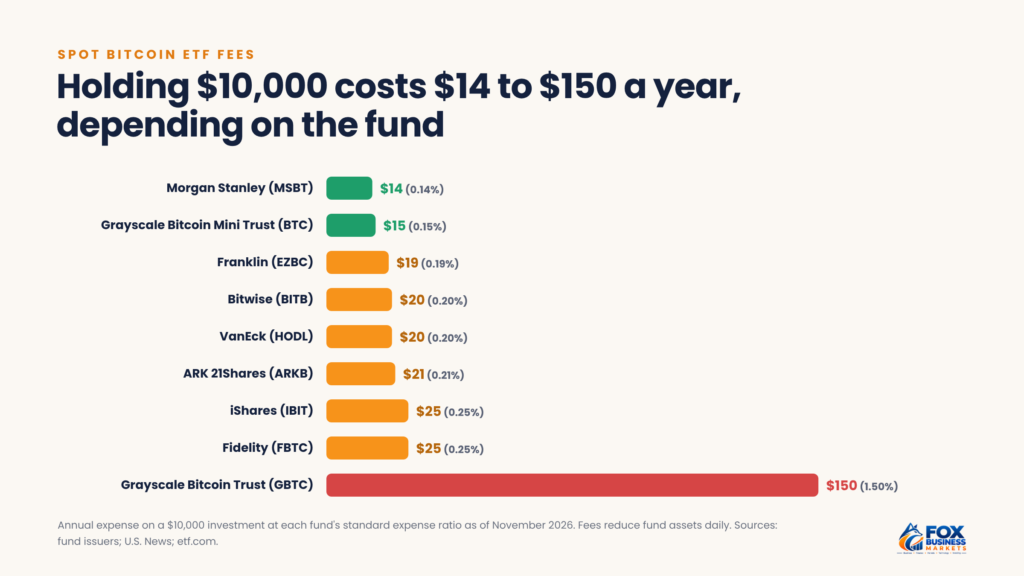
Annual cost of holding $10,000 in each spot Bitcoin ETF
Choosing the cheapest fund saves real money. On $10,000, a 0.14% expense ratio costs about $14 a year, while GBTC’s 1.50% costs about $150.
ETFs and direct ownership each have strengths:
- ETFs are simpler. No private keys to manage, familiar brokerage accounts, and standard brokerage tax forms.
- ETFs fit retirement accounts. You can hold them in an IRA, where gains can grow tax-deferred or tax-free.
- Direct ownership offers control. You can move coins to your own wallet, use them for payments, and trade around the clock.
- ETFs trade only during market hours. Crypto itself trades 24/7, so prices can move while the ETF market is closed.
Should You Buy Crypto All at Once or Over Time?
Many investors spread purchases out through dollar-cost averaging, buying a fixed dollar amount on a regular schedule. To see how that would have worked for Bitcoin, we tested buying $100 at the end of every month, with a new start date each month from December 2014, and compared it with investing the same total all at once on the first date.
Holding period | Share of periods with a gain: monthly buying | Share of periods with a gain: all at once | Worst result: monthly buying | Worst result: all at once |
| 12 months | 74% | 72% | -54% | -73% |
| 36 months | 95% | 100% | -10% | +5% |
| 60 months | 100% | 100% | +40% | +16% |
Each result measures value one month after the last purchase versus total invested. 12-month periods start December 2014 through November 2025; 36-month periods through November 2023; 60-month periods through November 2021. Uses month-end Coinbase prices; excludes fees. Source: Federal Reserve Bank of St. Louis (FRED); Fox Business Markets analysis.
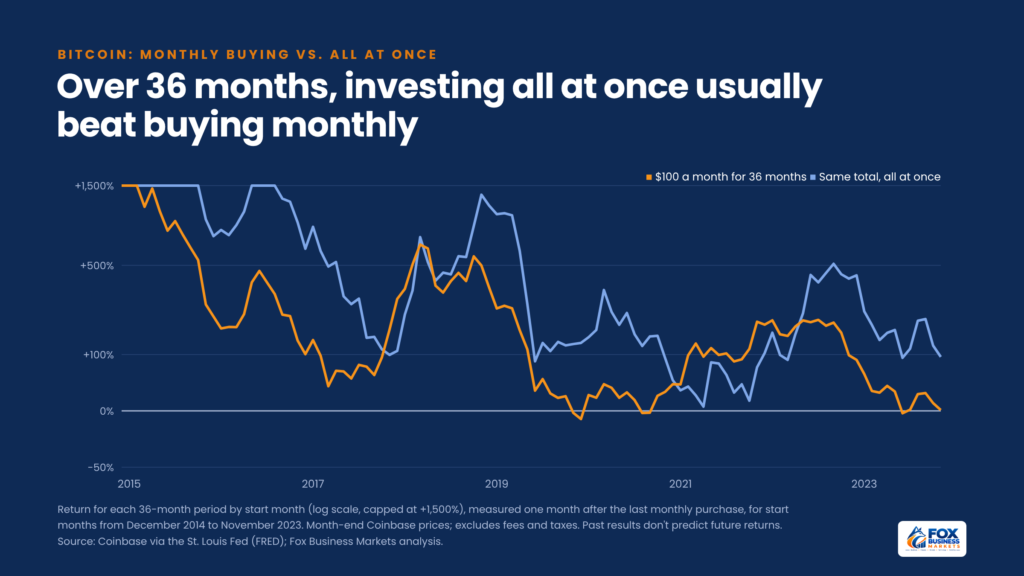
Bitcoin dollar-cost averaging versus lump-sum results over 36-month periods
The results show a clear trade-off:
- Investing all at once usually earned more. Because Bitcoin rose so much overall, putting money in early beat monthly buying in about 69% of 12-month periods and 81% of 36-month periods.
- Monthly buying softened the worst one-year outcome. Over 12 months, the worst monthly-buying result was a 54% loss, compared with a 73% loss for buying all at once at the end of December 2017, near that cycle’s peak. Over 36 months, though, the lump sum’s worst result was better.
- Longer holding periods produced better results. Every 60-month period in our test ended with a gain.
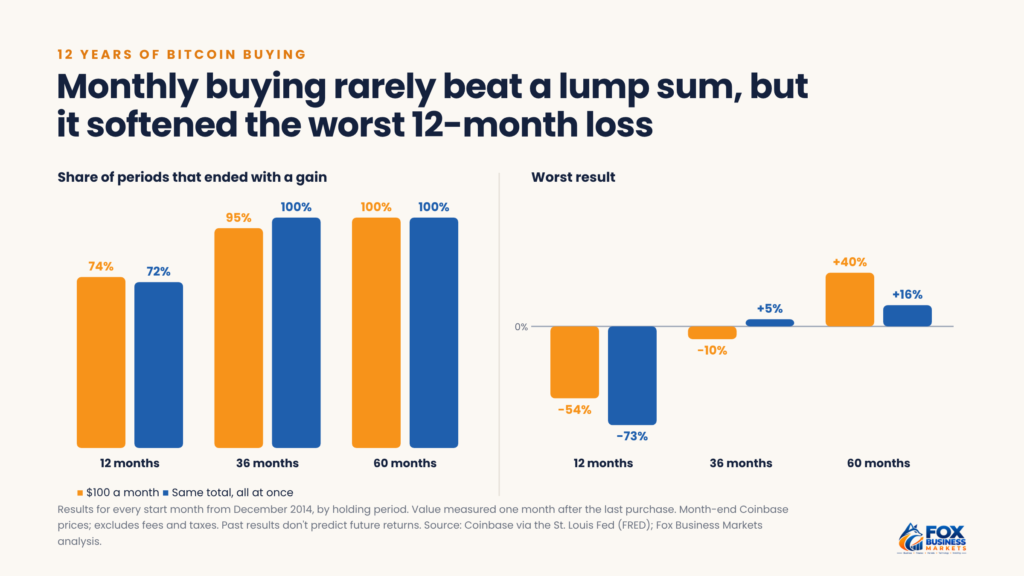
Share of profitable periods and worst outcomes for monthly versus lump-sum Bitcoin buying
Someone who bought $100 a month from January 2025 through October 2026, investing $2,200, would have had about $1,910 by Nov. 10, 2026, a loss of about 13%.
Bitcoin’s past gains were unusually large, and these results may not repeat. Our test covers one asset that survived and grew, the periods overlap so they aren’t independent results, and it ignores fees and taxes. In our test, lump-sum investing tended to win when prices rose, while regular buying reduced the damage of putting everything in at a peak. Long-term stock investors face a similar choice, which our guide to how the stock market works covers.
Where Should You Store Your Crypto After You Buy?
Once you buy, you need to decide who holds the keys:
- Leave it on the platform (custodial). Easiest for beginners. The platform secures your coins, and you can recover your account if you forget your password. The risk is that a hack, freeze, or bankruptcy can lock you out. Crypto held on a platform generally isn’t protected by Federal Deposit Insurance Corp. (FDIC) or Securities Investor Protection Corp. (SIPC) insurance.
- Use a software wallet (hot wallet). An app on your phone or computer where you hold your own keys. It’s convenient for frequent use but exposed to malware and phishing.
- Use a hardware wallet (cold storage). A small device that keeps your keys offline. Many experts consider it safer for larger amounts held long term, though losing both the device and your recovery phrase means losing the coins.
If you hold your own keys, your wallet will give you a recovery phrase, usually 12 or 24 words. Write it down and store it somewhere safe and offline. Anyone who gets it can take your coins, and if you lose it, no company can help you recover them.
How Are Crypto Purchases Taxed?
Buying crypto with dollars isn’t a taxable event. Taxes come into play when you sell, trade, or spend it:
- Selling or trading: You owe capital gains tax on any profit and can deduct a loss. Swapping one coin for another counts as a sale.
- Spending: Using crypto to buy something is also treated as selling it.
- Holding period: Crypto held more than a year qualifies for lower long-term capital gains rates. Gains on crypto held a year or less are taxed as ordinary income.
- Form 1099-DA: Brokers began reporting crypto sales to the Internal Revenue Service (IRS) on this form for transactions in 2025. Starting with crypto bought in 2026 and kept with the same broker, they must also report your cost basis.
- Wash sales: As of November 2026, the wash sale rule that applies to stocks still doesn’t apply to crypto held directly, so you can sell at a loss and buy back without losing the deduction, according to Harness. Congress has considered changing this. The rule does apply to crypto ETFs, which are securities.
Spot crypto ETFs are taxed like other ETF shares. Holding them in an IRA lets gains grow without annual tax.
How Can You Avoid Crypto Buying Scams?
Scammers frequently pressure victims into buying crypto and sending it to them. Common warning signs:
- Someone contacts you first with an investment opportunity, often after starting a friendship or romance online.
- You’re told to use a crypto ATM to pay a bill, a fine, or a “safe account.” The CFTC says government agencies and legitimate companies never ask you to move money this way.
- Guaranteed returns or pressure to act right away.
- An unfamiliar trading website or app that shows big gains but makes withdrawals difficult.
To protect yourself, buy only through well-known platforms you find yourself, never through links or contacts from strangers. If someone asks you to buy crypto and send it to them, stop and talk to someone you trust. Report suspected fraud to the FBI’s Internet Crime Complaint Center at ic3.gov.
Is It a Myth That You Need a Lot of Money to Buy Crypto?
Yes. Most platforms let you buy a fraction of a coin, often starting at a few dollars. You don’t need to buy a whole Bitcoin, which cost about $73,300 on Nov. 10, 2026, according to Coinbase data on FRED.
Small purchases do have a catch: fees take a bigger bite. A $1 fee is 0.1% of a $1,000 order but 5% of a $20 purchase. If you plan to buy small amounts regularly, look for a platform with low percentage fees, or consider a low-cost ETF.
Starting small can be a sensible way to learn how to buy crypto and how prices behave without risking much. Whatever you put in, assume it could fall sharply in value.
Frequently Asked Questions
Can you buy crypto with a credit card?
Some platforms accept credit cards, but many card issuers treat crypto purchases as cash advances. That can mean an upfront fee, a higher interest rate, and no grace period, on top of the platform’s card fee. Tip: Avoid borrowing to buy crypto, since a price drop could leave you owing more than your coins are worth.
Can you hold crypto in a 401(k)?
It depends on your plan. A few 401(k) providers offer crypto options. The Labor Department withdrew its 2022 warning about crypto in 2025, and a rule easing alternative investments in 401(k)s was under final White House review as of November 2026. Most plans still don’t include crypto. Tip: Ask your plan administrator what’s available, and consider an IRA with a spot ETF if your 401(k) doesn’t offer it.
How do you turn crypto back into cash?
Most exchanges and apps let you sell crypto for dollars and transfer the money to your linked bank account, usually within a few business days. Selling can trigger capital gains tax. Tip: Check withdrawal limits and fees before you sell, especially if you need the money by a set date.
Can you buy crypto for a child?
Minors usually can’t open their own crypto accounts. Some parents hold crypto for a child in their own name or invest through a custodial brokerage account that offers crypto ETFs. Tip: Know that assets in a custodial account legally belong to the child and pass to their control at the age your state sets, usually 18 or 21.
Start Small, Keep Costs Low, and Protect Your Keys
Buying crypto is easier than it used to be, through exchanges, apps, and ETFs. For broader context, see our fintech statistics. But costs vary widely, scams target new buyers, and prices can fall sharply after you buy.
Choose a licensed platform you find yourself, fund it with a bank transfer, compare the total cost of each purchase, and secure your account or wallet before you buy more. Keep crypto to an amount you can afford to lose.
This article is for general information only and isn’t financial, tax, legal, or investment advice. Consider your own situation or talk to a qualified professional before making decisions.

