Quick answer: Stablecoins are cryptocurrencies designed to hold a steady value, usually $1, by keeping reserves of cash, Treasury bills, or other assets. Tether (USDT) and USD Coin (USDC) make up about 85% to 87% of the market, depending on the data provider. U.S. federal rules under the GENIUS Act take effect on Jan. 18, 2027.
Stablecoins were worth about $290 billion on Nov. 10, 2026, according to StablecoinBeat. That’s more than 10 times their size at the end of 2020, when the market was worth about $27 billion, based on DefiLlama data.
Growth has reversed this year, though. Total supply hit a record of roughly $316 billion to $322 billion in May and June 2026, depending on the data provider, then fell by more than $25 billion as Tether shrank, crypto prices dropped, and new rules in Europe and the U.S. reshaped who can issue the tokens. The two biggest issuers still hold well over $100 billion in U.S. Treasury bills, which makes them some of the largest holders of short-term government debt in the world.
This guide explains what stablecoins are, how they keep their value, what backs the biggest ones, what the Guiding and Establishing National Innovation for U.S. Stablecoins (GENIUS) Act requires, whether you can earn interest on them, how they’ve failed before, and how to use them safely.
What Are Stablecoins?
A stablecoin is a digital token that runs on a blockchain, like Bitcoin or Ether, but is built to keep a fixed price. Most track the U.S. dollar at a 1-to-1 rate, so one token aims to be worth $1 at all times.
That stability makes stablecoins useful in ways other cryptocurrencies aren’t:
- Trading: Crypto traders park money in stablecoins between trades without cashing out to a bank.
- Payments: Stablecoins move between digital wallets around the clock, often settling in seconds.
- Cross-border transfers: People and businesses send dollars abroad without waiting for bank wires.
- Dollar access: In countries with high inflation or currency controls, stablecoins offer a way to hold digital dollars.
Unlike Bitcoin, a stablecoin isn’t meant to rise in value. If you’re new to crypto, our guide to what cryptocurrency is covers how blockchains and wallets work.
How Do Stablecoins Keep Their Value?
Stablecoins use different methods to hold their peg, and the method determines how much risk you take on:
Type | How it works | Examples | Main risk |
| Fiat-backed | Issuer holds cash, Treasury bills, and similar assets equal to the tokens outstanding | USDT, USDC | Issuer, bank, or reserve problems |
| Crypto-backed | Users lock up more crypto than the stablecoins they borrow | DAI, USDS | Sharp crypto price drops |
| Synthetic | Holds crypto and offsetting short futures positions to stay neutral | Ethena USDe | Funding rates turning negative, exchange failures |
| Algorithmic | Uses code and a second token to expand or shrink supply, with little or no reserve | TerraUSD (failed) | Collapse when confidence breaks |
Fiat-backed stablecoins dominate. The issuer creates new tokens when customers deposit dollars and destroys them when customers redeem. Large trading firms that can create or redeem tokens directly with the issuer keep the market price near $1. If a token trades at $0.99, they can buy it and redeem it for $1, profiting from the gap and pushing the price back up.
Most individual investors can’t redeem directly with Tether or Circle, though. They buy and sell on exchanges, so they rely on those large firms to keep prices in line.
How Big Is the Stablecoin Market?
The stablecoin market grew quickly in 2021, shrank during the 2022 crypto crash and into 2023, and then grew to new records in 2024 and 2025.
Date | Total stablecoin market value |
| End of 2020 | About $27 billion |
| End of 2021 | About $163 billion |
| End of 2022 | About $138 billion |
| End of 2023 | About $130 billion |
| End of 2024 | About $206 billion |
| End of 2025 | About $308 billion |
| June 12, 2026 | About $316 billion |
| Nov. 10, 2026 | About $290 billion |
Sources: DefiLlama data reported by Transak; StablecoinBeat.
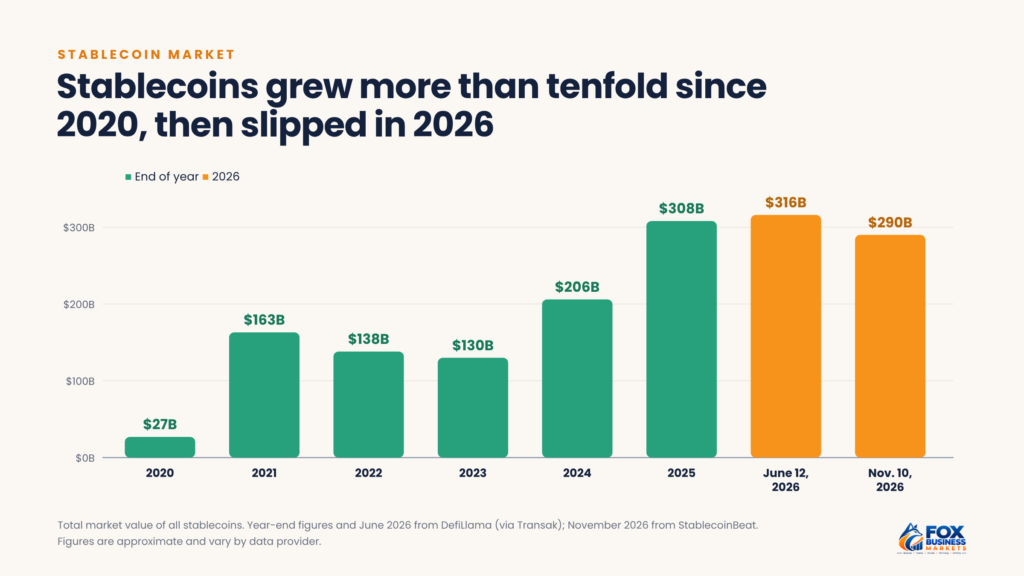
Total stablecoin market value from 2020 to November 2026
Two coins control most of the market. On Nov. 10, 2026, Tether held about 62.5% and USDC about 24.7% of the $282.8 billion market tracked by Stablecoin.com.
Stablecoin | Issuer | Market value | Share |
| Tether (USDT) | Tether | $176.9 billion | 62.5% |
| USD Coin (USDC) | Circle | $69.8 billion | 24.7% |
| USDS | Sky (formerly MakerDAO) | $8.5 billion | 3.0% |
| Ethena USDe | Ethena Labs | $4.9 billion | 1.7% |
| Dai (DAI) | Sky (formerly MakerDAO) | $4.5 billion | 1.6% |
Source: Stablecoin.com, Nov. 10, 2026. Figures vary slightly by data provider.
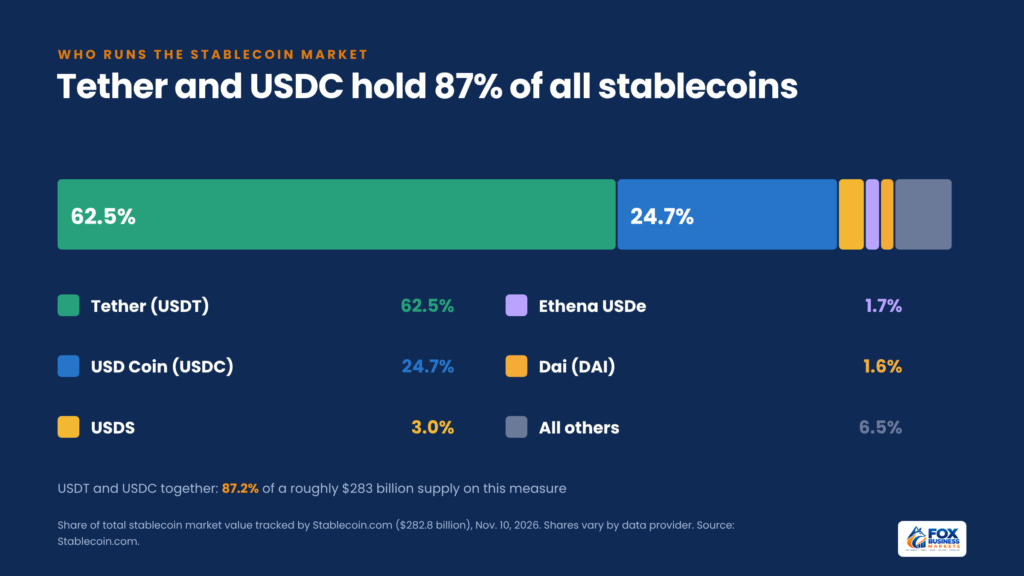
Stablecoin market share by coin, November 2026
Tether accounts for much of the 2026 slowdown. Its supply fell from about $190 billion in May to about $184 billion by midyear, as MiCA’s transition period ended on July 1 and USDT lost its remaining foothold on licensed EU exchanges, which had begun delisting it in late 2024. Supply held near that level through September, then dropped to about $177 billion by early November.
What Backs Tether and USDC?
The two largest stablecoins hold their reserves in different ways.
Tether publishes quarterly reports from accounting firm BDO. As of Sept. 30, 2026, it reported $191.45 billion in assets against $183.50 billion in liabilities, leaving a cushion of about $7.95 billion. It reported $1.5 billion in net operating profit for the third quarter, according to Bitcoin.com News. These reports are attestations, which check the numbers at a single point in time, not full audits.
We broke down Tether’s reported reserves by asset type:
Asset | Amount | Share of reserves |
| U.S. Treasury bills | $122.8 billion | 64% |
| Other cash and cash equivalents, including repurchase agreements | $16.7 billion | 9% |
| Gold and other precious metals | $19.1 billion | 10% |
| Bitcoin | $8.4 billion | 4% |
| Loans, investments, and other assets | $24.4 billion | 13% |
Source: Tether third-quarter 2026 attestation via Bitcoin.com News; Fox Business Markets analysis. “Loans, investments, and other assets” is the remainder after the listed categories.
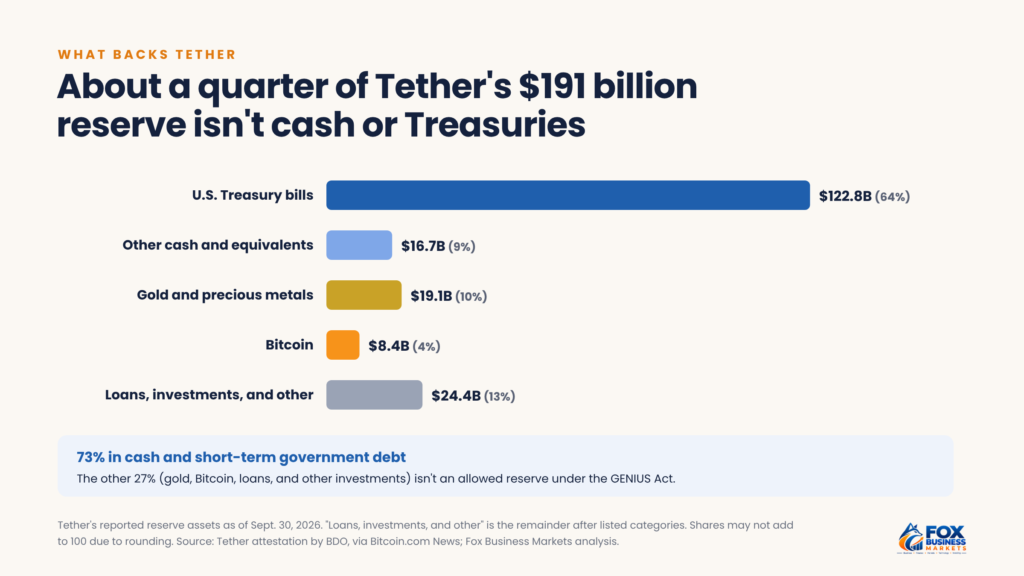
Breakdown of Tether’s reserves by asset type, Sept. 30, 2026
About 73% of Tether’s reserves sit in cash and short-term government debt. The other 27%, including gold, Bitcoin, and loans, could lose value in a market slump. The GENIUS Act doesn’t allow those assets as reserves for U.S.-regulated stablecoins.
Circle, the company behind USDC, is publicly traded and reports quarterly earnings. It had $73.9 billion of USDC in circulation at the end of the third quarter of 2026 (about $69.8 billion by Nov. 10) and earned $658 million in reserve income that quarter, according to The Block. Circle keeps USDC reserves in cash at banks and in a government money market fund managed by BlackRock, which holds short-term Treasuries and repurchase agreements.
What Does the GENIUS Act Require?
The GENIUS Act, signed on July 18, 2025, created the first federal rules for payment stablecoins. It takes effect on Jan. 18, 2027, 18 months after enactment. Key requirements include:
- One-to-one reserves: Issuers must back each token with cash, bank deposits, short-term Treasury bills, Treasury-backed repurchase agreements, or money market funds holding those assets.
- Monthly disclosure: Issuers must publish their reserve makeup each month, examined by a registered public accounting firm, with executives certifying the reports.
- Licensed issuers only: Only approved issuers, such as bank subsidiaries, federally approved nonbanks, and qualifying state-regulated firms, can issue payment stablecoins in the U.S.
- No interest from issuers: Issuers can’t pay holders interest or yield just for holding the token.
- Holder priority: If an issuer fails, stablecoin holders get first claim on reserves.
- No government backing: Issuers can’t say their tokens are insured or backed by the U.S. government.
The Office of the Comptroller of the Currency (OCC), which oversees national banks, issued the first final rule to carry out the law on Oct. 21, 2026. Other regulators, including the Treasury Department, are still working on their rules.
Foreign issuers such as Tether face a separate path. To serve U.S. users, a foreign issuer’s home country must have rules that the Treasury Department deems comparable, and the issuer must also register with the OCC and hold enough reserves at U.S. financial institutions to meet U.S. redemptions. Tether instead launched a separate U.S. stablecoin, USAT, in January 2026, issued through Anchorage Digital Bank to meet the new rules.
How Do Stablecoin Issuers Make Money?
Fiat-backed issuers run a simple business. Customers hand over dollars, the issuer puts those dollars into Treasury bills and bank deposits, and the issuer keeps the interest. When short-term interest rates rise, issuer profits rise with them, and when rates fall, profits shrink.
Circle’s results show how sensitive the model is to rates. Its reserve income fell 8% from a year earlier in the third quarter of 2026, to $658 million, even though average USDC in circulation rose 8%, because the return on its reserves dropped by 0.61 percentage point. Circle also shares a large part of its reserve income with partners that distribute USDC; its distribution, transaction, and other costs were $412 million in the quarter.
Some issuers earn extra fees for creating or redeeming tokens, and Tether also profits from its gold and Bitcoin holdings when those prices rise. Token holders get none of this income. Their tokens stay at $1 while the issuer keeps the yield.
How Are Stablecoins Regulated Outside the U.S.?
Other major economies have moved faster than the U.S. on stablecoin rules:
- European Union: MiCA’s stablecoin rules began applying in mid-2024. Issuers need a license from an EU regulator and must hold much of their reserves in European bank deposits. USDC is licensed in the EU through Circle’s French subsidiary, while major EU exchanges have delisted USDT for European users.
- Hong Kong: A licensing system for issuers of stablecoins tied to fiat currencies took effect in August 2025.
- Other markets: Singapore, Japan, and the United Kingdom have adopted or proposed their own rules for stablecoin issuers and reserves.
Rules differ on what reserves are allowed, where they must be held, and whether issuers can pay interest. A stablecoin that’s legal in one country may not be available on exchanges in another.
Can You Earn Interest on Stablecoins?
Not from the issuer. The GENIUS Act bans issuers from paying yield just for holding a stablecoin. But some crypto exchanges and apps pay “rewards” on stablecoin balances, often funded by payments they receive from issuers.
Whether those rewards can continue is still being debated in Congress. Banks argue that stablecoin rewards could pull deposits away from community banks. Crypto firms say rewards help consumers and competition. A broader crypto market structure bill, the Digital Asset Market Clarity (CLARITY) Act, included limits on rewards for idle balances, but a Senate vote to advance it failed 49 to 50 on Sept. 15, 2026, according to American Banker.
Other ways to earn on stablecoins carry more risk:
- Crypto lending platforms: You lend stablecoins to borrowers. Several such platforms froze withdrawals and went bankrupt in 2022.
- Decentralized finance (DeFi): You deposit stablecoins into lending protocols run by code. Rates change constantly, and bugs or hacks can wipe out deposits.
- Yield-bearing tokens: Some tokens pass through Treasury interest or trading profits, but they aren’t payment stablecoins and may carry extra risks.
A high-yield savings account at a bank or credit union offers interest with Federal Deposit Insurance Corp. (FDIC) or National Credit Union Administration (NCUA) insurance. For money you can’t afford to lose, that’s usually the safer choice.
What Are Stablecoins Used For?
Most stablecoin activity still connects to crypto trading, but payments are growing. Circle said USDC handled $13.9 trillion in onchain transactions in the third quarter of 2026, up 49% from a year earlier. Much of that volume involves automated trading and transfers between platforms, not purchases.
Common uses include:
- Moving money between exchanges: Traders shift funds quickly without bank delays.
- Sending money abroad: Workers can send stablecoins to family overseas, often faster than a wire. The recipient still needs a way to convert them into local currency.
- Business payments: Some companies use stablecoins to pay suppliers and contractors in other countries.
- Saving in dollars: People in countries with weak currencies use stablecoins to hold value in dollars.
- Card payments: Some payment networks now settle certain transactions in stablecoins behind the scenes.
Payment companies are adding stablecoin features alongside traditional rails. Our guides to payment processing and fintech explain how these systems fit together.
When Have Stablecoins Lost Their Peg?
Stablecoins are designed to stay at $1, but several have failed to do so:
- TerraUSD (UST), May 2022: This algorithmic stablecoin, worth about $18 billion at its peak, collapsed within days when holders rushed to sell. Its sister token, Luna, became nearly worthless, and the crash helped trigger a wider crypto meltdown.
- USD Coin (USDC), March 2023: When Silicon Valley Bank failed, Circle disclosed that $3.3 billion of USDC reserves were stuck there. USDC fell to about 87 cents before recovering once regulators said all bank deposits would be protected.
- Smaller tokens: Many smaller stablecoins have traded below $1 during market stress or after hacks.
Even fiat-backed stablecoins can wobble if investors doubt the reserves or can’t redeem quickly. The GENIUS Act’s reserve and disclosure rules aim to lower that risk, but they can’t remove it entirely.
Is It a Myth That Every Stablecoin Is Always Worth $1?
Yes. A stablecoin’s $1 value is a goal, not a guarantee. Its price depends on the quality of its reserves, the issuer’s ability to process redemptions, and market confidence.
Most of the time, major stablecoins trade within a cent of $1. But under stress, prices can slip, and holders who can’t redeem directly with the issuer may have to sell at a loss on an exchange. TerraUSD’s 2022 collapse and USDC’s brief drop to about 87 cents in 2023 show how fast that can happen.
The type of stablecoin makes the biggest difference. A token backed by cash and Treasury bills held at regulated firms carries different risks from one backed by crypto or trading strategies. Read how a stablecoin works before treating it like cash.
What Are the Risks of Stablecoins?
Stablecoins carry risks that bank deposits don’t:
- No deposit insurance: Stablecoins aren’t covered by FDIC or NCUA insurance, even if a bank holds the reserves.
- Issuer risk: If an issuer mismanages reserves or fails, holders could face delays or losses.
- Exchange and wallet risk: If the exchange holding your stablecoins fails or is hacked, you could lose access.
- Freezes: Major issuers can freeze tokens in specific wallets, usually at the request of law enforcement.
- Network risk: Sending tokens on the wrong blockchain or to the wrong address can mean losing them for good.
- Scams: Fraudsters often ask victims to pay in stablecoins because transfers are fast and hard to reverse.
- Regulatory change: New rules could change which stablecoins are available or how platforms can pay rewards.
How Can You Use Stablecoins Safely?
If you decide to use stablecoins, a few steps lower the risk:
- Pick a major, transparent stablecoin. Look for regular reserve reports and, after January 2027, a U.S.-licensed issuer.
- Use a well-known, regulated platform. Our guide to how to buy crypto covers choosing an exchange.
- Double-check networks and addresses. Send a small test amount first, and confirm the receiving platform supports the same blockchain.
- Keep balances modest. Treat stablecoins as a tool for moving money, not a place for your emergency fund.
- Understand any rewards. Ask who pays them, how they’re funded, and whether you can withdraw at any time.
- Watch for scams. No legitimate government agency or business will demand payment only in stablecoins.
- Keep records. Track purchases, sales, and transfers in one place.
If you want long-term crypto exposure rather than a digital dollar, a Bitcoin exchange-traded fund (ETF) offers another route through a regular brokerage account.
Frequently Asked Questions
Do you owe taxes when you use stablecoins?
Possibly. The Internal Revenue Service (IRS) treats stablecoins as property, so selling, swapping, or spending them is a taxable event. Because prices usually stay near $1, gains or losses are often tiny, but they still need to be reported. Tip: Keep a record of each transaction, since your exchange’s tax form may not capture transfers between wallets.
Do stablecoin transfers have fees?
Usually, yes. Most transfers require a small network fee paid in the blockchain’s own token, such as Ether on Ethereum, and exchanges may add their own withdrawal fees. Costs range from fractions of a cent on some networks to several dollars on busier ones. Tip: Keep a small amount of the network’s native token in your wallet so you can cover transfer fees.
Is a stablecoin the same as a central bank digital currency?
No. A stablecoin is issued by a private company. A central bank digital currency (CBDC) would be issued directly by a central bank, such as the Federal Reserve. A January 2025 executive order barred federal agencies from working to create a U.S. CBDC. Tip: If someone offers you a “digital dollar from the government,” treat it as a likely scam.
Can you exchange stablecoins for cash at a bank?
Usually not directly. Most people sell stablecoins on an exchange or app and then withdraw the dollars to a linked bank account, which can take one to several business days. Tip: Check withdrawal fees and limits before you need the money, especially for large amounts.
Treat Stablecoins as Digital Cash, Not Savings
Stablecoins have become a $290 billion market and a core part of how money moves in crypto. Federal rules taking effect in January 2027 should make the largest U.S. stablecoins more transparent and more tightly backed.
But they’re not bank deposits. Use them for what they do well, such as moving money quickly, hold only what you need, choose major tokens with clear reserves, and keep your savings somewhere insured.
This article is for general information only and isn’t financial, tax, legal, or investment advice. Consider your own situation or talk to a qualified professional before making decisions.

