
Quick answer: Cryptocurrency is a digital asset that runs on a blockchain, a shared public ledger kept by computers around the world instead of a bank. Bitcoin, Ethereum, and stablecoins are the best-known types. Crypto can be bought through exchanges, apps, and exchange-traded funds (ETFs), but prices swing sharply, and scams are common.
Bitcoin hit a record $124,720 on Oct. 5, 2025, according to Coinbase prices tracked by the St. Louis Fed. Nearly nine months later, on June 30, 2026, it closed at $58,586, a drop of 53%. It closed near $73,300 on Nov. 10, 2026.
Even with those swings, crypto has moved into the mainstream. About 10% of U.S. adults used or held crypto in 2025, up from 8% in 2024 but below the 2021 peak of 12%, according to the Federal Reserve’s 2026 household survey. At the same time, Americans reported a record $11.4 billion in crypto-related fraud losses to the Federal Bureau of Investigation (FBI) in 2025.
This guide explains what cryptocurrency is, how blockchains work, the main types of crypto, how Bitcoin’s price has behaved, how crypto is bought, stored, regulated, and taxed in the U.S., and the risks to weigh before you put any money in.
What Is Cryptocurrency?
Cryptocurrency is a digital asset that uses cryptography and a shared ledger to record who owns what, without a central authority such as a bank or government. People can send it directly to one another over the internet, at any hour, across borders.
Most cryptocurrencies share a few features:
- Decentralized records: Ownership is tracked on a blockchain that thousands of computers maintain and check.
- Digital ownership: You control crypto through a private key, a long secret code. Whoever holds the key can move the coins.
- Limited or set supply: Many cryptocurrencies follow fixed rules for how many coins exist. Bitcoin, for example, is capped at 21 million coins.
- No government backing: Crypto isn’t legal tender in the U.S. and isn’t backed by a central bank, so its value depends on what buyers will pay.
Bitcoin, launched in 2009 by a person or group using the name Satoshi Nakamoto, was the first cryptocurrency. Thousands have followed. Crypto is one part of the broader shift in financial technology covered in our guide to what fintech is.
How Does Blockchain Work?
A blockchain is a record of transactions grouped into blocks, with each block linked to the one before it. Once a block is added, changing it would mean redoing all the blocks that follow, which is designed to be practically impossible on a large network.
The basic process works like this:
- You send a transaction. Your wallet signs it with your private key, proving you own the coins.
- The network checks it. Computers on the network confirm you have the funds and haven’t already spent them.
- The transaction joins a block. Pending transactions are bundled into a new block.
- The network agrees on the block. A consensus method decides which block gets added next.
- The ledger updates everywhere. Every copy of the blockchain adds the new block, and the transfer is complete.
The two main consensus methods are:
- Proof of work: Used by Bitcoin. Computers called miners compete to solve math puzzles, and the winner adds the next block and earns new coins plus fees. It has proven hard to attack on large networks but uses a lot of electricity.
- Proof of stake: Used by Ethereum since 2022. Validators lock up, or “stake,” their own coins as collateral for the right to add blocks. Those who cheat can lose part of their stake. It uses far less energy.
Bitcoin’s mining reward is cut in half about every four years in an event called the halving. The most recent halving, in April 2024, cut the reward to 3.125 bitcoins per block.
What Are the Main Types of Cryptocurrency?
Cryptocurrencies fall into a few broad groups:
| Type | What it is | Examples |
| Bitcoin | The first and largest cryptocurrency, designed as digital money with a fixed supply | Bitcoin (BTC) |
| Smart contract platforms | Blockchains that run programs, letting developers build apps, tokens, and financial services | Ethereum (ETH), Solana (SOL), Cardano (ADA) |
| Stablecoins | Tokens designed to hold a steady value, usually $1, usually backed by cash and short-term government debt, though reserves and transparency vary | Tether (USDT), USD Coin (USDC) |
| Altcoins and memecoins | Other coins, from serious projects to jokes driven by social media | Dogecoin (DOGE), many others |
| Tokens | Assets issued on another blockchain, used for apps, voting, or representing real-world assets | Tokens on Ethereum and other networks |
Bitcoin is still the largest cryptocurrency by far. It made up about 60% of the total crypto market, which was worth about $2.54 trillion on Nov. 8, 2026, according to a DailyForex market overview. Stablecoins totaled about $292 billion.
Ethereum, the second-largest cryptocurrency, works differently. It lets developers build applications that run without a central company, which made it the base for much of decentralized finance (DeFi). Our comparison of Ethereum and Cardano explains how two smart contract platforms differ.
How Has Bitcoin’s Price Changed Over Time?
Bitcoin’s price has risen sharply over the long term, with deep drops along the way. Its price on Coinbase rose from about $370 in December 2014 to about $73,300 in November 2026, roughly a 200-fold increase.
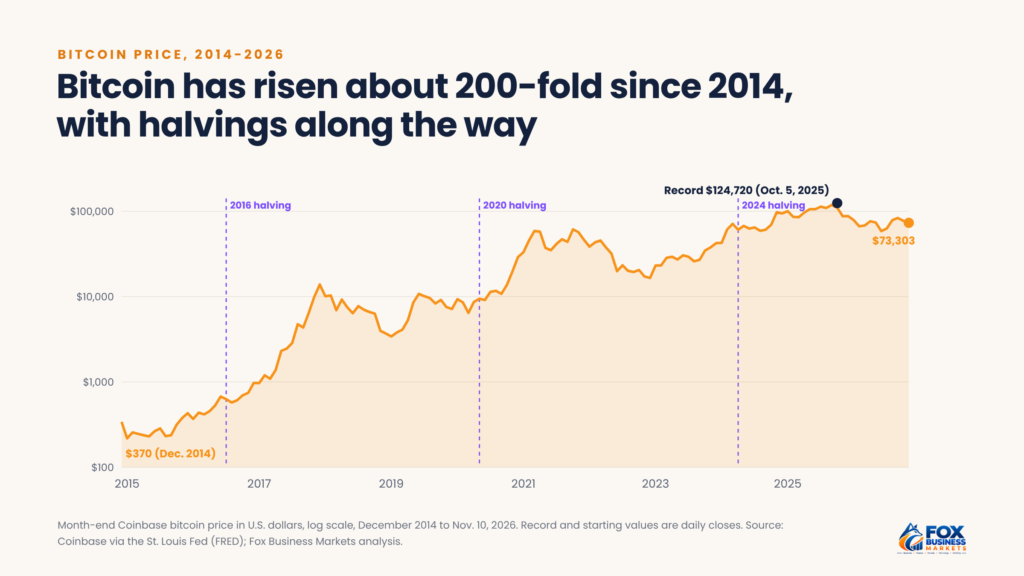
Bitcoin price on a log scale from 2014 to 2026 with halving dates
Year by year, the path has been anything but smooth:
| Year | Bitcoin price change |
| 2015 | +27% |
| 2016 | +126% |
| 2017 | +1,324% |
| 2018 | -73% |
| 2019 | +94% |
| 2020 | +306% |
| 2021 | +59% |
| 2022 | -64% |
| 2023 | +156% |
| 2024 | +123% |
| 2025 | -7% |
| 2026 (through Nov. 10) | -16% |
Change in the last Coinbase price of each year. Source: Federal Reserve Bank of St. Louis (FRED); Fox Business Markets analysis.
Many investors link Bitcoin’s big rallies to its halvings, which cut the supply of new coins. Halvings in 2016, 2020, and 2024 were each followed by large gains within about 18 months. But that pattern rests on only a few cycles, and other forces, such as interest rates, ETF demand, and investor sentiment, also drive prices.
How Deep Have Crypto Crashes Been?
Bitcoin has repeatedly lost more than half its value. Based on daily Coinbase prices since December 2014, its major declines from a peak to a low were:
| Peak | Low | Decline |
| $19,650 (Dec. 16, 2017) | $3,183 (Dec. 15, 2018) | -84% |
| $63,661 (April 13, 2021) | $29,789 (July 20, 2021) | -53% |
| $67,510 (Nov. 8, 2021) | $15,756 (Nov. 21, 2022) | -77% |
| $124,720 (Oct. 5, 2025) | $58,586 (June 30, 2026) | -53% |
Daily closing prices on Coinbase. Source: FRED; Fox Business Markets analysis.
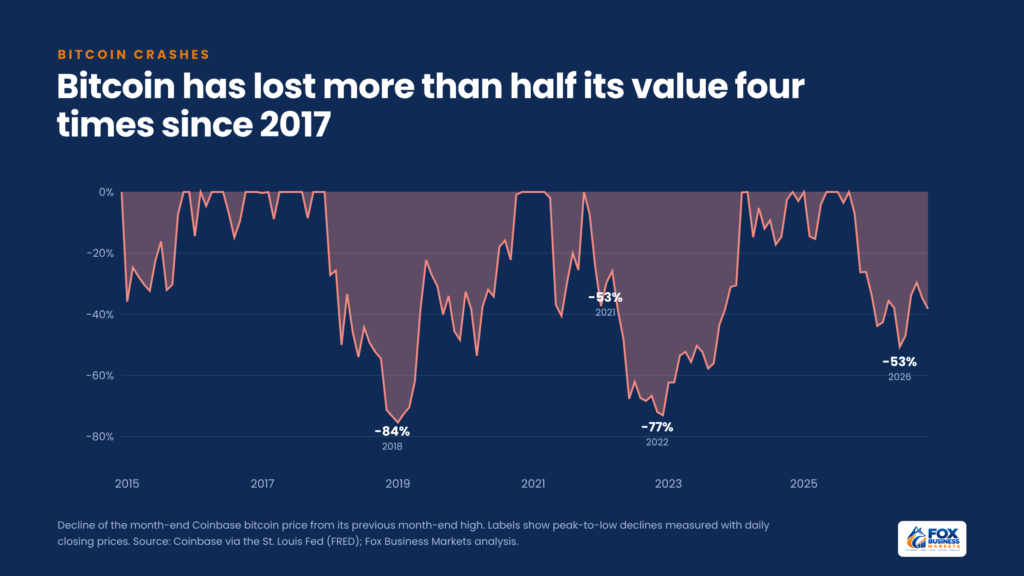
Bitcoin drawdowns from its previous peak, 2014 to 2026
The first three crashes eventually reversed, but recovery took more than two years after the 2017 and 2021 peaks. The latest hasn’t: as of Nov. 10, 2026, Bitcoin was still about 41% below its October 2025 record.
The 2022 crash also brought down major companies. The collapse of the FTX exchange in November 2022 left customers unable to withdraw billions of dollars, and its founder was later convicted of fraud.
How Volatile Is Crypto Compared With Stocks?
Bitcoin is far more volatile than the stock market. Using trading days when both markets were open, we compared daily price swings for Bitcoin and the S&P 500:
| Period ending Nov. 10, 2026 | Bitcoin volatility | S&P 500 volatility |
| Past 12 months | 41.7% | 13.7% |
| Past 5 years | 51.3% | 17.1% |
Annualized standard deviation of daily changes. Sources: FRED (Coinbase Bitcoin and S&P 500 data); Fox Business Markets analysis.
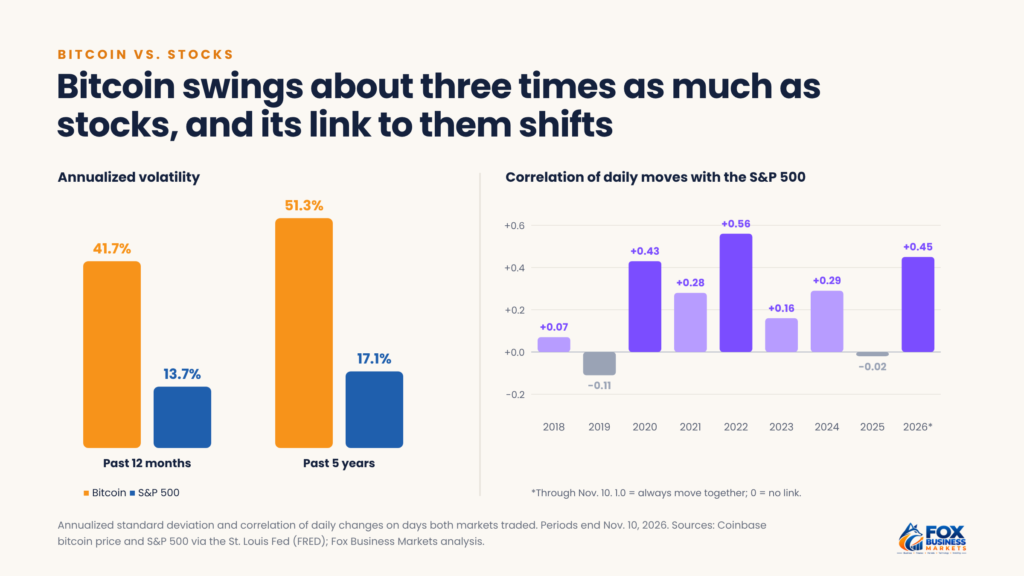
Bitcoin versus S&P 500 volatility and their correlation by year
Bitcoin has been roughly three times as volatile as stocks. Its link to the stock market also changes over time. The correlation between their daily moves was near zero or slightly negative in 2018, 2019, and 2025, but rose to 0.56 in 2022, when both fell as interest rates climbed, and to 0.45 so far in 2026. In other words, Bitcoin hasn’t reliably protected investors when stocks fall.
Our figures use one exchange’s once-daily prices, which can differ from other exchanges and from intraday highs and lows, and they cover only days when both markets traded. Past patterns don’t predict future returns.
What Is Decentralized Finance (DeFi)?
Decentralized finance, or DeFi, refers to financial services built on blockchains, mostly Ethereum and similar networks, that run through code instead of banks or brokers. These programs, called smart contracts, carry out transactions automatically when set conditions are met.
Common DeFi services include:
- Decentralized exchanges: Users trade tokens directly from their own wallets, with prices set by pools of tokens rather than a company’s order book.
- Lending and borrowing: Users deposit crypto to earn interest or post crypto as collateral to borrow other tokens.
- Stablecoin payments: Dollar-backed stablecoins move between wallets and apps around the clock, often for a few cents or less on some networks.
- Staking: Holders of proof-of-stake coins lock them up to help secure the network and earn rewards.
DeFi can offer access and speed that traditional finance doesn’t, but it carries extra risks. Bugs in smart contracts have led to large thefts, many projects have little or no oversight, and loans backed by crypto can be liquidated automatically when prices fall. Unlike banks, DeFi platforms usually have no customer service desk that can reverse a mistake. Anyone exploring DeFi should start with small amounts and well-established platforms.
Crypto also differs sharply from other markets people trade. Currencies, for example, are backed by governments and trade in a far larger market, as our guide to forex trading explains.
How Do People Buy, Store, and Use Crypto?
Americans can get crypto exposure in several ways:
- Crypto exchanges: Platforms such as Coinbase and Kraken let you buy, sell, and hold many coins.
- Brokerage and payment apps: Apps such as Robinhood, PayPal, and Cash App offer crypto alongside other services.
- Exchange-traded funds (ETFs): Spot Bitcoin ETFs began trading in January 2024, and spot Ethereum ETFs followed in July 2024. They let you hold crypto exposure in a regular brokerage or retirement account.
Once you own crypto, you need somewhere to keep it:
- Custodial wallets: The exchange or app holds your keys. It’s convenient, but you depend on the company’s security and solvency.
- Hot wallets: Software wallets on your phone or computer where you hold your own keys. They’re connected to the internet, which makes them easier to hack.
- Cold wallets: Hardware devices or offline storage that keep keys away from the internet. They’re safer for larger amounts, but if you lose the device and backup phrase, the coins are gone for good.
Most Americans use crypto as an investment rather than as money. In the Fed’s survey, about 9% of adults held crypto as an investment in 2025, while about 2% used it to buy something. For more data, see our fintech statistics.
How Is Crypto Regulated in the U.S.?
U.S. crypto rules are still being written. Key pieces in place as of November 2026:
- Stablecoins: The GENIUS Act, signed in July 2025, created the first federal rules for payment stablecoins, requiring them to be backed one-for-one by cash, short-term Treasury securities, and similar liquid assets. Regulators missed the law’s July 2026 deadline for final rules, according to The Block. The Office of the Comptroller of the Currency issued the first final rule in October 2026, taking effect in January 2027.
- Securities and commodities: The Securities and Exchange Commission (SEC) oversees crypto that counts as a security, while the Commodity Futures Trading Commission (CFTC) oversees Bitcoin futures and fraud in commodity markets.
- Market structure: The CLARITY Act, which would divide oversight between the SEC and CFTC, passed the House in July 2025. On Sept. 15, 2026, it failed a Senate cloture (procedural) vote, 49 to 50, short of the 60 votes needed, according to FinTech Weekly. Its future is uncertain.
- ETFs: The SEC has approved spot ETFs for Bitcoin, Ethereum, and other crypto assets.
Exchanges serving U.S. customers must generally verify users’ identities and follow anti-money-laundering rules. But crypto accounts don’t carry Federal Deposit Insurance Corp. (FDIC) insurance, and Securities Investor Protection Corp. (SIPC) coverage generally doesn’t apply to crypto that isn’t a registered security.
How Is Crypto Taxed?
The IRS treats cryptocurrency as property, not currency. That means:
- Selling, trading, or spending crypto can trigger a capital gain or loss, based on the difference between what you paid and what you received.
- Holding period counts. Crypto held more than a year qualifies for lower long-term capital gains rates.
- Earning crypto from work, mining, or staking generally counts as ordinary income when you receive it.
- New reporting forms: Brokers began reporting crypto sales on Form 1099-DA for transactions in 2025, starting with gross proceeds. Brokers must also report cost basis for crypto bought in 2026 or later and kept with the same broker.
Keep records of every purchase, sale, and transfer. A tax professional can help if you’ve traded often or across several platforms.
What Are the Biggest Risks of Cryptocurrency?
Crypto carries risks that go beyond normal investing:
- Price crashes: Bitcoin has fallen more than 50% four times since 2017, and smaller coins can lose nearly all their value.
- Scams: Americans reported $11.4 billion in crypto-related losses to the FBI’s Internet Crime Complaint Center (IC3) in 2025, up 22% from 2024, according to IC3 data reported by The Block. Investment fraud, often run through fake trading sites and online romance scams, accounted for $7.2 billion, and people 60 and older lost $4.4 billion.
- Crypto ATM scams: Losses through crypto kiosks reached $389 million in 2025, up 58%, according to the same FBI data.
- Hacks: Hackers stole about $3.4 billion in crypto in 2025, according to blockchain analysis firm Chainalysis, as reported by The Block. The largest single theft was about $1.5 billion from the Bybit exchange.
- Lost keys: If you lose your private key or recovery phrase, no one can restore your coins.
- Platform failures: Exchanges and lenders can freeze withdrawals or go bankrupt, as FTX and several crypto lenders did in 2022.
Scammers often contact victims first, promise guaranteed returns, or ask for payment in crypto or through a crypto ATM. Any of those is a warning sign.
Is It a Myth That Cryptocurrency Is Anonymous?
Yes, mostly. Bitcoin and most other blockchains are public. Every transaction, the amount, and the wallet addresses involved are recorded permanently for anyone to see.
Wallet addresses don’t show names, so crypto is better described as pseudonymous. But regulated exchanges collect identity information, and firms such as Chainalysis trace funds across blockchains for law enforcement. Investigators have used those tools to recover stolen funds and identify criminals.
Some privacy-focused coins and mixing services try to hide transactions, but many exchanges won’t list them, and U.S. authorities have prosecuted mixer operators. For most users, crypto is far less private than cash.
How Can You Get Started With Crypto Safely?
If you decide to invest in crypto, these steps can help limit the risks:
- Limit your exposure. Many advisers suggest keeping speculative assets like crypto to a small share of your investment portfolio, an amount you could lose without derailing your goals.
- Use a regulated platform. Choose a well-known U.S. exchange, broker, or ETF rather than an unfamiliar website or app.
- Start with established assets. Bitcoin and Ethereum have the longest track records and the most trading.
- Consider ETFs for simplicity. A spot ETF lets you hold crypto exposure in a brokerage or retirement account without managing keys.
- Secure your accounts. Use strong, unique passwords and an authenticator app for two-factor authentication.
- Store keys carefully. If you hold your own coins, keep your recovery phrase offline and private.
- Ignore unsolicited offers. Never send crypto to someone who contacted you first with an investment opportunity.
- Track your taxes. Record every transaction for your tax return.
If you’d rather build wealth with less volatility, our stock market statistics and guide to how the stock market works offer other paths. If you’d like professional help managing digital assets, see our guide to how crypto asset managers work.
Frequently Asked Questions
Do you owe taxes on crypto you receive as a gift?
Generally, no. Receiving a gift isn’t a taxable event for you. When you later sell it, you usually take over the giver’s cost basis and holding period. The giver may need to file a gift tax return if the gift exceeds the annual exclusion, which is $19,000 per recipient in 2026. Tip: Ask the giver for the purchase date and price when you receive the gift.
What happens when all bitcoins are mined?
Bitcoin’s supply is capped at 21 million coins, and the last ones are expected to be mined around the year 2140. After that, miners would earn only transaction fees for adding blocks. Tip: Don’t assume a fixed supply guarantees higher prices, since demand can fall as well as rise.
Can cryptocurrency be passed on to heirs?
Yes. Crypto is property and can be included in a will or trust. But if no one can access your private keys or exchange accounts, your heirs may not be able to recover it. Tip: Document where your crypto is held and how heirs can access it, and keep those instructions secure.
Is crypto a good hedge against inflation?
Results have been mixed. Bitcoin fell 64% in 2022, a year of high inflation, while gold was roughly flat. Its price has moved more with investor risk appetite than with inflation. Tip: Don’t rely on crypto alone to protect your savings from rising prices.
Treat Crypto as a Small, High-Risk Slice of Your Portfolio
Cryptocurrency has grown from a niche experiment into a $2.5 trillion market with ETFs, federal stablecoin rules, and millions of American users. It has also crashed by more than half several times and is widely used in scams.
If you invest, keep it to an amount you can afford to lose, use regulated platforms, guard your keys, and treat crypto as a speculative addition to a diversified plan, not the foundation of it.
This article is for general information only and isn’t financial, tax, legal, or investment advice. Consider your own situation or talk to a qualified professional before making decisions.

