Quick answer: Forex trading means buying one currency while selling another, always in pairs such as EUR/USD (euro/U.S. dollar). It’s the world’s largest market, with about $9.6 trillion traded per day. In the U.S., retail traders can use leverage of up to 50:1, but broker disclosures show most retail accounts lose money.
About $9.6 trillion changes hands in the foreign exchange market every day, according to the Bank for International Settlements (BIS). That’s up 28% from 2022 and about eight times the 2001 level.
Yet individual traders are a tiny slice of that market, and where brokers must disclose results, most retail accounts lose money. Across 49 brokers’ EU- and U.K.-regulated entities, which must publish the figure, an average of 71% of retail accounts lost money, according to a 2026 BrokerRank analysis. In the U.S., clients of all retail forex dealers combined held just $470 million in August 2026.
This guide explains how forex trading works, who the big players are, how quotes, pips, and leverage work, what moves currencies, how U.S. rules protect traders, and the risks to weigh before you open an account.
What Is Forex Trading?
Forex trading is the buying and selling of currencies to profit from changes in their value. Forex is short for “foreign exchange,” and it’s also called FX or currency trading.
Every forex trade involves two currencies at once. If you buy EUR/USD (the euro against the U.S. dollar), you’re buying euros and selling U.S. dollars at the same time. If the euro rises against the dollar, your position gains. If it falls, you lose.
The same market serves very different purposes:
- Businesses convert sales and costs between currencies, and many hedge against exchange-rate swings.
- Investors buy foreign stocks and bonds, which requires foreign currency.
- Central banks manage reserves and sometimes intervene to steady their currencies.
- Banks and hedge funds trade for clients and for profit.
- Retail traders speculate on price moves through online brokers.
Exchanging money for a trip abroad is also a foreign exchange transaction, but it’s a different activity from trading. Our guide to foreign currency exchange covers rates and fees for travelers.
How Does the Forex Market Work?
Forex has no central exchange. Unlike stocks, which trade on exchanges such as the New York Stock Exchange, currencies trade over the counter (OTC), through a global network of banks, electronic platforms, and brokers.
That structure has three practical effects:
- Trading runs around the clock. The market is open 24 hours a day, five days a week, from about 5 p.m. Eastern time on Sunday to 5 p.m. Eastern on Friday.
- Prices can differ slightly by dealer. No single official price exists, so quotes vary a little between providers.
- Your broker is often your counterparty. Many retail forex dealers take the other side of customer trades, which is one reason regulators watch them closely.
Which Trading Sessions Matter Most?
Activity follows the sun across four main trading sessions: Sydney, Tokyo, London, and New York. London is the largest center by far. The United Kingdom handled about 38% of global forex turnover in April 2025, followed by the United States at about 19%, Singapore at 11.8%, and Hong Kong at 7.0%, according to the BIS. Together, those four centers handled about three-quarters of all trading.
The busiest hours usually come when London and New York overlap, from about 8 a.m. to noon Eastern time. Spreads tend to be tightest then, and big economic releases often land in that window.
How Big Is the Forex Market?
Average daily turnover reached $9.6 trillion in April 2025, according to the BIS Triennial Central Bank Survey, which collects data from more than 1,100 banks and dealers in 52 jurisdictions every three years.
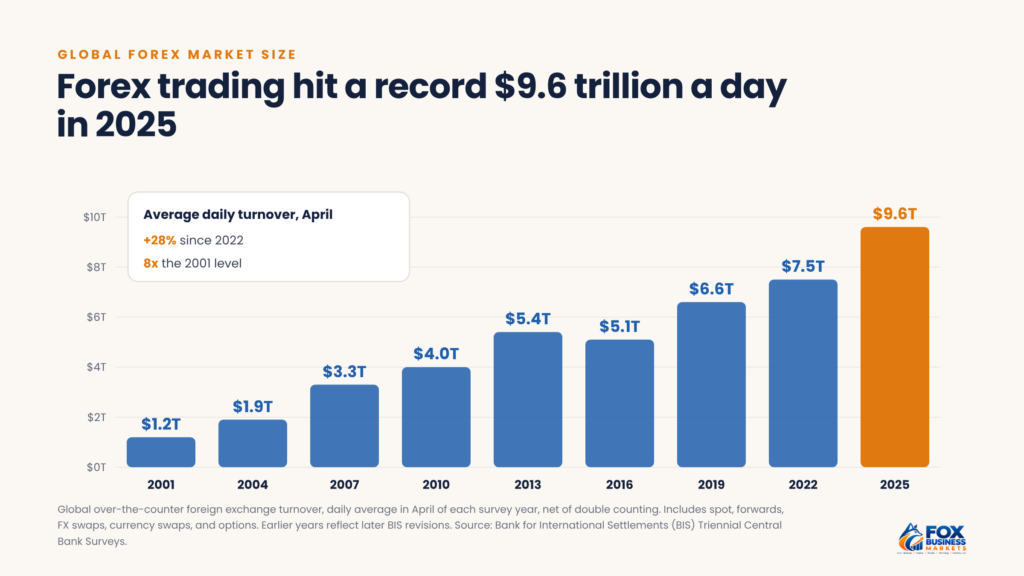
Global foreign exchange turnover per day from 2001 to 2025
Most of that volume isn’t simple currency buying. FX swaps, which large institutions use to manage short-term funding, made up about 42% of turnover in 2025. Spot trades, the kind most retail traders make, made up about 31%, or $3 trillion a day.
Who Trades Forex?
Banks dominate the market. Trading between large dealer banks made up 46% of global turnover in 2025, according to the BIS. Other financial institutions, including smaller banks, pension funds, insurers, hedge funds, and proprietary trading firms, made up another 50%. Nonfinancial companies accounted for just 5%.
Retail traders don’t appear as a separate category in the BIS data because their trades flow through brokers and banks. Their footprint is small. In the U.S., total client money at retail forex dealers stood at about $470 million in August 2026, according to Commodity Futures Trading Commission (CFTC) data reported by Finance Magnates. Six dealers reported retail forex client funds, and Gain Capital and OANDA held about 71% of the total.
Which Currencies Are Traded Most?
The U.S. dollar is on one side of about 89% of all forex trades, according to the BIS.
Currency | Share of global turnover, April 2025 |
| U.S. dollar (USD) | 89.2% |
| Euro (EUR) | 28.9% |
| Japanese yen (JPY) | 16.8% |
| British pound (GBP) | 10.2% |
| Chinese renminbi (CNY) | 8.5% |
| Swiss franc (CHF) | 6.4% |
| Australian dollar (AUD) | About 6% |
| Canadian dollar (CAD) | About 6% |
Source: BIS Triennial Central Bank Survey 2025. Shares sum to 200% because every trade involves two currencies.
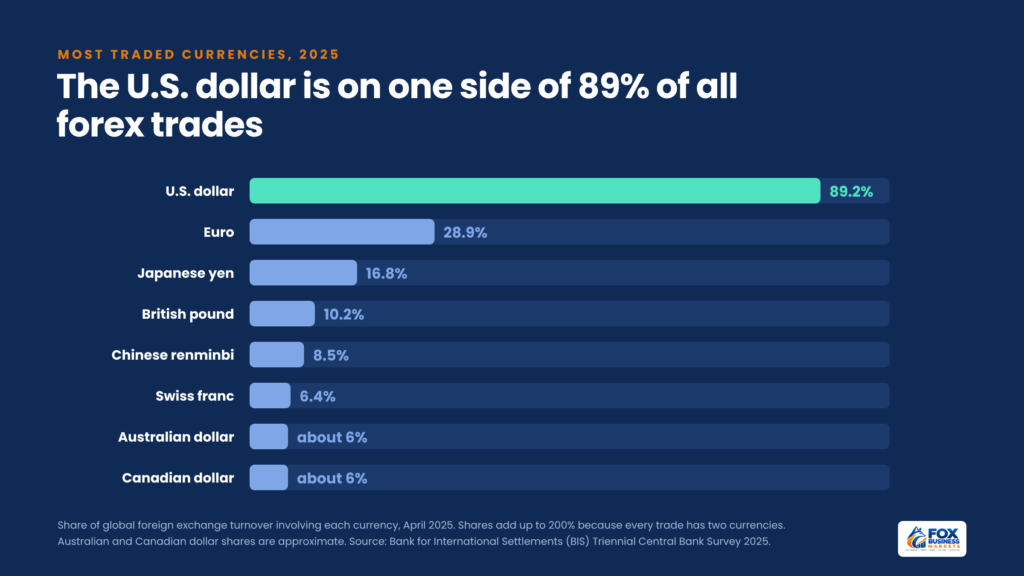
Most traded currencies by share of global forex turnover in 2025
The most traded pair is EUR/USD, at about 21% of global turnover. USD/JPY follows at about 14%, and GBP/USD at 7.6%. Among major currencies, the renminbi gained the most share: trading in USD/CNY rose 59% from 2022 to 2025, lifting the pair’s share of global turnover to 8.1%.
How Do Forex Quotes, Pips, and Lots Work?
A forex quote shows how much of the second currency you need to buy one unit of the first.
- Base currency: the first currency in the pair. In EUR/USD, it’s the euro.
- Quote currency: the second currency. In EUR/USD, it’s the dollar.
- Example: EUR/USD at 1.1160 means 1 euro costs $1.116.
Each quote has two prices. The bid is what a dealer will pay you, and the ask is what you pay. The gap between them, called the spread, is a main cost of trading.
Price moves are measured in pips. For most pairs, a pip is 0.0001, the fourth decimal place. For pairs involving the Japanese yen, a pip is 0.01. If EUR/USD rises from 1.1160 to 1.1185, it has gained 25 pips.
Trade sizes are measured in lots:
Lot type | Units of base currency | Value of 1 pip on EUR/USD |
| Standard lot | 100,000 | $10 |
| Mini lot | 10,000 | $1 |
| Micro lot | 1,000 | 10 cents |
So a 25-pip move on one standard lot of EUR/USD gains or loses about $250.
What Is Leverage in Forex?
Leverage lets you control a large position with a small deposit, called margin. With 50:1 leverage, a $2,000 deposit can control a $100,000 position.
Leverage magnifies gains and losses equally. On a $100,000 position, a 1% move against you costs $1,000. At 50:1 leverage on a $2,000 deposit, that single 1% move wipes out half your money. A 2% move wipes out all of it.
U.S. rules cap leverage for retail traders. Under CFTC rules in effect since October 2010:
- Major currencies (as designated by the NFA, such as the euro, yen, pound, and Canadian and Australian dollars): maximum 50:1, or a 2% security deposit.
- All other currencies: maximum 20:1, or a 5% deposit.
Dealers can require larger deposits, and the NFA can raise requirements for specific currencies after sharp moves.
Offshore brokers often advertise leverage of 500:1 or more to U.S. customers. Those firms aren’t registered in the U.S. and fall outside the protections described below.
What Are the Main Ways to Trade Currencies?
Retail traders can get currency exposure in several ways, and the products work differently:
- Spot forex: You buy or sell a currency pair at the current price through a forex dealer. Positions held overnight are “rolled” to the next day, and you pay or earn a small financing charge, called a swap or rollover, based on the two currencies’ interest rates. This is the most common product for U.S. retail traders.
- Currency futures: Standardized contracts to exchange currencies at a set price on a future date. They trade on regulated exchanges such as CME Group, with a fixed contract size and transparent pricing.
- Forward contracts: Customized agreements between two parties, mainly used by businesses to lock in an exchange rate for a future payment.
- Currency options: Contracts that give you the right, but not the obligation, to exchange currencies at a set price. If you buy an option, your maximum loss is the premium you pay. Selling options carries much larger risk.
- Currency exchange-traded funds (ETFs): Funds that track a currency or a basket of currencies and trade like stocks in a regular brokerage account, usually with no leverage, though some leveraged currency ETFs exist and all charge fees.
Contracts for difference (CFDs), which are popular in Europe, Australia, and much of Asia, aren’t available to retail traders in the U.S.
What Are Common Forex Trading Strategies?
Forex traders usually fall into a few styles, based mostly on how long they hold a position:
Style | Typical holding period | What it relies on |
| Scalping | Seconds to minutes | Tiny price moves, very tight spreads, fast execution |
| Day trading | Minutes to hours, closed by day’s end | Intraday swings and news releases |
| Swing trading | Several days to a few weeks | Chart patterns and short-term trends |
| Position trading | Weeks to months | Interest rate trends and economic outlook |
Traders also split by method. Technical analysis studies price charts, trends, and indicators such as moving averages to time trades. Our introduction to technical analysis price patterns covers the basics, which apply to currency charts as well. Fundamental analysis focuses on interest rates, inflation, and economic growth to judge where a currency should head.
One well-known strategy is the carry trade. A trader borrows in a low-interest currency, such as the Japanese yen, and buys a higher-yielding one to earn the rate difference. It can pay steadily for months, then unwind violently when markets panic. A rush out of yen carry trades in August 2024 helped drive one of the sharpest one-day stock market drops in Japan’s history.
No strategy works in every market. Shorter holding periods usually mean more trades, more costs, and less room for error.
What Moves Currency Prices?
Currencies move on the relative strength of economies and on expected interest rates. The main drivers:
- Interest rates. Higher rates tend to attract foreign money and lift a currency. Central bank decisions, such as those by the Federal Reserve and the European Central Bank, are among the biggest market movers.
- High inflation erodes a currency’s purchasing power, though it may also push a central bank to raise rates.
- Economic data. Jobs reports, gross domestic product (GDP), and retail sales shift expectations for growth and rates. Our list of major news events traders watch covers the key releases.
- Trade and capital flows. Countries that export more than they import tend to see steady demand for their currency.
- Risk sentiment. In times of stress, investors often buy perceived safe havens such as the dollar, the yen, and the Swiss franc.
Recent years show how big these swings can be. The U.S. Dollar Index, which tracks the dollar against six major currencies, fell about 9.4% in 2025, its worst year since 2017, according to NPR, as the Fed cut rates and trade policy shifted. In 2026 it has partly rebounded. The index closed at 101.88 on Oct. 30, 2026, up about 3.7% from its 2025 close of 98.28, according to RTTNews. Firm U.S. inflation and the Federal Reserve’s Oct. 28 decision to hold rates at 3.75% to 4% supported the dollar.
How Is Forex Trading Regulated in the U.S.?
Retail forex in the U.S. is regulated by the CFTC and the National Futures Association (NFA), the industry’s self-regulatory body. Key rules:
- Registration: Firms offering retail forex must register as a retail foreign exchange dealer (RFED) or futures commission merchant (FCM) and join the NFA.
- Leverage limits: 50:1 on majors and 20:1 on other pairs, as described above.
- First-in, first-out (FIFO): If you hold several positions in the same pair, the oldest must be closed first, under NFA Compliance Rule 2-43(b).
- No hedging in one account: The same rule bars dealers from carrying offsetting long and short positions in the same pair in a customer account.
You can check whether a firm is registered through the NFA’s BASIC database. The CFTC warns that forex scams often promise guaranteed returns, use high-pressure sales tactics, or operate from overseas, where U.S. regulators have little reach. Its fraud advisory covers the warning signs to check before you deposit money anywhere.
Forex gains have tax consequences too. Retail spot forex gains are generally taxed as ordinary income under Section 988 of the Internal Revenue Code, unless a trader elects different treatment in advance. Talk to a tax professional before you trade in size.
How Risky Is Forex Trading?
Forex trading carries more risk than most individual investors realize. Leverage, nonstop trading, and sudden swings around news events all work against beginners.
The clearest evidence comes from Europe and the U.K., where regulators require brokers to disclose what share of retail accounts lose money. BrokerRank’s 2026 review of those disclosures from 49 brokers found loss rates from 51% to 81%, with an average of 71%.
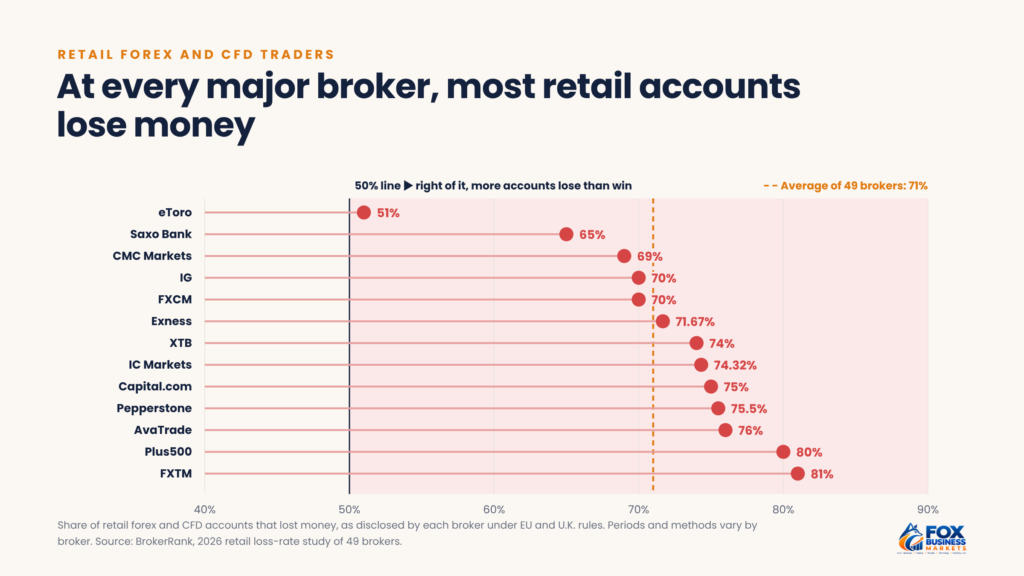
Share of retail forex and CFD accounts that lose money at major brokers
These figures cover CFDs as well as forex, and each broker calculates them a little differently. Still, the pattern is consistent. At every broker in the sample, most retail accounts lost money.
Other risks to weigh:
- Gap risk: Prices can jump over weekends or after major news, skipping past your stop-loss order.
- Counterparty risk: If your broker fails or isn’t regulated, your money may be at risk.
- Overtrading: The 24-hour market makes it easy to trade too often, and spreads add up.
- No built-in return: Unlike stocks, currencies don’t pay dividends or grow earnings, so forex trading doesn’t build wealth on its own over time.
Is It a Myth That Forex Is a Fast Way to Get Rich?
Yes. Social media is full of forex traders showing off big wins, but the data tell a different story. Most retail accounts lose money, and the few large winners don’t show what typical traders earn.
Forex is a zero-sum market before costs. When one trader profits on a currency move, another trader or dealer loses the same amount. Spreads, commissions, and overnight financing charges then make the average result negative. Professional dealers also have faster systems, better pricing, and far more capital than individual traders.
Courses and “signal” services that promise steady monthly returns deserve extra caution. The CFTC has repeatedly charged firms that used fake track records to sell forex programs.
If your goal is long-term wealth, diversified stock and bond investments have historically had a far better long-term record. Our guide to how the stock market works explains why, and our compound interest guide shows how steady returns grow over time.
How Can You Start Trading Forex?
If you still want to try forex trading, a careful start can limit the damage from early mistakes:
- Learn the basics first. Understand pips, lots, margin, and spreads before you put money at risk.
- Choose a U.S.-regulated broker. Confirm its RFED or FCM registration through NFA BASIC.
- Practice on a demo account. Most brokers offer free demo accounts with virtual money. Platforms such as MetaTrader are widely used.
- Start small. Use micro lots so a 10-pip move costs about $1, not $100.
- Risk 1% or less per trade. Set a stop-loss order on every position, though a stop can’t guarantee your exit price.
- Use less leverage than allowed. Just because 50:1 is available doesn’t mean you should use it.
- Keep a trading journal and routine. Track every trade and review what works. Our guide to organizing a forex trading routine offers a framework.
- Use only money you can afford to lose. Keep retirement savings and emergency funds out of trading accounts.
Frequently Asked Questions
How much money do you need to start forex trading?
Some U.S. brokers have no minimum deposit, and others require $50 to $250. Micro lots let you trade with small amounts, but a tiny account leaves little room for losses. Tip: Fund your account only after a few weeks on a demo account, and remember that demo results don’t include real slippage or emotions.
Can you trade forex in an IRA?
Some brokers allow forex trading in self-directed individual retirement accounts (IRAs), usually with lower leverage or none at all. Many custodians don’t permit it. Tip: Ask your IRA custodian in writing whether forex is allowed before moving any money.
What is the difference between forex and crypto trading?
Forex trades government-issued currencies through a mature, highly liquid global market regulated in the U.S. by the CFTC and NFA. Crypto trades digital assets that are usually far more volatile and trade seven days a week. Tip: Check which regulator oversees any platform before depositing money, since protections differ widely.
What is a margin call in forex?
A margin call happens when losses shrink your account below the margin your broker requires to keep a position open. U.S. dealers typically close some or all of your positions automatically, often at a loss, rather than wait for you to add money. Tip: Keep extra cash in your account and use low leverage so a normal price swing doesn’t trigger a forced close.
Protect Your Capital Before You Chase Profits
Forex trading gives you access to the world’s largest and most liquid market, open nearly around the clock. But leverage, costs, and professional competition make it a hard place to earn steady profits, and most retail accounts lose money.
Treat forex as high-risk speculation, not a core investment. Learn the mechanics, practice first, use a U.S.-regulated broker, and risk only money you can afford to lose.
This article is for general information only and isn’t financial, tax, legal, or investment advice. Consider your own situation or talk to a qualified professional before making decisions.

