Quick answer: Compound interest is interest earned on both your original money and the interest it has already earned. Each period, the interest is added to your balance, so the next period’s interest is calculated on a bigger amount. Over long periods, this makes savings and investments grow much faster than simple interest, and it makes unpaid debt grow faster too.
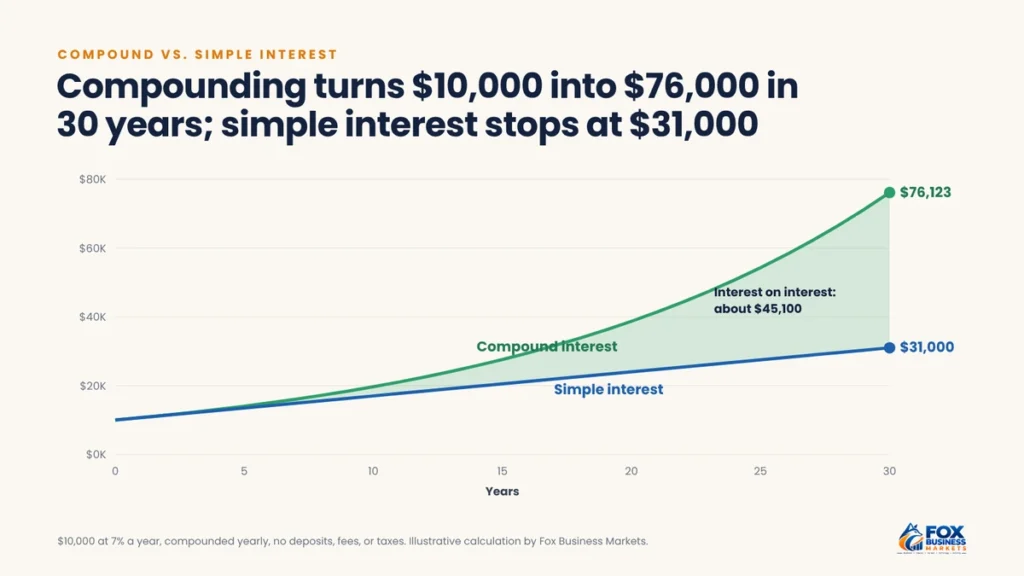
Put $10,000 away at 7% a year for 30 years. With simple interest, you’d end up with $31,000. With compound interest, you’d have about $76,100. Same deposit, same rate, same time: the extra $45,000 or so is interest earned on interest.
That gap is why compounding shows up in nearly every money decision you make, from where you keep your savings to how quickly you pay off a credit card. It works the same way whether it’s helping you or costing you.
What Is Compound Interest?
“Compound interest is the interest you earn on interest,” according to the SEC’s Investor.gov. Each time interest is calculated, it’s added to your balance. The next calculation then uses that larger balance.
Investor.gov gives a simple example. A $100 deposit earning 5% a year grows to $105 after one year. In year two, the 5% applies to $105, not $100, so you end with $110.25. That extra quarter is small. Over decades, those extra amounts pile up into most of your balance.
Compound interest applies to more than savings accounts. The same effect drives returns on investments that are reinvested, such as stock dividends and fund distributions, even though those returns aren’t technically “interest.” It also applies to most credit card balances, which is why debt can grow quickly if you only make small payments.
How Is Compound Interest Different From Simple Interest?
Simple interest is paid only on your original amount, called the principal. Compound interest is paid on the principal plus all the interest you’ve already earned.
This is how $10,000 grows at 7% a year with each method:
Years | Simple interest | Compound interest (yearly) | Difference |
| 5 | $13,500 | About $14,026 | About $526 |
| 10 | $17,000 | About $19,672 | About $2,672 |
| 20 | $24,000 | About $38,697 | About $14,697 |
| 30 | $31,000 | About $76,123 | About $45,123 |
Illustrative calculation by Fox Business Markets. No deposits after the first, no withdrawals, fees, or taxes.
In the first few years, the two barely differ. By year 30, compound growth has produced more than twice as much as simple interest. That slow start and fast finish is the defining shape of compounding.
What Is the Compound Interest Formula?
The standard formula is:
A = P × (1 + r/n)^(n × t)
- A is the final amount
- P is the principal, your starting amount
- r is the annual interest rate as a decimal (5% = 0.05)
- n is how many times interest compounds each year (12 for monthly, 365 for daily)
- t is the number of years
Worked example. You deposit $10,000 at 5% interest, compounded monthly, for 10 years:
- r/n = 0.05 ÷ 12 = 0.004167
- n × t = 12 × 10 = 120
- A = $10,000 × (1.004167)^120 = about $16,470
Your interest earned is about $6,470. With simple interest, it would be $5,000.
This formula covers a single deposit. If you add money regularly, each deposit compounds for a different length of time, so the math is easier with a spreadsheet’s FV function or the SEC’s free compound interest calculator.
How Does Compounding Work With Regular Deposits?
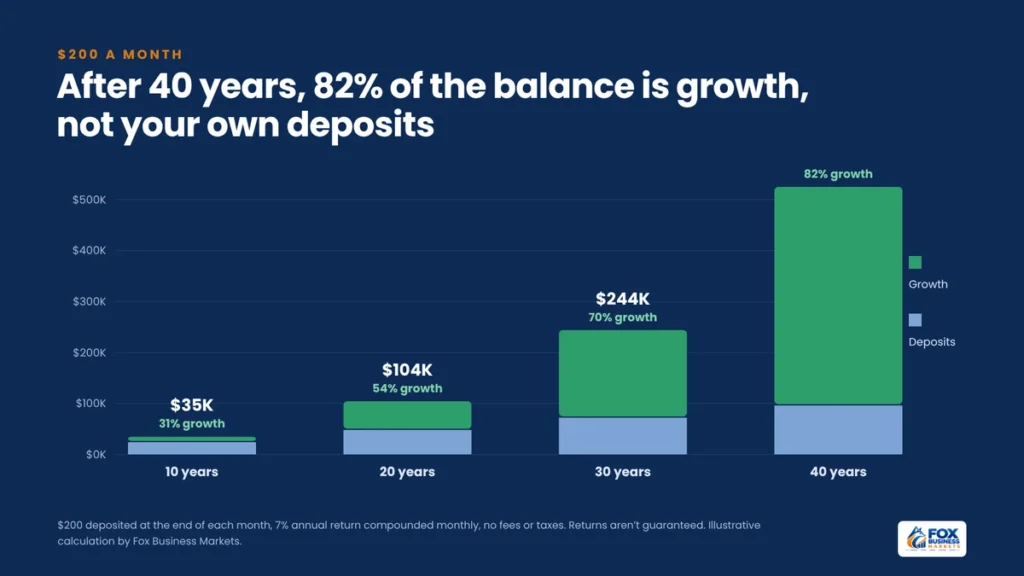
Most people don’t invest one lump sum and walk away. They add money every month. Compounding works on each deposit separately, so earlier deposits grow the most. This is what $200 a month becomes at a 7% average annual return:
Years of saving | You contributed | Account value | Growth from compounding | Share of balance from growth |
| 10 | $24,000 | About $34,600 | About $10,600 | 31% |
| 20 | $48,000 | About $104,200 | About $56,200 | 54% |
| 30 | $72,000 | About $244,000 | About $172,000 | 70% |
| 40 | $96,000 | About $525,000 | About $429,000 | 82% |
Illustrative calculation by Fox Business Markets: $200 deposited at the end of each month, 7% annual return compounded monthly, no fees or taxes. Returns aren’t guaranteed.
Two things stand out. First, around year 19, the growth in the account passes the total amount you’ve put in. After that point, your money is doing more of the work than your paycheck. Second, the last 10 years add more than the first 30 combined: the balance roughly doubles from year 30 to year 40, even though you only add another $24,000.
Does Compounding Frequency Matter?
Yes, but less than most people think. More frequent compounding adds a little extra, because interest starts earning interest sooner. For $10,000 at 5% over 10 years:
Compounding | Value after 10 years |
| Yearly | About $16,289 |
| Monthly | About $16,470 |
| Daily | About $16,487 |
Illustrative calculation by Fox Business Markets.
Going from yearly to daily compounding adds about $198 over 10 years. Going from a 5% rate to a 6% rate would add far more, so the rate is the number to compare.
That’s also why banks advertise the annual percentage yield (APY). Under the federal Truth in Savings rules, APY is a rate “reflecting the total amount of interest paid on an account, based on the interest rate and the frequency of compounding for a 365-day period,” according to Regulation DD. A 5% rate compounded monthly equals an APY of about 5.12%. Comparing APYs lets you compare accounts that compound on different schedules.
How Long Does It Take to Double Your Money?
The Rule of 72 gives a quick estimate. Divide 72 by your annual rate of return, and the result is roughly how many years it takes your money to double. Investor.gov uses the example of a 9% return, which doubles your money in about eight years.
Annual return | Rule of 72 estimate | Actual years to double |
| 4% | 18 years | 17.7 years |
| 6% | 12 years | 11.9 years |
| 8% | 9 years | 9.0 years |
| 10% | 7.2 years | 7.3 years |
| 12% | 6 years | 6.1 years |
Actual years assume yearly compounding. Calculation by Fox Business Markets.
The rule is most accurate for rates between about 6% and 10%. It also works in reverse as a warning: money in an account paying 0.5% would take about 139 years to double (the Rule of 72 says 144), while a credit card balance at 24% would double in about three years if you never paid it down.
Why Does Starting Early Matter So Much?
Because compounding needs time more than it needs money. Consider two savers who each earn 7% a year:
- Early saver: Invests $5,000 a year from age 25 to 34, then stops. Total contributed: $50,000.
- Late saver: Invests $5,000 a year from age 35 to 64. Total contributed: $150,000.
At 65, the early saver has about $562,700. The late saver has about $505,400, despite putting in three times as much money.
Illustrative calculation by Fox Business Markets: contributions at the start of each year, 7% annual return, no fees or taxes. Returns aren’t guaranteed.
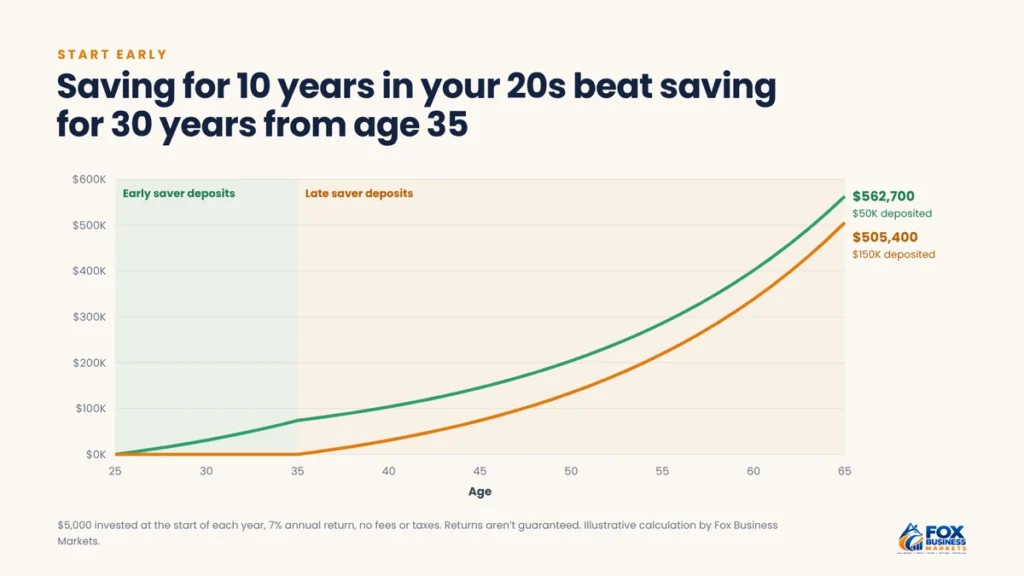
The early saver’s first 10 deposits had 30 to 40 years to grow. The late saver’s deposits had at most 30 years, and the last ones barely had time to compound at all. If you’re deciding when to begin, our guide on how to start investing walks through the first steps.
This doesn’t mean it’s too late if you’re 40 or 50. It means the best time to add money is as early as you can, and that small, regular contributions made sooner often beat larger ones made later.
Is Compound Interest the Same as Compound Returns?
Not exactly. Interest is a fixed or stated rate paid on a deposit or charged on a loan. Investments such as stocks and funds don’t pay interest; they produce returns from price changes and dividends. When those returns are reinvested, they compound the same way interest does, which is why people use the two terms loosely.
The difference shows up when returns swing. A savings account at 4% grows by 4% every year. An investment that averages 7% might gain 20% one year and lose 10% the next. Losses hurt compounding more than gains help it: a 20% gain followed by a 20% loss leaves you 4% below where you started, not even. So the long-term growth rate of a volatile investment is usually a bit lower than its simple average yearly return.
That’s why examples using a steady 7% are a simplification. They’re useful for seeing how time and contributions work together, but your real balance will move up and down along the way. Diversifying, holding for long periods, and avoiding panic selling after a drop all help your actual results stay closer to the long-run trend.
Which Accounts Compound, and How?
Not every place you keep money compounds the same way. This comparison shows what to expect:
Where your money is | How growth compounds | Is the rate fixed? | Main risk |
| Savings and money market accounts | Interest usually compounds daily or monthly and is added to your balance | No, banks can change it anytime | Rate falls below inflation |
| Certificates of deposit (CDs) | Interest compounds for the full term at a set rate | Yes, for the term | Early-withdrawal penalty |
| Treasury bills | Sold at a discount; you earn the difference at maturity, and compounding happens only if you reinvest | Yes, until maturity | Rates may be lower when you reinvest |
| Bond funds | Interest payments compound if reinvested; fund price moves with interest rates | No | Price drops when rates rise |
| Stock index funds | Dividends and price gains compound if reinvested | No | Losses in market downturns |
For money you’ll need within a few years, insured savings accounts and CDs give you predictable compounding. For goals decades away, investments that can earn more over time give compounding more to work with, in exchange for ups and downs along the way. Many people use both: savings for the short term, investments for the long term.
Where Does Compounding Work for You?
High-yield savings accounts and CDs. The rate you earn makes a large difference. The FDIC’s national average savings rate was 0.38% in August 2026, according to FDIC data published on FRED. At that rate, $10,000 grows to about $10,390 in 10 years with monthly compounding. At 4%, it grows to about $14,900. If your emergency savings are earning close to nothing, a high-yield savings account lets compounding do more of the work.
Retirement accounts. In a 401(k) or IRA, your investment returns compound without being reduced by yearly taxes on gains and dividends. That lets more of your money stay invested and keep growing. Which account is better depends on your tax bracket now versus later; see our comparison of a Roth IRA vs. traditional IRA.
Reinvested dividends. When a stock or fund pays dividends and you automatically buy more shares, those new shares produce their own dividends. Over long periods, reinvested dividends make up a meaningful part of total stock market returns.
Where Does Compounding Work Against You?
Credit cards. Many card issuers calculate interest using a daily periodic rate, generally the APR divided by 360 or 365. When they add each day’s interest to the balance, “interest is compounding on a daily basis,” the CFPB explains. The average rate on credit card accounts charged interest was 22.36% in August 2026 (preliminary), according to the Federal Reserve. At that rate, a $5,000 balance with no payments and no new purchases would grow to about $6,250 in one year.
Minimum payments. Paying only the minimum keeps most of the balance in place, so interest keeps compounding on it for years. Paying more than the minimum, or targeting your highest-rate debt first, cuts the amount that compounds. Our guide on how to pay off debt shows the fastest methods.
Other loans. Many installment loans, such as most auto loans and mortgages, charge interest on the remaining principal each month and don’t add unpaid interest to the balance as long as you pay on time. Some loans, including certain student loans, can add unpaid interest to the principal in specific situations, which then raises future interest. Check your loan terms for the word “capitalization.”
What Slows Compounding Down?
Four things slow compounding.
Fees. A fund’s expense ratio is taken out every year, so it compounds against you. On $100,000 invested for 30 years at a 7% return before fees, a 0.05% annual fee leaves about $750,600, while a 0.64% fee leaves about $635,800, a difference of more than $114,000. Those two fees are the 2025 averages for index and actively managed equity mutual funds, according to the Investment Company Institute. Low-cost index funds keep more of your return compounding.
Taxes. In a regular taxable account, you may owe tax each year on interest, dividends, and realized gains. Paying that tax from the account means less money compounding. Tax-advantaged accounts like IRAs and 401(k)s avoid that yearly drag.
Inflation. If your savings earn 4% and prices rise 3%, your real return is closer to 1%. Money earning less than inflation loses buying power even as the balance grows.
Withdrawals. Every dollar you take out early stops compounding, along with all the growth it would have earned. That’s one reason to keep an emergency fund separate from long-term investments.
How Can You Get More From Compounding?
- Automate your deposits. Set up a transfer for the day after payday so saving happens before spending. Consistency feeds compounding more than occasional large deposits.
- Raise your rate of saving with each raise. Increasing your 401(k) contribution by one percentage point a year is barely noticeable in your paycheck but adds up over decades.
- Reinvest everything. Turn on automatic dividend reinvestment in brokerage and retirement accounts, so payouts buy more shares instead of sitting in cash.
- Compare APYs, not compounding schedules. A higher rate beats more frequent compounding.
- Don’t interrupt it. Avoid cashing out retirement accounts when changing jobs; roll them over instead, so the balance keeps compounding.
Is Compound Interest Guaranteed to Make You Rich?
No. Compounding is a mathematical effect, not a promise of returns. Savings accounts and CDs pay a stated rate, but stocks and funds don’t, and their returns can be negative for years at a time, as the section on compound returns explains. Compounding also can’t rescue a rate that’s too low: a balance earning 0.38% a year is compounding, but it still loses buying power when inflation runs higher. What it does reward reliably is starting early, adding money regularly, and leaving it alone.
Frequently Asked Questions
What is continuous compounding?
Continuous compounding is the mathematical limit of compounding infinitely often, using the formula A = P × e^(r × t). In practice, it adds almost nothing over daily compounding: $10,000 at 5% for 10 years grows to about $16,487 either way. If an account advertises continuous compounding, compare its APY with other accounts rather than the compounding method.
How much do I need to invest each month to reach $1 million?
At a 7% average annual return, you’d need to invest about $380 a month for 40 years, about $820 a month for 30 years, or about $1,920 a month for 20 years. Returns aren’t guaranteed, so treat these as rough targets. Start with what you can afford and increase your contributions as your income grows.
How do I calculate compound interest in a spreadsheet?
In Excel or Google Sheets, use =FV(rate, periods, payment, -present value). For $10,000 at 5% compounded monthly for 10 years, enter =FV(0.05/12, 120, 0, -10000), which returns about $16,470. To include a $200 monthly deposit, change the third value to -200. Double-check results with the SEC’s free compound interest calculator.
Is the interest I earn on savings taxed?
Yes. Interest from savings accounts, CDs, and money market accounts is generally taxed as ordinary income in the year it’s paid, even if you leave it in the account. Banks send Form 1099-INT if you earn $10 or more, but you owe tax on smaller amounts too. Holding savings for long-term goals in tax-advantaged accounts can reduce that drag.
Put Compounding to Work This Month
Move savings into an account that pays a competitive APY, invest for long-term goals in low-cost funds inside tax-advantaged accounts, and set up automatic contributions so new money keeps compounding. On the other side, pay down high-rate credit card balances first, because the same math that builds savings can grow debt.
Start now, even with a small amount.
This article is for general information only and isn’t financial, tax, legal, or investment advice. Consider your own situation or talk to a qualified professional before making decisions.

