Quick answer: Key crypto statistics for 2026: the crypto market was worth about $2.56 trillion on Nov. 11, with Bitcoin making up about 58%. About 9% of U.S. adults owned crypto in 2026, down from 14% in 2025, according to Gallup. Americans reported a record $11.4 billion in crypto fraud losses in 2025.
Crypto has had a rough year. Bitcoin traded at about $73,300 on Nov. 10, 2026, about 41% below its record close of $124,720 in October 2025, based on Coinbase prices from the St. Louis Fed’s Federal Reserve Economic Data (FRED). Ether was down about 58% from its own peak.
Crypto has also moved deeper into mainstream finance. Spot Bitcoin exchange-traded funds (ETFs) hold more than $90 billion, stablecoins top $280 billion, and federal stablecoin rules take effect in January 2027. Yet fewer Americans say they own crypto than a year ago, and scam losses keep climbing.
This roundup collects the latest crypto statistics on market size, Bitcoin’s yearly returns, volatility, ownership, scams, and hacks, along with our own analysis of FRED price data.
Crypto Statistics at a Glance
- $2.56 trillion: Total crypto market value on Nov. 11, 2026 (CoinPaprika).
- 8%: Bitcoin’s share of the total crypto market (CoinPaprika).
- $124,720: Bitcoin’s record daily close, on Oct. 5, 2025 (FRED).
- -16.4%: Bitcoin’s return in 2026 through Nov. 10, after a 7.1% loss in 2025 (FRED; Fox Business Markets analysis).
- 3 times: How volatile Bitcoin was compared with the S&P 500 over the past year (FRED; Fox Business Markets analysis).
- 9%: Share of U.S. adults who owned crypto in 2026, down from 14% in 2025 (Gallup).
- 19%: Share of U.S. adults who have ever invested in or used crypto (Pew Research Center).
- $11.4 billion: Crypto fraud losses reported to the FBI in 2025, a record (FBI).
- $4.4 billion: Crypto fraud losses reported by Americans 60 and older in 2025 (FBI).
- $3.4 billion: Crypto stolen in hacks in 2025, including $1.5 billion from the Bybit exchange (Chainalysis).
How Big Is the Crypto Market?
The total value of all cryptocurrencies was about $2.56 trillion on Nov. 11, 2026, according to CoinPaprika, which tracked 11,664 active assets. That was down 6.5% over the previous week.
Bitcoin dominates. It accounted for about 57.8% of the market, worth roughly $1.48 trillion. Ether, the second-largest cryptocurrency, traded at about $2,060 on Nov. 11, according to CoinPaprika.
For background on how these assets work, see our guide to what cryptocurrency is. Our guides to stablecoins and Bitcoin ETFs go deeper on those two segments.
How Has Bitcoin Performed Each Year?
Bitcoin’s yearly returns have swung far more than the stock market’s. We calculated calendar-year returns from Coinbase’s daily Bitcoin prices on FRED:
Year | Bitcoin return |
| 2015 | +26.6% |
| 2016 | +126.2% |
| 2017 | +1,324.2% |
| 2018 | -73.4% |
| 2019 | +93.9% |
| 2020 | +305.5% |
| 2021 | +59.3% |
| 2022 | -64.3% |
| 2023 | +155.9% |
| 2024 | +123.1% |
| 2025 | -7.1% |
| 2026 (through Nov. 10) | -16.4% |
Source: Coinbase Bitcoin price (CBBTCUSD) via FRED; Fox Business Markets analysis. Returns run from the first to the last available price of each year.
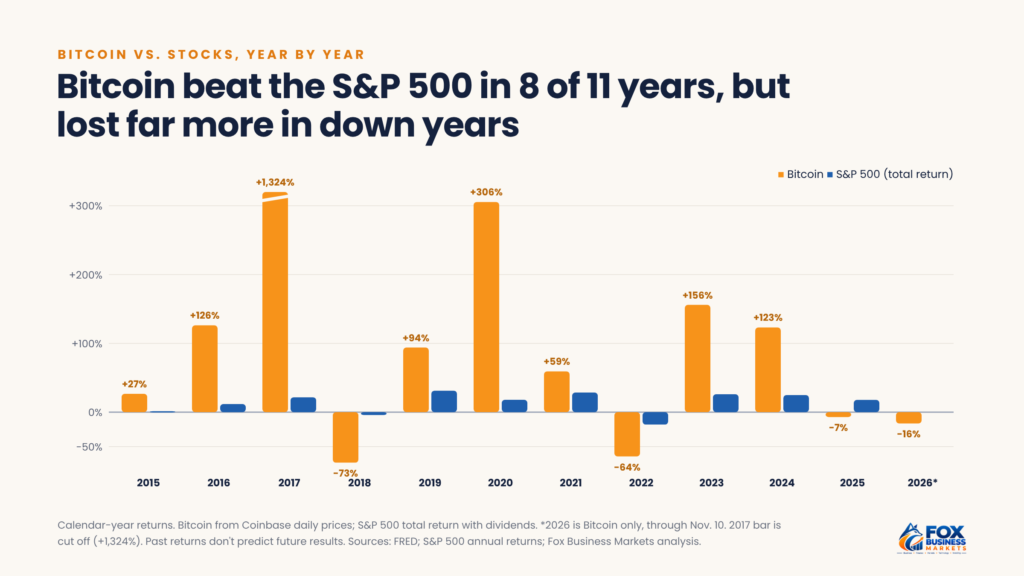
Bitcoin’s annual returns from 2015 to 2026
Bitcoin rose in eight of the 11 full years and fell in three. It beat the S&P 500’s total return, including dividends, in the same eight years and lagged it in the three down years. A Bitcoin bought for about $370 on Dec. 1, 2014, the first price in FRED’s series, was worth about $73,300 on Nov. 10, 2026, nearly 200 times as much. But the path included four declines of more than 50% from a peak:
Peak | Trough | Decline |
| December 2017 | December 2018 | -83.8% |
| April 2021 | July 2021 | -53.2% |
| November 2021 | November 2022 | -76.7% |
| October 2025 | June 2026 | -53.0% |
Measured from record highs using daily closes. Source: FRED; Fox Business Markets analysis.
Ether has fallen even further from its peak. It closed at a record $4,831 on Aug. 21, 2025, and was about $2,043 on Nov. 10, 2026, a drop of about 58%.
What Happened to Crypto Prices in 2026?
Bitcoin started 2026 well below its October 2025 record and kept sliding through the first half of the year. Month-end prices on Coinbase:
Month-end | Bitcoin price |
| December 2025 | $87,696 |
| January 2026 | $78,727 |
| February 2026 | $66,680 |
| March 2026 | $68,134 |
| April 2026 | $76,442 |
| May 2026 | $73,688 |
| June 2026 | $58,586 |
| July 2026 | $62,887 |
| August 2026 | $78,603 |
| September 2026 | $83,483 |
| October 2026 | $77,404 |
Source: Coinbase Bitcoin price via FRED.
The June 30 close of $58,586 marked the low point of the slide, about 53% below the record. Bitcoin then rallied about 42% to the end of September before giving back some of those gains in October and early November.
The slump showed up across the market. Stablecoin supply shrank, and spot Bitcoin ETF assets fell from nearly $170 billion in October 2025 to $92.8 billion.
How Do Bitcoin’s Monthly Returns Look?
We measured Bitcoin’s month-end prices from December 2014 through October 2026, a total of 142 months:
- Up months: Bitcoin rose in 80 months, or about 56% of the time.
- Big moves: It gained or lost 20% or more in 39 months, more than one in four.
- Sharp drops: It fell 20% or more in nine months.
- Best month: May 2017, up about 66%.
- Worst month: June 2022, down about 38%, during the crypto lending collapse.
Source: Coinbase month-end Bitcoin prices via FRED; Fox Business Markets analysis.
Some calendar months have looked stronger than others. October rose in nine of 12 years, and August fell in eight of 12. With only a dozen observations for each month, though, those patterns could easily be chance. They’re not a reliable guide to timing purchases.
How Much More Volatile Is Bitcoin Than the S&P 500?
We compared the daily price swings of Bitcoin and the S&P 500 on matching trading days, then annualized them:
Period | Bitcoin volatility | S&P 500 volatility |
| Past 12 months | 41.7% | 13.7% |
| Past five years | 51.3% | 17.1% |
Annualized standard deviation of daily price returns on days both markets traded, using the S&P 500 price index. Source: FRED; Fox Business Markets analysis.
Bitcoin has been about three times as volatile as the stock market. Its link with stocks also changes from year to year. The correlation between their daily moves ranged from -0.11 in 2019 to 0.56 in 2022 and was 0.45 in 2026 so far. A correlation near zero means the two moved independently, while a figure near 1 means they moved together.
These measures look backward and depend on the period chosen. They don’t predict future swings. For stock market numbers, see our stock market statistics.
How Do Bitcoin Returns Compare With Stocks Over Time?
From the start of 2015 through the end of 2025, our calculations show $1,000 in Bitcoin would have grown to about $257,000, before fees and taxes. The same $1,000 in the S&P 500, with dividends reinvested, would have grown to about $4,000, based on annual return data from NYU professor Aswath Damodaran.
But the starting point makes a big difference. Investors who bought near a peak, such as December 2017 or November 2021, waited years to break even, and those who bought at the October 2025 record were down about 41% as of Nov. 10, 2026. Stocks rose far less but with much smaller swings along the way.
Past results don’t predict future returns. Bitcoin’s early gains came when it was a tiny asset, and a market worth more than $1 trillion is unlikely to grow at the same pace.
How Many Americans Own Crypto?
Estimates vary because surveys ask different questions:
Survey | Question | Result |
| Gallup, June 2026 | Currently own crypto | 9% of U.S. adults (14% in 2025) |
| Pew Research Center, January 2026 | Have ever invested in, traded, or used crypto | 19% of U.S. adults (16% in 2021) |
| Federal Reserve, 2025 survey | Used crypto for any purpose in the past year | About 10% of U.S. adults (12% in 2021) |
Sources: Gallup; Pew Research Center; Federal Reserve Survey of Household Economics and Decisionmaking via Cointelegraph.
Gallup found a sharp drop in the past year. Among U.S. investors, ownership fell from 17% in 2025 to 11% in 2026. Sixty-three percent of investors called crypto “very risky,” and 66% said they weren’t interested in buying it.
The Federal Reserve’s survey shows most people use crypto as an investment, not money. In 2025, about 9% of adults used crypto to invest, about 2% to make purchases, and about 1% to send money to family or friends.
Who Owns Crypto?
Ownership skews male and toward middle-aged investors, according to Gallup’s survey of U.S. investors:
Group | Owned crypto in 2025 | Owned crypto in 2026 |
| Men | 23% | 16% |
| Women | 9% | 5% |
| Ages 18 to 29 | 18% | 8% |
| Ages 30 to 49 | 25% | 20% |
| Ages 50 to 64 | 17% | 10% |
| Ages 65 and older | 7% | 4% |
| Income $90,000 or more | 19% | 15% |
| Income under $48,000 | 12% | 4% |
Share of U.S. investors who own crypto. Source: Gallup.
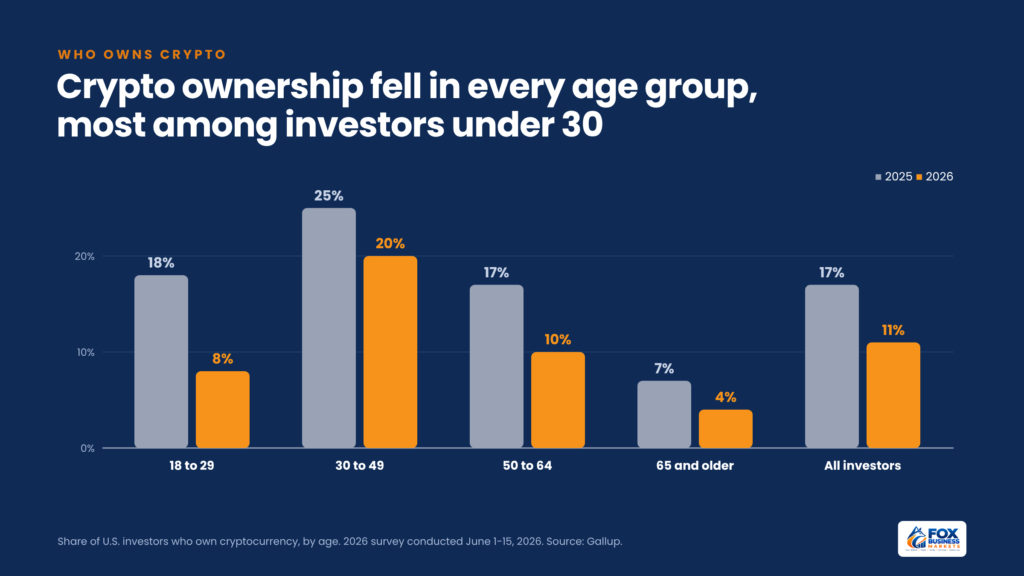
Crypto ownership among U.S. investors by age, 2025 versus 2026
Ownership fell in every group, but the drop was largest among investors under 30, down 10 percentage points to 8%. Among age groups, investors ages 30 to 49 now have the highest ownership rate, at 20%.
Pew’s broader measure of anyone who has ever used crypto found similar patterns. Thirty-eight percent of men ages 18 to 29 had used crypto, compared with 15% of women that age. Among upper-income adults, 27% had used it.
How Much Do Americans Lose to Crypto Scams?
Crypto now figures in more than half of all internet crime losses reported to the FBI’s Internet Crime Complaint Center (IC3). Americans reported $11.4 billion in crypto-related losses in 2025, up about 22% from 2024, according to The Block.
Year | Reported crypto fraud losses |
| 2023 | $5.6 billion |
| 2024 | $9.3 billion |
| 2025 | $11.4 billion |
Source: FBI Internet Crime Complaint Center.
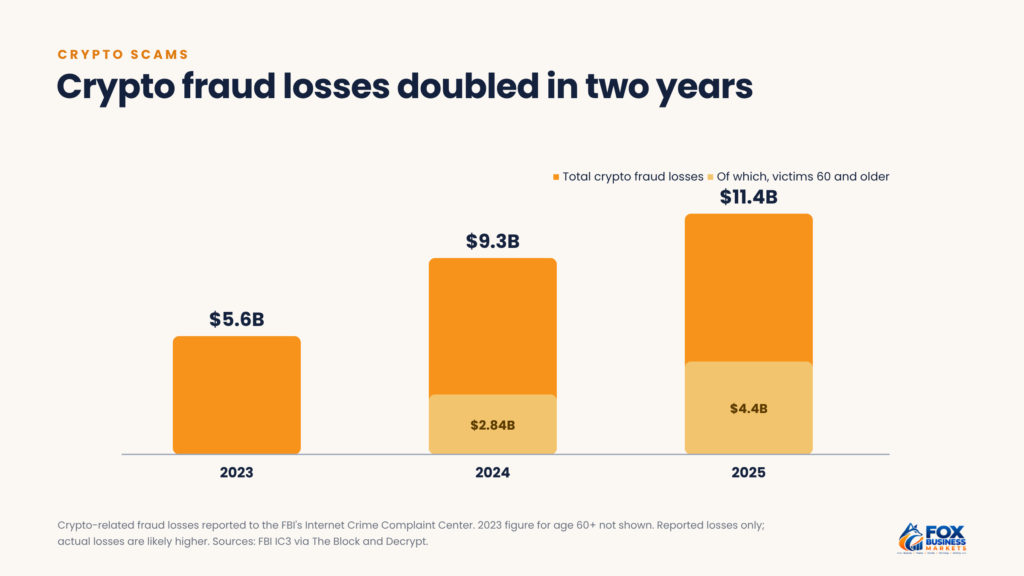
Crypto fraud losses reported to the FBI, 2023 to 2025
Other key figures from the FBI’s 2025 data:
- 181,565 complaints involved crypto, with an average reported loss of about $62,600.
- $7.2 billion came from crypto investment scams, in which fraudsters persuade victims to “invest” on fake platforms.
- $4.4 billion was lost by Americans 60 and older, up from $2.84 billion in 2024.
- $389 million was lost through crypto ATM scams, up 58%.
- 18,589 victims lost more than $100,000 each.
These figures include only reported losses. Many victims never file complaints, so actual losses are likely higher.
How Much Crypto Is Stolen in Hacks?
Hackers stole about $3.41 billion in crypto in 2025, slightly more than the $3.38 billion stolen in 2024, according to blockchain analysis firm Chainalysis, as reported by The Block.
- One hack drove the total: The $1.5 billion theft from the Bybit exchange in February 2025 made up about 44% of the year’s losses.
- North Korea led: Hackers linked to North Korea stole at least $2.02 billion in 2025.
- Individuals were targeted too: Chainalysis counted 158,000 personal wallet compromises affecting at least 80,000 people, with $713 million in losses.
Most of the largest losses hit exchanges and other services rather than individuals. But attacks on personal wallets are increasingly common, which is one reason to choose platforms and storage methods carefully. Our guide to how to buy crypto covers safer ways to buy and store it.
How Big Are Crypto ETFs and Stablecoins?
Two parts of the crypto market have become major segments on their own: exchange-traded funds and stablecoins.
Spot Bitcoin ETFs:
- $92.8 billion: Total net assets on Nov. 10, 2026, down from nearly $170 billion in early October 2025.
- $55.4 billion: Cumulative net inflows since the funds launched in January 2024.
- About 63%: BlackRock’s iShares Bitcoin Trust’s share of total assets.
- $1.37 billion: The largest single-day inflow, on Nov. 7, 2024.
- $3.48 billion: Net outflows in November 2025, the largest monthly withdrawal since February 2025.
Stablecoins:
- About $290 billion: Total market value on Nov. 10, 2026, according to StablecoinBeat, down from a record of more than $315 billion earlier in 2026.
- About $27 billion: The market’s size at the end of 2020, based on DefiLlama data.
- About 87%: The combined share of Tether and USD Coin, based on Stablecoin.com data.
- $122.8 billion: Tether’s holdings of U.S. Treasury bills on Sept. 30, 2026.
Sources: SoSoValue via TokenPost and The Block; StablecoinBeat; DefiLlama via Transak; Stablecoin.com; Tether attestation via Bitcoin.com News.
Is It a Myth That Most Americans Own Crypto?
Yes. Crypto gets heavy media attention, and ads for exchanges appear everywhere from sports arenas to social media. That can make it seem like most people own it.
Gallup found that 9% of U.S. adults owned crypto in 2026. Even Pew’s broadest measure, which counts anyone who has ever used crypto, reached only 19%. By comparison, 62% of Americans own stocks, directly or through retirement accounts, according to Gallup.
Our investing statistics show how crypto fits alongside other investments Americans hold.
How Did We Research These Crypto Statistics?
We combined published data with our own calculations:
- Prices and returns: We used Coinbase’s daily Bitcoin and Ether prices from the St. Louis Fed’s FRED database (series CBBTCUSD and CBETHUSD), from Dec. 1, 2014, through Nov. 10, 2026. Yearly returns run from each year’s first to last available price, and monthly returns use month-end closes.
- Volatility: We annualized the standard deviation of daily price returns for Bitcoin and the S&P 500 price index on days both markets traded.
- Stocks comparison: S&P 500 total returns, including dividends, come from NYU professor Aswath Damodaran’s annual data.
- Surveys and reports: Ownership, fraud, hack, ETF, and stablecoin figures come from the sources named in each section, using the latest release available on Nov. 11, 2026.
Our calculations don’t include fees, taxes, or trading costs, and Coinbase prices can differ slightly from other exchanges. Results also depend on the period chosen, so they describe the past rather than predict the future.
Frequently Asked Questions
Which country has the highest crypto adoption?
India ranked first in Chainalysis’s 2025 Global Crypto Adoption Index, followed by the United States and Pakistan. The index weighs crypto activity against population and purchasing power, not just total dollars. Tip: Treat adoption rankings as a measure of activity, not a sign that crypto is a safer investment in any one country.
How many Bitcoin have been lost for good?
No one knows exactly. In a 2020 estimate, Chainalysis said about 3.7 million Bitcoin, roughly 20% of the coins mined at the time, appeared to be lost because owners lost their private keys or passwords. Those coins still count toward Bitcoin’s 21 million supply limit but can’t be used. Tip: Store your recovery phrase offline in a secure place, and make sure a trusted person knows how to find it.
How much electricity does Bitcoin use?
Bitcoin mining uses a large amount of electricity, roughly comparable to a midsize country, according to estimates from the University of Cambridge. Estimates vary with Bitcoin’s price, mining equipment, and energy sources. Tip: If energy use is a concern, research how a cryptocurrency secures its network before buying.
Does the U.S. government own Bitcoin?
Yes. A March 2025 executive order created a Strategic Bitcoin Reserve, made up of Bitcoin the federal government had seized in criminal and civil cases. The order directs agencies not to sell it. Tip: Government holdings don’t guarantee Bitcoin’s price, so base your decisions on your own goals and risk tolerance.
Use Crypto Statistics to Size Your Risk
These crypto statistics cut both ways. Bitcoin has multiplied in value over the past decade, and crypto now has a place in ETFs and stablecoins. But it has also crashed repeatedly, ownership is falling, and scams cost Americans billions every year.
Before you invest, decide how much of a drop you could handle, and size your position to match. Keep crypto to a small share of your portfolio, use well-known platforms, and treat any unsolicited investment pitch involving crypto as a likely scam.
This article is for general information only and isn’t financial, tax, legal, or investment advice. Consider your own situation or talk to a qualified professional before making decisions.

