Quick answer: A Bitcoin ETF is an exchange-traded fund that tracks the price of Bitcoin, letting you invest through a regular brokerage account or individual retirement account (IRA) without holding coins yourself. Spot Bitcoin ETFs, which own actual Bitcoin, launched in the U.S. in January 2024. Fees range from 0.14% to 1.5% a year.
U.S. spot Bitcoin ETFs held $92.8 billion in assets on Nov. 10, 2026, and investors had put a net $55.4 billion into them since their January 2024 launch, according to SoSoValue data reported by TokenPost. BlackRock’s iShares Bitcoin Trust (IBIT) alone held $58.2 billion, about 63% of the total.
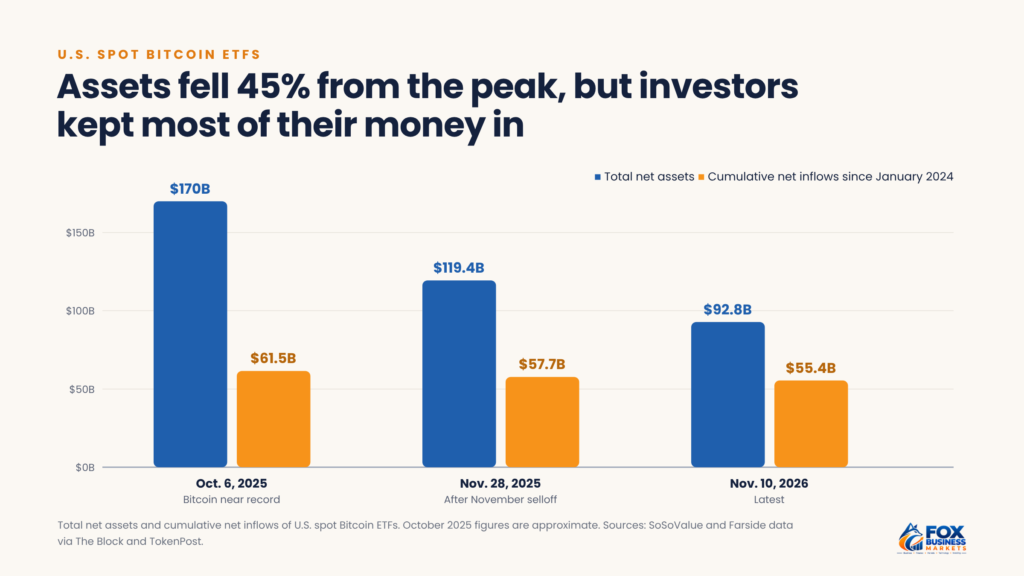
Those numbers are well below their peak. In early October 2025, when Bitcoin hit a record, the funds held nearly $170 billion and had drawn about $61.5 billion in net inflows, according to The Block. Since then, falling prices, along with some withdrawals, have cut assets by about 45%.
This guide explains what a Bitcoin ETF is, how spot and futures funds work, how much money they hold, which funds are largest and cheapest, how ETFs compare with buying Bitcoin directly, what happens on weekends, how they’re taxed, and the risks to weigh.
What Is a Bitcoin ETF?
A Bitcoin ETF is a fund that trades on a stock exchange and aims to track the price of Bitcoin. You buy and sell its shares through a brokerage account, just like shares of a stock or an index fund.
Investors use them mainly for convenience:
- No crypto account needed: You can buy shares in the same brokerage account you use for stocks.
- No private keys: The fund stores the Bitcoin with a professional custodian, so you don’t have to secure a wallet.
- Retirement account access: You can hold Bitcoin ETFs in an IRA and, in some cases, a workplace plan.
- Familiar tax forms: Your broker reports sales on a standard tax form.
- Regulated structure: The funds are registered with the Securities and Exchange Commission (SEC) and must publish their holdings and costs.
The trade-off is that you own shares of a fund, not the Bitcoin itself. You can’t send it to someone, spend it, or move it to your own wallet, and you pay an annual fee. For a primer on the asset itself, see our guide to what cryptocurrency is.
How Do Spot Bitcoin ETFs Work?
A spot Bitcoin ETF holds real Bitcoin. Each share represents a small slice of the fund’s Bitcoin, which shrinks slightly over time as fees are paid. The process works like this:
- Large trading firms create shares. Firms called authorized participants deliver cash (or, since July 2025, Bitcoin itself) to the fund in exchange for new ETF shares.
- The fund buys and stores Bitcoin. A custodian holds the coins, mostly in offline cold storage. Coinbase is the custodian for most U.S. funds, while Fidelity holds Bitcoin for its own fund.
- Investors trade shares on the exchange. You buy and sell shares from other investors at market prices during stock market hours.
- Arbitrage keeps prices close to Bitcoin’s value. If shares trade above or below the value of the fund’s Bitcoin, authorized participants create or redeem shares to profit from the gap, which pushes the price back in line.
The SEC approved the first spot Bitcoin ETFs on Jan. 10, 2024. In July 2025, it allowed authorized participants to create and redeem shares using Bitcoin directly, which can make the process cheaper and more efficient.
What Is the Difference Between Spot and Futures Bitcoin ETFs?
Before 2024, U.S. investors could only buy Bitcoin futures ETFs, the first of which launched in October 2021. These funds don’t own Bitcoin. Instead, they hold futures contracts that bet on Bitcoin’s future price.
| Feature | Spot Bitcoin ETF | Bitcoin futures ETF |
| What it holds | Actual Bitcoin | Bitcoin futures contracts |
| Tracking | Closely follows Bitcoin’s price, minus fees | Can drift from Bitcoin’s price over time |
| Extra costs | Annual expense ratio | Expense ratio plus costs of rolling contracts each month |
| Typical fees | 0.14% to 1.5% | Often around 0.95% |
| Taxes | Generally taxed as if you owned the Bitcoin directly | Can produce taxable distributions each year |
Futures funds must regularly sell expiring contracts and buy new ones. When later contracts cost more than current ones, as they often do, that “roll” chips away at returns. For long-term holders, spot ETFs usually track Bitcoin more closely.
How Did Bitcoin ETFs Come About?
Getting a spot Bitcoin ETF approved took more than a decade:
- 2013: Cameron and Tyler Winklevoss filed the first application for a Bitcoin ETF. The SEC eventually rejected it, citing concerns about fraud and manipulation in Bitcoin markets.
- 2017 to 2023: The SEC turned down or delayed dozens of similar applications, while the Grayscale Bitcoin Trust (GBTC) traded over the counter, often at a large discount or premium to the value of its Bitcoin.
- October 2021: The first Bitcoin futures ETF began trading. The SEC approved it because Bitcoin futures trade on a regulated U.S. exchange.
- August 2023: A federal appeals court ruled that the SEC had not adequately explained why it rejected Grayscale’s request to convert its trust into an ETF while approving futures funds.
- January 2024: The SEC approved 11 spot Bitcoin ETFs at once, including GBTC’s conversion. Trading began Jan. 11, when Bitcoin closed at about $46,300 on Coinbase.
- 2025: The SEC allowed in-kind creations and redemptions, then approved generic listing standards for crypto ETFs.
Wall Street’s biggest firms now compete for the business. Morgan Stanley, which until October 2025 let its advisors offer the funds only to wealthy clients with an aggressive risk profile, launched its own Bitcoin ETF in April 2026 with the lowest fee in the group.
How Much Money Is in Bitcoin ETFs?
Spot Bitcoin ETF assets have risen and fallen with Bitcoin’s price since the funds launched in January 2024.
| Date | Total net assets | Cumulative net inflows since launch |
| Oct. 6, 2025 | Nearly $170 billion | About $61.5 billion |
| Nov. 28, 2025 | $119.4 billion | $57.7 billion |
| Nov. 10, 2026 | $92.8 billion | $55.4 billion |
Sources: SoSoValue data reported by The Block and TokenPost.
Spot Bitcoin ETF net assets and cumulative inflows, October 2025 to November 2026
Most of the drop in spot Bitcoin ETF assets came from Bitcoin’s falling price, not from investors leaving. Cumulative inflows fell only about 10% from their early October 2025 level, while assets fell about 45%. Investors did pull some money out during the slide. In November 2025 alone, spot Bitcoin ETFs saw $3.48 billion in net outflows, and outflows continued into November 2026, with about $1.28 billion leaving from Nov. 2 to Nov. 6.
The funds held about 6.3% of Bitcoin’s total market value on Nov. 10, 2026, making them one of the largest groups of Bitcoin holders in the world.
Which Bitcoin ETFs Are the Biggest and Cheapest?
BlackRock’s IBIT dominates. In October 2025, it neared $100 billion in assets, about 435 trading days after launch, which The Block said would almost certainly make it the fastest ETF ever to reach that mark. It held $58.2 billion on Nov. 10, 2026, while Morgan Stanley’s low-fee fund was the only one to draw new money that day, according to TokenPost.
Fees vary widely. Standard expense ratios for spot Bitcoin ETFs as of November 2026:
| Fund | Ticker | Expense ratio |
| Morgan Stanley Bitcoin Trust | MSBT | 0.14% |
| Grayscale Bitcoin Mini Trust | BTC | 0.15% |
| Franklin Bitcoin ETF | EZBC | 0.19% |
| Bitwise Bitcoin ETF | BITB | 0.20% |
| VanEck Bitcoin ETF | HODL | 0.20% |
| ARK 21Shares Bitcoin ETF | ARKB | 0.21% |
| iShares Bitcoin Trust | IBIT | 0.25% |
| Fidelity Wise Origin Bitcoin Fund | FBTC | 0.25% |
| Grayscale Bitcoin Trust | GBTC | 1.5% |
Sources: fund issuers; U.S. News via WTOP; etf.com.
GBTC charges far more because it began as a private trust in 2013 and kept its fee when it converted to an ETF in January 2024. It has lost billions of dollars in assets as investors moved to cheaper funds. Our guide to how to buy crypto covers buying coins directly instead.
Trading costs also differ. Larger funds such as IBIT usually trade with tighter bid-ask spreads, which can lower costs for investors who trade often.
What Happens to Bitcoin ETFs on Weekends?
Bitcoin trades around the clock, every day of the year. Bitcoin ETFs trade only during U.S. stock market hours, Monday through Friday, which leaves a gap every weekend.
We measured how Bitcoin’s daily price changes were spread across the week from January 2024 through Nov. 10, 2026, using daily Coinbase prices from the St. Louis Fed’s Federal Reserve Economic Data (FRED):
| Day | Share of Bitcoin’s total daily price movement |
| Monday | 16.6% |
| Tuesday | 16.7% |
| Wednesday | 16.1% |
| Thursday | 15.6% |
| Friday | 11.9% |
| Saturday | 9.5% |
| Sunday | 13.5% |
Method: we added up the absolute daily percentage changes in Bitcoin’s Coinbase closing price and grouped them by the day each change ended. This shows where movement happened, not whether it was up or down, and a different period could give different shares. Source: FRED; Fox Business Markets analysis.
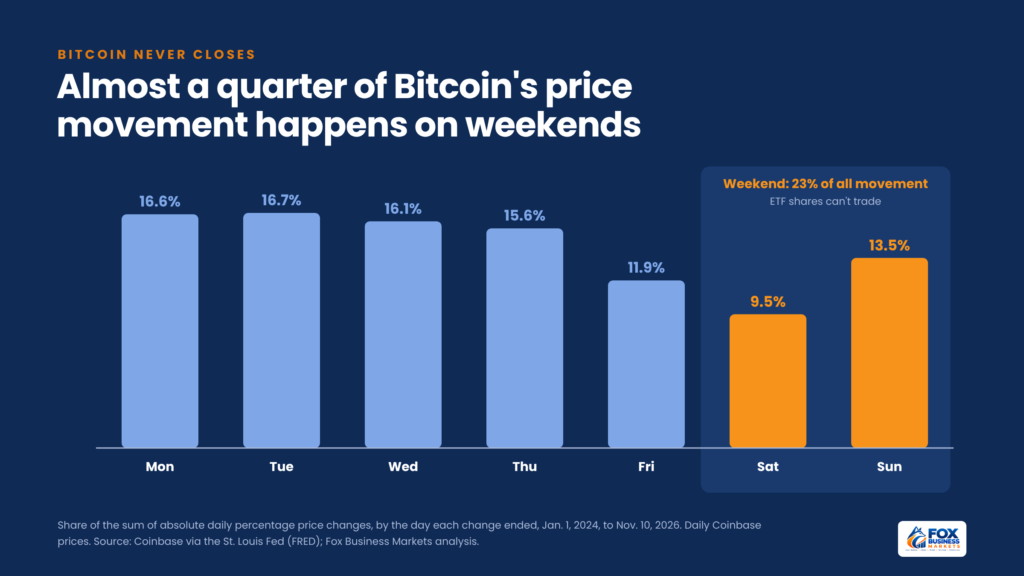
Share of Bitcoin’s daily price movement by day of the week, 2024 to 2026
About 23% of Bitcoin’s total price movement happened on Saturdays and Sundays, when ETF shares can’t trade. From Friday’s close to Sunday’s close, Bitcoin moved an average of about 2% up or down.
ETF holders absorb those weekend moves all at once when trading resumes Monday, often as a gap up or down at the open. If you might need to react quickly to news, direct ownership offers more flexibility. Our guide to forex trading hours explains how a similar weekend gap works in currency markets.
Is a Bitcoin ETF Cheaper Than Buying Bitcoin Directly?
It depends on how long you hold. ETFs charge a small fee every year, while buying directly usually costs more upfront but nothing to keep coins in your own wallet.
We compared the total cost of holding $10,000 of Bitcoin over time, assuming Bitcoin’s price stays flat and costs are paid on the original amount:
| Method | Cost to buy and later sell | Annual cost | Total cost after 5 years |
| ETF at 0.14% | Typically $0 commission | $14 | About $70 |
| ETF at 0.25% | Typically $0 commission | $25 | About $125 |
| GBTC at 1.5% | Typically $0 commission | $150 | About $750 |
| Exchange, simple trade (about 0.5% spread each way, plus a variable Coinbase fee) | At least $100 | $0 in your own wallet | At least $100 |
| Exchange, advanced trade at the lowest tier (1.2% taker fee each way) | About $240 | $0 in your own wallet | About $240 |
Fee levels from fund issuers and NerdWallet’s Coinbase review. Excludes bid-ask spreads on ETFs, network fees, hardware wallet costs, and taxes. Fox Business Markets analysis.
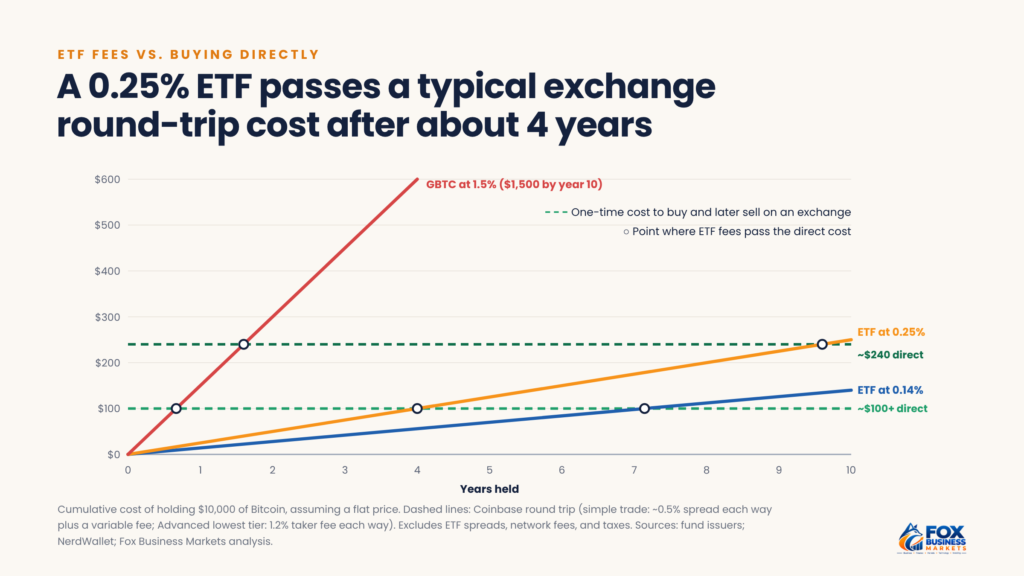
Cumulative cost of holding $10,000 of Bitcoin through ETFs versus buying directly
For a 0.25% fund such as IBIT or FBTC, the annual fees overtake a $100 round-trip exchange cost after about four years (longer if your exchange also charges a transaction fee), and a $240 cost after nearly 10 years. A 0.14% fund takes about seven years to pass the $100 mark. GBTC’s fee overtakes either direct option within two years.
Holding your own coins means managing keys and taking on the risk of losing them. Many investors accept a small annual fee for the simplicity and protections of a brokerage account.
How Are Bitcoin ETFs Taxed?
Most spot Bitcoin ETFs are structured as grantor trusts. For tax purposes, that generally means you’re treated as owning a share of the fund’s Bitcoin:
- Selling shares: Gains or losses are capital gains or losses, long term if you held more than a year.
- Fund expenses: The fund sells small amounts of Bitcoin to pay its fees, which can create tiny taxable gains or losses that show up on your tax documents.
- Wash sales: It’s unsettled whether the wash sale rule applies to grantor-trust Bitcoin ETFs. Some tax advisors treat the shares as securities subject to the rule, while others say the IRS looks through to the Bitcoin, which isn’t covered. If you sell at a loss and buy the same fund back within 30 days, check with a tax professional before claiming the loss.
- Retirement accounts: In an IRA, gains grow tax-deferred, or tax-free in a Roth IRA if you meet the rules.
- Reporting: Your broker reports sales on Form 1099-B, as with other investments.
Some funds also send a separate grantor trust tax statement. A tax professional can help if your situation is complicated.
What Are the Risks of Bitcoin ETFs?
An ETF wrapper makes Bitcoin easier to own, but it doesn’t make it safer:
- Price swings: ETF shares move with Bitcoin, which has fallen more than 50% several times since 2017, most recently from its October 2025 record close of about $124,700 to below $60,000 in 2026.
- Weekend gaps: Large moves while the stock market is closed can hit your shares all at once.
- Fees: Annual fees reduce returns, especially in GBTC.
- Custody concentration: Most funds rely on the same custodian. A major security failure could affect several funds at once, though custodians keep most coins offline and carry some insurance.
- Tracking differences: Shares can trade slightly above or below the value of the fund’s Bitcoin, especially during volatile periods.
- No coin access: You can’t withdraw Bitcoin from the fund or use it on a blockchain.
- Regulatory change: Future rules for crypto or ETFs could affect how the funds operate.
ETF shares are generally covered by Securities Investor Protection Corp. (SIPC) protection if your brokerage fails, but SIPC doesn’t protect against investment losses.
Is It a Myth That ETF Inflows Drive Bitcoin’s Price?
Partly. Big inflows and rising prices often happen together, which makes flows look like the cause. The largest daily inflow on record, $1.37 billion on Nov. 7, 2024, came right after the U.S. presidential election, as Bitcoin rallied.
But the relationship runs both ways. Investors tend to buy after prices rise and sell after they fall. When Bitcoin hit its record in October 2025, inflows were strong. As prices fell, outflows followed, with billions of dollars leaving in late 2025.
ETF demand is one force among many. Bitcoin also trades on global exchanges around the clock, and large holders, leveraged traders, and long-term owners all move the price when they buy or sell. Treat daily flow headlines as a sign of sentiment, not a reliable forecast.
Who Might Prefer a Bitcoin ETF Over Owning Coins?
The right choice depends on what you want Bitcoin for. An ETF usually fits better if you:
- Want Bitcoin exposure inside an IRA or other tax-advantaged account.
- Already use a brokerage account and want all your investments in one place.
- Don’t want to manage private keys, seed phrases, or hardware wallets.
- Plan to hold for a few years and don’t expect to trade on weekends.
- Want a straightforward way to leave the investment to heirs through your normal account beneficiaries.
Owning Bitcoin directly usually fits better if you:
- Want to send, spend, or use Bitcoin on a blockchain.
- Plan to hold for a decade or longer and are comfortable securing your own wallet.
- Want to trade at any hour, including weekends and holidays.
- Prefer not to depend on a fund sponsor or custodian.
Some investors do both, holding an ETF in a retirement account and a smaller amount of coins in their own wallet.
How Can You Choose a Bitcoin ETF?
If you’ve decided to invest, a few steps help narrow the choice:
- Compare expense ratios. For a long-term holding, a fee difference of 0.1 percentage point adds up over the years. Check for fee waivers and when they end.
- Check size and trading volume. Larger funds tend to have tighter bid-ask spreads.
- Look at the sponsor and custodian. Established firms with clear custody arrangements reduce operational risk.
- Decide on the account. Holding the fund in an IRA can defer taxes on gains, or avoid them in a Roth IRA.
- Size your position. Many investors keep crypto to a small share of their investment portfolio.
- Use limit orders. They help you avoid buying at a poor price, especially near the market open after a weekend.
- Plan for volatility. Decide in advance how you’ll react to a 30% or 50% drop.
You buy Bitcoin ETF shares the same way you buy any stock. Our guide to how to buy stocks walks through accounts and order types.
Frequently Asked Questions
Do Bitcoin ETFs pay dividends?
No. Bitcoin doesn’t generate income, so spot Bitcoin ETFs don’t pay dividends or interest. Your return comes only from changes in Bitcoin’s price, minus fees. Tip: If you want income, look to dividend stocks or bonds rather than Bitcoin funds.
Do Bitcoin ETFs have a minimum investment?
No, beyond the price of one share, and many brokers let you buy fractional shares for as little as $1 or $5. Share prices differ from fund to fund, so the price of one share says nothing about a fund’s value. Tip: Compare funds by expense ratio and size, not by share price.
Are there ETFs for other cryptocurrencies?
Yes. Spot Ether ETFs began trading in July 2024, and after the SEC approved generic listing standards in September 2025, ETFs tied to other crypto assets, including Solana and XRP, followed. These funds tend to be smaller and can be more volatile. Tip: Compare fees and trading volume carefully, since smaller crypto ETFs may cost more to trade.
Can you trade options on Bitcoin ETFs?
Yes. Options on IBIT began trading in November 2024, and options are now available on several other Bitcoin ETFs. Options can be used to hedge or to speculate, but they carry extra risks. Tip: Learn how options work, and start small, before using them with a volatile asset like Bitcoin.
Weigh Convenience Against Cost Before You Buy
Spot Bitcoin ETFs make it easy to add Bitcoin to a brokerage account or IRA, with professional custody and familiar tax forms. But they don’t trade on weekends, they charge annual fees, and they rise and fall with one of the most volatile assets in the market.
If you invest, pick a low-cost fund, hold it in the right account, keep your position small, and be ready for sharp swings.
This article is for general information only and isn’t financial, tax, legal, or investment advice. Consider your own situation or talk to a qualified professional before making decisions.

