Quick answer: Series E funding is a startup’s fifth lettered round of venture capital, after Series A through D. Companies usually raise it when they need more money before an initial public offering (IPO) or sale. In the first quarter of 2026, the median Series E or later round valued companies at about $1.1 billion, according to Carta.
Coding startup Cognition raised more than $2 billion in a Series E round in September 2026 at a $48 billion valuation, nearly double the $26 billion it was worth at its Series D less than four months earlier, according to Dealroom. Rounds that size are no longer unusual: Crunchbase counted a record 27 rounds of $1 billion or more in the third quarter of 2026.
Many companies that reach Series E aren’t headline artificial intelligence (AI) firms, though. They’re mature startups that have stayed private longer, sometimes because the IPO market was weak or private investors offered better terms. For founders, employees with stock options, and investors, the terms of a Series E reveal more than its size.
What Is Series E Funding?
Series E funding is the fifth round of priced equity financing after a startup’s seed stage. The letters follow a simple sequence:
- Series A: The first major round, used to build a repeatable business.
- Series B: Money to scale sales, marketing, and teams.
- Series C: Growth capital for expansion, often into new markets.
- Series D: Additional growth funding, or a bridge when a company needs more time.
- Series E: A later round for companies that have stayed private beyond the usual path.
No rule says what a Series E must be used for. The letter only shows how many priced rounds came before it. Some companies go public after Series C, while others raise Series F, G, or beyond.
In each priced round, investors buy newly issued preferred shares at a set price. That price determines the company’s valuation and how much existing owners are diluted. Our guide to startup funding stages covers the earlier rounds in more detail.
How Do Valuations Change From Seed to Series E?
Valuations generally rise with each round, but not at a steady pace. We compared Carta’s median post-money valuations by stage for the first quarter of 2026 and calculated the jump from each stage to the next:
Stage | Median post-money valuation | Increase from prior stage |
| Seed | $21.6 million | — |
| Series A | $63 million | 2.9x |
| Series B | $177 million | 2.8x |
| Series C | $385 million | 2.2x |
| Series D | $459 million | 1.2x |
| Series E and later | $1.1 billion | 2.4x |
Post-money valuation is the company’s value right after the new money comes in.
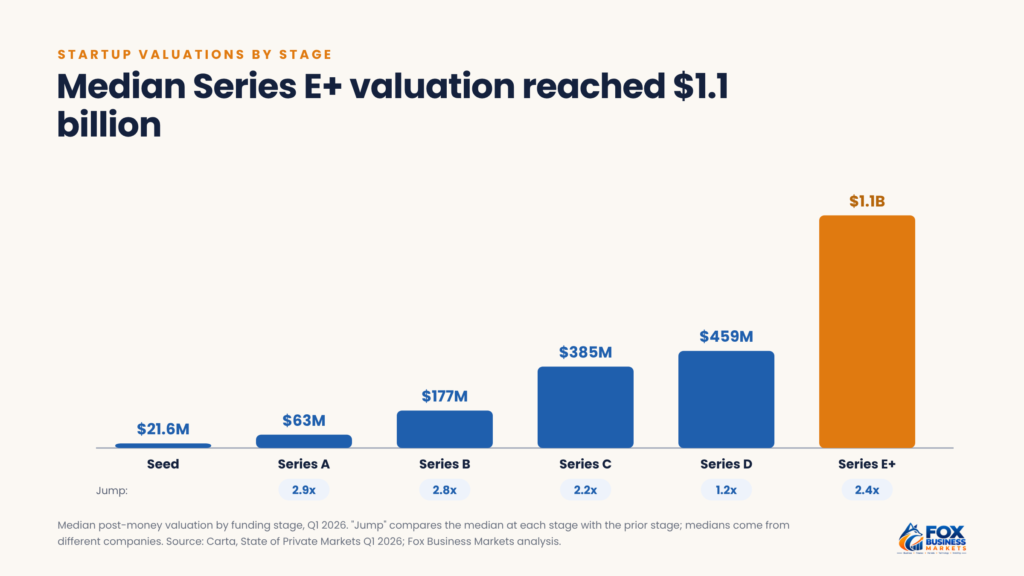
Medians for each stage come from different companies, so the “increase” shows the gap between typical companies at each stage, not the growth of any single company. Source: Carta, State of Private Markets Q1 2026; Fox Business Markets analysis.
Median startup valuation by funding stage, Q1 2026
Valuations rose only 1.2x from Series C to Series D but 2.4x from Series D to Series E and later. Carta found that 15% of Series D rounds in 2025 were bridge rounds, which are often raised to buy time. Quarterly medians at these stages rest on a few dozen deals and can swing widely: Carta’s median Series E-and-later valuation was nearly $3 billion in the fourth quarter of 2025, and its 12-month median for Series D was $540 million. Companies that make it to Series E tend to be the larger survivors, which pushes the median above $1 billion.
How Big Are Series E Rounds in 2026?
Late-stage rounds have grown sharply, driven largely by AI. Carta reported 32 Series E and later rounds among companies on its platform in the first quarter of 2026, up 14% from 28 a year earlier. The average round size at that stage rose from $98.1 million to $165.3 million, up about 69%.
Averages are pulled up by a handful of giant deals. The latest median Carta reported, for the fourth quarter of 2025, was $79.5 million per Series E-and-later round, a better guide to a typical round than the average. Estimates vary by source: some industry benchmarks that include the largest AI deals put a typical Series E closer to $200 million.
Four Series E rounds announced in 2026 show the range:
Company | What it does | Series E amount | Valuation | Announced |
| Cognition | AI coding agents | More than $2 billion | $48 billion | September 2026 |
| Sierra | AI customer service agents | $950 million | $15.8 billion | May 2026 |
| Temporal | Software that keeps apps running through failures | $550 million | $12.55 billion | September 2026 |
| Current | Consumer banking app | $80 million | $1.5 billion | June 2026 |
Sources: Dealroom (Cognition); Unite.AI (Temporal); Pulse 2.0 (Current); TechCrunch and Quartz (Sierra, post-money valuation).
Current’s round valued it below the $2.2 billion it reached in 2021, making it a down round.
Venture funding across the market reflects the same AI-driven shift. Global venture funding reached $159 billion in the third quarter of 2026, with $105 billion going to late-stage companies and a record 27 rounds of $1 billion or more, according to Crunchbase. AI companies took about 64% of venture dollars that quarter.
How Is Series E Different From Series D?
The line between Series D and Series E isn’t fixed, but a few patterns show up in the data and in deal terms:
| Series D | Series E and later | |
| Average round size, Q1 2026 | $152.9 million | $165.3 million |
| Number of rounds, Q1 2026 | 33 | 32 |
| Typical investors | Growth funds, existing investors | Growth funds, crossover funds, private equity, sovereign funds |
Source: Carta, State of Private Markets Q1 2026, covering companies on its platform. Typical investors: Fox Business Markets.
Many companies plan for Series D to be their last round before an IPO or sale. By Series E, a company has usually either grown big enough to attract large new investors or needs more time than its original plan allowed. Average round sizes were within about 8% of each other, so the bigger gap between the stages is valuation.
For a company deciding whether to raise again, the questions are practical: How much runway is left, can it reach profitability without new money, and would public investors pay more or less than private ones? Our startup statistics cover funding and survival data for U.S. startups.
Why Do Companies Raise a Series E?
A Series E usually means a company is past the startup stage but not ready, willing, or able to go public. Common reasons include:
- A delayed IPO: If public markets are weak, a company may raise privately instead of listing at a lower price.
- Expensive growth: AI companies need huge sums for computing power, chips, and data centers.
- Expansion: Money to enter new countries, build new products, or buy other companies.
- More runway: A company that hasn’t reached profitability may need cash to get there.
- Employee liquidity: Some rounds include a tender offer, which lets employees and early investors sell shares.
- Strategic investors: A company may bring in a large partner, such as a chipmaker or cloud provider, that also becomes a customer or supplier.
The reason is usually spelled out in the company’s announcement, but the terms often aren’t. Without the terms, outsiders can’t always judge how healthy the company is.
Who Invests in Series E Funding Rounds?
Series E investors are usually larger and more varied than those in early rounds:
- Late-stage venture funds: Firms that specialize in growth companies, such as Andreessen Horowitz’s growth fund or Lightspeed.
- Crossover funds: Investors such as Tiger Global or Wellington Management that buy both private and public stocks and often plan to hold shares after an IPO.
- Private equity firms: Firms that may use structured terms to limit their risk.
- Sovereign wealth funds: Government-backed funds from countries such as Saudi Arabia, the United Arab Emirates, and Singapore.
- Corporate investors: Big tech and industry companies that invest for strategic reasons.
- Existing investors: Earlier backers often put in more money to keep their ownership from shrinking.
When AI coding startup Cognition raised more than $2 billion in its September 2026 Series E, the round was led by Andreessen Horowitz and Accel, both new investors in the company. Temporal’s round was led by Lightspeed, with Wellington Management, Growth Equity at Goldman Sachs Alternatives, and Tiger Global as co-leads. Sierra’s round was led by Tiger Global and GV.
Is Series E Funding a Good or Bad Sign?
It can be either. The letter alone doesn’t tell you much, so look at the details:
Signs of strength | Signs of strain |
| Valuation well above the last round | Valuation flat or lower than the last round (a down round) |
| New, well-known lead investors | Only existing investors putting in more money |
| Fast-growing revenue | Slowing growth or rising losses |
| Clear use of funds, such as expansion | Vague plans or repeated “extensions” |
| Standard terms | Heavy investor protections, such as large liquidation preferences |
Bridge rounds, which are raised on top of an earlier round to buy time rather than fund a big new push, can be a warning sign. Carta found that 20% of Series E-and-later rounds in 2025 were bridge rounds, about twice the average rate of the past seven years, compared with 15% at Series D.
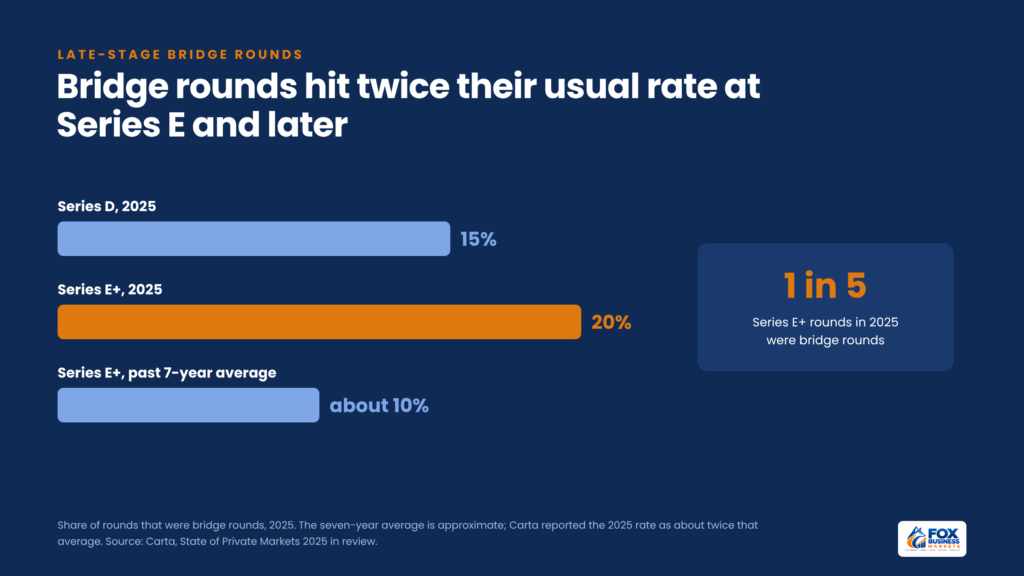
Share of late-stage rounds that were bridge rounds, 2025
Down rounds were less common overall in early 2026. Carta said they made up 11.4% of all rounds in the first quarter, compared with under 14% in the fourth quarter of 2025.
How Does Series E Funding Affect Founders and Employees?
Every new round issues new shares, which shrinks the percentage owned by everyone else. This is called dilution. At Series E, the dilution from a single round is often modest because the valuation is high relative to the amount raised.
We estimated the share of each company sold in four 2026 Series E rounds by dividing the amount raised by the reported valuation:
Company | Amount raised | Reported valuation | Estimated share sold |
| Cognition | More than $2 billion | $48 billion | At least 4.2% |
| Sierra | $950 million | $15.8 billion | 6.0% |
| Temporal | $550 million | $12.55 billion | 4.4% |
| Current | $80 million | $1.5 billion | 5.3% |
Assumes reported valuations are post-money and the full amount bought newly issued shares. Tender offers, secondary sales, and option pool changes can change the real figure. Fox Business Markets analysis.
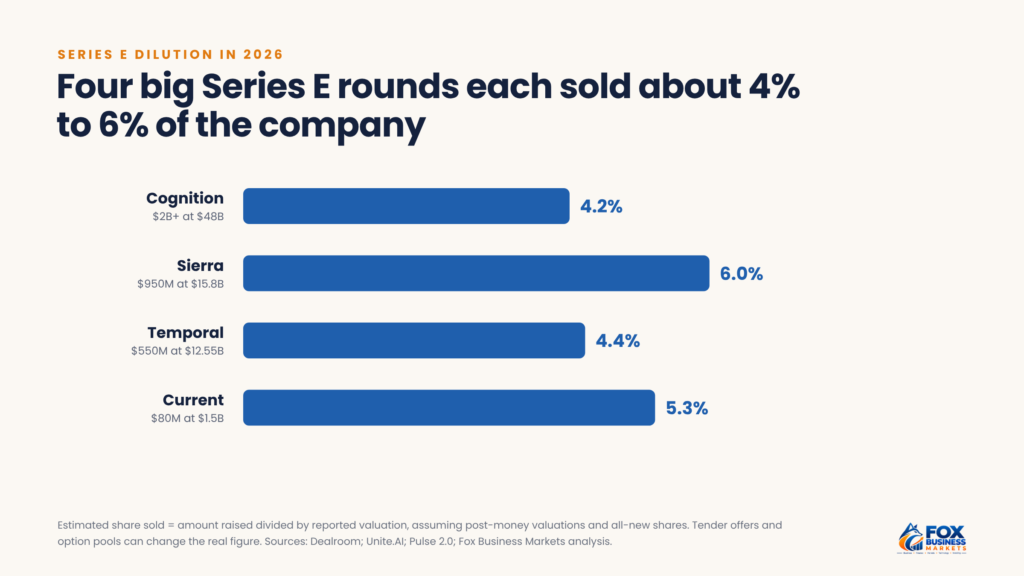
Estimated share of company sold in 2026 Series E rounds
A 4% to 6% stake per round sounds small, but dilution compounds. An employee who owned 0.5% of a company after its Series A could own about 0.26% after four more rounds if each sold 15% of the company, a hypothetical example, even if the value of those shares rose.
For employees with stock options, a few other points come into play:
- Liquidation preferences: If a company sells for less than expected, late-stage investors are paid first, and common shareholders, including employees, may receive little.
- Tender offers: Some Series E rounds let employees sell part of their shares, offering cash before an IPO.
- Option exercise costs: A higher valuation can raise the 409A valuation (an independent appraisal of common stock’s fair market value required under Section 409A of the tax code). That means higher strike prices on new option grants and a bigger taxable gain when you exercise existing options.
If you hold startup equity, ask for the company’s capitalization table and the terms of the latest round. A startup valuation estimator can help you model scenarios, but it can’t replace the actual documents.
What Terms Show Up in Late-Stage Rounds?
Late-stage investors often negotiate protections that early investors don’t get. Common ones include:
- Liquidation preference: The right to be paid back before common shareholders in a sale. A 1x preference is standard; higher multiples protect investors further.
- Participating preferred stock: Investors get their money back and also share in the remaining proceeds.
- IPO ratchet: If the company goes public at a lower price than the investor paid, the investor gets extra shares.
- Anti-dilution protection: If a future round is priced lower, the investor’s share price is adjusted downward.
- Redemption rights: The right to require the company to buy back shares after a set period.
These terms can make a headline valuation look better than the reality for common shareholders. A company might accept a higher price with tougher terms rather than a lower price with standard ones.
Is It a Myth That a Series E Means an IPO Is Close?
Yes. Many companies raise a Series E precisely because an IPO isn’t close. Some raise Series F, G, and later rounds and stay private for years.
Private funding has grown large enough that some companies don’t need public markets for capital. Global late-stage startups raised $105 billion in the third quarter of 2026 alone, according to Crunchbase. Other companies use late rounds to avoid going public in a weak market.
What Comes After Series E?
Companies that raise a Series E usually follow one of these paths:
- IPO: The company lists shares on a stock exchange, giving investors and employees a way to sell.
- Acquisition: A larger company buys the startup. Our guide to mergers and acquisitions explains how these deals work.
- More private rounds: Series F, G, and beyond, or structured deals with private equity firms.
- Secondary sales: Investors and employees sell existing shares to new buyers without the company raising money.
- Down round or restructuring: If growth stalls, the company may raise at a lower valuation or cut costs.
- Shutdown: Some late-stage companies still fail.
How We Analyzed the Data
We used Carta’s State of Private Markets reports for the first quarter of 2026 and full-year 2025, which cover startups that use Carta for equity management. We calculated the increase in median valuation between stages and estimated the share sold in four 2026 Series E rounds by dividing the amount raised by the reported valuation. Carta’s medians compare different companies at each stage, and published valuations may be pre-money or post-money, so these figures are estimates. Deal examples come from company announcements and news reports, and Carta’s data may not represent companies that don’t use its platform. The figures describe recent deals, not what any company should expect.
Frequently Asked Questions
Can individual investors buy into a Series E round?
Usually not directly. Series E rounds are private offerings open mainly to institutional investors and, in some cases, accredited investors, who generally must meet income or net worth tests (such as $200,000 in annual income, or $1 million in net worth excluding a primary home) or hold certain financial licenses. Some individuals get exposure through venture funds, secondary marketplaces, or publicly traded funds that hold private stakes. Tip: Expect high fees and long lockups with private-company investments, and check how a fund values its holdings.
What does Series E-1 or E-2 mean?
These labels usually mark extensions of a Series E round. A company may raise more money on similar terms months after the first close and call it Series E-1, or sell shares at a slightly different price in a separate tranche. Tip: If you hold equity, ask how each extension’s terms and price compare with the original round.
How long does it take to close a Series E?
It varies. Large late-stage rounds can take several months because investors review detailed financials, legal documents, and growth plans, and some include multiple closings. A competitive round led by eager investors can move much faster. Tip: Start conversations with investors at least six months before you’ll need the cash.
Do companies that raise a Series E have to disclose their finances?
Not publicly in the way listed companies do. Private companies share financial details with their investors under the terms of their agreements, but they don’t file quarterly reports with the Securities and Exchange Commission (SEC). Companies that rely on the SEC’s Regulation D exemption, as most venture rounds do, must file a short Form D notice within 15 days of the first sale, but it discloses little financial information. Tip: Treat press releases as marketing, and rely on investor reports or audited figures when you can get them.
Read the Terms, Not Just the Valuation
A Series E shows that a company has raised a lot of money and stayed private longer than most. A big valuation can hide terms that favor late investors over founders and employees.
If you’re raising, investing, or holding equity, look past the headline number. Check the valuation change from the last round, who’s leading the deal, whether it’s a bridge, and what protections new investors received. For a company still in its growth years, our guide to how to build a startup covers each funding stage.
This article is for general information only and isn’t financial, tax, legal, or investment advice. Consider your own situation or talk to a qualified professional before making decisions.

