


Startup funding stages are the rounds a company goes through as it raises money from investors, from a small pre-seed check to a public listing. Each stage has a typical size, a typical valuation, and a typical share of the company that founders give up. Knowing these numbers before you pitch helps you raise the right amount, at the right time, without giving away more than you need to.
The stakes are high right now. US venture deal value reached $515.8 billion through the first three quarters of 2026, with AI companies taking a record 82.7% share (PitchBook-NVCA). This guide explains each of the startup funding stages, with the latest median round sizes, valuations, and dilution from US startup data.
Key Takeaways
- A typical seed round in 2026 raised $4.1 million at a $24.3 million median valuation, based on Carta data.
- Median dilution was 18% at both seed and Series A, then fell to 12% at Series B and under 10% at Series C.
- The median gap between a seed round and a Series A was 1.9 years at the end of 2025.
- Most startups never reach the later stages. Plan each round around clear milestones, not a fixed schedule.
How We Researched This
We used data from Carta, which tracks thousands of startup cap tables; Crunchbase and PitchBook-NVCA for funding totals; Renaissance Capital for the IPO market; and Y Combinator for how SAFEs work. Carta’s stage medians cover more than 1,000 software rounds raised in the six months before July 2026. We note the date of every figure and link to each source.
Startup Funding Stages at a Glance
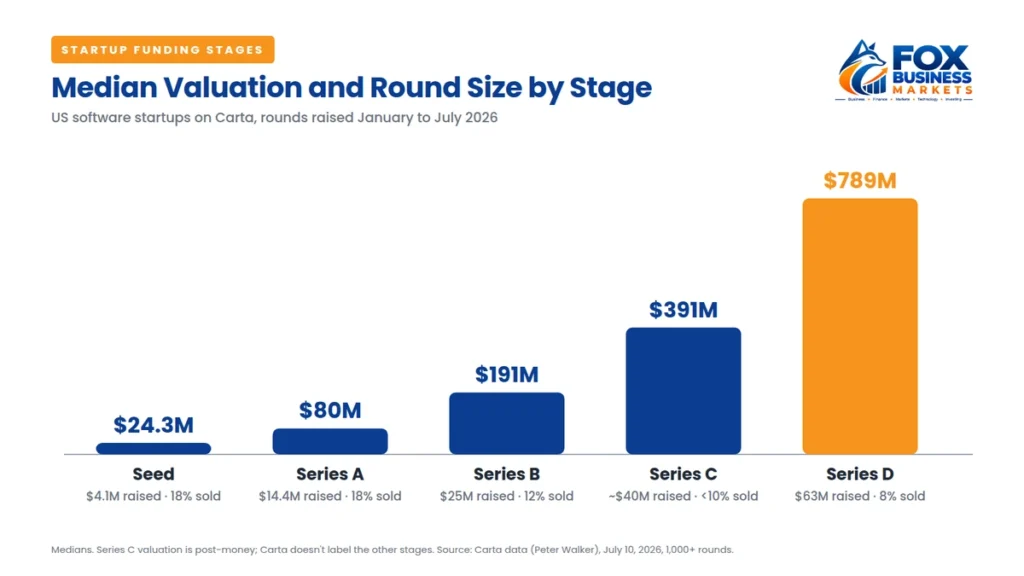
Here’s what a typical round looked like at each stage in 2026, based on Carta’s medians for US software startups (Carta):
| Stage | Median amount raised | Median valuation | Share of company sold |
| Pre-seed | About $276,000 (average) | Varies widely | Varies |
| Seed | $4.1 million | $24.3 million | 18% |
| Series A | $14.4 million | $80 million | 18% |
| Series B | $25 million | $191 million | 12% |
| Series C | Nearly $40 million | $391 million (post-money) | Under 10% |
| Series D | $63 million | $789 million | 8% |
Pre-seed figure is the average instrument size in Q2 2026 (Carta). Other figures are medians for rounds raised in roughly January to July 2026. Medians vary a lot by industry and location.
The 7 Startup Funding Stages Explained
1. Pre-Seed: Proving the Idea
Pre-seed is the first outside money, usually used to build a first product and test whether customers want it. It often comes from the founders themselves, friends and family, angel investors, or accelerators.
Rounds are small. US startups on Carta raised $3.19 billion across more than 11,500 pre-seed instruments in Q2 2026, and the average instrument was $276,000 (Carta). Accelerators fit here too. Y Combinator, for example, invests $500,000 in each company it accepts (Y Combinator).
Most pre-seed money is raised with a SAFE (simple agreement for future equity). Y Combinator introduced the SAFE, and its post-money version lets founders “calculate immediately and precisely how much ownership of the company has been sold” (Y Combinator). The SAFE turns into shares later, usually at the next priced round.
What investors want to see: a strong founding team, a clear problem, and early signs of demand.
2. Seed: Finding Product-Market Fit
Seed money helps a startup turn an early product into something customers pay for regularly. In 2026, the median seed round raised $4.1 million at a $24.3 million valuation, and founders sold a median of 18% of the company (Carta).
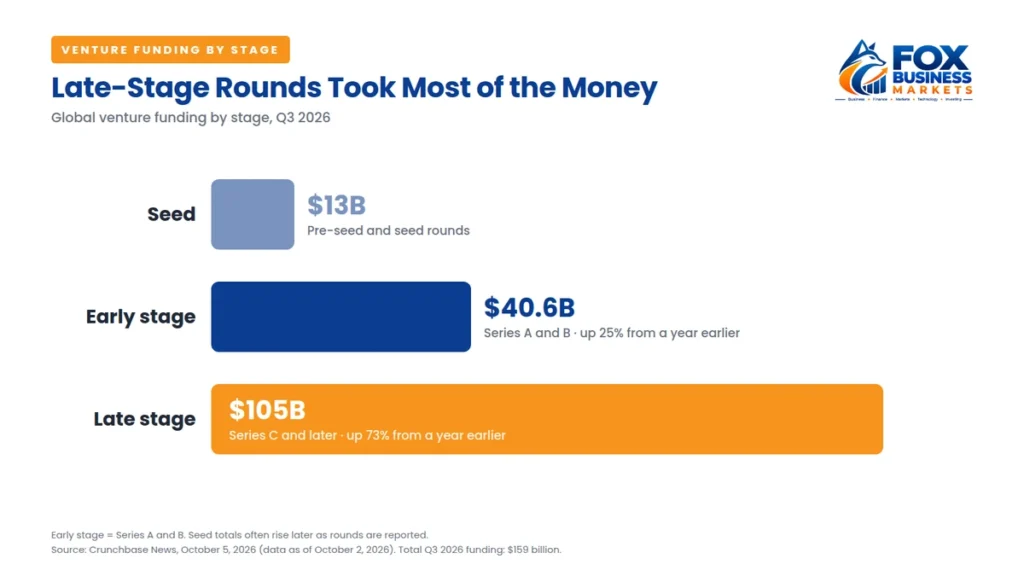
Seed investors include angel investors, seed-stage venture funds, and sometimes larger funds. Globally, seed rounds raised $13 billion in Q3 2026 (Crunchbase News).
What investors want to see: real users or early revenue, and proof that the product solves the problem well.
3. Series A: Building a Repeatable Business
Series A is usually the first large priced round led by a venture capital firm. The goal is to turn early traction into a business that can grow in a repeatable way. The median Series A in 2026 raised $14.4 million at an $80 million valuation, with 18% dilution, the lowest in several years (Carta).
Getting from seed to Series A is the hardest jump. The median time between the two rounds was 1.9 years in Q4 2025 (Carta). Among 3,000+ US startups on Carta that raised a Series A in 2025, only 15% did so less than a year after their previous round, and 39% waited three years or more (Carta).
What investors want to see: steady revenue growth, strong customer retention, and a clear plan for using the money.
4. Series B: Scaling Up
At Series B, a startup has a working business model and needs money to grow faster: more sales staff, new markets, and a bigger product team. The median Series B in 2026 raised $25 million at a $191 million valuation, and founders sold a median of 12% of the company.
What investors want to see: proof that more spending leads to predictable growth, and improving unit economics.
5. Series C: Expanding the Business
Series C funds expansion into new markets, new products, or acquisitions. The median Series C in 2026 raised nearly $40 million at a $391 million post-money valuation, with companies selling less than 10% of themselves. Investors at this stage often include growth equity firms, hedge funds, and corporate investors.
What investors want to see: a market leader, or a clear path to becoming one, and a realistic route to profit.
6. Series D and Later: Late-Stage Growth
Not every company raises a Series D. Those that do are often preparing for an IPO or a large acquisition, or need more time to reach their goals. The median Series D in 2026 raised $63 million at a $789 million valuation, with 8% of the company sold.
Late-stage rounds take most of the money. Globally, late-stage startups raised $105 billion in Q3 2026, compared with $40.6 billion for early-stage rounds and $13 billion for seed (Crunchbase News).
7. IPO or Acquisition: The Exit
The final stage is an exit, when investors and founders can turn their shares into cash. The two main paths are an initial public offering (IPO), where the company lists its shares on a stock exchange, and an acquisition by a larger company.
In the US, 30 companies went public in the third quarter of 2026, raising $32.8 billion, according to Renaissance Capital (Renaissance Capital). Only 18 of those listings came from venture-backed companies, most of them in healthcare (PitchBook-NVCA). For most startups, an acquisition is the more common exit.
SAFEs, Convertible Notes, and Priced Rounds
Across the startup funding stages, money usually comes in one of three forms:
- SAFE (simple agreement for future equity): The investor gives money now and gets shares later, usually when the startup raises a priced round. SAFEs are quick and cheap to sign, which is why they dominate pre-seed and many seed rounds.
- Convertible note: Similar to a SAFE, but it’s technically a loan. It usually carries an interest rate and a maturity date, and it converts into shares at a later round.
- Priced round: The company and investors agree on a valuation, and investors buy shares at a set price. Most Series A rounds and every later stage are priced rounds, and they usually come with a board seat and more detailed legal terms.
A SAFE or note is simpler at first, but it still dilutes you when it converts. Keep a running total of every SAFE you sign so you know how much of the company you’ve already promised away before your first priced round.
How Much of the Company Do Founders Keep?
Every round shrinks the founders’ share as a company moves through the startup funding stages. Using Carta’s 2026 medians, here’s how ownership could change for founders who start with 100% of the company:
| After this round | Share sold | Founders’ approximate share |
| Seed | 18% | 82% |
| Series A | 18% | 67% |
| Series B | 12% | 59% |
| Series C | About 10% | 53% |
| Series D | 8% | 49% |
Simplified example. Real ownership is usually lower because of employee option pools, SAFEs, and convertible notes.
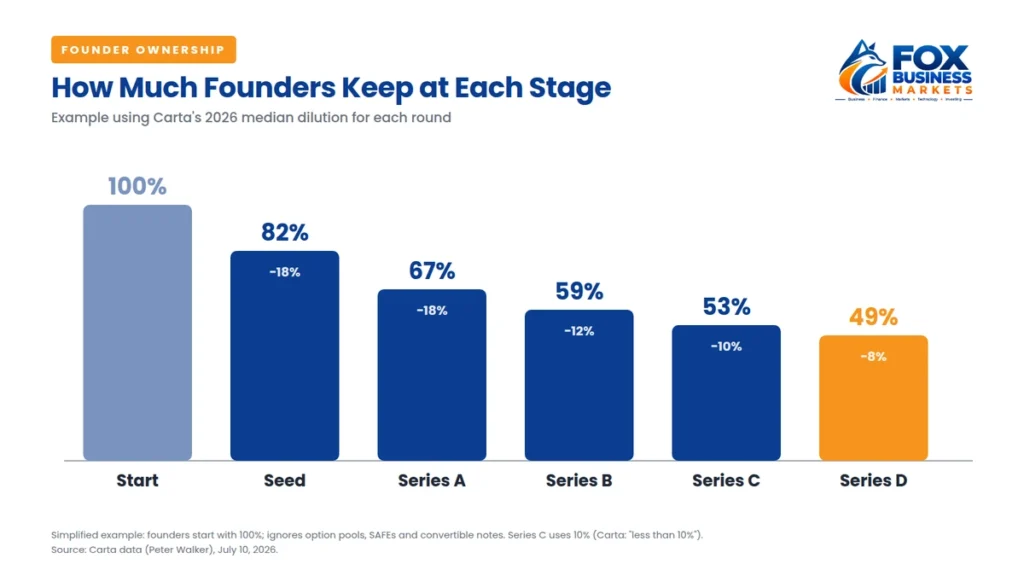
A smaller share isn’t necessarily bad. In this example, the company’s value grows from $24.3 million at seed to $789 million at Series D, so a 49% stake could be worth far more than 100% of the early company. Our business ownership calculator shows how much you keep after any investment.
How to Choose the Right Funding Stage for Your Startup
Understanding the startup funding stages is only half the job. The other half is deciding when to raise:
- Raise for milestones, not for time. Raise enough to reach the proof the next investors will want, plus a safety cushion.
- Don’t raise more than you need. More money often means more dilution and pressure to grow faster than the business can handle.
- Know your runway. Running out of capital was the most common final cause in CB Insights’ 2026 study of failed startups, cited by 70% of them (CB Insights).
- Consider skipping venture capital. Many strong companies never move through the startup funding stages at all. See our list of bootstrapped companies that grew on customer revenue.
If you’re still at the idea stage, start with our step-by-step guide on how to start a startup, and use our startup cost calculator to plan how much you need.
Frequently Asked Questions
What are the stages of startup funding?
The main startup funding stages are pre-seed, seed, Series A, Series B, Series C, later rounds such as Series D, and an exit through an IPO or acquisition. Each stage is larger than the last and comes with higher expectations from investors.
How much is a typical seed round?
Based on Carta data for US software startups, the median seed round in 2026 raised $4.1 million at a $24.3 million valuation.
How much equity do you give up in each round?
In 2026, median dilution was 18% at seed and Series A, 12% at Series B, under 10% at Series C, and 8% at Series D, based on Carta data.
How long does it take to go from seed to Series A?
The median time between a seed round and a Series A was 1.9 years at the end of 2025, according to Carta. Many startups take three years or more.
What is the difference between pre-seed and seed funding?
Pre-seed is usually the first, smallest round, used to build a product and test demand. Seed is larger and helps a startup reach product-market fit. Pre-seed often uses SAFEs, while seed can be a SAFE or a priced round.
Do all startups go through every funding stage?
No. Many startups raise one or two rounds and are then acquired, become profitable, or shut down. Others skip venture capital entirely and grow on their own revenue.
Final Takeaway
The startup funding stages follow a clear pattern: each round is bigger, the valuation is higher, and founders usually sell a smaller share. But the stages aren’t a checklist every company must complete. Raise only when the money helps you reach the next milestone, know how much of your company you’re giving up, and remember that the best round is often the one you don’t need.