

How to start a startup comes down to a simple order: find a real problem, prove people will pay to solve it, set up the company correctly, and only then raise money and grow. Most founders get the order wrong. They build first and look for customers later, and that is why so many startups fail before they ever find their market.
The timing is unusual. Global venture funding reached $159 billion in the third quarter of 2026, and AI startups took $102 billion of it, or 64% (Crunchbase News). Money is available, but it’s concentrated in fewer, bigger bets. This guide explains how to start a startup in the US, step by step, with the real costs, the funding options, and the mistakes to avoid.
Key Takeaways
- Validate demand before you build. In a 2026 study, 43% of failed startups had poor product-market fit.
- Investors usually expect US startups to be Delaware C corporations. Setting one up can cost as little as $500.
- Founders typically give up about 19% to 20% of the company in each of the seed and Series A rounds.
- Running out of cash is the most common final cause of failure, so plan your runway before you spend.
How We Researched This
We used primary sources wherever possible: funding data from Crunchbase and Carta, startup failure data from CB Insights, business formation data from the US Census Bureau, and rules and fees from the IRS, the State of Delaware, and the Small Business Administration, then organized it into a practical guide on how to start a startup. Every figure includes its date and a link to the source.
What Is a Startup?
A startup is a new company built to grow fast, usually by finding a repeatable way to sell a product to a very large market. That’s what separates it from a typical small business, which aims to be profitable and stable rather than to grow tenfold. A local bakery is a small business. A company building software that every bakery in the country could use is a startup.
The difference matters because it changes how you fund and run the business. Startups often lose money for years while they grow and rely on investors to cover the gap. Small businesses usually rely on the owner’s savings, loans, and early profits. If you’re learning how to start a startup, plan for that difference from day one.
The State of Startups in 2026
Americans keep starting companies at a high rate. They filed about 5.6 million applications to start a business in 2025 (Census Bureau via FRED), and 531,728 in August 2026 alone, seasonally adjusted (Census Bureau).
Venture money is flowing, but unevenly:
- $159 billion in global venture funding in Q3 2026, down 25% from $212 billion in Q2 (Crunchbase News)
- 64% of that went to AI startups
- $13 billion went to seed-stage rounds worldwide
- $24 million was the median seed valuation (post-money) in the US at the end of 2025, an all-time high (Carta)
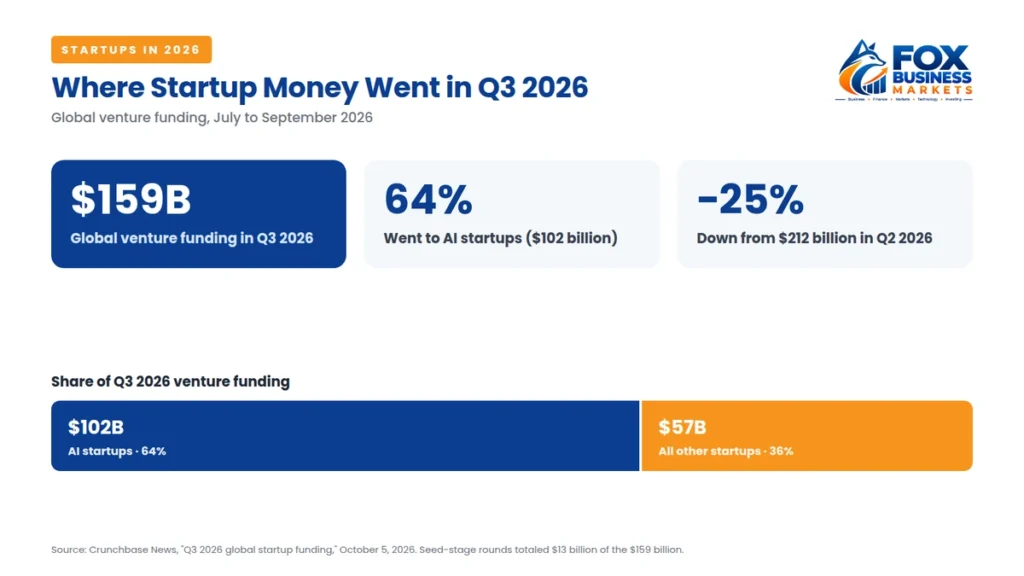
The takeaway for anyone figuring out how to start a startup: investors are paying more for strong early companies, but the bar to get funded is high. A clear problem and early proof that customers want your product matter more than ever.
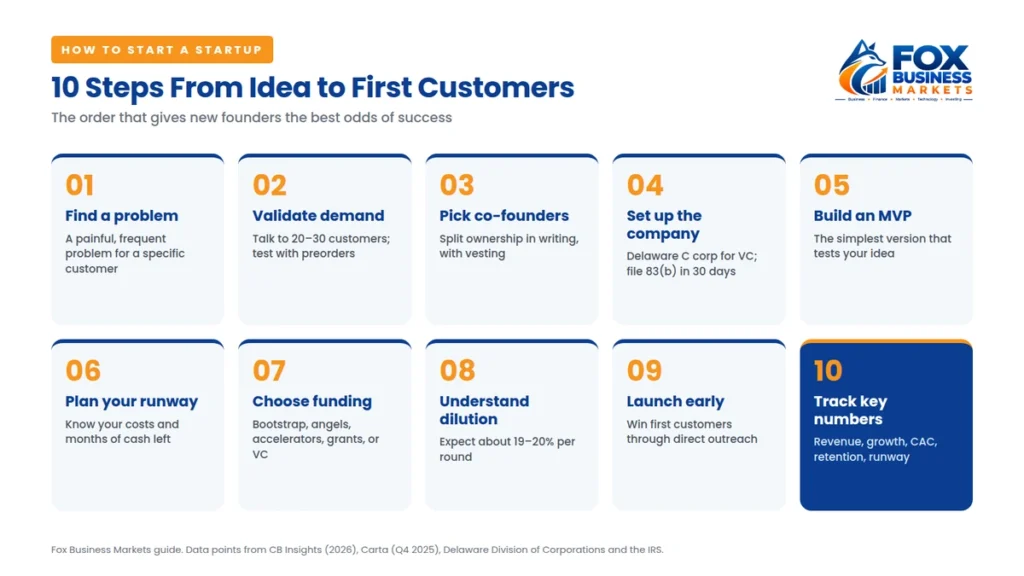
How to Start a Startup: 10 Steps
Here’s how to start a startup in the order that gives you the best chance of success.
1. Find a Problem Worth Solving
Start with a problem, not a product. The best startup ideas solve a painful, frequent problem for a specific group of people who already spend money or time trying to fix it. Look at your own work, your industry, or a group you know well. If you can name the customer, describe the problem in one sentence, and explain why current solutions fall short, you have a starting point.
2. Validate Demand Before You Build
This step is where most founders cut corners. In CB Insights’ March 2026 study of 431 venture-backed startups that shut down, 43% had poor product-market fit, meaning not enough people wanted what they built (CB Insights).
Talk to at least 20 to 30 potential customers before writing much code. Then test whether they’ll act: a waiting list, a landing page with a “buy” button, a preorder, or a paid pilot. People saying “I’d use that” is weak evidence. People paying, or giving you their time, is strong evidence.
3. Choose Co-Founders and Split Ownership
You can start alone. According to Y Combinator, “nearly one in five YC companies has a solo founder” (Y Combinator). But many founders pair up to cover more skills, such as one technical founder and one focused on sales.
Agree on ownership early and put it in writing. Use vesting, typically over four years, so a co-founder who leaves early doesn’t keep a large stake. Our business ownership calculator can help you find a fair starting split based on what each person contributes.
4. Set Up the Company the Right Way
For US founders who plan to raise venture capital, most investors expect a Delaware C corporation. More than two-thirds of Fortune 500 companies are incorporated in Delaware, and nearly 70% of US IPOs in 2025 chose the state (Delaware Division of Corporations). If you plan to stay small and self-funded, an LLC in your home state is often simpler and cheaper.
Key costs and deadlines to know:
| Item | Cost or deadline | Source |
|---|---|---|
| Stripe Atlas Delaware setup | $500 one-time, then $100 a year for a registered agent | Stripe |
| Delaware franchise tax | $175 minimum (Authorized Shares method) | Delaware |
| Delaware annual report fee | $50, due March 1 | Delaware |
| IRS 83(b) election | Must be filed within 30 days of receiving your shares | IRS |
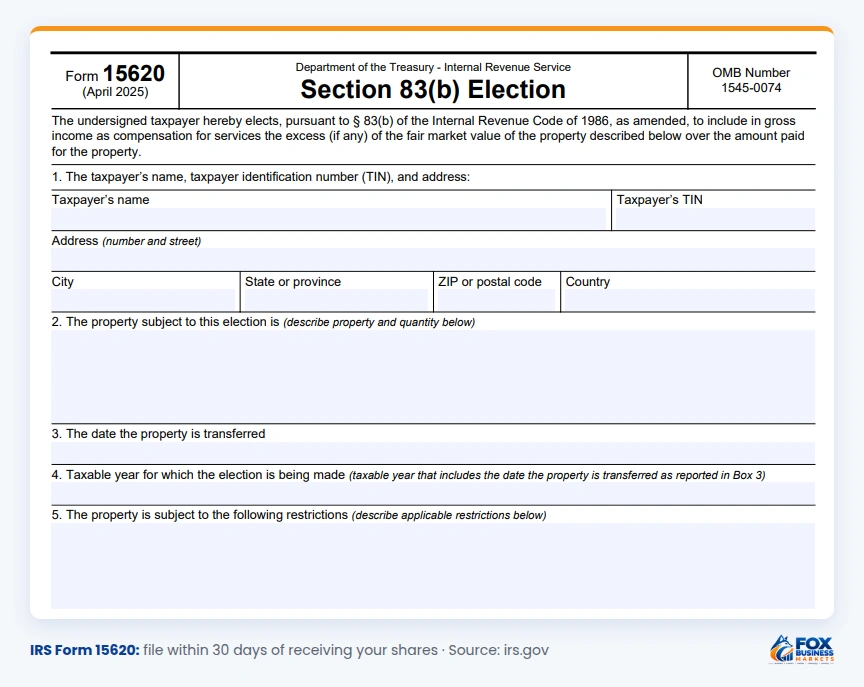
US founders shouldn’t miss the 83(b) deadline. Filing it on time can save you a large tax bill later when their shares rise in value. Talk to a lawyer or accountant before you sign your founder documents.
5. Build a Minimum Viable Product
A minimum viable product (MVP) is the simplest version of your product that solves the core problem. Its job is to help you learn, not to impress. Cut every feature that doesn’t help you test your main assumption. Many founders now use AI tools and no-code platforms to build a first version in weeks instead of months.
6. Estimate Your Costs and Runway
Running out of money is the most common final cause of startup failure. In the same CB Insights study, 70% of failed startups ran out of capital. Any plan for how to start a startup needs a budget. Before you spend, add up your one-time and monthly costs and work out your runway, meaning how many months you can operate before the money runs out.
Our guide on how much it costs to start a business breaks down typical expenses, and our startup cost calculator shows how much cash you need, including a safety cushion.
7. Choose How to Fund It
There’s no single right way to fund a startup. Here are the main options:
| Funding option | Typical amount | What you give up |
|---|---|---|
| Bootstrapping (your savings and revenue) | Whatever you can afford | Nothing; you keep full ownership |
| Friends and family | Small checks | Usually equity or a loan |
| Angel investors | Usually smaller than venture rounds | Equity, often through a SAFE |
| Accelerators (such as Y Combinator) | YC invests $500,000 | YC gets 7% for $125,000, plus more when you raise later |
| US government grants (SBIR/STTR) | Phase I awards up to $323,090 | No equity |
| Venture capital | Millions, at seed and beyond | Roughly 19% to 20% per round |
Sources: Y Combinator, SBIR.gov, Carta.
Venture capital isn’t the only path. Companies like Mailchimp and Atlassian grew for years on customer revenue alone. See how in our list of bootstrapped companies.
8. Understand Dilution Before You Raise
Every time you sell shares, your percentage of the company shrinks. According to Carta, median dilution at both seed and Series A is still between 19% and 20% (Carta). So founders who own 100% before a seed round might own about 80% after it, and about 64% after a Series A.
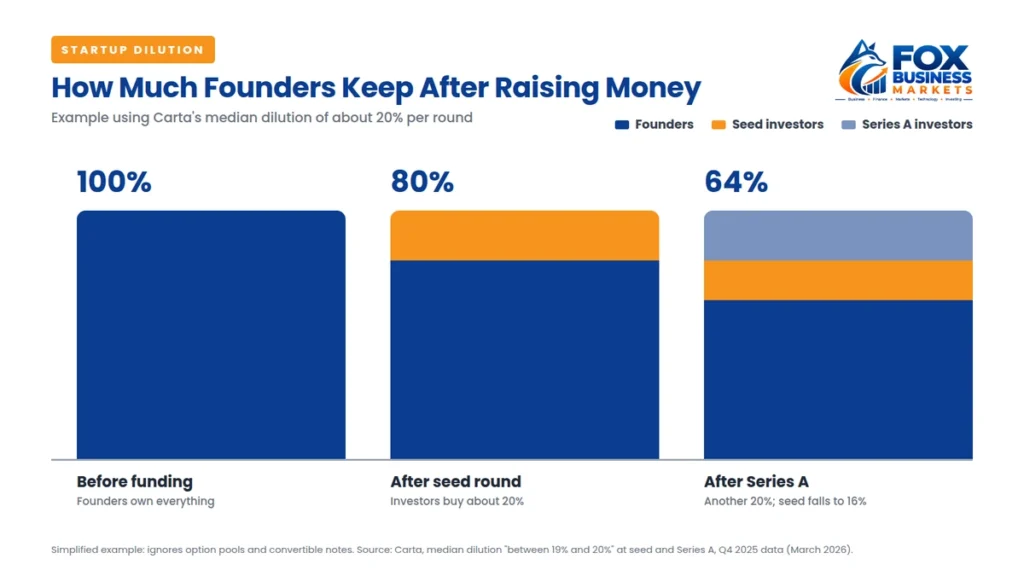
That’s not necessarily bad. A smaller share of a much more valuable company can be worth far more. But know the math before you sign. Our business ownership calculator shows how much you keep after an investment.
9. Launch and Win Your First Customers
Launch earlier than feels comfortable. Your first customers will usually come from direct effort: personal outreach, communities where your customers spend time, and partnerships, not paid ads. Ask every early customer what made them buy and what nearly stopped them. Their answers will shape your product and your marketing.
10. Track the Numbers That Matter
Once you have customers, track a few key numbers every month: revenue, growth rate, customer acquisition cost, retention, and how many months of cash you have left. Our business revenue calculator adds up revenue across products, and our business KPI calculator shows your margins and break-even point.
Common Mistakes to Avoid
Even founders who know how to start a startup on paper make these mistakes:
- Building before validating. Months of work on a product nobody wants is the most expensive mistake.
- Skipping the paperwork. A missed 83(b) election or an unwritten ownership split can cause serious problems later.
- Raising too much, too early. More money often means more dilution and pressure to grow faster than the business can handle.
- Ignoring runway. Know exactly when your money runs out, and start raising or cutting costs well before then.
For a deeper look at why companies close, read our guide on why small businesses fail.
Frequently Asked Questions
How to start a startup with no money?
Start with a problem you can test cheaply. Validate demand with conversations, a landing page, or preorders, and build a simple version with no-code or AI tools. Keep your job until you have paying customers, then consider accelerators, grants, or angel investors.
How much does it cost to start a startup?
It varies widely. Incorporating a Delaware corporation through Stripe Atlas costs $500, plus a $175 minimum franchise tax and a $50 annual report fee each year. Your biggest costs will usually be people, software, and marketing.
Should my startup be an LLC or a C corporation?
In the US, most investors expect a Delaware C corporation if you plan to raise venture capital. If you plan to grow on your own revenue, an LLC is often simpler. A lawyer or accountant can help you decide.
How much equity should I give investors?
It depends on your stage and valuation. Carta’s data shows founders typically sell about 19% to 20% of the company in each of the seed and Series A rounds.
What is an 83(b) election?
It’s a form you file with the IRS to pay tax on your founder shares when they’re worth very little, instead of later when they may be worth much more. It must be filed within 30 days of receiving the shares.
How long does it take to start a startup?
You can incorporate in a few days and build a simple MVP in weeks. Finding product-market fit usually takes much longer, often a year or more.
Final Takeaway
Knowing how to start a startup is less about having a brilliant idea and more about doing things in the right order. Prove demand first, set up the company correctly, know your runway, and raise money only when it helps you grow. The founders who follow that order give themselves the best odds in a market where money is plentiful but competition for it is fierce.