
Bootstrapped companies are businesses built on the founders’ own money and the cash their customers pay, not on investors’ checks. It sounds like the hard way to grow, but it’s how most American businesses begin. About 64% of US entrepreneurs used personal or family savings as their main source of startup money, while just 0.5% used venture capital, according to a Kauffman Foundation analysis of Census Bureau data (Kauffman Foundation).
A few of those self-funded businesses became worth billions. Below are five of the best-known bootstrapped companies, how they grew without outside money, and what happened next. Three never took a dollar from investors. Two waited years before they did.
Key Takeaways
- Bootstrapped companies grow on the founders’ savings and customer revenue instead of investor money.
- Mailchimp, Zoho, and Plenty of Fish never took outside investment. Mailchimp sold for about $12 billion.
- Atlassian and GitHub bootstrapped for years and raised money only after they were profitable.
- What they shared: early paying customers, low costs, and patience.
What Is a Bootstrapped Company?
A bootstrapped company is one that funds its growth from the founders’ savings and its own revenue instead of selling shares to venture capitalists or other investors. The founders keep full ownership and control, but they can only spend what the business earns. That limit forces them to find paying customers early and stay profitable.
Some companies stay bootstrapped forever. Others bootstrap for years, then raise money once they’re already profitable and can set their own terms.
5 Bootstrapped Companies at a Glance
| Company | Founded | Outside money | Where it ended up |
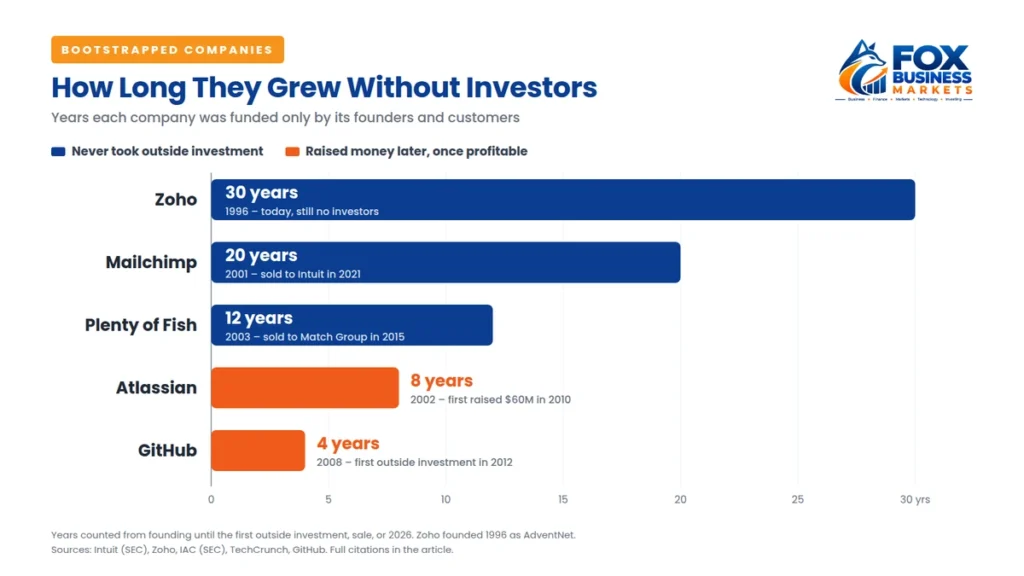
| Mailchimp | 2001 | Never | Sold to Intuit for about $12 billion (2021) |
| Zoho | 1996 | Never | More than 1 million paying customers (2026) |
| Plenty of Fish | 2003 | Never | Sold to Match Group for $575 million in cash (2015) |
| Atlassian | 2002 | First raised after 8 years | $6.6 billion revenue (fiscal 2026) |
| GitHub | 2008 | First raised after 4 years | Sold to Microsoft for $7.5 billion (2018) |
How We Chose These Companies
We picked companies that were funded by their founders and customers for at least four years, grew into well-known businesses, and have verifiable records of their funding. Every figure comes from company filings, official announcements, or major news outlets, linked in the text. Where a company has since been sold and no longer reports its own results, we say so.
1. Mailchimp: A Side Project Sold for $12 Billion
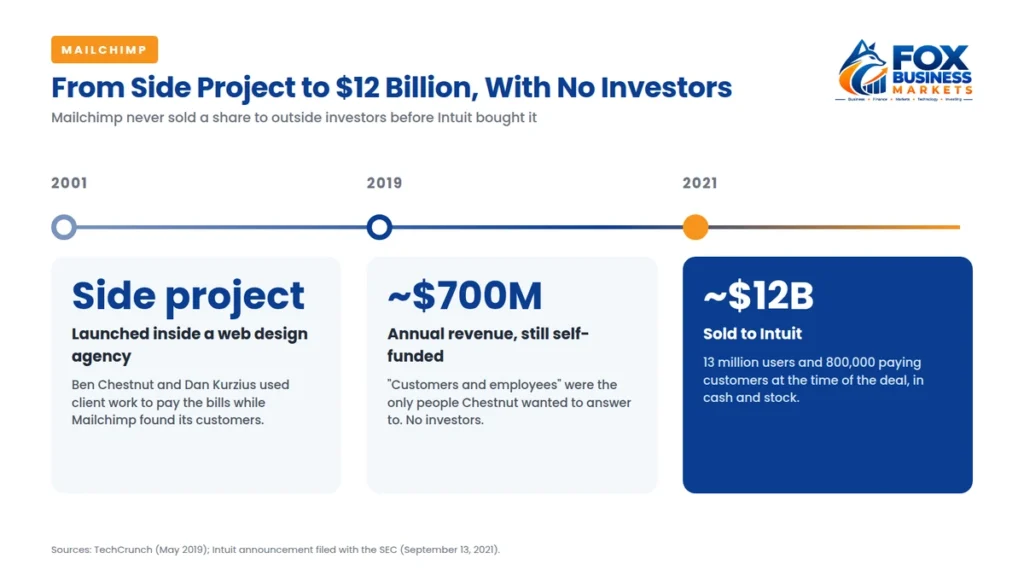
How it started: Ben Chestnut and Dan Kurzius launched Mailchimp in 2001 as a side product of their small web design agency. Chestnut had just been laid off from a dot-com company and used his severance to get by. He later called Mailchimp “a side project” (TechCrunch).
How it grew without investors: The agency’s client work paid the bills while Mailchimp slowly found its audience: small businesses that wanted simple email marketing. By 2019, Mailchimp was bringing in about $700 million a year, still without outside investors. Chestnut explained why he never wanted them: “Today, I have two constituents to worry about: customers and employees. To have a third called investors? No, I can’t do that” (TechCrunch).
Where it ended up: In September 2021, Intuit agreed to buy Mailchimp for about $12 billion in cash and stock. At the time, Mailchimp had 13 million users and 800,000 paying customers (SEC). Because the founders had never sold shares to investors, they kept the rewards for themselves and their team.
The lesson: Revenue from a service business can fund a product business until it can stand on its own.
2. Zoho: The Company That Said No to $10 Million
How it started: Sridhar Vembu started the company in 1996 as AdventNet, a maker of network management software, with help from his brother Kumar. It didn’t launch Zoho, its suite of online business apps, until 2005, and later renamed the whole company after it (Entrepreneur India).
How it grew without investors: Around 1999 or 2000, at the height of the dot-com boom, a venture capital firm offered Vembu a $10 million check at a $140 million valuation. He turned it down (YourStory). His reasoning: “Money always comes with strings attached” (Entrepreneur India). Instead, Zoho grew slowly by selling software to small and mid-sized businesses at lower prices than its larger rivals, and it kept its costs low.
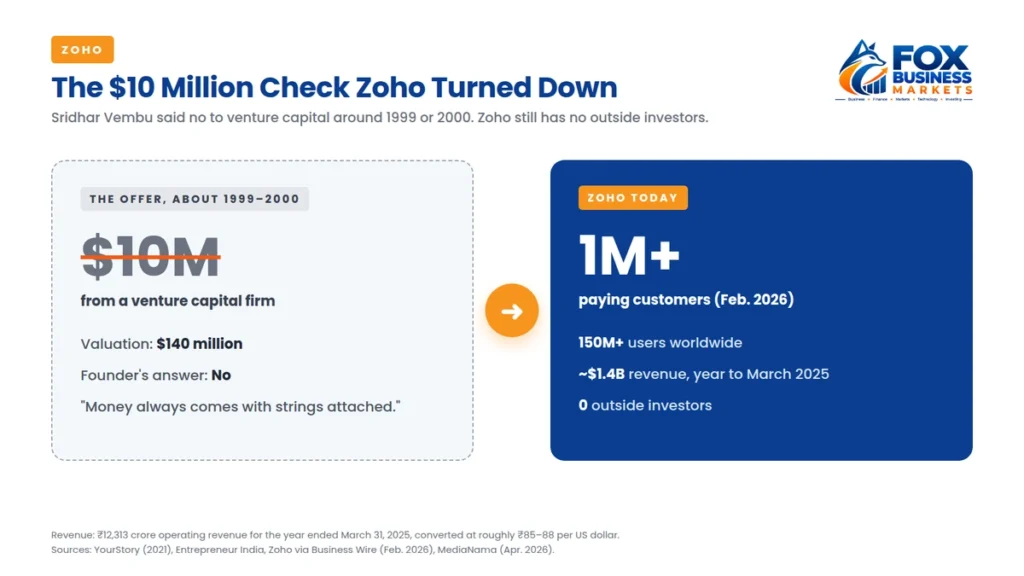
Where it is now: In February 2026, Zoho said it had passed 1 million paying customers and more than 150 million users, after growing revenue 20% in 2025 (Business Wire via Joplin Globe). For the year ended March 2025, it reported operating revenue of ₹12,313 crore, or roughly $1.4 billion, and net profit of ₹3,191.5 crore (MediaNama). It still has no outside investors.
The lesson: Saying no to investors only works if the business can pay its own way. Zoho could.
3. Plenty of Fish: One Founder, $575 Million in Cash
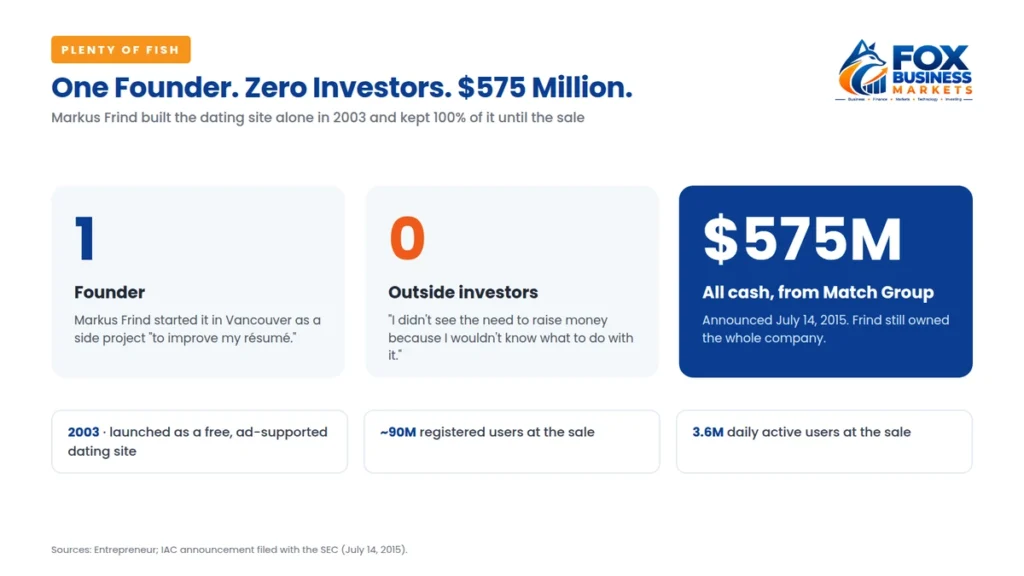
How it started: Markus Frind built Plenty of Fish alone in Vancouver in 2003. It was a free online dating site he created as a side project “to improve my résumé” (Entrepreneur).
How it grew without investors: Plenty of Fish was free for users, so it earned money from advertising, and Frind kept costs extremely low. For years, he ran the site largely on his own. When asked why he never raised money, he said: “I didn’t see the need to raise money because I wouldn’t know what to do with it” (Entrepreneur).
Where it ended up: In July 2015, Match Group agreed to buy Plenty of Fish for $575 million in cash (SEC). The site had about 90 million registered users at the time. Frind still owned the entire company, so none of the sale price went to outside investors.
The lesson: A small, low-cost team can compete with funded rivals when the product spreads on its own.
4. Atlassian: Bootstrapped for 8 Years on a Credit Card
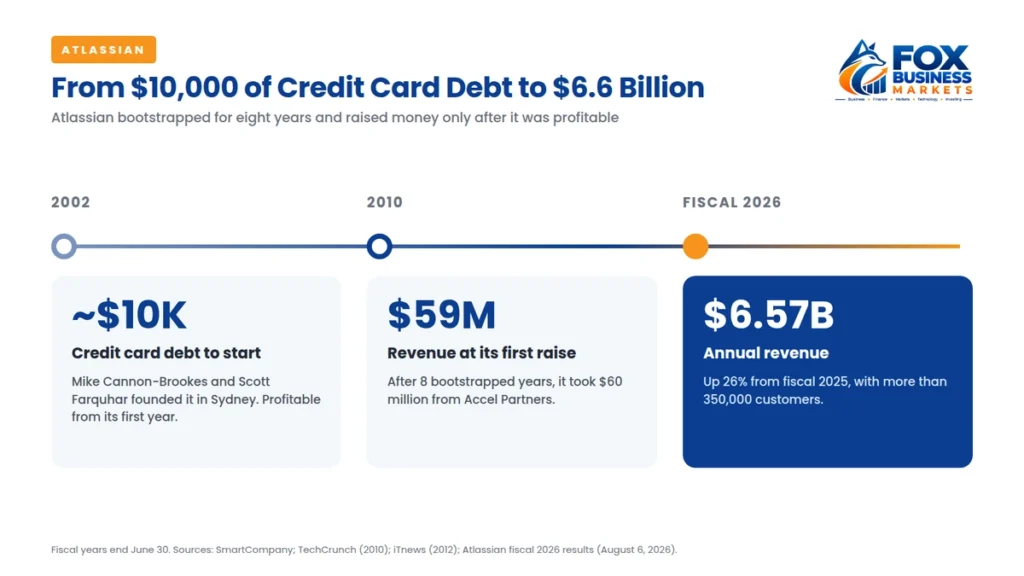
How it started: Mike Cannon-Brookes and Scott Farquhar founded Atlassian in Sydney in 2002, funded with about $10,000 of credit card debt. Farquhar’s original goal was modest: to earn more than $48,500 a year and not have to wear a suit to work (SmartCompany).
How it grew without investors: Atlassian sold software tools such as Jira to developers online, without a large sales team, which kept costs down. It was profitable from its first year. “We were bootstrapped for eight years – we didn’t raise any money for the first eight years,” Cannon-Brookes said (iTnews). When it finally raised $60 million from Accel Partners in 2010, it was already earning $59 million a year (TechCrunch).
Where it is now: Atlassian reported revenue of $6.57 billion for its fiscal year ended June 30, 2026, up 26%, with more than 350,000 customers (Atlassian).
The lesson: Raising money after you’re profitable means you set the terms, not the investors.
5. GitHub: Profitable Before Its First Investor
How it started: Tom Preston-Werner, Chris Wanstrath, and PJ Hyett launched GitHub in 2008 as a place for programmers to store and share code.
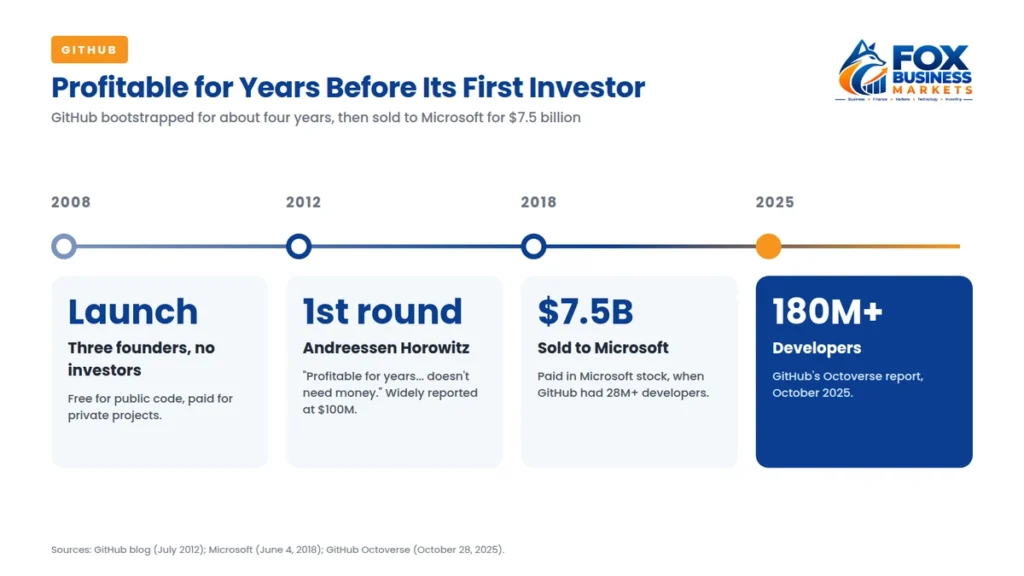
How it grew without investors: GitHub let developers use public projects for free and charged for private ones. That simple model made it profitable. When it took its first outside investment, from Andreessen Horowitz in July 2012, the company wrote: “Our company has been profitable for years, is growing fast, and doesn’t need money.” It added: “We’ve done all this without any outside investment” (GitHub). The round was widely reported at $100 million.
Where it is now: Microsoft agreed to buy GitHub for $7.5 billion in stock in June 2018, when it had more than 28 million developers (Microsoft). By October 2025, GitHub had more than 180 million developers (GitHub).
The lesson: A free version can grow the user base while a paid version funds the business.
What Did These Bootstrapped Companies Have in Common?
- They charged customers early. Each one had revenue before it had scale, so it never depended on someone else’s money.
- They kept costs low. Small teams, online sales, and no expensive offices or ad campaigns at the start.
- They served a clear, specific customer. Small businesses, developers, or single people looking for a date.
- They were patient. Zoho took nearly a decade to launch its main product. Atlassian waited eight years before raising money.
- They kept control. The founders made decisions for customers and employees, not to hit an investor’s deadline.
Bootstrapping vs. Venture Capital: Which Is Better?
| Bootstrapping | Venture capital | |
| Money | Savings and customer revenue | Investors buy a share of the company |
| Ownership | Founders keep it | Founders give part of it away |
| Speed | Usually slower | Usually faster |
| Pressure | Stay profitable | Grow quickly and deliver a big return |
| Best for | Businesses that can earn money early | Businesses that need heavy spending before they earn |
Neither path is always better. A business that needs years of research or factories before its first sale usually needs investors. A business that can charge customers from day one often doesn’t. Not sure which fits your idea? Our guide to franchise vs. startup compares the costs and risks of starting out, and our business growth calculator shows what steady growth can add up to over time.
Should You Bootstrap Your Business? 4 Questions to Ask
The companies above make bootstrapping look easy, but it worked because their businesses fit it. Before you decide, answer these four questions honestly:
- Can you charge customers in the first few months? Mailchimp, Atlassian, and GitHub all sold a product people paid for early. If your idea needs years of work before the first sale, bootstrapping will be hard.
- How much do you need to get started? Atlassian began with about $10,000 on a credit card. A business that needs a factory, a store, or expensive equipment usually needs more than savings can cover.
- Can you live on a small income for a while? Bootstrapped founders often pay themselves little at first and put the profit back into the business.
- How fast do you need to grow? If a well-funded competitor could take your market in a year, slow and steady growth may not be enough.
If you answered yes to the first three and your market isn’t a race, bootstrapping is worth serious thought.
Frequently Asked Questions
What are some famous bootstrapped companies?
Mailchimp, Zoho, and Plenty of Fish never took money from outside investors. Atlassian and GitHub were bootstrapped for years before raising venture capital once they were already profitable.
Is bootstrapping better than raising venture capital?
It depends on the business. Bootstrapping lets founders keep ownership and control but usually means slower growth. Venture capital brings money faster, but founders give up part of the company and face pressure to grow quickly.
How do bootstrapped companies grow without investors?
They use the founders’ savings to start, then reinvest the money customers pay them. Most keep costs low, charge for their product early, and focus on staying profitable.
Can a bootstrapped company take investment later?
Yes. Atlassian raised $60 million after eight years, and GitHub took its first investment after four. Raising money once a company is profitable usually lets the founders negotiate better terms.
Final Takeaway
Bootstrapped companies prove that a business doesn’t need investors to become worth billions. It needs paying customers, low costs, and patience. For more stories of founders who built something big against the odds, read our entrepreneur success stories, or see how some of America’s biggest companies came back from the edge in companies that almost went bankrupt.