

Why do small businesses fail? Most close because they run out of cash before they find enough paying customers. Rising costs, weak demand, poor pricing, and trouble getting credit usually push them there. The numbers are sobering: about 22% of new US business locations close within their first year, and only about half are still open after five years, according to the Bureau of Labor Statistics (BLS).
Pressure is rising again. US business bankruptcy filings climbed 7.1% in 2025, to 24,737 (US Courts), and jumped 16.9% in the 12 months ending June 2026 (US Courts). Among larger companies, S&P Global Market Intelligence counted 785 bankruptcies in 2025, the most since 2010 (MonitorDaily). So why do small businesses fail so often? Here’s what the latest data shows, which industries last longest, and how to improve your odds.
Key Takeaways
- About 22% of new business locations close in their first year, and about 65% close within 10 years.
- Running out of money is the most common final cause of failure, but it’s usually a symptom of deeper problems.
- In a Federal Reserve survey, 94% of small employer firms faced at least one financial challenge in 2025, led by rising costs.
- The popular claim that “82% of businesses fail because of cash flow” has no verifiable original source.
How We Researched This
To answer the question “why do small businesses fail,” we used official data wherever possible: survival rates from the Bureau of Labor Statistics, bankruptcy counts from the US Courts, and owner surveys from the Federal Reserve and the National Federation of Independent Business. Startup failure reasons come from CB Insights, which studies venture-backed companies. We note the date of every figure, and we flag claims we couldn’t verify.
Small Business Failure Rate: How Many Survive?
The Bureau of Labor Statistics tracks every new business location in the US and how long it stays open. Its latest data, through March 2025, shows a steady decline over time:
| Years after opening | Still open | Closed |
| 1 year | 77.9% | 22.1% |
| 2 years | 65.9% | 34.1% |
| 5 years | 51.4% | 48.6% |
| 10 years | 34.7% | 65.3% |
Source: BLS Business Employment Dynamics. Each row tracks a different group of businesses: those that opened in 2024, 2023, 2020, and 2015.
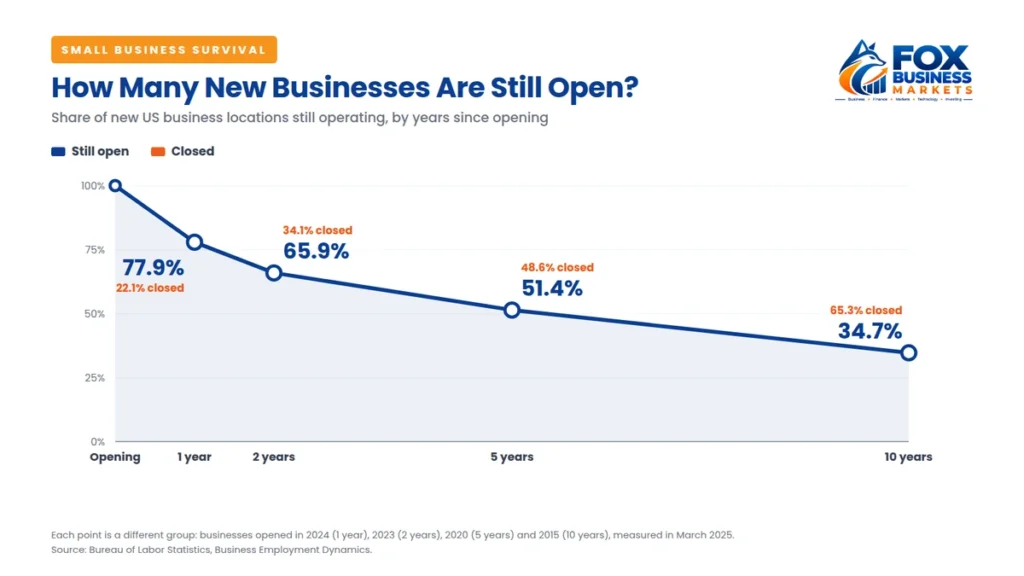
This pattern has barely changed in three decades. Across groups of businesses opened between 1994 and 2015, first-year survival has stayed around 75% to 81%, and 10-year survival around 32% to 35%. Not every closure is a failure, though. Some owners sell, retire, or move on to something else.
Meanwhile, Americans keep starting new businesses. They filed about 5.6 million applications to start a business in 2025, up from about 5.2 million in 2024 (Census Bureau via FRED).
Small Business Failure vs. Startup Failure: What’s the Difference?
Why do small businesses fail differently from startups? The two are often mixed up. Small business data, like the BLS figures above, covers every new business location, from dentists’ offices to food trucks. Startup data, like CB Insights’ studies, covers venture-backed companies that aim to grow fast and often spend heavily before they turn a profit. Startups fail more often for lack of funding or demand, while Main Street businesses more often struggle with costs, cash flow, and staffing. Both groups appear in the reasons below, and we label which is which.
Why Do Small Businesses Fail? 7 Top Reasons
Why do small businesses fail? The data points to seven recurring problems, and most failures involve more than one.
1. They Run Out of Cash
Cash is usually the final blow. In CB Insights’ March 2026 study of 431 venture-backed startups that shut down since 2023, 70% ran out of capital. But the report calls this “almost always the final cause of death, not the root problem” (CB Insights).
A business can even be profitable on paper and still run out of cash if customers pay late or unsold inventory ties up its money. Small businesses lean heavily on their owners to fill the gaps. Among employer firms that faced financial challenges in 2025, 54% used the owner’s personal funds to cope (Federal Reserve via FRED).
Myth vs. fact: You may have read that “82% of businesses fail because of cash flow problems,” a figure credited to a U.S. Bank study. We couldn’t find the original study. Every citation we found is secondhand, with no title, year, or sample size. Cash problems are real and well documented, but treat the 82% figure as unverified.
2. There’s No Real Demand
Some businesses fail because not enough people want what they sell. In CB Insights’ 2026 study, 43% of failed startups had poor product-market fit, meaning their product didn’t meet a strong enough need (CB Insights). Testing demand before you spend heavily, with presales, a waiting list, or a small first batch, is the cheapest protection.
3. Costs Rise Faster Than Sales
Rising costs were the most common financial challenge for small businesses in 2025, according to the Federal Reserve’s Small Business Credit Survey. More than four in ten employer firms cited costs related to tariffs. Rising costs hit hardest in leisure and hospitality (90% of firms), retail (86%), and manufacturing (80%) (Federal Reserve).
Many owners responded by raising prices. A net 31% of small businesses raised prices in August 2026, according to the National Federation of Independent Business (NFIB).
4. The Prices Don’t Cover the Costs
A business can be busy and still lose money if each sale doesn’t earn enough. In the CB Insights study, 19% of failed startups had unsustainable unit economics, meaning each customer cost more to serve than they brought in. For small businesses, this often means underpricing to win customers, then never catching up. Our business idea profit calculator shows your profit per sale and the sales you need to break even.
5. Bad Timing or a Weak Economy
Sometimes the idea is fine, but the moment isn’t. In CB Insights’ 2026 study, 29% of failed startups cited bad timing or economic conditions. Small businesses feel this too: in the Federal Reserve survey, expectations for revenue and hiring were the weakest since 2020, and only 47% of firms were operating at a profit at the end of 2024 (Federal Reserve via FRED).
6. They Can’t Get Credit
When money runs short, a loan can buy time, but it isn’t guaranteed. In the Federal Reserve survey, 38% of small employer firms applied for a loan, line of credit, or merchant cash advance in 2025. Of those, 42% got the full amount, 36% got part of it, and 22% got nothing (Federal Reserve).
7. They Can’t Find or Afford Good Workers
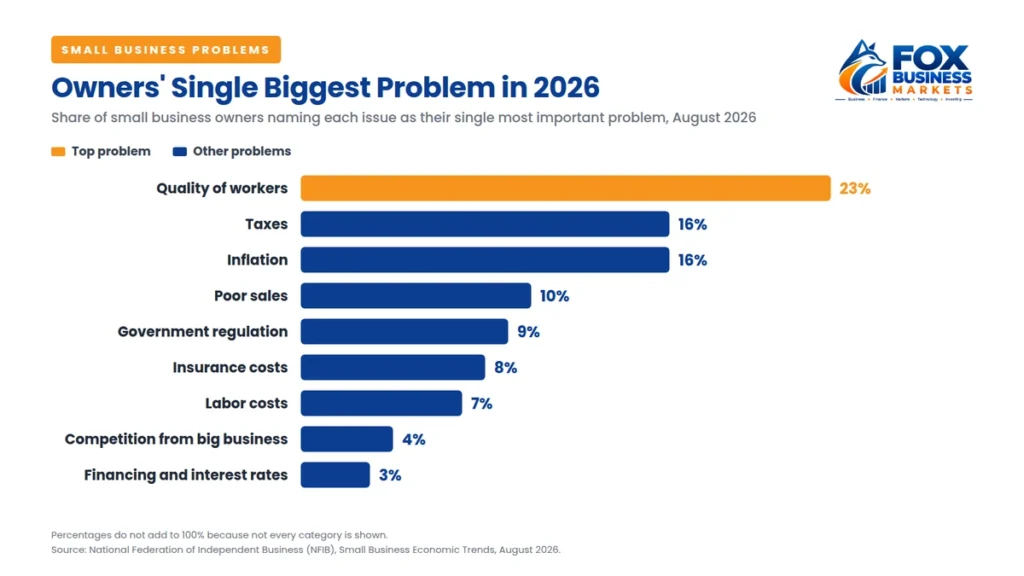
Hiring is now owners’ biggest headache. In NFIB’s August 2026 survey, 23% of small business owners named the quality of available workers as their single most important problem, more than any other issue. Taxes and inflation tied for second, at 16% each (NFIB). Another 7% named labor costs, so the problem is both finding workers and paying them. For a small team, one bad hire or one key employee leaving can disrupt the whole business.
Which Industries Have the Highest Survival Rates?
Industry is a big part of the answer to why do small businesses fail. Survival varies a lot by industry. Among businesses that opened in 2015, here’s how many were still open 10 years later (BLS):
| Highest 10-year survival | Lowest 10-year survival | ||
| Agriculture | 53.0% | Mining, oil, and gas | 24.5% |
| Utilities | 47.2% | Information | 30.0% |
| Manufacturing | 45.3% | Professional services | 34.3% |
| Real estate | 45.0% | Wholesale trade | 34.4% |
| Retail | 44.2% | Management of companies | 35.8% |
Myth vs. fact: Restaurants are often called the riskiest business to start. In BLS data, accommodation and food services had a 41.6% 10-year survival rate, in the middle of the pack, not at the bottom.
5 Warning Signs a Business Is in Trouble
Why do small businesses fail when the warning signs often show up early? Because owners miss them or wait too long to act. Watch for these:
- Cash reserves keep shrinking month after month, even when sales look steady.
- The owner is covering bills with personal money or credit cards. In 2025, more than half of small firms with financial challenges did this.
- Profit margins are falling because costs rise faster than prices.
- One customer brings in most of the revenue, so losing it would be a crisis.
- The business borrows to cover payroll or rent instead of to grow.
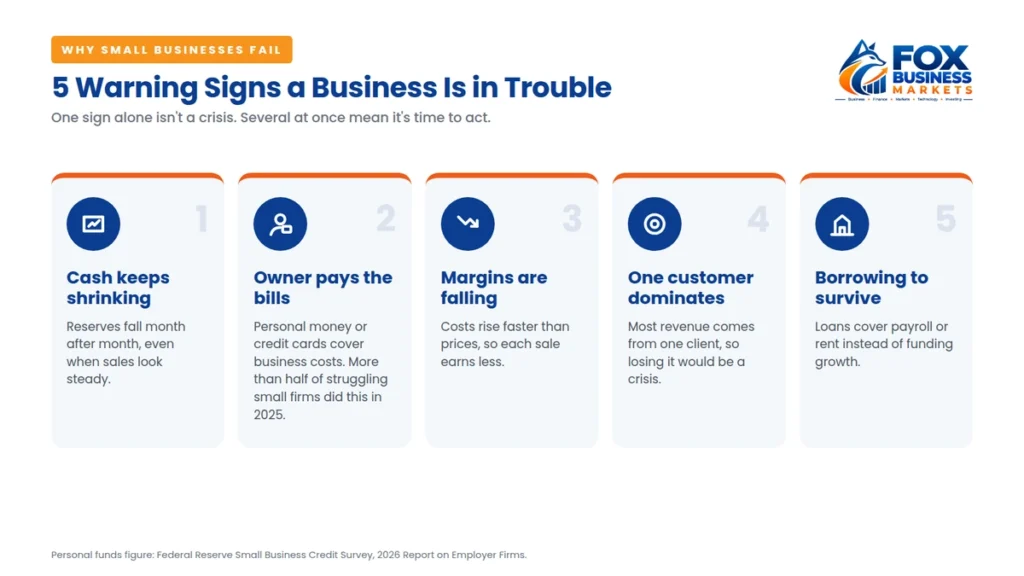
One sign alone isn’t a crisis. Several at once mean it’s time to cut costs, raise prices, or rethink the plan. Our business KPI calculator can show your margins and break-even point.
How to Keep Your Business From Failing
- Know your real startup cost. Add up one-time costs, monthly costs, and a cash cushion before you open. Our guide on how much it costs to start a business and our startup cost calculator can help.
- Keep at least a year of expenses in reserve. The SBA recommends planning for at least one year of monthly expenses (SBA).
- Test demand early. Sell to real customers before you invest heavily in inventory, space, or staff.
- Price for profit, not just sales. Make sure every sale covers its own cost and a share of your fixed costs.
- Start lean. Many successful companies grew on customer revenue alone. See how in our list of bootstrapped companies.
Even big companies come close to failing. Read how FedEx, Apple, and others recovered in companies that almost went bankrupt, or see how founders beat the odds in our entrepreneur success stories.
Frequently Asked Questions
What percentage of small businesses fail?
About 22% of new US business locations close within their first year, about 49% within five years, and about 65% within 10 years, according to the latest Bureau of Labor Statistics data.
What is the number one reason small businesses fail?
Running out of cash is the most common final cause, but it usually results from deeper problems, such as weak demand, rising costs, or prices that don’t cover expenses.
Why do small businesses fail in the first year?
About 22% of new business locations close within their first year. The most common causes are underestimating startup costs, slower sales than expected, and not keeping enough cash in reserve to cover the gap.
Is it true that 90% of businesses fail?
Not within a few years. BLS data shows about half of new businesses survive five years and about a third survive 10 years. Over three decades, though, most do close: only 12.6% of business locations opened in 1994 were still open in 2025.
How long do most small businesses last?
About half of new business locations are still open after five years, and about a third after 10 years. Survival depends heavily on the industry, the owner’s preparation, and economic conditions.
Which industry has the highest business survival rate?
Agriculture had the highest 10-year survival rate in the latest BLS data, at 53%. Mining, oil, and gas had the lowest, at 24.5%.
Final Takeaway
So, why do small businesses fail? Rarely because of one bad day. They fail because cash runs out before the business finds enough customers at the right price. Know your numbers before you start, keep a cushion, and test demand early. These steps won’t guarantee success, but they put you on the right side of the statistics.