
Business Idea Profit Calculator: Free & Easy Tool
The Business Idea Profit Calculator shows whether a business idea can make money before you invest in it. Enter your price, cost per sale, expected monthly sales, and fixed costs to see your monthly profit, break-even point, and how many months it takes to earn back your startup cost. Results update as you type.
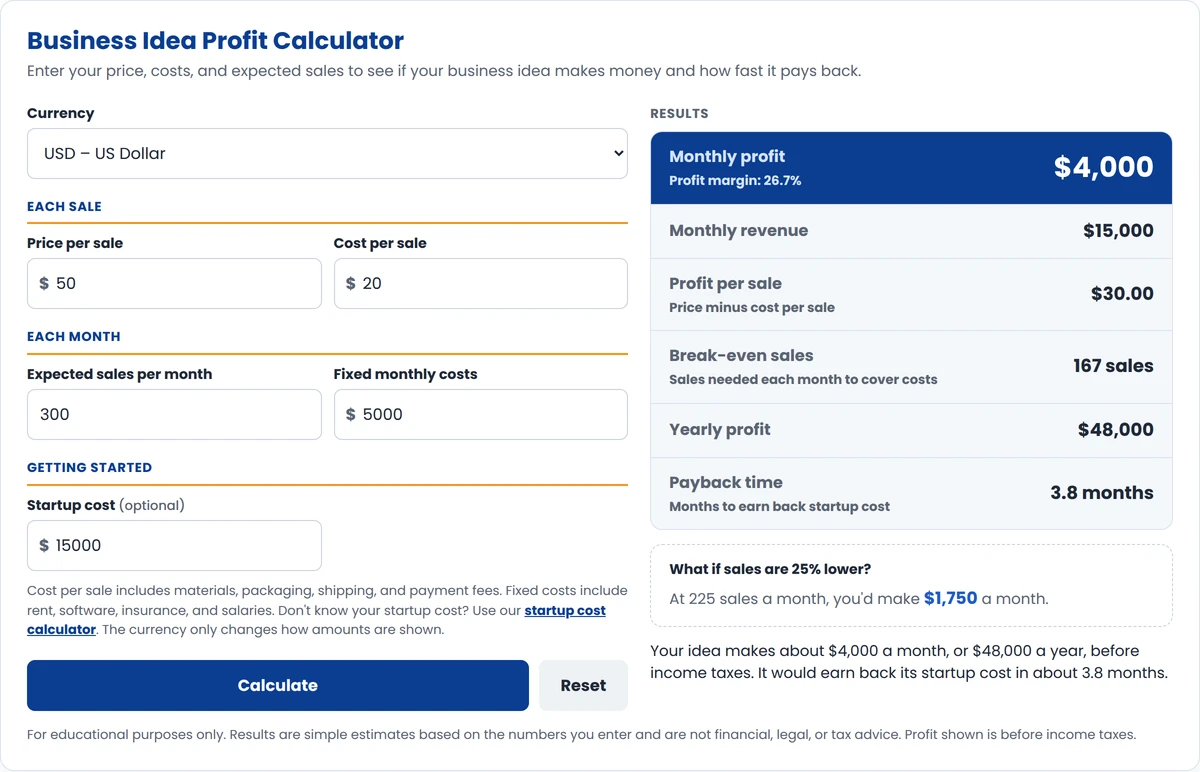
Enter your price, costs, and expected sales to see if your business idea makes money and how fast it pays back.
Cost per sale includes materials, packaging, shipping, and payment fees. Fixed costs include rent, software, insurance, and salaries. Don't know your startup cost? Use our startup cost calculator. The currency only changes how amounts are shown.
Results
For educational purposes only. Results are simple estimates based on the numbers you enter and are not financial, legal, or tax advice. Profit shown is before income taxes.
How to Use the Business Idea Profit Calculator
- Currency: Pick the currency your numbers are in. It only changes how amounts are shown; it does not convert them.
- Price per sale: Enter what a customer pays for one product or service.
- Cost per sale: Enter what each sale costs you, such as materials, packaging, shipping, and payment or platform fees.
- Expected sales per month: Enter a realistic number, not your best-case hope.
- Fixed monthly costs: Enter costs you pay every month no matter how much you sell, such as rent, software, insurance, and salaries.
- Startup cost (optional): Enter what you'll spend before opening to see how long it takes to earn it back.
Results update as you type.
How Is Business Idea Profit Calculated?
Profit per sale = Price per sale − Cost per sale
Monthly profit = (Profit per sale × Sales per month) − Fixed monthly costs
Profit margin = Monthly profit ÷ Monthly revenue × 100
Break-even sales = Fixed monthly costs ÷ Profit per sale
Payback time = Startup cost ÷ Monthly profit
Example: You plan to sell a product for $50 that costs $20 to make and ship. You expect 300 sales a month, your fixed costs are $5,000 a month, and you need $15,000 to start.
- Profit per sale is $50 − $20 = $30.
- Monthly profit is ($30 × 300) − $5,000 = $4,000, a 26.7% profit margin on $15,000 in revenue.
- Break-even is $5,000 ÷ $30 = 167 sales a month.
- Payback time is $15,000 ÷ $4,000 = about 3.8 months.
- If sales are 25% lower (225 a month), profit falls to $1,750 a month.
Cost per Sale vs. Fixed Costs: What Goes Where?
| Type | Examples | How it behaves |
|---|---|---|
| Cost per sale | Materials, packaging, shipping, payment processing, marketplace fees, sales commissions | Goes up with every sale you make |
| Fixed monthly costs | Rent, software subscriptions, insurance, salaries, loan payments | Stays the same whether you sell 10 or 1,000 |
| Startup cost | Registration, equipment, first inventory, website, deposits | Paid once before you open |
Getting this split right matters. If a cost rises with each sale but you list it as fixed, the calculator will overstate your profit as you grow.
Real Example: Selling a $40 Item on Etsy
Marketplace fees are a cost per sale that new sellers often forget. Here's what Etsy charges a US seller on a $40 item, before shipping and optional ads:
- Listing fee: $0.20 per item (Etsy)
- Transaction fee: 6.5% of the price, or $2.60 (Etsy)
- Payment processing: 3% + $0.25 for US bank accounts, or $1.45 (Etsy)
That's $4.25 in fees on every $40 sale, or about 10.6% of the price. If materials and packaging cost $10 (our assumption for this example), the cost per sale is $14.25 and the profit per sale is $25.75. With $45 a month in general liability insurance, the median small business premium according to Insureon, the seller breaks even at 2 sales a month and makes about $2,530 a month at 100 sales.
Where Can You Find Your Numbers?
- Price: Check what competitors charge for something similar.
- Cost per sale: Ask suppliers for quotes, and check your marketplace or payment processor's fee page.
- Fixed costs: Get quotes for rent, insurance, and software.
- Startup cost: Add it up with our startup cost calculator, or see our guide on how much it costs to start a business.
What the Business Idea Profit Calculator Can and Cannot Tell You
It can show whether an idea makes money at the price, costs, and sales you expect, how many sales you need to break even, and how fast you'd earn back your startup cost.
It cannot:
- Tell you how many customers you'll actually get. Your sales estimate is the biggest guess in the calculation.
- Include income taxes, which reduce the profit you keep.
- Show growth over time. Use our business growth calculator to project revenue over several years.
- Analyze a business that's already running in detail. Our business KPI calculator shows gross, operating, and net margins.
Frequently Asked Questions
How do I know if my business idea will be profitable?
Subtract your cost per sale from your price, multiply by the sales you expect each month, and subtract your fixed costs. If the result is positive, the idea is profitable at those numbers. Then test a lower sales number to see how much room you have.
What is a break-even point?
It's the number of sales you need each month to cover all your costs, so you make no profit and no loss. Divide your fixed monthly costs by your profit per sale to find it.
What is a payback period?
It's how long it takes for your monthly profit to add up to what you spent to start the business. A $15,000 startup cost with $4,000 a month in profit pays back in about 3.8 months.
What is a good profit margin for a new business?
It depends on the industry. Low-cost digital products can have high margins, while retail and food businesses often have thin ones. Compare your margin with similar businesses rather than a single target.
Why does the calculator test a 25% drop in sales?
Because sales estimates for new ideas are often too optimistic. If your idea still makes money with 25% fewer sales, it has a safety margin. If it turns into a loss, you may need a higher price, lower costs, or a more careful sales estimate.
Final Takeaway
A business idea is only as good as its numbers. Use the calculator above to check your profit per sale, your break-even point, and what happens if sales come in lower than you hope, before you spend money to start.