Carol had kept her emergency fund at the same big bank for nineteen years. She’s a school librarian outside Columbus, and the account held $18,000 she was proud of never touching. One evening her son asked what it was earning. She logged in and found the answer: a rate near the national average that would pay her about $68 over a full year. At an online bank paying 4.2%, the same money would earn about $756, roughly $690 more for doing nothing different except changing where it sits. (Carol is a composite example, but her math is based on real October 2026 rates.)
That gap is the whole case for a high-yield savings account. This guide explains how high-yield savings accounts work, what they pay right now, whether your money is safe in one, and when a different account makes more sense.
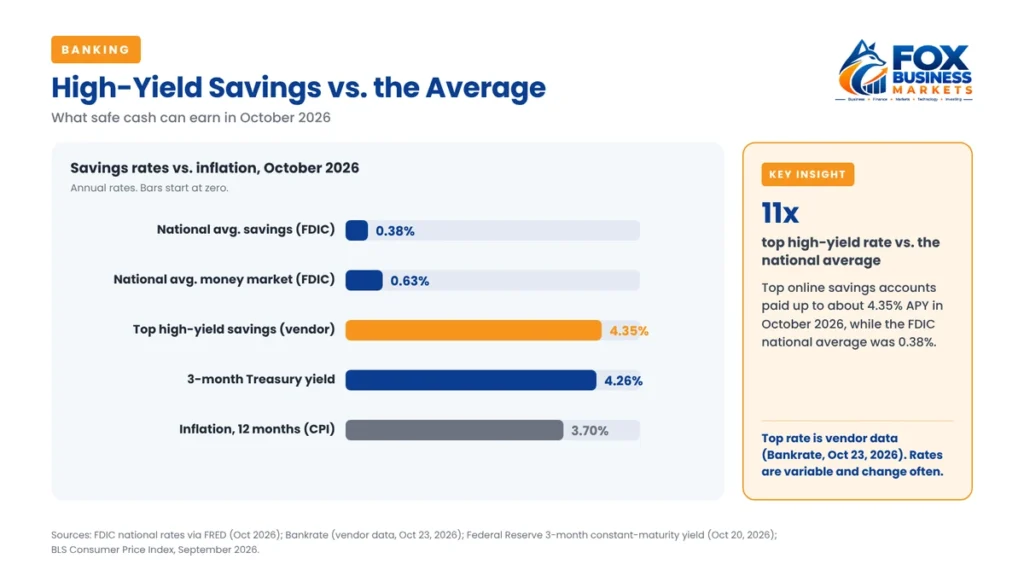
Quick answer: A high-yield savings account is a savings account that pays much more interest than the national average, usually offered by online banks and credit unions. In October 2026, top accounts paid roughly 4% to 4.35% APY, according to vendor surveys, compared with an FDIC national average of 0.38%, excluding short-term promotional rates. They’re FDIC- or NCUA-insured, easy to access, and ideal for emergency funds and short-term goals.
What Is a High-Yield Savings Account?
A high-yield savings account (HYSA) is a regular savings account that pays a significantly higher interest rate than a typical bank savings account. There’s no legal definition of “high-yield.” The term simply means a rate well above the national average.
The difference can be huge. The FDIC’s national average savings rate was 0.38% in October 2026, according to FDIC data published on FRED. At the same time, NerdWallet (vendor data) reported that “HYSAs with low opening deposit requirements can earn over 4% APY,” and that “the top accounts on our list earn more than 10 times the national average.” Bankrate (vendor data) listed a top savings rate of 4.35% APY on October 23, 2026.
Most high-yield savings accounts are offered by online banks, which don’t pay for big branch networks, and by some credit unions. Some traditional banks also offer high-yield accounts, often under a separate name from their standard savings account.
How Does a High-Yield Savings Account Work?
A high-yield savings account works like any savings account: you deposit money, the bank pays interest, and you can transfer money out when you need it. The difference is simply the rate.
Interest is usually compounded daily or monthly and paid monthly. Banks advertise the annual percentage yield (APY), which federal Regulation DD defines as “a percentage rate reflecting the total amount of interest paid on an account, based on the interest rate and the frequency of compounding for a 365-day period” according to the Consumer Financial Protection Bureau’s Truth in Savings rules. Because APY includes compounding, it’s the best number to compare accounts.
The rate is variable. High-yield savings rates tend to follow the Federal Reserve’s federal funds rate. On September 16, 2026, the Fed raised its target range by a quarter point to 3.75% to 4.00%, and its next scheduled meeting is October 27–28, 2026 (check the Fed’s calendar for the latest decision). When the Fed raises rates, online savings yields usually rise; when it cuts, they usually fall, sometimes within days. Rates at big traditional banks often barely move.
Most high-yield accounts connect to your checking account at another bank. Moving money between them by electronic transfer usually takes one to three business days, so keep everyday spending money in checking. Our guide to checking vs savings accounts explains how to set up the two together.
How Much More Does a High-Yield Savings Account Earn?
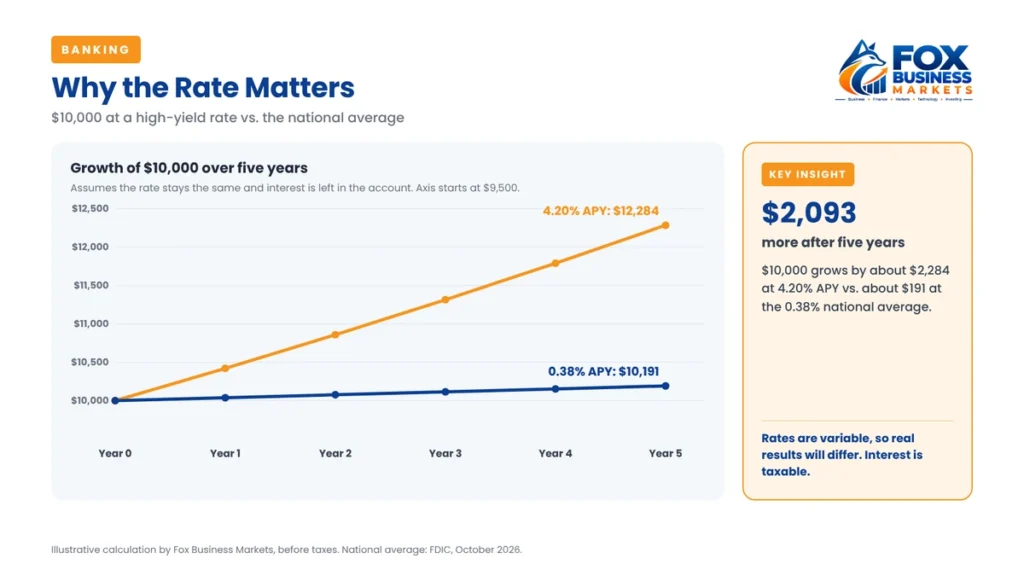
On $10,000, a high-yield account paying 4.2% APY earns about $420 in a year, compared with about $38 at the 0.38% national average. That’s more than ten times as much, and the gap grows over time.
Balance | At 0.38% (national average) | At 4.20% (high-yield) | Difference |
| $5,000 | $19 | $210 | $191 |
| $10,000 | $38 | $420 | $382 |
| $18,000 | $68 | $756 | $688 |
| $25,000 | $95 | $1,050 | $955 |
One year of interest at the APY shown, before taxes. Calculated by Fox Business Markets; rates change often.
Over five years at those same rates, $10,000 would grow by about $2,284 at 4.2% versus about $191 at 0.38%. Rates won’t stay fixed for five years, but the comparison shows why the account you choose matters.
Is a High-Yield Savings Account Worth It?
For most people, yes. A high-yield savings account is worth it for money you want to keep safe and easy to reach, like an emergency fund, a down payment fund, or savings for a large purchase in the next year or two. You give up almost nothing compared with a regular savings account and earn far more interest.
It’s especially worth it right now because the gap between the best accounts and the national average remains wide. With consumer prices up 3.7% over the 12 months ending September 2026, according to the Bureau of Labor Statistics, money earning 0.38% is losing buying power quickly. A rate above 4% roughly matches inflation before taxes. After taxes you may still lose a little buying power, but far less than at 0.38%.
Here’s when an HYSA is not the best choice:
- For everyday spending. Use checking, so you’re not waiting days for transfers.
- For long-term goals, like retirement more than five years away. Stocks and bonds in a retirement account have historically grown faster over long periods, with more risk.
- If you need cash deposits often. Online banks can make depositing cash difficult.
- If you have high-interest credit card debt. Paying off a card charging about 22% (the Federal Reserve’s average on accounts assessed interest was 22.36% in August 2026) beats earning 4% in savings. Keep a starter emergency fund, then attack the debt. Our guide on how to pay off debt explains why.
Is a High-Yield Savings Account Safe?
A high-yield savings account at an FDIC-insured bank or federally insured credit union is as safe as any other savings account. Deposits are insured up to $250,000 per depositor, per institution, for each account ownership category. Online banks are covered by the same rules as branch banks.
Be careful with fintech apps. Some popular savings apps aren’t banks themselves; they hold your money at a partner bank. In those cases, FDIC protection works only if the partner bank is insured and the records are kept correctly. And, as the FDIC explains, “FDIC insurance protects you only in the unlikely event the insured bank fails.” It “does not protect you against losses due to the non-bank company’s bankruptcy or failure to meet its obligations to its customers.”
Before you open an account, check two things: the name of the actual bank holding your money, and whether that bank appears in the FDIC’s BankFind tool or the credit union appears in the NCUA’s locator. Our banking basics guide explains how deposit insurance works.
What Are the Pros and Cons of a High-Yield Savings Account?
The biggest advantages of a high-yield account are a much higher rate with the same safety as regular savings. The main drawbacks are variable rates and slower access than checking.
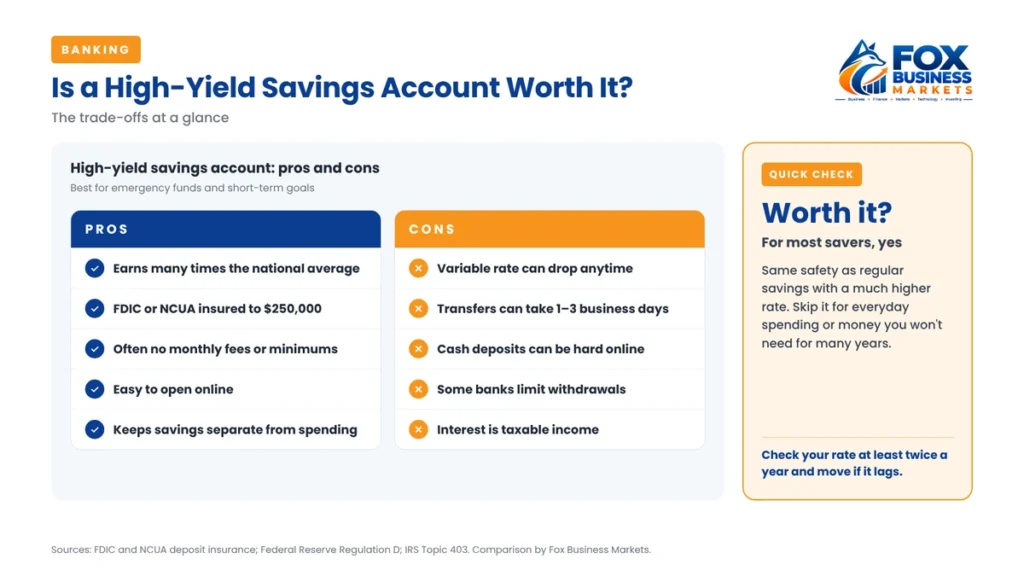
Pros | Cons |
| Earns many times the national average | Rate can drop at any time |
| FDIC or NCUA insured up to $250,000 | Transfers to checking can take 1–3 business days |
| Often no monthly fees or minimum balance | Cash deposits can be hard at online-only banks |
| Easy to open online | Some banks limit monthly withdrawals |
| Keeps savings separate from spending | Interest is taxable |
On withdrawals: in April 2020 the Federal Reserve deleted Regulation D’s six-per-month limit on convenient transfers and withdrawals from savings accounts, but banks may still set their own limits or charge fees. Check the account terms.
How Do You Choose a High-Yield Savings Account?
Choose a high-yield savings account by comparing the APY, the fees and minimums, the insurance, and how easily you can move money. A slightly lower rate at a reliable bank with no fees often beats the highest advertised rate with strings attached.
- Compare the APY, but check whether it’s a promotional or teaser rate. For example, NerdWallet noted that one bank’s headline rate of up to 5% was a six-month promotion that required a linked checking account, after which it reverted to the standard rate (4.21% as of October 22, 2026).
- Check for fees and minimums. Many high-yield accounts have no monthly fee and low or no minimum deposit, but some require a balance to earn the top rate.
- Confirm the insurance. Look for FDIC or NCUA coverage and, for apps, the name of the partner bank.
- Test access. How fast are transfers? Is there a mobile app, customer service by phone, or an ATM card?
- Watch the rate after you open the account. Some banks quietly let rates on older accounts lag behind new ones. If your rate falls well behind competitors, move your money.
That last point matters. In January 2025, the Consumer Financial Protection Bureau sued Capital One, alleging that customers in its older 360 Savings product were kept at a 0.30% rate while a newer, similar product paid up to 4.35%. The CFPB voluntarily dismissed its case in February 2025, and Capital One disputed the allegations. But in April 2026, a federal judge approved a revised $425 million class-action settlement over the same accounts, which also requires Capital One to raise legacy 360 Savings rates to match 360 Performance Savings for two years, according to news reports. The lesson stands: check your rate at least once or twice a year.
Do You Pay Taxes on a High-Yield Savings Account?
Yes. Interest from a high-yield savings account is taxable income in the year it’s credited to your account. According to the IRS, you should receive a Form 1099-INT if you earned $10 or more in interest, but you “must report all taxable and tax-exempt interest on your federal income tax return” even if you don’t get the form.
Interest is taxed at your ordinary income tax rate, plus state income tax where applicable. If you’re comparing a high-yield savings account with Treasury bills, remember that T-bill interest is exempt from state and local income tax. The three-month Treasury yield was about 4.26% on October 20, 2026 (constant maturity), according to Federal Reserve data on FRED.
High-Yield Savings vs. Money Market vs. CD: Which Is Best?
A high-yield account is best for flexible savings, a money market account adds check-writing or a debit card, and a certificate of deposit (CD) locks in a rate for a set term.
Account | Typical access | Rate type | Best for |
| High-yield savings | Transfers anytime | Variable | Emergency fund, short-term goals |
| Money market account | Transfers plus limited checks or debit | Variable | Larger balances needing occasional access |
| CD | Locked until maturity; early withdrawal penalty | Fixed | Money you won’t need for a set time |
| Treasury bills | At maturity (4 to 52 weeks), or sell early at market price | Fixed for the term | Larger sums; state-tax-free interest |
If you expect rates to fall, a CD can lock in today’s rate. If you might need the money anytime, stick with a high-yield savings account. Many people use both: an HYSA for their emergency fund and CDs or T-bills for money they know they won’t need.
Frequently Asked Questions
What is a high-yield savings account?
A high-yield savings account is a savings account that pays much more interest than the national average. In October 2026, top accounts paid roughly 4% to 4.35% APY, according to vendor surveys, versus an FDIC national average of 0.38%. They’re usually offered by online banks and credit unions and are FDIC- or NCUA-insured.
Is a high-yield savings account safe?
Yes, if it’s held at an FDIC-insured bank or federally insured credit union. Deposits are protected up to $250,000 per depositor, per institution, for each ownership category. If you use a fintech app, confirm the partner bank, because FDIC insurance doesn’t protect you if a non-bank company fails.
How much will I earn in a high-yield savings account?
At 4.2% APY, $10,000 earns about $420 in a year, compared with about $38 at the 0.38% national average. Your actual earnings depend on your balance, the APY, and how the rate changes, since high-yield savings rates are variable and often move with the Federal Reserve’s rate decisions.
Can you lose money in a high-yield savings account?
Not from market swings. Your balance won’t fall like a stock investment, and insured deposits are protected up to the limits. However, inflation can erode buying power if your rate is lower than inflation, and fees could reduce small balances. Choose a no-fee, insured account with a competitive rate.
Do high-yield savings account rates change?
Yes. High-yield savings rates are variable, so banks can raise or lower them at any time. They often follow the Federal Reserve’s federal funds rate, which the Fed raised to a range of 3.75% to 4.00% on September 16, 2026. Check your rate periodically and move your money if it falls well behind competitors.
Is a high-yield savings account better than a CD?
It depends on when you need the money. A high-yield savings account lets you withdraw anytime, but its rate can change. A CD locks in a fixed rate but charges a penalty for early withdrawal. Use a high-yield account for emergency funds and a CD for money you won’t need until a set date.
The Bottom Line
Carol moved her $18,000 to an online bank the same week. She kept her checking account where it was, linked the two, and set a reminder to compare rates every six months. Nothing about her savings habits changed. Her money just started earning about ten times as much.
That’s the simple promise of a high-yield savings account: the same safety and access as regular savings, with a much better return. Keep your emergency fund and short-term savings in an insured high-yield account, compare APYs and fees before you open one, watch for teaser rates, and check your rate a couple of times a year. For more on building your savings, see our personal finance guide and the latest banking statistics.

