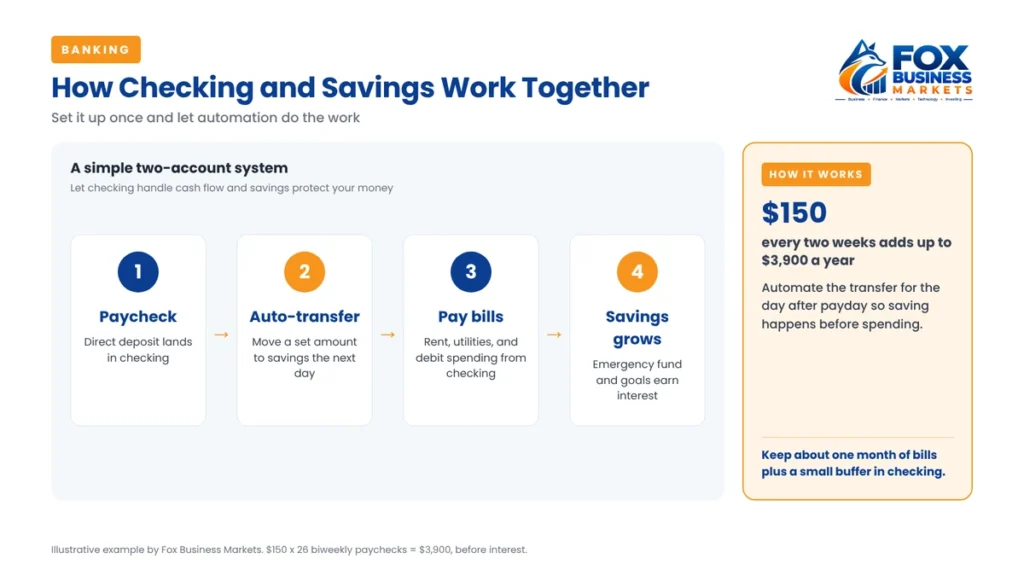
For three years, Andre kept all his money in one checking account. He’s a kitchen manager in Portland, he earns a decent paycheck, and every month he told himself he’d “leave some in there” for later. Every month, later never came. The money just blended in with rent, groceries, and takeout, and by payday it was gone. The fix turned out to be almost embarrassingly simple: a second account, a savings account, and a $150 automatic transfer the morning each biweekly paycheck landed. A year later he had $3,900 he’d never have saved otherwise. (Andre is a composite example, but his one-account habit is extremely common.)
The difference between checking and savings isn’t just about interest rates. It’s about giving each dollar a job. This guide explains the checking vs savings account question in plain English: what each one does, what each one pays and costs, and how to use them together.
Quick answer: A checking account is for spending: paychecks come in, and bills, debit card purchases, and transfers go out with unlimited access. A savings account is for money you’re setting aside: it usually pays more interest, but it’s not designed for everyday spending. Most people need both, with an automatic transfer from checking to savings on payday.
What Is the Difference Between a Checking and a Savings Account?
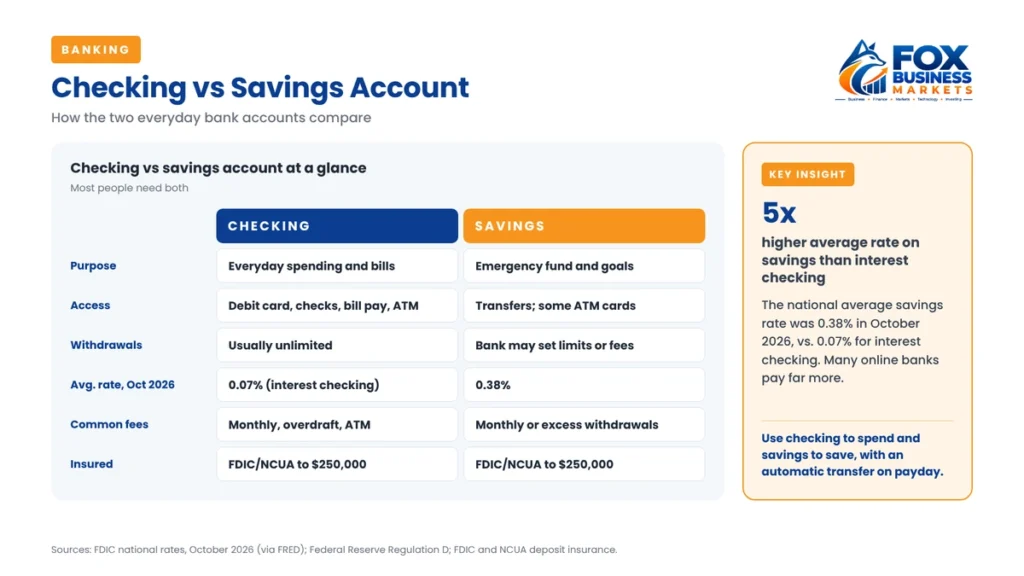
The main difference between a checking vs savings account is purpose. Checking is built for frequent transactions, and savings is built for holding money and earning interest. Both are deposit accounts, and both are protected by FDIC insurance at banks or NCUA insurance at credit unions, up to $250,000 per depositor, per institution, for each ownership category.
Feature | Checking account | Savings account |
| Main purpose | Everyday spending and bills | Emergency fund and goals |
| Typical access | Debit card, checks, bill pay, transfers, ATM | Transfers to checking; some offer ATM cards |
| Withdrawal limits | Usually none | No federal limit, but some banks set their own |
| National average rate (Oct 2026) | 0.07% (interest checking) | 0.38% |
| Common fees | Monthly maintenance, overdraft, ATM | Monthly fee or excess-withdrawal fees at some banks |
| Insured | Yes, FDIC or NCUA up to $250,000 | Yes, FDIC or NCUA up to $250,000 |
National average rates are from the FDIC’s October 2026 national rates, as published on FRED.
What Is a Checking Account Used For?
A checking account is your financial hub for money coming in and going out. Most people use it to receive direct deposits, pay rent and bills, make debit card purchases, withdraw cash from ATMs, write the occasional check, and send money through payment apps.
Checking accounts usually pay little or no interest. The FDIC’s national average rate on interest checking was just 0.07% in October 2026. That’s fine, because checking isn’t where your money is supposed to grow. It’s where your money moves.
Checking accounts also come with protections. Under the Federal Reserve’s Regulation CC, banks generally must make direct deposits and other electronic payments, cash deposited in person, and certain low-risk checks (like U.S. Treasury and cashier’s checks) available by the next business day. For other checks, the first $275 of a day’s deposits must be available the next business day, an amount that took effect July 1, 2025, according to the Federal Reserve. Exceptions apply, for example for new accounts and large deposits. And if your debit card is lost or stolen, federal law limits your losses if you report it quickly. Our banking basics guide explains those rules.
What Is a Savings Account Used For?
A savings account is where you keep money you don’t plan to spend right away: an emergency fund, a vacation fund, a down payment, or money for an annual bill like car insurance. It earns interest, and keeping it separate from checking makes it less likely to disappear into daily spending.
The national average savings rate was 0.38% in October 2026, according to FDIC data on FRED. That average is dragged down by big banks that pay very little. Many online banks and credit unions pay several times the national average, which is why it pays to shop around. Our guide to the high-yield savings account explains how they work.
Savings accounts used to come with a federal limit of six withdrawals or transfers per month. The Federal Reserve removed that limit from Regulation D in April 2020, but banks are still allowed to set their own limits or charge fees for frequent withdrawals. Read your account terms before you rely on savings for everyday spending.
Do You Need Both a Checking and a Savings Account?
Yes, most people should have both. The checking vs savings account choice isn’t really either-or: checking handles your everyday cash flow, and savings protects money from being spent by accident. Using them together is one of the simplest money systems that actually works.
Here’s the setup that worked for Andre:
- Direct deposit your paycheck into checking.
- Schedule an automatic transfer to savings for payday (or the day after), even if it’s only $25 or $50.
- Pay bills and spend from checking only.
- Leave savings alone unless it’s a real emergency or the goal you’re saving for.
- Keep a small buffer in checking, such as a few hundred dollars, so a surprise charge doesn’t cause an overdraft.
Some people go one step further and keep savings at a different bank, often an online bank with a higher rate. That extra step makes impulse transfers less tempting. Our guide to building an emergency fund covers how much to keep there.
How Much Should You Keep in Checking vs Savings?
A simple checking vs savings account split: keep enough in checking to cover about one month of bills plus a small buffer, and put the rest in savings. There’s no official rule, but this rough guideline keeps your spending money accessible while the rest earns more interest.
Too much in checking means missed interest and more temptation to spend. Too little in checking means overdraft risk. If your bank charges a monthly fee unless you keep a minimum balance, factor that in too. According to Bankrate’s 2025 study (vendor data), non-interest checking accounts that charge a monthly fee required an average balance of $496 to waive it.
For savings, start with a small emergency fund of about $1,000, then work toward three to six months of essential expenses. Money for goals more than a few years away may belong in retirement or investment accounts instead.
What Fees Do Checking and Savings Accounts Charge?
In any checking vs savings account comparison, checking usually carries more fees, including monthly maintenance fees, overdraft and insufficient funds (NSF) fees, and out-of-network ATM fees. Many banks and credit unions now offer free checking, so you rarely have to pay these if you choose well.
According to Bankrate’s 2025 Checking Account and ATM Fee Study (vendor data):
- Among non-interest checking accounts that charge a monthly fee, the average fee was $5.47.
- Interest checking accounts averaged $15.65 a month, and it took a record $10,705 average balance to avoid the fee.
- The average overdraft fee was $26.77, and the average NSF fee was $16.82.
- Using an out-of-network ATM cost $4.86 on average, combining the ATM owner’s surcharge and your own bank’s fee.
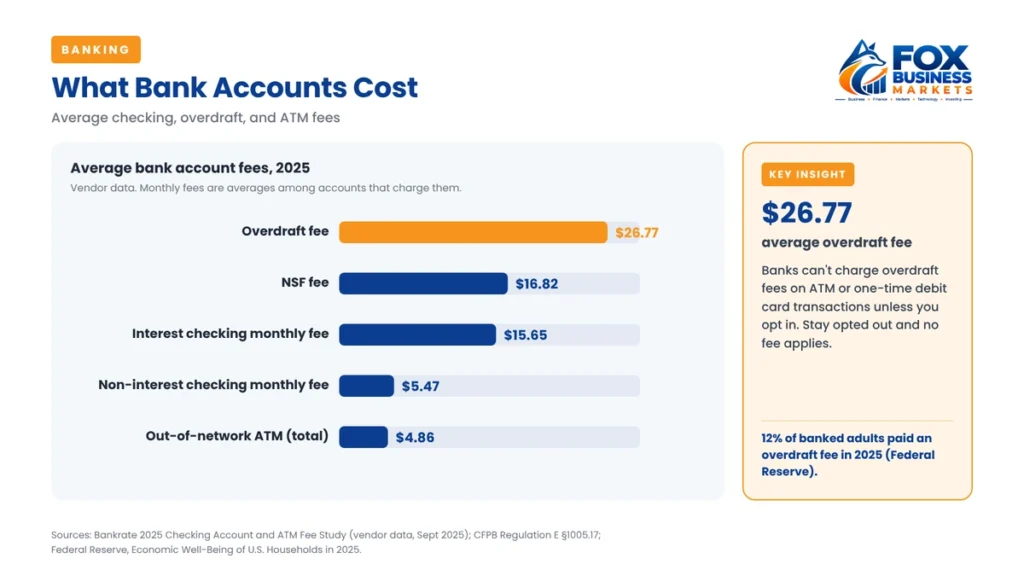
Overdrafts are where many people lose the most. The Federal Reserve’s 2025 household survey found that 12% of adults with a bank account paid an overdraft fee in the prior 12 months. The Consumer Financial Protection Bureau (CFPB) has previously found that nearly 80% of combined overdraft and NSF fees were paid by fewer than 9% of accountholders, those who overdrew more than 10 times a year.
You have a powerful tool here. Under the CFPB’s Regulation E, banks can’t charge an overdraft fee on ATM withdrawals or one-time debit card purchases unless you’ve opted in to overdraft coverage. If you haven’t opted in, the bank can’t charge an overdraft fee on those transactions; it will usually decline them, though it may pay them without a fee. If you opted in and regret it, you can revoke it. (Checks, ACH payments, and recurring debit card payments aren’t covered by the opt-in rule and can still trigger fees.)
Can You Be Denied a Checking Account?
Yes. Banks and credit unions usually check a special checking account report before opening an account. It’s not the same as your credit report. According to the CFPB, these reports come from companies such as ChexSystems and Early Warning Services, and you’re entitled to a free copy every 12 months, plus another if you’re denied an account based on one.
Common reasons for denial include an unpaid negative balance from an account a bank closed, suspected fraud, or a joint account with someone who had those problems, the CFPB says. If a report contains errors, you have the right to dispute them. If you’re denied, ask about “second chance” or lower-risk checking accounts, which many banks and credit unions offer.
Savings accounts can be easier to open, but if you can’t get a checking account, a prepaid card can cover everyday payments in the meantime, and a credit union’s lower-risk starter account can help you work back to regular checking. Our step-by-step guide on how to open a bank account covers what you’ll need.
Checking vs Savings vs. Money Market: What’s the Difference?
A money market account adds a third option to the checking vs savings account decision. It’s a hybrid: it’s a savings account that often comes with limited check-writing or a debit card, and it usually pays a bit more than standard savings. The FDIC’s national average money market rate was 0.63% in October 2026, according to FRED.
Money market accounts can make sense for larger balances that you want to keep easy to reach. Watch for higher minimum balances and fees. And don’t confuse a money market account at an FDIC-insured bank (or NCUA-insured credit union), which is covered within the $250,000 limits, with a money market mutual fund, which is an investment and isn’t insured.
Frequently Asked Questions
What is the main difference between a checking and a savings account?
A checking account is designed for everyday spending, with unlimited access through debit cards, checks, and bill pay. A savings account is designed for setting money aside and usually pays more interest. In October 2026, the national average rate was 0.07% for interest checking and 0.38% for savings, according to FDIC data.
Should I keep my money in checking or savings?
Keep enough in checking to cover about one month of bills plus a small buffer, and keep the rest in savings. Checking pays little interest and makes money easy to spend. Savings earns more and keeps your emergency fund and goals separate. An automatic transfer to savings on payday makes this easy.
Can I use a savings account like a checking account?
Not really. That’s the core of the checking vs savings account difference: savings accounts aren’t built for daily spending. Many don’t come with debit cards or checks, and some banks still limit withdrawals or charge fees for frequent transfers, even though the federal six-withdrawal limit ended in 2020. Use checking for spending and move money from savings only when needed.
Are checking and savings accounts FDIC-insured?
Yes. Both are covered by FDIC insurance at banks or NCUA insurance at federally insured credit unions, up to $250,000 per depositor, per institution, for each account ownership category. Checking and savings accounts in your name alone, with no beneficiaries, at the same bank are added together under the single-account category, so plan if you have more than $250,000.
How can I avoid checking account fees?
Choose a free checking account or one that waives fees with direct deposit or a balance you can easily keep. Don’t opt in to overdraft coverage for debit card and ATM transactions, set low-balance alerts, and use in-network ATMs. Bankrate’s 2025 study (vendor data) found the average overdraft fee was $26.77.
Do I need a checking account if I have a savings account?
Most people do. Without checking, paying bills, using a debit card, and receiving direct deposits becomes harder, and you may end up using costly alternatives like check-cashing services. If you can’t open a checking account because of past problems, ask banks and credit unions about second-chance checking accounts.
The Bottom Line
Andre didn’t need a budgeting app or a raise. He needed a second account and one automatic transfer. Once his savings lived in its own place, it stopped disappearing into everyday spending.
That’s the real answer to the checking vs savings account question: you don’t choose one. Use checking as the hub where money comes in and bills go out, and use savings as the place where money is protected and earns more. Keep checking lean, automate your savings, avoid overdraft fees by staying opted out, and shop around for a better savings rate. For the bigger picture, see our personal finance guide and the latest banking statistics.

