
On a Friday evening in late September 2026, customers of Nano Banc in Irvine, California, learned that their bank had been closed by California regulators. Sunwest Bank of Sandy, Utah, took over substantially all of its deposits right away. Checks and debit cards kept working over the weekend, and the branch reopened as Sunwest on Monday. Nano Banc had $736 million in assets, which made it the largest of the six U.S. bank failures in 2026 so far. For most customers, the dramatic part of the story lasted one weekend.
That’s what good banking basics buy you: not a bank that can never fail, but accounts set up so that even when one does, your money is safe and your life goes on. This guide explains how banks work, how your deposits are protected, and how to choose the right bank or credit union for you.
Quick answer: Banking basics come down to four things: banks hold your deposits and lend them out, earning the difference in interest; the FDIC (or the NCUA for credit unions) insures your deposits up to $250,000 per depositor, per institution, for each ownership category; checking accounts are for spending and savings accounts are for saving; and the right bank is the one with low fees, competitive rates, and the access you actually use.
Banking Basics: What Is a Bank, and How Do Banks Make Money?
A bank is a financial institution that takes deposits from customers, keeps that money safe, and lends much of it out to borrowers. Your checking and savings balances fund mortgages, car loans, credit cards, and business loans.
Banks make most of their money from the gap between what they pay depositors and what they charge borrowers. The Federal Reserve Bank of Kansas City’s teaching materials put it simply: “The borrowers pay interest on their loans at a higher rate than the interest that banks pay depositors for saving. The difference between these rates is the bank’s profit, or income after costs.”
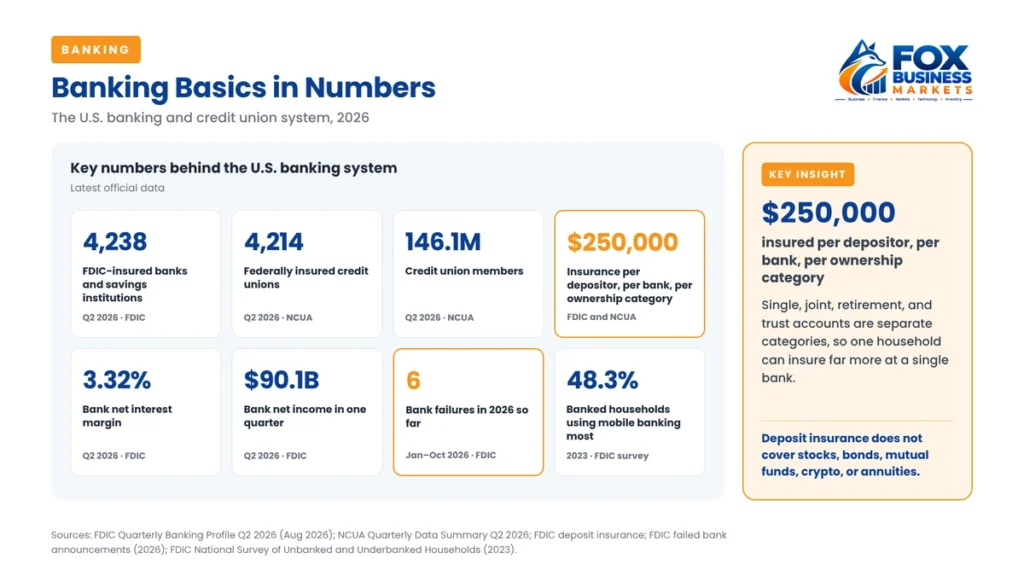
That gap is called the net interest margin. For the U.S. banking industry, it was 3.32% in the second quarter of 2026, according to the Federal Deposit Insurance Corporation’s (FDIC) Quarterly Banking Profile. Banks also earn money from fees, including monthly maintenance fees, overdraft fees, ATM fees, and wire transfer fees. That second source is the one you can control as a customer.
The industry is large and, for now, profitable. FDIC-insured banks earned $90.1 billion in net income in the second quarter of 2026, and the report covered 4,238 insured commercial banks and savings institutions.
What Is the Difference Between a Bank and a Credit Union?
The main difference is ownership. Banks are businesses owned by shareholders or private owners, while credit unions are owned by their members, the people who keep money there. According to the National Credit Union Administration’s (NCUA) MyCreditUnion.gov, “Credit unions are owned and controlled by the people, or members, who use their services,” and profits are returned to members through lower fees, higher savings rates, and lower loan rates. A volunteer board elected by members runs each credit union.
In practice, credit unions often offer lower loan rates and lower fees, while big banks usually offer more branches, ATMs, and technology. To join a credit union, you need to meet its membership rules, which are often based on where you live or work, or on a group you belong to.
| Banks | Credit unions | |
| Owned by | Shareholders or private owners | Members (customers) |
| Deposit insurance | FDIC, up to $250,000 | NCUA, up to $250,000 |
| Number (Q2 2026) | 4,238 FDIC-insured institutions | 4,214 federally insured credit unions |
| Who can join | Generally anyone who meets ID and screening requirements | Members who meet eligibility rules |
| Typical strengths | Branches, ATMs, apps, product range | Lower fees, better loan rates, service |
Credit unions are a big part of the system. Federally insured credit unions had 146.1 million members and about $2.5 trillion in assets in the second quarter of 2026, according to the NCUA’s Quarterly Data Summary.
Is Your Money Safe in a Bank?
Yes, if your bank is FDIC-insured and you stay within the coverage limits. The FDIC says its “deposit insurance covers $250,000 per depositor, per FDIC-insured bank, for each account ownership category.” Credit union deposits get the same $250,000 protection from the NCUA’s share insurance.
“Ownership category” is the key phrase. Single accounts, joint accounts, certain retirement accounts, and trust accounts are separate categories, so a married couple can have far more than $250,000 insured at one bank. Under FDIC rules that took effect April 1, 2024, trust accounts are insured up to $250,000 per beneficiary for up to five beneficiaries, a maximum of $1,250,000 per owner at each bank.
Deposit insurance covers checking, savings, money market deposit accounts, and CDs. It also covers cashier’s checks and money orders issued by the bank. It doesn’t cover stocks, bonds, mutual funds, crypto, annuities, life insurance, Treasury securities, or the contents of a safe deposit box, even if you bought them through a bank.
Bank failures are rare but real. There were two in 2025 and six so far in 2026, including Nano Banc. In each 2026 failure, the FDIC arranged for another bank to take over the failed bank’s insured deposits, and in most cases nearly all deposits. At Community Bank and Trust–West Georgia, about $27 million of uninsured deposits was not transferred, which is why staying under the limits matters.
What Are the Main Types of Bank Accounts?
One of the most useful banking basics is knowing the four main account types. The main types of bank accounts are checking, savings, money market accounts, and certificates of deposit (CDs). Most people need a checking account for bills and a separate savings account for goals and emergencies.
Account | Best for | Access | National average rate (Oct 2026) |
| Checking | Paychecks, bills, debit card | Unlimited | 0.07% (interest checking) |
| Savings | Emergency fund, short-term goals | Easy transfers | 0.38% |
| Money market account | Larger savings with check-writing | Limited checks or debit | 0.63% |
| Certificate of deposit (CD) | Money you won’t need for a set term | Locked until maturity | 1.76% (12-month) |
Rates are FDIC national averages published in October 2026 (FDIC national rates).
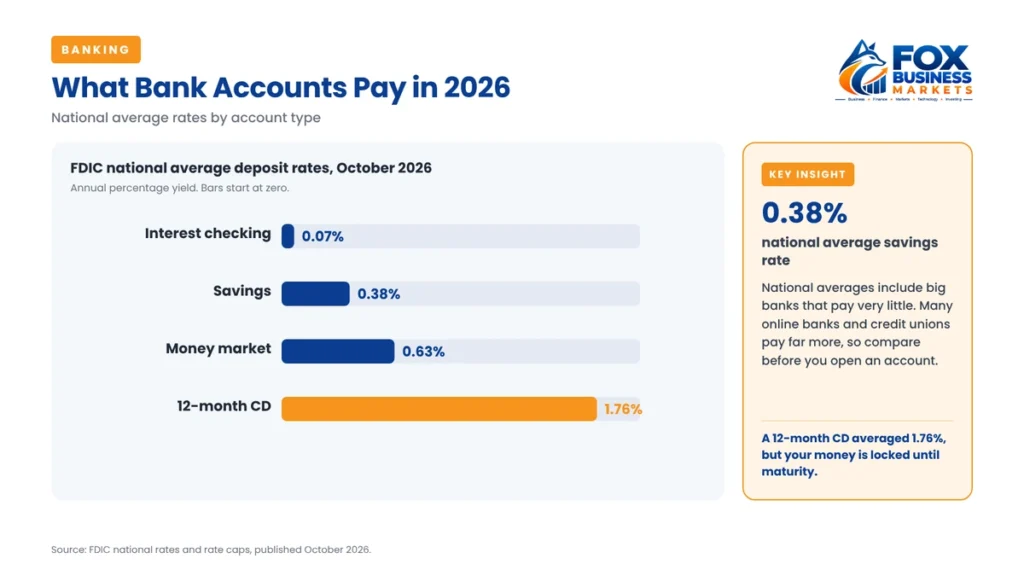
National averages are low because they include the big banks, which often pay very little. Many online banks and credit unions pay far more on savings, which is why shopping around matters. We compare the two everyday accounts in detail in our guide to checking vs. savings accounts, and our guide to the high-yield savings account explains how to earn more on your cash.
Savings accounts no longer have a federal six-withdrawal limit. The Federal Reserve removed that rule from Regulation D in April 2020, but its FAQ notes that banks are allowed, not required, to drop it. Some still limit withdrawals or charge fees for extra transfers, so check your account terms.
What Fees Do Banks Charge, and How Do You Avoid Them?
The most common bank fees are monthly maintenance fees, overdraft and insufficient funds (NSF) fees, out-of-network ATM fees, paper statement fees, and wire transfer fees. You can avoid most of them by choosing the right account and setting up a few alerts, one of the simplest banking basics that saves real money.
Overdraft fees are the most expensive for many customers. The Consumer Financial Protection Bureau (CFPB) found that overdraft and NSF fee revenue at banks with more than $1 billion in assets fell to $5.83 billion in 2023, from $11.96 billion in 2019, as many banks cut or eliminated these fees. But the CFPB also noted that some banks still charge overdraft fees as high as $37 each.
A CFPB rule that would have limited overdraft fees at banks and credit unions with more than $10 billion in assets (for example, to $5) never took effect. Congress overturned it with a Congressional Review Act resolution signed May 9, 2025 (Public Law 119-10). That means it’s up to you to pick a bank with friendly overdraft policies.
Here’s how to avoid most bank fees:
- Choose a no-fee account, or one that waives the monthly fee with direct deposit or a minimum balance you can easily keep.
- Don’t opt in to (or revoke) overdraft coverage for debit card and ATM transactions, so purchases are declined instead of charged a fee.
- Set low-balance alerts in your bank’s app.
- Use in-network ATMs, or a bank that reimburses ATM fees.
- Ask for a refund. Some banks will waive an occasional overdraft fee if you ask, especially if it’s your first.
How Do You Choose the Right Bank?
When it comes to banking basics, the right bank is the one that fits how you actually handle money, not the one with the biggest ad budget. Ask yourself these questions before you open an account:
- Is it FDIC- or NCUA-insured? Check with the FDIC’s BankFind tool or the NCUA’s credit union locator.
- What are the fees, and how easy are they to avoid?
- What does savings pay? Compare it with the national average and with online banks.
- How will you deposit cash, if you ever handle it? Online banks can make this harder.
- Are there ATMs and branches where you live and travel?
- How good is the app? Mobile check deposit, transfers, alerts, and card locking matter more than ever.
- How does it handle overdrafts?
Here’s an honest opinion: you don’t have to pick just one. Many people keep a checking account at a big bank or local credit union for convenience, and a high-yield savings account at an online bank for better interest. Just keep both accounts insured, and stay under the limits.
When you’re ready, our step-by-step guide on how to open a bank account covers the documents you’ll need.
Is Online Banking Safe?
Online banking follows the same banking basics as a branch: it’s as safe as the bank behind it, as long as the institution is insured and you protect your login. Mobile banking is now the norm. According to the FDIC’s 2023 household survey, 48.3% of banked households used mobile banking as their primary way to access their accounts. The same survey found that 4.2% of U.S. households, about 5.6 million, had no bank or credit union account at all.
Some online-only “fintech” apps aren’t banks themselves. They partner with an insured bank to hold your money. Pass-through FDIC insurance can cover your money only if the partner bank is FDIC-insured and the account and fintech records correctly show what you own. And FDIC insurance protects only against the failure of the bank, not the failure of the app company. Before you keep a large balance in an app, confirm the name of its partner bank.
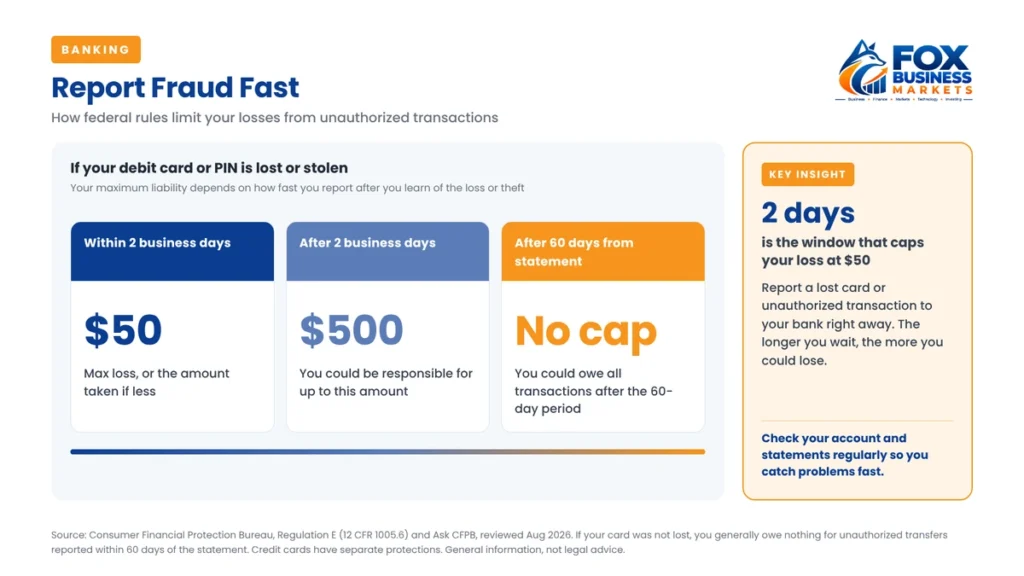
Federal law also limits your losses if your debit card or account is used without permission, but timing matters. According to the CFPB, if your debit card or PIN is lost or stolen:
- If you report it within 2 business days of learning of the loss or theft, you’re responsible for no more than $50 or the amount of the unauthorized transactions, whichever is less.
- After 2 business days, you could be responsible for up to $500.
- If you don’t report unauthorized transactions within 60 days after your statement is sent, you could have to pay the full amount of transactions that happen after that 60-day period.
If your card wasn’t lost but unauthorized transfers show up on your statement, you generally owe nothing if you report them within 60 days after the statement is sent; after that, you could be liable for later transfers. The lesson: check your account regularly and report problems immediately.
Frequently Asked Questions
What are banking basics?
Banking basics are depositing money in an insured account, using checking for everyday spending and savings for goals, and avoiding unnecessary fees. Banks lend out deposits and earn the difference in interest. Your deposits are insured up to $250,000 per depositor, per bank, for each ownership category by the FDIC or NCUA.
How much money is FDIC-insured?
The FDIC insures $250,000 per depositor, per FDIC-insured bank, for each account ownership category, such as single, joint, retirement, and trust accounts. That means one person can have more than $250,000 insured at one bank by using different ownership categories. Credit union deposits get the same $250,000 coverage from the NCUA.
Is a credit union better than a bank?
Neither is better for everyone. Credit unions are member-owned and often offer lower fees and better loan rates, but you must meet membership rules. Banks usually offer more branches, ATMs, and technology. Both are federally insured up to $250,000. Compare fees, rates, and access before choosing one.
What happens to my money if my bank fails?
If your bank is FDIC-insured and your deposits are within the insurance limits, your money is protected. Usually the FDIC arranges for another bank to take over the failed bank’s deposits, often over a weekend, and your accounts keep working. In 2026, insured deposits at all six failed banks were transferred to other banks, but uninsured balances weren’t always covered.
How many bank accounts should I have?
Most people should have at least two: a checking account for paychecks and bills, and a separate savings account for an emergency fund and goals. Keeping savings separate, sometimes at a different bank, makes it less likely you’ll spend it by accident. More accounts can help with specific goals, but each one adds something to track.
Do savings accounts still limit withdrawals?
There’s no longer a federal limit. The Federal Reserve removed the six-withdrawal-per-month rule from Regulation D in April 2020. However, banks are allowed to keep their own limits, and some still restrict withdrawals or charge fees for extra transfers. Check your account agreement to see what applies to you.
The Bottom Line
The customers of Nano Banc spent one strange weekend wondering what would happen to their money. Then they found out: nothing bad happened to their insured deposits. Their accounts moved to another bank, and life went on.
That’s the real point of banking basics. Keep your money in insured institutions and within the coverage limits. Use checking for spending and savings for saving. Choose accounts that pay a fair rate and charge few fees, and watch your account closely so you can report problems fast. Get those few things right, and your bank becomes one of the safest, most boring parts of your financial life, which is exactly what it should be. For the bigger picture, see our personal finance guide, and check the latest banking statistics.