Renée had tried budgeting three times. She’s a physical therapy assistant in Denver, and every January she downloaded a new app, color-coded twenty categories, and quit by February. The fourth attempt started differently. Two days before payday, her checking account showed $38, and a $64 renewal charge for a streaming bundle she’d forgotten about bounced. She didn’t need a prettier app. She needed to know where her money went and a plan simple enough to survive a busy month. (Renée is a composite example, but her story is a familiar one.)
This guide shows you how to make a budget the way that finally worked for her: start with real numbers, pick one method, and keep it small enough to maintain.
Quick answer: To make a budget, total your monthly take-home pay, track 30 days of spending, list your fixed bills, and choose a method such as 50/30/20 or zero-based budgeting. Then assign every dollar to needs, wants, savings, or debt, and review the plan once a month so it matches your real life.
How to Make a Budget in 7 Steps
Here’s how to make a budget in seven steps: find your take-home pay, track your spending, list your bills, pick a method, assign your money, cut where it counts, and review monthly. You can usually set up a working first draft in one evening and refine it over the next month.
Step 1: Figure Out Your Monthly Take-Home Pay
Your budget runs on take-home pay, the amount that actually lands in your bank account after taxes, insurance premiums, and retirement contributions. Don’t use your salary.
If you’re paid every two weeks, build your monthly budget on two paychecks. In most years, two months bring a third paycheck (three in some years); treat it as extra money for savings or debt. If you have side income, add only what you reliably earn, not your best month.
Irregular income is more common than many people think. The Federal Reserve’s Economic Well-Being of U.S. Households in 2025 report found that 30% of adults had income that varied at least occasionally during the year, and 11% struggled to pay bills because of it. If that’s you, build your budget around your lowest typical month (more on that below).
Step 2: Track 30 Days of Spending
Before you decide where your money should go, find out where it actually goes. Pull the last 30 to 60 days of bank and credit card statements and sort every charge into a category.
Expect a surprise or two. Many people underestimate food delivery, small online orders, and subscriptions. The Consumer Financial Protection Bureau (CFPB) offers a free spending tracker as part of its Your Money, Your Goals toolkit if you’d rather use paper than an app.
Step 3: List Your Fixed Bills and Due Dates
Fixed bills are the ones that cost about the same every month: rent or mortgage, car payment, insurance, phone, internet, minimum debt payments, and child care. Write each one down with its due date.
Due dates matter as much as amounts. If rent and a car payment both hit in the first week, your first paycheck of the month has to cover them. The CFPB’s bill calendar makes this easy to see.
Step 4: Choose a Budgeting Method
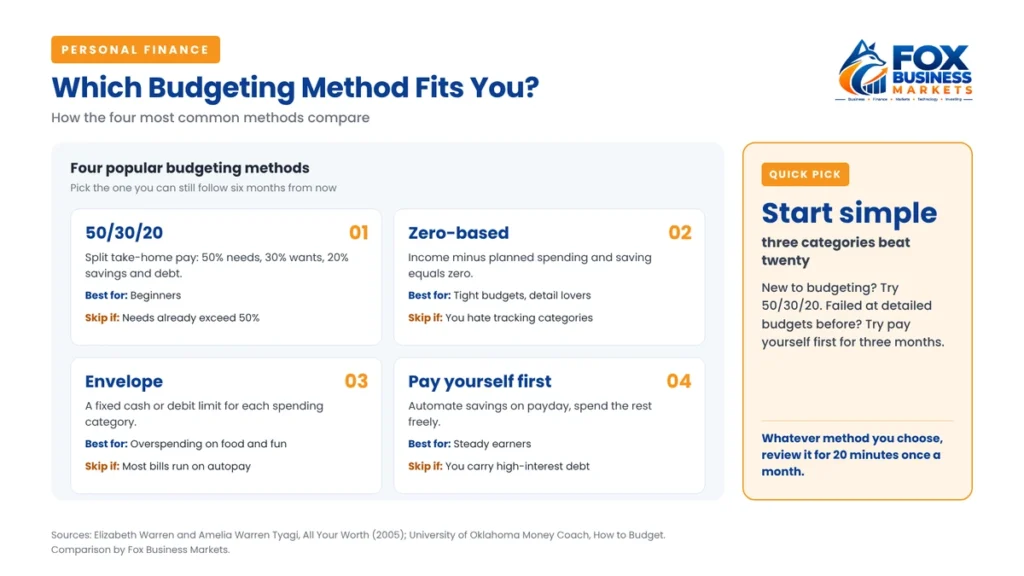
A budgeting method is simply a rule for dividing your money, and choosing one is the heart of how to make a budget you’ll keep. The best one is the one you’ll still be using in six months. The four most common options are compared in the table below. If you’re not sure, start with 50/30/20, because it has only three categories.
Step 5: Give Every Dollar a Job
Now assign your take-home pay to categories until nothing is left over. Put savings and debt payments in before wants, not after. Money that’s “left over at the end of the month” has a way of disappearing.
Set up automatic transfers on payday: one to savings, one to any extra debt payment. Automation is the closest thing to a budgeting superpower, because it removes the monthly decision. If you don’t have a cushion yet, your first savings goal should be a starter emergency fund.
Step 6: Cut Where It Counts
Cut big expenses first. According to the Bureau of Labor Statistics’ Consumer Expenditures in 2024 report, the average consumer unit (BLS’s term for a household) spent $78,535 that year, and housing ($26,266) and transportation ($13,318) took about half of it. A cheaper apartment, a roommate, refinancing a car loan, or shopping your auto insurance can save more than a year of skipped lattes.
Then hunt the small leaks. Review every recurring charge on your statements and cancel what you don’t use. The Federal Trade Commission’s “click to cancel” rule, which would have required easy online cancellation, was struck down by the 8th U.S. Circuit Court of Appeals in July 2025, and in March 2026 the FTC asked for public comment on whether to write a new rule. No federal click-to-cancel rule is in effect, but a federal law, the Restore Online Shoppers’ Confidence Act (ROSCA), still requires online sellers to offer a simple way to cancel, and many states have their own auto-renewal laws. Follow the FTC’s consumer advice: keep a copy of your cancellation request; if you can’t cancel, ask your card company to stop the payments, and if charges continue after you cancel, dispute them with your card issuer.
Step 7: Review Your Budget Every Month
A budget is a plan, not a contract. Set a 20-minute monthly check-in, ideally a few days before the new month starts. Compare what you planned with what you spent, move money between categories, and plan for anything unusual coming up (birthdays, car registration, holidays).
The first three months are the hardest. Budgets often fail because people treat one overspent category as proof that budgeting “doesn’t work.” It’s actually the system doing its job: showing you where the plan was unrealistic.
Which Budgeting Method Should You Use?
When you’re figuring out how to make a budget, the best method depends on how much detail you want and how predictable your income is. Here’s an honest comparison of the four most popular options.
Method | How it works | Best for | Skip it if |
| 50/30/20 | 50% of take-home pay to needs, 30% to wants, 20% to savings and debt | Beginners who want a simple guide | Your needs already exceed 50% |
| Zero-based | Income minus all planned spending and saving equals zero | Detail-oriented people, tight budgets | You hate tracking categories |
| Envelope | A set amount of cash or debit spending for each category | Overspenders on food and fun | You pay most bills by card or autopay |
| Pay yourself first | Save and invest a fixed amount on payday, spend the rest freely | Steady earners who don’t overspend | You’re carrying high-interest debt |
The 50/30/20 rule was popularized by Elizabeth Warren and Amelia Warren Tyagi in their 2005 book All Your Worth. Zero-based budgeting follows a simple idea that the University of Oklahoma’s Money Coach program sums up as “income minus outgo equals zero.” Every dollar gets assigned somewhere, including savings.
Here’s an honest opinion: if you’ve failed at detailed budgets before, try pay-yourself-first with one rule (automate savings and bills, spend the rest guilt-free) for three months. Simple beats perfect.
What Does a Sample Monthly Budget Look Like?
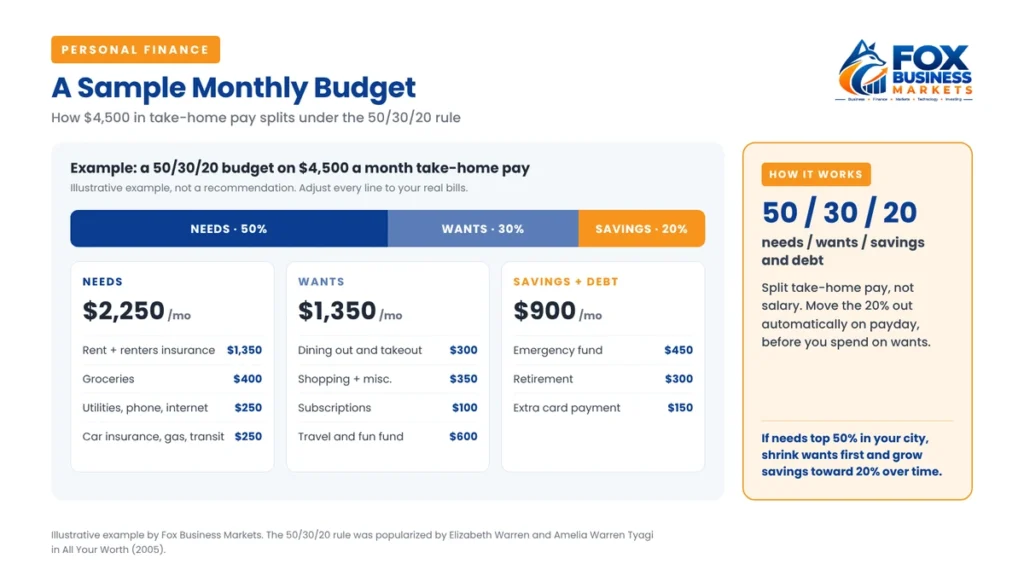
A sample 50/30/20 budget on $4,500 a month in take-home pay puts $2,250 toward needs, $1,350 toward wants, and $900 toward savings and debt. Your numbers will differ, but if you’re learning how to make a budget for the first time, seeing the split in real dollars makes it easier to build your own.
Category | Monthly amount | Bucket |
| Rent and renters insurance | $1,350 | Needs |
| Groceries | $400 | Needs |
| Utilities, phone, internet | $250 | Needs |
| Car insurance, gas, transit | $250 | Needs |
| Dining out and takeout | $300 | Wants |
| Shopping, personal, and miscellaneous | $350 | Wants |
| Subscriptions and memberships | $100 | Wants |
| Travel and fun fund | $600 | Wants |
| Emergency fund | $450 | Savings and debt |
| Retirement (beyond workplace plan) | $300 | Savings and debt |
| Extra credit card payment | $150 | Savings and debt |
| Total | $4,500 |
This is an illustration, not a recommendation for your city. In many areas, rent alone would take more than $1,350, which is exactly where the rule needs adjusting.
How Much of Your Budget Should Go to Housing?
A common guideline is to keep housing costs at or below 30% of your gross (pre-tax) income, the measure HUD and Census data use. Because your budget runs on take-home pay, that same rent will look like a bigger share of your paycheck. The Department of Housing and Urban Development (HUD) considers households that pay more than 30% of their income for housing “cost-burdened,” and those paying more than 50% for rent “severely” burdened, according to HUD User.
Many renters can’t meet that line. A May 2026 Congressional Research Service report found that 22.7 million renter households, 49.4%, were cost-burdened in 2024, and 26.2% were severely cost-burdened.
If housing takes more than 30% of your income, don’t conclude that budgeting is pointless for you. Shrink the wants bucket for now, look for income growth, and plan your next move (a roommate, a cheaper unit, or a different neighborhood) around the number your budget can actually carry.
How Is Inflation Affecting Your Budget in 2026?
Inflation is hitting some budget lines much harder than others in 2026, so last year’s budget may already be out of date. Consumer prices rose 3.7% in the 12 months ending September 2026, according to the Bureau of Labor Statistics’ Consumer Price Index report released October 14, 2026.
The overall number hides big differences. Energy prices jumped 20.4% over the year, led by gasoline at 34.2%. Electricity rose 4.4%, restaurant meals (food away from home) 3.5%, and shelter 3.2%. Groceries (food at home) rose a milder 1.8%, and motor vehicle insurance actually fell 5.0%.
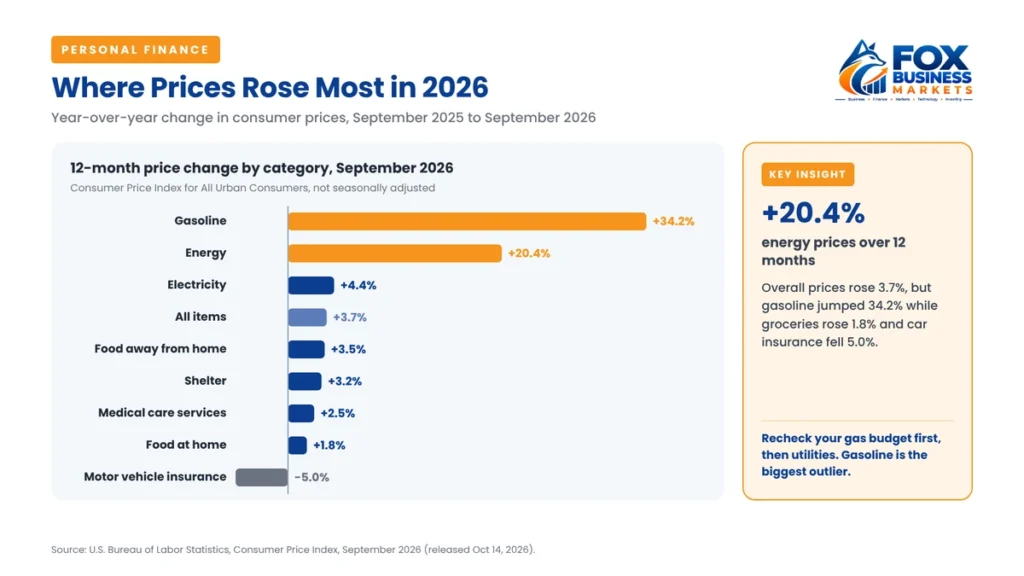
What does that mean for your budget? Recheck your gas line first, then utilities. Lower average car insurance premiums may show up at your next renewal, but comparing quotes is still the surest way to save.
How Do You Budget With Irregular Income?
If you’re working out how to make a budget with irregular income, build your plan around your lowest typical month and treat everything above it as a bonus. Freelancers, gig workers, servers, and commission-based salespeople all benefit from this approach.
- Look at the last 12 months of income and find your lowest normal month (ignore one-time disasters).
- Build a bare-bones budget that fits that number: needs, minimum debt payments, and a small savings transfer.
- In good months, send the extra to a “buffer” savings account first, then to goals.
- In slow months, pull from the buffer to cover the gap.
Once your buffer holds a full month of expenses, you can pay yourself a steady “salary” from it each month, which makes budgeting feel almost normal.
Why Do Most Budgets Fail?
Knowing how to make a budget is the easy part; keeping it is harder. Budgets often fail because they’re too strict, too detailed, or built on guesses instead of real spending. A budget that plans $200 for groceries when you’ve spent $550 every month for a year isn’t a budget; it’s a wish.
Other common reasons: forgetting irregular expenses (annual subscriptions, car repairs, gifts), having no fun money at all, and giving up after one bad month. The fix for most of these is the same. Base the plan on real numbers, include a “miscellaneous” cushion (about 5% is a common choice), and keep a small amount for things you enjoy.
When does budgeting not help? If your income genuinely can’t cover your basic needs, a spreadsheet won’t close the gap. In that case, focus on raising income and lowering fixed costs, and look into local assistance programs. Our personal finance guide covers the bigger picture, and our guide on how to pay off debt can help if debt payments are what’s squeezing you.
Frequently Asked Questions
What is the easiest way to make a budget?
The easiest way to learn how to make a budget is the 50/30/20 method. Total your monthly take-home pay, then plan to spend about 50% on needs, 30% on wants, and 20% on savings and debt payments. Your plan is judged on just three buckets, which makes it far easier to stick with than detailed budgets.
What are the 5 basic steps of budgeting?
The five basic steps are: calculate your monthly take-home pay, track your actual spending for a month, list your fixed bills and due dates, assign every dollar to needs, wants, savings, or debt, and review the budget monthly. Adding automatic transfers for savings and bill payments makes the whole system much easier to maintain.
How much should I budget for groceries?
Grocery budgets depend on household size, location, and diet, so start with what you actually spent over the past two or three months. The average household spent $6,224 on food at home in 2024, about $519 a month, according to the Bureau of Labor Statistics. Grocery prices rose 1.8% over the year ending September 2026.
Is it better to budget weekly or monthly?
Most people should budget monthly, because rent, loans, and most bills are monthly. If you’re paid weekly or tend to overspend, add a weekly check-in for flexible categories like groceries and dining out. Many people combine the two: a monthly plan for bills and savings, and a weekly limit for day-to-day spending.
What should I do if my budget doesn’t balance?
If your budget doesn’t balance, cut wants first, then look at your biggest fixed costs, like housing, car payments, and insurance. Call providers to negotiate or switch plans, cancel unused subscriptions, and pause extra savings temporarily if needed. If basic needs still exceed income, focus on raising income and contacting local assistance programs.
Should I use a budgeting app or a spreadsheet?
Use whichever you’ll open every week. Apps sync with your accounts automatically and save time, but some charge monthly fees. Spreadsheets are free and flexible but need manual updates. Paper works too. The CFPB offers free worksheets, including a spending tracker and bill calendar, in its Your Money, Your Goals toolkit.
The Bottom Line
Renée’s fourth budget didn’t use twenty categories. It used three. She tracked one month of spending, found $180 in subscriptions and delivery fees she didn’t miss, and set up two automatic transfers on payday. Six months later, she hadn’t bounced a single charge, and she had her first $1,000 in savings.
That’s how to make a budget that lasts: start from real numbers, choose one simple method, pay your savings and bills first, and review the plan monthly instead of abandoning it after one bad week. Some prices in 2026 are moving fast, especially gasoline, so the budget you make today should be a living document. Build the first draft tonight. It doesn’t have to be perfect to start working.