
Danielle had a good month going until her car didn’t start. She’s a dental hygienist in Columbus, and she earns a steady paycheck that has never felt small. The repair shop called on a Tuesday afternoon: a new alternator plus labor came to $1,140. She had $600 in checking and a credit card with a balance she’d been meaning to pay down since spring. That night she sat at the kitchen table and realized she couldn’t say where her last three paychecks had gone.
Danielle is a composite example, but nothing about her situation is unusual. She doesn’t have a money problem as much as a system problem, and that’s what personal finance is really about.
Quick answer: Personal finance is how you manage your own money: earning it, spending it, saving it, borrowing it, investing it, and protecting it. Good personal finance means you can pay today’s bills, handle a surprise expense without panic, and keep making progress toward goals like a home, a debt-free life, or retirement.
What Is Personal Finance?
Personal finance is the set of decisions you make about your own money and your household’s money. It covers six areas: earning income, spending, saving, investing, managing credit, and managing risk. Those six come straight from the National Standards for Personal Financial Education, published in 2021 by the Council for Economic Education and the Jump$tart Coalition and used by schools across the country.
Business finance asks whether a company is profitable. Personal finance asks a more personal question: does your money let you live the life you want, now and later?
The Consumer Financial Protection Bureau (CFPB) gives a useful target. It defines financial well-being as “a state of being wherein a person can fully meet current and ongoing financial obligations, can feel secure in their financial future, and is able to make choices that allow them to enjoy life.” Notice that the definition doesn’t mention a dollar figure. Someone earning $45,000 with no debt and three months of savings can be in better shape than someone earning $150,000 who is one missed paycheck from trouble.
Why Does Personal Finance Matter?
Personal finance matters because small, repeated decisions decide whether a surprise bill is an annoyance or a crisis. The data shows most Americans are holding steady, but more than a third would struggle to cover even a $400 surprise with cash.
The Federal Reserve’s Economic Well-Being of U.S. Households in 2025 report, published in May 2026, found that 73% of adults were “doing okay” or “living comfortably” financially near the end of 2025. That’s the same as the year before but below the high of 78% in 2021.
The same survey found that 63% of adults would cover a hypothetical $400 emergency expense entirely with cash or its equivalent, which the Fed defines as cash, savings, or a credit card paid off in full at the next statement. That share climbed from 50% in 2013 to 68% in 2021, then slipped back to 63%, where it has stayed for four years.
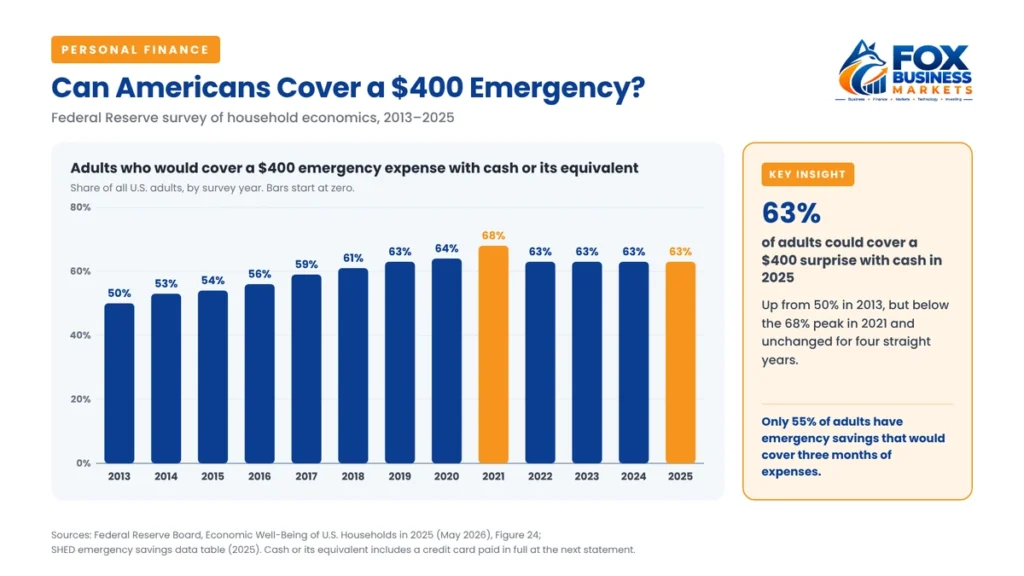
Just 55% of adults said they had emergency savings that would cover three months of expenses, according to the Fed’s emergency savings data table. And only 35% of adults who aren’t yet retired thought their retirement savings plan was on track.
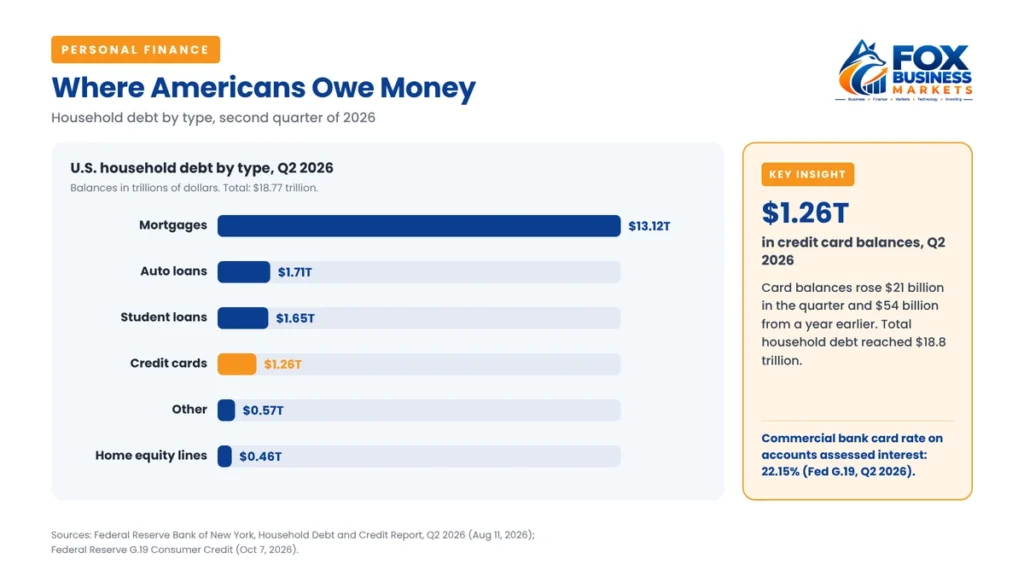
Household debt is near a record. It totaled $18.8 trillion in the second quarter of 2026, according to the New York Fed’s Household Debt and Credit Report, up $383 billion from a year earlier (though down $13 billion from the first quarter). Credit card balances alone were $1.26 trillion.
None of these numbers is a reason to panic. They are a reason to build a simple system. Income and education matter a lot, but habits matter at every income level, and they’re the part you control.
What Are the 6 Areas of Personal Finance?
The six areas of personal finance are earning, spending, saving, investing, managing credit, and managing risk. Each one affects the others: a raise doesn’t help if spending rises to match it, and investing doesn’t help if a credit card is charging you more than your investments earn.
1. Earning Income
Your income is the fuel for everything else. It includes your paycheck, side income, and benefits that are easy to overlook, such as an employer’s retirement match or health insurance.
Look at your pay stub, not just your salary. The gap between gross pay and take-home pay (federal and state taxes, Social Security, Medicare, insurance premiums, retirement contributions) can be large, and your budget runs on take-home pay, not salary. If you’re thinking about earning more on the side, our guide to small business ideas is a good starting point.
2. Spending
Spending is where most money plans succeed or fail. The goal isn’t to spend as little as possible; it’s to spend on purpose.
The Bureau of Labor Statistics’ Consumer Expenditure Survey, released in December 2025, shows where the average American household’s money went in 2024. Average annual spending was $78,535. Housing took 33.4% of it, transportation 17.0%, food 12.9%, personal insurance and pensions 12.5%, and healthcare 7.9%.
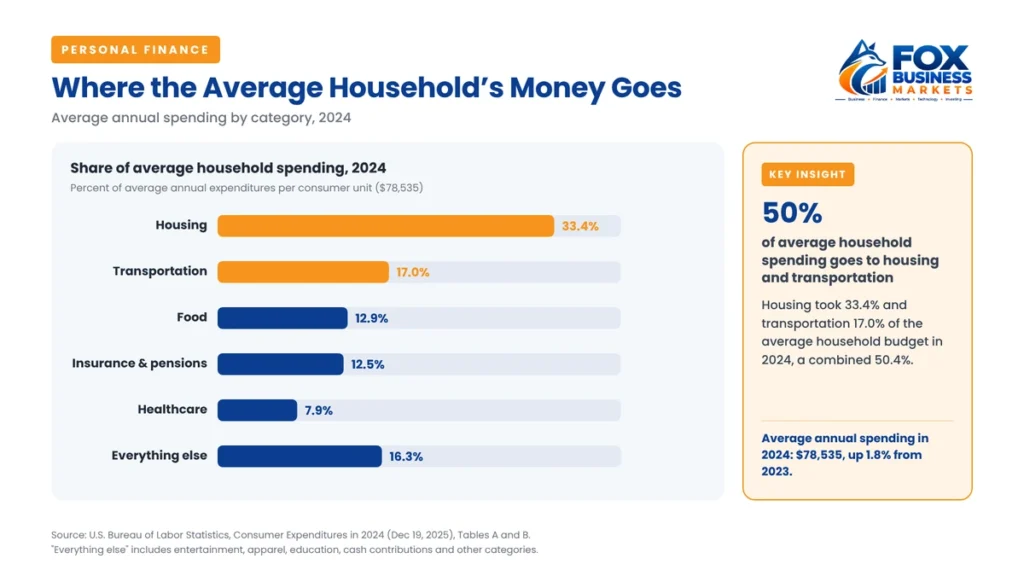
Housing and transportation together take about half of the average household’s spending. That’s why one decision, like a cheaper apartment or keeping a paid-off car three more years, usually saves more than cutting a hundred small treats. Our step-by-step guide on how to make a budget shows how to set this up.
3. Saving
Saving is setting money aside for things you know are coming (a vacation, a new laptop, a down payment) and for things you can’t predict (a job loss, a car repair, a vet bill).
The second kind is your emergency fund. The Financial Industry Regulatory Authority (FINRA) says that ideally it should “eventually equal about three to six months’ worth of living expenses.” That can sound impossible, so start smaller. When the CFPB launched its Start Small, Save Up initiative in 2019, then-Director Kathleen Kraninger said, “Our research finds that even small amounts of liquid savings can make a big difference.” A starter fund of $1,000 would have turned Danielle’s alternator from a crisis into an inconvenience. Our guide to building an emergency fund walks through it.
Keep savings somewhere safe. Deposits at FDIC-insured banks are protected up to $250,000 per depositor, per insured bank, for each account ownership category, and the NCUA offers the same $250,000 coverage at federally insured credit unions.
4. Investing
Investing means putting money into assets, such as stock and bond funds, that can grow faster than inflation over long periods. It’s how most people build retirement savings, and it’s the area where time matters most.
For most beginners, investing starts with an employer retirement plan. For 2026, the IRS lets you contribute up to $24,500 to a 401(k), 403(b), or governmental 457 plan, plus an $8,000 catch-up if you’re 50 or older. Savers aged 60 to 63 can instead make catch-up contributions of up to $11,250, and under the SECURE 2.0 Act some higher earners must make catch-ups as Roth contributions. The IRA limit is $7,500, with a $1,100 catch-up for people 50 and up. The IRS usually announces the following year’s limits in the fall, so check for 2027 numbers before you set next year’s contributions.
Here’s an honest opinion: if your employer matches part of your 401(k) contributions, contribute at least enough to get the full match before you do almost anything else on this list. It’s part of your pay, and skipping it means leaving that pay on the table.
5. Managing Credit
Managing credit means borrowing in ways that help you and avoiding the kinds that quietly drain you. Your credit score affects your mortgage rate, car loan rate, apartment applications, and sometimes insurance prices.
According to myFICO, FICO scores weigh five things: payment history (35%), amounts owed (30%), length of credit history (15%), new credit (10%), and credit mix (10%). Payment history and amounts owed together make up 65% of the score, though myFICO notes that “the importance of these categories may vary from one person to another.”
Credit card debt is the expensive kind. The Federal Reserve’s G.19 report put the average rate at commercial banks on credit card accounts assessed interest at 22.15% in the second quarter of 2026. At that rate, a $5,000 balance costs roughly $92 a month in interest before you pay down a dollar of it. Our guide on how to pay off debt compares the avalanche and snowball methods.
You can check your credit reports from Equifax, Experian, and TransUnion for free every week at AnnualCreditReport.com. The FTC confirms the weekly free reports are now permanent.
6. Managing Risk
Managing risk means protecting what you’ve built from events that could wipe it out. In practice, that’s insurance (health, auto, renters or homeowners, disability, and life insurance if someone depends on your income) plus basic documents like a will and beneficiary designations.
This is the least exciting part of managing money, and it’s the one people skip most. A single uninsured hospital stay or car accident can undo years of saving. If you have kids or a partner who relies on your paycheck, term life insurance and a simple will matter more than picking the perfect investment fund.
In What Order Should You Tackle Your Finances?
Start with the steps that prevent the most damage, then move to the ones that build wealth. The exact order depends on your situation, but this sequence is a common starting point:
- Track one month of spending. You can’t fix what you can’t see. Use your bank app or a simple spreadsheet.
- Cover the basics of insurance (health, auto, renters or homeowners) and keep it in place. Add life insurance and a will as soon as anyone depends on you.
- Build a starter emergency fund of about $1,000 so a small surprise doesn’t land on a credit card.
- Get your full employer 401(k) match, if you have one (check your plan’s vesting schedule).
- Pay off high-interest debt, starting with credit cards charging around 20% or more.
- Grow your emergency fund toward three to six months of living expenses.
- Invest more for retirement through a 401(k), an IRA, or both.
- Save for other goals, such as a home, a car, or a child’s education.
When does this order not work? If you have no emergency savings and a job that feels shaky, build cash first even if it delays debt payoff. If your only debts are low-rate (roughly 5% or less), such as many mortgages, you can usually invest while paying them on schedule.
Do Common Money Rules of Thumb Actually Work?
Money rules of thumb work as starting points, not as laws. Use them to get moving, then adjust to your real numbers.
Rule | What it says | Where it falls short |
| 50/30/20 budget | 50% of take-home pay to needs, 30% to wants, 20% to savings and debt | Hard to hit in high-rent cities, where housing alone can pass 40% |
| 3 to 6 months of expenses | Emergency fund size, per FINRA | Freelancers and single-income households may need more |
| Pay yourself first | Move savings out automatically on payday | Only works if your budget leaves room for the transfer |
| Get the full 401(k) match | Contribute enough to collect free employer money | Not every employer offers one, and you may need to stay long enough to vest |
The 50/30/20 rule was popularized by Elizabeth Warren and Amelia Warren Tyagi in their 2005 book All Your Worth. It’s a useful sketch. If 50% won’t cover your needs, don’t give up on budgeting. Shrink “wants” for a while, or treat 20% savings as a goal you grow into.
Which Money Stats Should You Stop Repeating?
Two numbers get passed around constantly, and both are often misused.
“78% of Americans live paycheck to paycheck.” This came from a 2017 CareerBuilder survey conducted by Harris Poll, and it was about full-time private-sector workers, not all Americans. CNBC’s report at the time said “seventy-eight percent of full-time workers.” It’s nearly a decade old and it measured how people felt, so it isn’t a current statistic about the country.
“Four in ten Americans can’t cover a $400 emergency.” This comes from the Fed’s survey reports of 2015 to 2018, when 39% to 46% of adults said they wouldn’t cover a $400 expense with cash or its equivalent. In 2025, 37% still wouldn’t, so the number isn’t far off. What it means is often misread. Most of that group would still pay: 15% would carry a credit card balance, 10% would borrow from family or friends, and 7% would sell something (people could pick more than one). About 12% said they couldn’t cover it by any means. It’s a sign of thin savings, not proof that four in ten people have no way to pay.
If you want current numbers, go to the source. Our personal finance statistics roundup collects the latest data from the Fed, BLS, and other official sources.
How Much Money Do You Need to Start Managing Your Finances?
You don’t need any money to start; you need information. The first steps (tracking spending, listing debts with their interest rates, checking your credit report, and reading your pay stub) cost nothing.
The first dollars you save should go somewhere boring and easy to reach, like a savings account at an insured bank or credit union. Many online banks have no minimum balance. Once you have a cushion, many brokerages let you buy low-cost index funds or fractional shares with very small amounts.
What Are the Most Common Personal Finance Mistakes?
The most common money mistakes are not the dramatic ones. They’re the quiet habits that compound over years:
- No emergency fund, which turns every surprise into new debt.
- Carrying a credit card balance at 20%+ interest while your savings earn far less.
- Skipping the employer match on a retirement plan.
- Letting lifestyle grow with every raise, so savings never grows.
- Ignoring insurance until something goes wrong.
- Waiting for the “right time” to start. Starting with $25 a month beats a perfect plan you never begin.
Skip the urge to fix everything this weekend. Pick one of these and fix it this month.
Frequently Asked Questions
What is personal finance in simple words?
Personal finance is how you handle your own money. It covers what you earn, how you spend, how much you save, what you borrow, how you invest, and how you protect yourself with insurance. The goal is simple: pay today’s bills comfortably, handle surprises without debt, and keep making steady progress toward the life you want later.
What are the 6 basics of personal finance?
The six basics are earning income, spending, saving, investing, managing credit, and managing risk. They come from the National Standards for Personal Financial Education, published in 2021 by the Council for Economic Education and the Jump$tart Coalition. Each area affects the others, so progress usually comes from working on several at once rather than mastering one first.
What should I do first to fix my finances?
Track one month of spending so you know where your money actually goes. Then build a small emergency fund of about $1,000, collect any employer 401(k) match, and attack high-interest credit card debt. These four steps prevent the most damage and create room for bigger goals like investing and buying a home.
How much should I have in an emergency fund?
FINRA suggests that an emergency fund should eventually cover about three to six months of living expenses. That’s a long-term target, not a starting point. Begin with about $1,000, then grow it over time. Freelancers and commission earners, whose income swings, and single-income households, where one job loss stops all income, should aim higher.
Is the 50/30/20 rule realistic?
The 50/30/20 rule is a good starting point but not realistic for everyone. In high-cost cities, rent alone can take 40% or more of take-home pay, which leaves little room for wants. Use it as a guide: if needs exceed 50%, cut wants first and treat the 20% savings target as a goal you work toward.
Can I learn personal finance on my own?
Yes. Most personal finance skills are learned by doing, not studying. Free, reliable resources include the CFPB, FINRA, Investor.gov from the SEC, and the IRS for tax rules. Start with your own numbers: read your pay stub, list your debts, and check your free credit reports. Consider a fee-only financial planner for complex decisions.
The Bottom Line
Danielle paid for her alternator with a mix of checking and her credit card, and it stung. But that night at the kitchen table turned into a plan. She tracked a month of spending, found $310 a month in subscriptions and takeout she didn’t miss, and set up an automatic transfer on payday. Six months later, she had a $1,200 emergency fund and had paid about $650 off her card. Her income hadn’t changed. Her system had.
That’s the real lesson of personal finance. You don’t need a finance degree or a big salary. You need to know where your money goes, keep a cushion for surprises, avoid expensive debt, grab free money like an employer match, and let time do the heavy lifting on your investments. Start with one step this week. The rest gets easier once you can see your numbers.