
Quick answer: Term life insurance covers you for a set period, such as 20 or 30 years, and costs far less for the same death benefit. Whole life insurance covers you for life and builds cash value, but its premiums are much higher. Most families who need coverage while raising children or paying a mortgage get more protection per dollar from term.
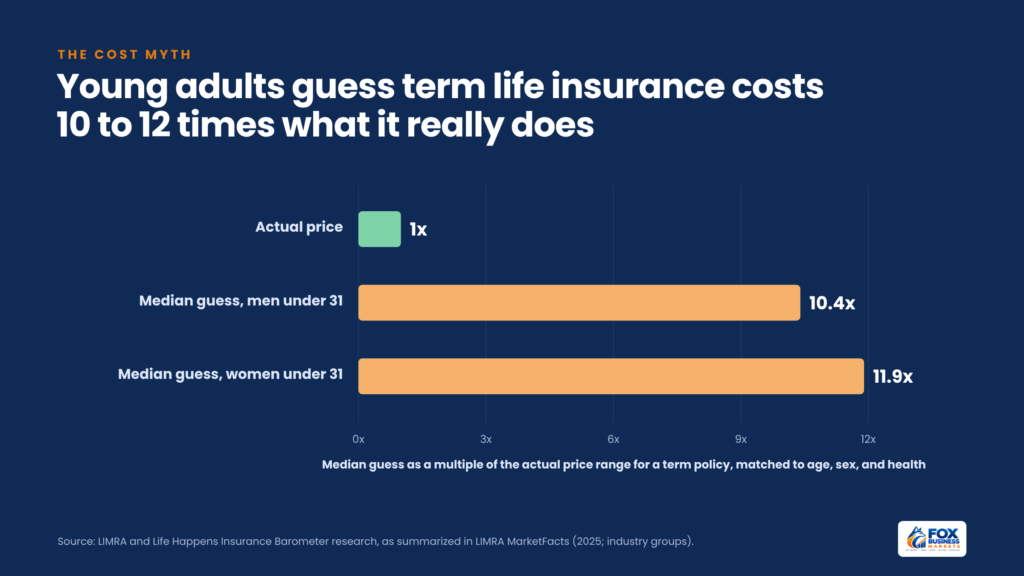
Only about half of Americans, 52%, own any life insurance, according to the 2026 Insurance Barometer Study from LIMRA and Life Happens. One big reason is cost, and most people guess wrong about it. In a 2025 LIMRA analysis, young, healthy adults overestimated the cost of a term policy by about 6 to 12 times.
The choice between policy types adds to the confusion. Term and whole life sound similar, but they’re built for different jobs, and the price gap between them is large.
This guide compares term vs. whole life insurance side by side: how each works, what you pay, how cash value grows, and how to decide which fits your family.
What Is Term Life Insurance?
Term life insurance pays a death benefit if you die during a set period, called the term. Common terms are 10, 20, and 30 years. If you’re alive when the term ends, the coverage stops and there’s no payout.
“Term insurance is intended to provide lower cost coverage for a specific period of time,” according to the National Association of Insurance Commissioners’ Life Insurance Buyer’s Guide.
Key features of most term policies:
- Level premiums for the term. With level term, your premium stays the same for the full 20 or 30 years.
- No cash value. You’re paying only for the death benefit.
- Renewal at a higher price. Many term policies can be renewed when the term ends, even if your health has changed, but at higher premiums, the NAIC notes.
Term works like auto insurance: you pay for protection during the years you need it, and if nothing happens, the money paid for that protection is spent.
What Is Whole Life Insurance?
Whole life insurance is a type of permanent, or cash value, life insurance, one of the main types of insurance families compare. It covers you for your entire life, as long as you pay the premiums, so your beneficiaries receive a death benefit whenever you die.
Key features:
- Lifetime coverage. No expiration date as long as the policy stays in force.
- Fixed premiums. You typically pay premiums on a set schedule, often the same amount for life.
- Cash value. Part of each premium goes into a cash value account that grows over time at a rate set by the policy.
- Possible dividends. Policies from some insurers, called participating policies, may pay dividends. Dividends aren’t guaranteed.
You can borrow against the cash value or surrender the policy for it. But unpaid loans and interest reduce the death benefit your family receives.
Term vs. Whole Life Insurance: How Do They Compare?
Feature | Term life | Whole life |
| How long it lasts | A set term, such as 20 or 30 years | Your entire life |
| Cost | Much lower for the same death benefit | Much higher |
| Premiums | Level during the term; higher if renewed | Usually fixed for life |
| Cash value | None | Yes, grows over time |
| Payout | Only if you die during the term | Whenever you die, if the policy is in force |
| Flexibility | Simple; buy the amount and term you need | Loans and withdrawals possible; more complex |
| Best for | Income replacement while others depend on you | Lifelong needs, such as estate planning or a lifelong dependent |
The biggest practical difference is price. Because term insurance covers only a limited period and builds no savings, insurers can offer the same death benefit for a fraction of a whole life premium.
Why Does Whole Life Cost So Much More?
A whole life premium pays for two things: lifelong insurance and a savings component.
Lifelong coverage is expensive because the insurer expects to pay the death benefit eventually. With term, most policyholders outlive the term, so the insurer pays far fewer claims. Whole life premiums also fund the cash value, which you’re building alongside the insurance.
You’re buying two products in one. The question is whether you’d do better buying them separately: cheaper term coverage for protection, and a retirement account or other investment for savings.
How Does Whole Life Cash Value Work?
Cash value grows tax-deferred inside the policy, meaning you don’t owe tax on the growth each year. Over time, you can use it in a few ways:
- Borrow against it. Policy loans don’t require a credit check, but they charge interest. If you die with a loan outstanding, the insurer subtracts it from the death benefit.
- Withdraw part of it. Some policies allow partial withdrawals, which can reduce the death benefit.
- Surrender the policy. You get the cash surrender value, minus any surrender charges, and coverage ends. Generally, the amount you receive above your cost in the policy (premiums paid, minus dividends and other amounts you’ve received tax-free) is taxable income.
- Use it to pay premiums. Some policies let cash value or dividends cover future premiums.
Keep three cautions in mind:
- Slow start. Cash value builds slowly in the early years, because a large share of early premiums covers costs.
- Early surrender losses. Surrendering in the first several years often returns less than you paid.
- No double payout. In a standard whole life policy, your beneficiaries generally receive the death benefit, not the death benefit plus the cash value.
The death benefit itself is generally tax-free to your beneficiaries. Life insurance proceeds paid because of the insured person’s death “aren’t includable in gross income and you don’t have to report them,” according to the IRS. Interest paid on those proceeds is taxable.
What About Universal and Variable Life?
Whole life isn’t the only permanent option. The NAIC describes two other common types:
- Universal life. You “can choose a flexible premium payment pattern as long as you pay enough to keep your policy in force.” Underfunding it can cause a lapse later.
- Variable life. Cash value is invested in subaccounts similar to mutual funds. These policies “have the greatest potential to build cash value but also the greatest risk of losing cash value,” the NAIC says.
Variable life policies are securities sold with a prospectus, so read the fees closely.
Does “Buy Term and Invest the Difference” Work?
“Buy term and invest the difference” is a common strategy: buy cheaper term coverage, then invest the money you would have spent on the higher whole life premium.
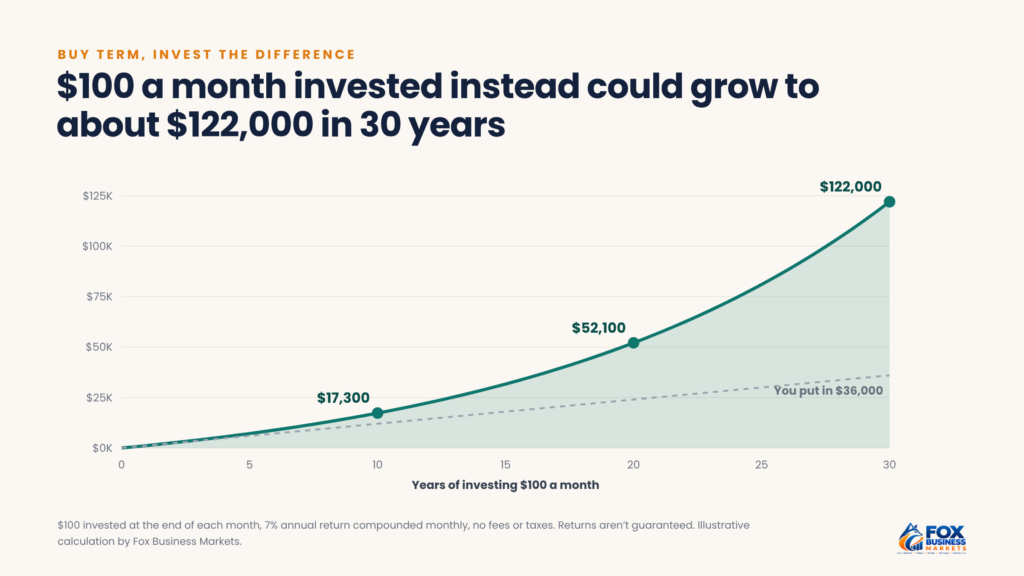
Thanks to compound interest, every $100 a month you invest at a 7% average annual return grows to about $52,100 after 20 years and about $122,000 after 30 years.
Illustrative calculation by Fox Business Markets: $100 invested at the end of each month, 7% annual return compounded monthly, no fees or taxes. Returns aren’t guaranteed.
Investing in a tax-advantaged account makes the strategy stronger, and our guide on how to start investing covers the first steps.
You have to actually invest the difference every month, and you have to be comfortable with market ups and downs. Whole life’s appeal is that it forces saving and offers guarantees. If you know you won’t invest consistently on your own, that structure can be worth something.
When Does Term Life Insurance Make More Sense?
Term is usually the better fit when:
- You need coverage for a specific period, such as until your children finish school or your mortgage is paid off.
- You want the most coverage for your budget. Term lets a young family buy a large death benefit at a manageable cost.
- You’re already saving for retirement in a 401(k) or IRA (see our Roth IRA vs. traditional IRA comparison) and don’t need life insurance to act as savings.
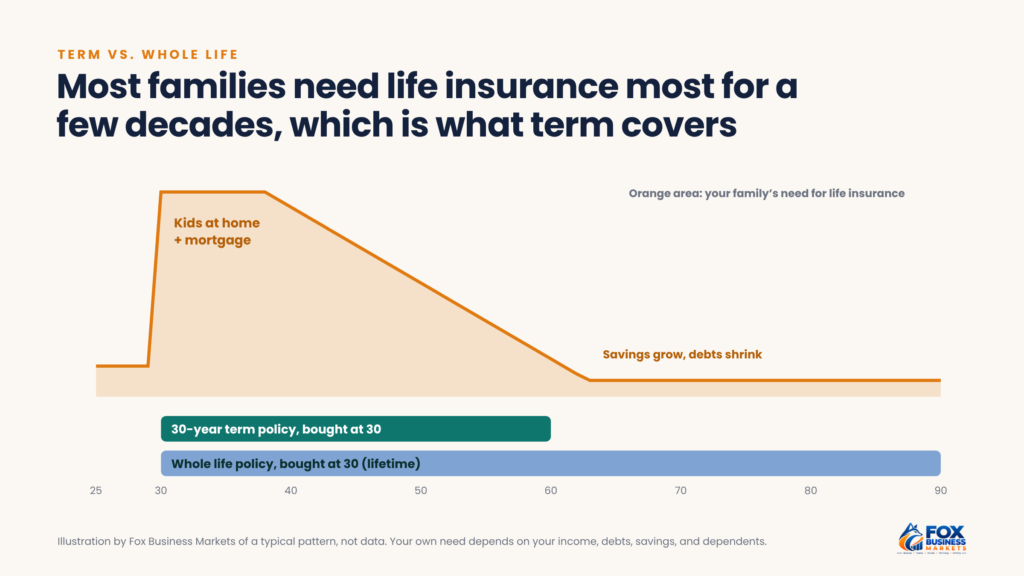
- Your need will shrink over time, as your savings grow and your debts fall.
A common approach is to match the term to your biggest obligation. A 30-year-old with a new 30-year mortgage and young children might choose a 30-year term.
When Can Whole Life Insurance Make Sense?
Whole life can be worth its higher cost in narrower situations:
- A lifelong dependent, such as a child with special needs who will need support after you’re gone.
- Estate planning, when heirs will need cash to pay estate taxes or settle an estate without selling a home or business.
- Business planning, such as funding a buy-sell agreement between business owners.
- You’ve maxed out tax-advantaged retirement accounts and want another tax-deferred place for savings, with guarantees.
- You value guarantees more than potential higher returns elsewhere.
If none of these apply, whole life is often more insurance than you need at a price that crowds out other goals.
How Much Life Insurance Do You Need?
“How much life insurance to buy depends on the financial needs that will continue after your death,” according to the NAIC. A practical way to estimate is to add up what your family would need:
- Income replacement: Your annual income times the number of years your family would rely on it.
- Debts: Your mortgage balance and other debts you’d want paid off.
- Future costs: College or other big expenses for your children.
- Final expenses: Funeral and end-of-life costs.
Then subtract savings and any existing coverage, including life insurance through work. A common rule of thumb is coverage of about 10 times your income, but your own number may be higher or lower. If budgeting for the premium is the hard part, our guide on how to make a budget can help you fit it in.
What Affects the Price of Life Insurance?
Whether you choose term or whole life, insurers set your premium based on how likely they are to pay a claim and when. The main factors are:
- Premiums rise with every birthday, which is why buying earlier usually locks in a lower rate for the whole term.
- Insurers review your medical history, current conditions, height and weight, and sometimes lab results. They then place you in a rating class, from preferred to standard to substandard.
- Tobacco and nicotine use. Smokers typically pay much more than nonsmokers for the same coverage.
- Coverage amount and term length. A larger death benefit or a longer term costs more.
- Occupation and hobbies. Dangerous jobs or activities, such as piloting small planes or scuba diving, can raise your rate.
- Women generally pay less than men of the same age, because they tend to live longer.
Because so much depends on health, it often pays to apply before a new diagnosis makes coverage more expensive or harder to get.
What Happens When Your Term Ends?
When a level term policy reaches the end of its term, you usually have three choices:
- Let it end. If your children are grown, your mortgage is paid off, afnd your savings can support your spouse, you may no longer need coverage.
- Renew it. Many policies let you continue year to year without a new medical exam, with premiums that rise each year.
- Buy a new policy. If you’re still healthy and need coverage, a new term policy may cost less than renewing, though it will be priced at your current age.
The best time to plan is several years before the term ends, while you still have options.
Which Riders Are Worth Considering?
Riders are optional add-ons that change what a policy does. Some come built in at no charge, while others raise your premium. These are the ones you’ll see most often on term and whole life policies:
- Accelerated death benefit. Lets you receive part of the death benefit early if you’re diagnosed with a terminal illness. Many insurers include it at no extra cost.
- Waiver of premium. Keeps the policy in force without premium payments if you become totally disabled and can’t work. It adds to the cost, so compare it with any disability insurance you already have.
- Child term rider. Adds a small amount of coverage for your children to your own policy, usually for one flat price no matter how many children you have.
- Return of premium. Some term policies refund your premiums if you outlive the term. These policies cost noticeably more than standard term, so compare that extra cost with what the same money could earn if you invested it.
Read each rider’s definitions before you sign, because insurers word them differently. A rider that sounds similar on two quotes can pay out under different conditions.
Is Life Insurance Through Work Enough?
Group life insurance through an employer is convenient and often free or cheap, but it usually isn’t enough by itself. Coverage is commonly limited to one or two times your salary, well below what many families need. And it usually ends when you leave the job, which can leave you uninsured when a new policy costs more.
Among Americans who own life insurance, 27% rely only on workplace coverage, according to the 2026 Insurance Barometer Study from LIMRA and Life Happens. A common approach is to treat group coverage as a bonus and buy an individual term policy for your core need, so your protection doesn’t depend on your employer.
Is Term Life Insurance a Waste If You Outlive It?
No. If you outlive your term policy, your family was protected during the years they depended on your income, which is what you paid for.
The real waste is paying for coverage that doesn’t match your need, either too little protection during your family’s most vulnerable years or expensive lifelong coverage you’ll never need. For most people, the need for life insurance is largest when children are young and debts are high, then shrinks as savings grow.
How Do You Buy Life Insurance?
- Estimate your coverage amount and term using the steps above.
- Compare quotes from several insurers. Use an independent agent or online marketplace to compare rates for the same coverage.
- Check the insurer’s financial strength with a rating agency, since the policy may need to pay out decades from now.
- Complete the application and underwriting, which may include a medical exam.
- Review the policy when it arrives. Most states give you a “free look” period. You can return a policy “for a full refund within a certain period, usually 10 days after you receive it,” according to the NAIC.
- Don’t cancel an existing policy until the new one is in force. “Don’t cancel your current policy until you get the new one,” the NAIC advises.
Frequently Asked Questions
Can I convert term life insurance to whole life later?
Often, yes. Many term policies include a conversion option that lets you switch to a permanent policy without a new medical exam, usually before a set age or deadline. The new premium is based on your age at conversion, so it will be higher. Check your policy’s conversion deadline now, especially if your health might change.
What happens if I stop paying whole life premiums?
The policy doesn’t vanish if it has cash value. State laws require nonforfeiture options, typically taking the cash surrender value, switching to a smaller paid-up policy with no further premiums, or converting to term coverage for a limited time. Call your insurer before you stop paying to compare the options.
Can I have more than one term life policy?
Yes. Some people “ladder” policies, such as a 30-year policy for the mortgage and a 20-year policy that ends when children become adults, so coverage shrinks as needs fall and premiums drop. Insurers will ask about existing coverage when you apply. Keep a list of all your policies where your beneficiaries can find it.
Do I need a medical exam to get life insurance?
Not always. Many insurers now offer accelerated or no-exam underwriting for healthy applicants, using health questions and records instead. Policies with no health questions at all, such as guaranteed issue, cost much more per dollar of coverage. If you’re healthy, a fully underwritten policy usually gives you the lowest price.
Match Your Policy to the Years Your Family Needs You
In the term vs. whole life insurance decision, term offers most families the most protection for the money during the years when children and debts depend on your income. Whole life makes sense for a narrower set of lifelong needs. Figure out how much coverage you need and for how long, compare quotes, and lock in a policy while you’re young and healthy.
This article is for general information only and isn’t financial, tax, legal, or insurance advice. Policies and rules vary by insurer and state, so read your policy and talk to a licensed professional before making decisions.