The latest small business statistics show how central small companies are to the US economy, and how much pressure they’re under. There are more than 36 million small businesses in the country, making up 99.9% of all firms and employing nearly half of private-sector workers. At the same time, rising costs top owners’ list of financial challenges, and business bankruptcy filings rose 16.9% in the year ending June 2026.
We gathered the most important small business statistics for 2026 in one place: how many businesses there are, how many jobs they create, how long they survive, how they’re funded, who owns them, and how owners feel right now. Every figure links to its original source.
Key Takeaways
- There are 36,207,130 small businesses in the US, 99.9% of all businesses.
- Small businesses employ 62.3 million people, or 45.9% of private-sector workers.
- About half of new business locations are still open after five years.
- 77% of small employer firms reported rising costs or tariff costs as a financial challenge.
- Labor quality was owners’ single most important problem in September 2026, cited by 26%.
- Business bankruptcy filings rose 16.9% in the 12 months ending June 30, 2026.
How We Researched This
To make these small business statistics reliable, we used only primary sources: the SBA Office of Advocacy, the Census Bureau, the Bureau of Labor Statistics, the Federal Reserve Banks’ Small Business Credit Survey, the National Federation of Independent Business (NFIB), and the US Courts. Many government counts rely on data that’s a few years old, so we note the year each figure covers. In US government data, a small business is generally an independent business with fewer than 500 employees.
Small Business Statistics at a Glance
| Statistic | Figure | Source |
| Number of US small businesses | 36,207,130 | SBA Office of Advocacy |
| Share of all US businesses | 99.9% | SBA Office of Advocacy |
| Small businesses with no employees | 82.3% | SBA Office of Advocacy |
| Workers employed by small businesses | 62.3 million (45.9%) | SBA Office of Advocacy |
| Share of net new jobs since 1995 | 61% | SBA Office of Advocacy |
| Business applications, September 2026 | 534,947 | Census Bureau |
| New businesses still open after 5 years | 51.4% | BLS |
| Business bankruptcy filings, year to June 2026 | 26,941 (+16.9%) | US Courts |
| Firms citing rising costs or tariffs as a challenge | 77% | Federal Reserve |
| NFIB Small Business Optimism Index, September 2026 | 97.9 | NFIB |
| Employer firms owned by women | 22.9% | Census Bureau |
| Businesses using AI | 19.8% | Census Bureau |
Below, we explain each of these small business statistics in more detail.
How Many Small Businesses Are There in the US?
According to the SBA Office of Advocacy’s 2026 report, based on 2022 data (SBA Office of Advocacy):
- There are 36,207,130 small businesses, or 9% of all businesses.
- 29,811,495 of them (82.3%) have no employees besides the owner.
- 6,395,635 (17.7%) have paid employees.
- 7% of businesses without employees are sole proprietorships, while 55% of small employer firms are S corporations.
Most small businesses, in other words, are one-person operations: freelancers, consultants, contractors, and side businesses.
Small Business Employment and Economic Impact
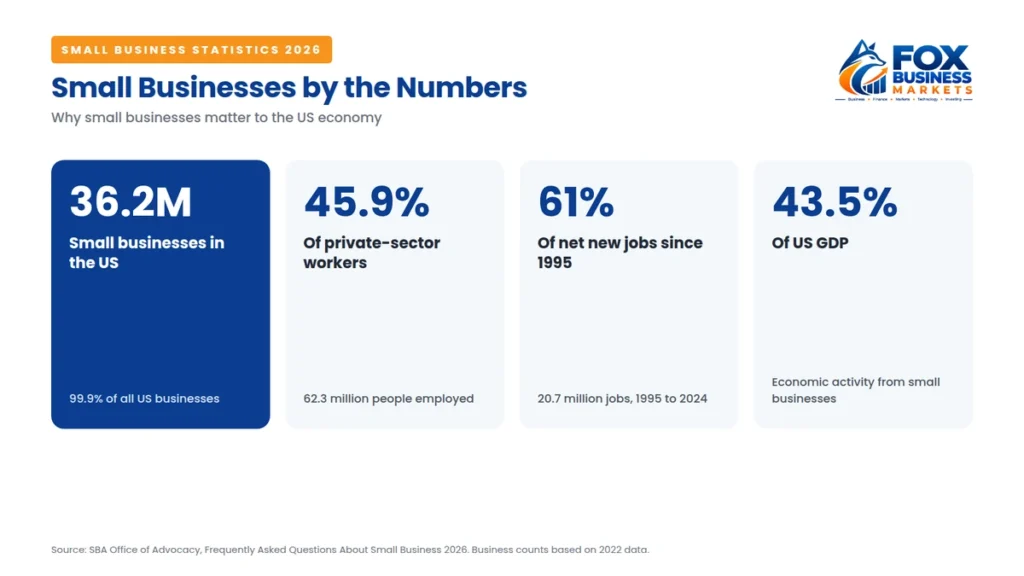
These small business statistics show why small companies matter so much to the economy (SBA Office of Advocacy):
- They employ 3 million people, or 45.9% of private-sector workers.
- They pay 7% of private-sector payroll, about $3.5 trillion.
- They created 7 million net new jobs from 1995 to 2024, about 61% of all net new jobs in that period.
- They make up 2% of exporters (270,014 businesses) and 33% of known export value ($588.4 billion).
- Economic activity from small businesses makes up 5% of US GDP (SBA Office of Advocacy).
New Business Statistics
Americans keep starting businesses at a strong pace:
- 534,947 business applications were filed in September 2026, seasonally adjusted, up 0.5% from August (Census Bureau).
- 29,022 of September’s applications are projected to become employer businesses within four quarters.
- About 5.6 million business applications were filed in 2025 (Census Bureau via FRED).
- 338,000 new business locations opened in Q4 2025, creating 1,006,000 jobs (BLS).
Most applications never turn into businesses with employees. Many are for sole proprietorships, side businesses, or ideas that don’t move forward.
Small Business Survival and Failure Statistics
The Bureau of Labor Statistics tracks how long new business locations stay open (BLS):
| Years after opening | Still open |
| 1 year | 77.9% |
| 2 years | 65.9% |
| 5 years | 51.4% |
| 10 years | 34.7% |
Bankruptcies are also rising. Business bankruptcy filings rose 16.9%, from 23,043 to 26,941, in the 12 months ending June 30, 2026 (US Courts). For the reasons behind these numbers, see our guide on why small businesses fail.
Small Business Survival by Industry
Survival rates vary widely by industry. Among business locations that opened in 2015, here’s the share still open 10 years later, according to the BLS (BLS):
| Highest 10-year survival | Lowest 10-year survival | ||
| Agriculture | 53.0% | Mining, oil, and gas | 24.5% |
| Utilities | 47.2% | Information | 30.0% |
| Manufacturing | 45.3% | Professional services | 34.3% |
| Real estate | 45.0% | Wholesale trade | 34.4% |
| Retail | 44.2% | Management of companies | 35.8% |
Restaurants are often called the riskiest small business, but these small business statistics tell a different story: accommodation and food services had a 41.6% 10-year survival rate, in the middle of the pack.
Small Business Finances and Funding Statistics
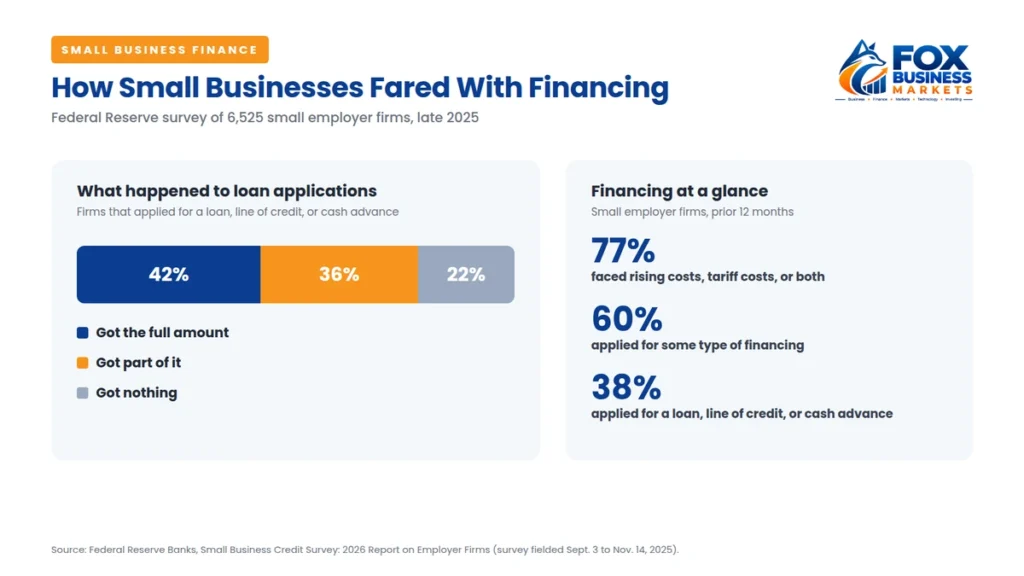
The Federal Reserve Banks’ 2026 survey of more than 6,500 small employer firms, conducted in late 2025, found (Federal Reserve):
- 77% of firms reported rising costs, tariff costs, or both as a financial challenge. Rising costs were the most common challenge.
- More than 4 in 10 firms said tariff-related costs were a challenge.
- 60% applied for some type of financing in the prior 12 months, and 38% applied for a loan, line of credit, or merchant cash advance.
- Of those loan applicants, 42% got the full amount, 36% got part of it, and 22% got nothing (Federal Reserve).
- The survey’s revenue expectations index fell from 39 to 33, a sign of weaker confidence.
Owners often fill the gaps themselves. Among firms facing financial challenges, 54% used the owner’s personal funds (Federal Reserve via FRED). On the lending side, the SBA guaranteed about 85,000 7(a) and 504 loans worth $45 billion in fiscal year 2025 (SBA).
Small Business Owner Sentiment
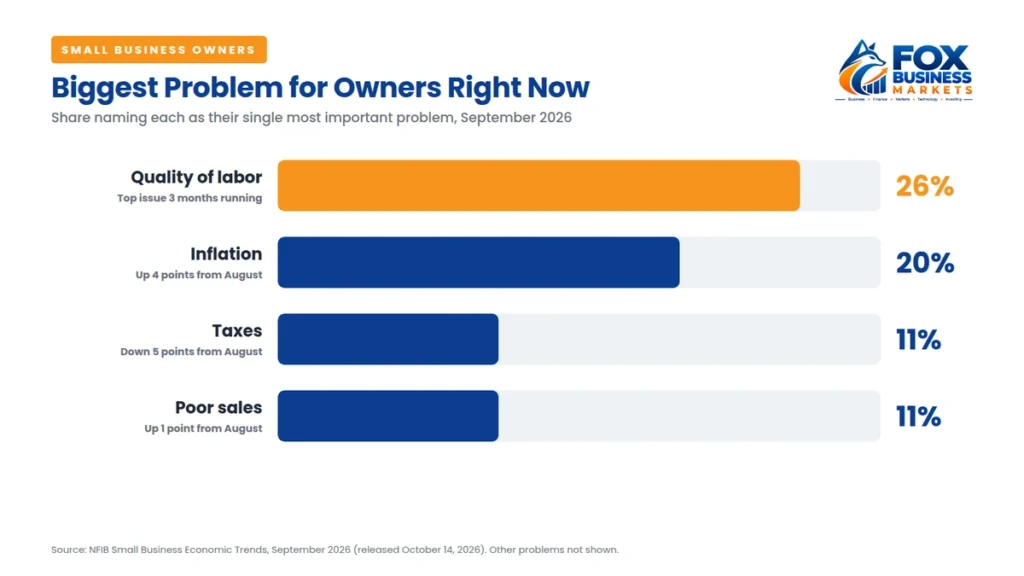
The NFIB Small Business Optimism Index, a monthly survey of small business owners, shows a cautious mood (NFIB). In September 2026:
- The index fell 8 points to 97.9, just below its 52-year average of 98, while NFIB’s Uncertainty Index rose 1 point to 90.
- 26% of owners named the quality of available labor as their single most important problem, the top issue for the third straight month.
- 20% named inflation, up 4 points from August.
- 11% named taxes, and 11% named poor sales.
- A net 17% plan to create new jobs in the next three months.
- 32% had job openings they couldn’t fill.
Who Owns Small Businesses?
The Census Bureau’s latest Annual Business Survey, covering 2023, counted about 5.9 million employer firms (Census Bureau):
| Owner group | Employer firms | Share |
| Women-owned | 1.4 million | 22.9% |
| Hispanic-owned | 496,000 | 8.4% |
| Veteran-owned | 261,000 | 4.4% |
| Black or African American-owned | 201,000 | 3.4% |
Counting businesses without employees too, women owned 14 million businesses in 2022, or 40.4% of all classifiable businesses, according to the SBA Office of Advocacy.
Small Businesses and AI
AI is one of the newest areas covered by small business statistics. Adoption is growing but still limited, especially among the smallest firms. Census Bureau survey data shows (Census Bureau):
- 8% of businesses were using AI as of early May 2026; usage hovered between 17% and 20% from December 2025 to May 2026.
- 20% to 23% expected to be using AI within six months.
- 37% of firms with at least 250 employees used AI, compared with less than 20% of firms with four or fewer employees.
What These Small Business Statistics Mean for Owners
- You’re in good company. With 36 million small businesses, most of them one-person operations, starting small is the norm.
- Plan for costs, not just sales. Rising costs are owners’ top financial challenge, so price carefully and keep a cash cushion.
- Expect financing to be uneven. Only 42% of loan applicants got the full amount they asked for.
- Hiring is hard. Labor quality is the top problem, so plan ahead for staffing.
- Survival takes time. Only about half of new locations reach year five, so build a business that can last through slow months.
If you’re thinking about joining them, read our step-by-step guide on how to start a small business, and estimate your numbers with our startup cost calculator. For venture-backed companies, see our separate roundup of startup statistics.
Frequently Asked Questions
How many small businesses are there in the US?
There are 36,207,130 small businesses in the US, making up 99.9% of all businesses, according to the SBA Office of Advocacy’s 2026 report based on 2022 data.
What percentage of small businesses fail?
About 22% of new business locations close within their first year, about half within five years, and about 65% within 10 years, according to the Bureau of Labor Statistics.
How many people do small businesses employ?
Small businesses employ 62.3 million people, or 45.9% of private-sector workers, according to the SBA Office of Advocacy.
What is the biggest problem for small businesses in 2026?
In NFIB’s September 2026 survey, the quality of available labor was the single most important problem, named by 26% of owners. Inflation was second at 20%.
How many small businesses have employees?
About 6.4 million small businesses, or 17.7%, have paid employees. The other 82.3% are run by the owner alone.
How many new businesses are started each year?
Americans filed about 5.6 million business applications in 2025, and 534,947 in September 2026 alone, according to Census Bureau data.
How much do small businesses contribute to GDP?
Economic activity from small businesses makes up 43.5% of US GDP, according to the SBA Office of Advocacy. Small businesses also pay 38.7% of private-sector payroll.
How many small businesses use AI?
About 19.8% of businesses were using AI as of May 2026, according to Census Bureau survey data. Adoption is lower among the smallest firms: less than 20% of firms with four or fewer employees used AI, compared with 37% of firms with 250 or more employees.
Final Takeaway
The 2026 small business statistics show a sector that is huge, resilient, and under real pressure. Small businesses employ nearly half of private-sector workers and create most new jobs, but owners face rising costs, uneven access to credit, and a tight labor market. Use these numbers to plan realistically, and check back as new data is released.