
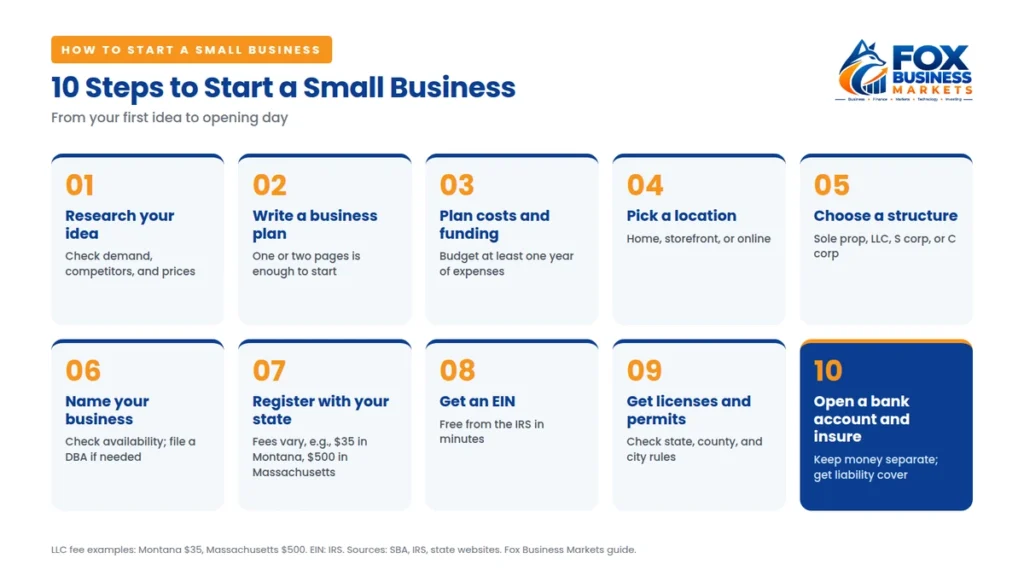
How to start a small business comes down to ten practical steps: pick an idea and test it, write a simple plan, work out your costs and funding, choose a location and a legal structure, register your name and business, get a tax ID, apply for licenses, and open a business bank account with the right insurance. None of these steps is hard on its own. The challenge is doing them in the right order, without wasting money or missing a legal requirement.
You won’t be alone. Americans filed 534,947 applications to start a business in September 2026 alone, seasonally adjusted (Census Bureau). This guide walks you through how to start a small business in the US, step by step, with the real costs and the free help available along the way.
Key Takeaways
- Plan for at least one year of expenses before you open, as the SBA recommends.
- Getting an EIN from the IRS is free. Never pay a website to get one.
- Most US companies no longer have to file beneficial ownership (BOI) reports, under a FinCEN rule that took effect in August 2026.
- Free mentoring is available through SCORE’s more than 10,000 volunteer mentors and nearly 1,000 Small Business Development Centers.
How We Researched This
To explain how to start a small business accurately, we used official sources: the US Small Business Administration (SBA) and its Office of Advocacy, the IRS, FinCEN, the Census Bureau, and state government websites, plus SCORE, America’s Small Business Development Centers, and insurance marketplace Insureon. Rules and fees change, so we include the date and a link for every figure. Always confirm the requirements in your own state and city.
Is a Small Business Right for You?
Before you learn how to start a small business, make sure it’s the right fit. A small business is usually built for steady profit and long-term stability, not for the rapid, investor-funded growth of a startup. Think of a bakery, a cleaning service, an accounting practice, or an online store. If you’re unsure which path fits your idea, read our guide on what a startup is and how it differs from a small business.
You’d be joining a big group. There are 36,207,130 small businesses in the US, and 82.3% of them have no employees besides the owner (SBA Office of Advocacy). Many owners start alone and hire later.
How to Start a Small Business in 10 Steps
Here’s how to start a small business in the order that saves the most time and money.
1. Choose an Idea and Research Your Market
Start with something people already pay for, and that you can deliver well. Then check demand before you spend: Who are your customers? Who are your competitors, and what do they charge? Why would someone choose you instead?
Talk to potential customers, look at competitors’ reviews, and if you can, test with a small first sale or preorder. Our business idea profit calculator shows whether your price and costs leave enough profit, and how many sales you need to break even.
2. Write a Simple Business Plan
A business plan doesn’t need to be long. One to two pages can cover what you’ll sell, who will buy it, how you’ll reach them, what you’ll charge, and what it will cost to run. If you plan to borrow money, lenders will usually expect a more detailed plan with financial projections.
3. Estimate Your Costs and Fund Your Business
Add up your one-time startup costs, such as equipment, inventory, registration, and a website, and your monthly costs, such as rent, software, insurance, and supplies. The SBA advises: “You’ll want to count at least one year of monthly expenses, but counting five years is ideal.” It also suggests adding about 10% extra as a cushion (SBA).
Our guide on how much it costs to start a business breaks down typical expenses, and our startup cost calculator adds them up for you.
Common ways to fund a small business include your own savings, a loan from a bank or an SBA-backed lender, a business credit card, and help from friends or family. Most small business owners use their own money at some point. Among employer firms that faced financial challenges in 2025, 54% used the owner’s personal funds (Federal Reserve via FRED).
4. Pick a Location
Your location affects your costs, taxes, licenses, and customers. A home-based business keeps costs low, but check local zoning rules first. A storefront brings more visibility, but also rent and deposits.
5. Choose a Business Structure
Your structure decides how you’re taxed, how much paperwork you have, and whether your personal assets are protected if the business is sued or can’t pay its debts.
| Structure | Personal liability protection | Taxes | Best for |
| Sole proprietorship | No | Profit is reported on your personal tax return | Solo, low-risk businesses that want simplicity |
| Partnership | No, for general partners | Profit passes through to the partners | Two or more owners who want simplicity |
| LLC | Yes | Pass-through by default; can choose S corp tax treatment | Most small businesses that want protection without much paperwork |
| S corporation | Yes | Pass-through; owners who work in the business must take a reasonable salary | Profitable businesses looking to manage self-employment taxes |
| C corporation | Yes | The company pays its own income tax | Businesses planning to raise outside investment |
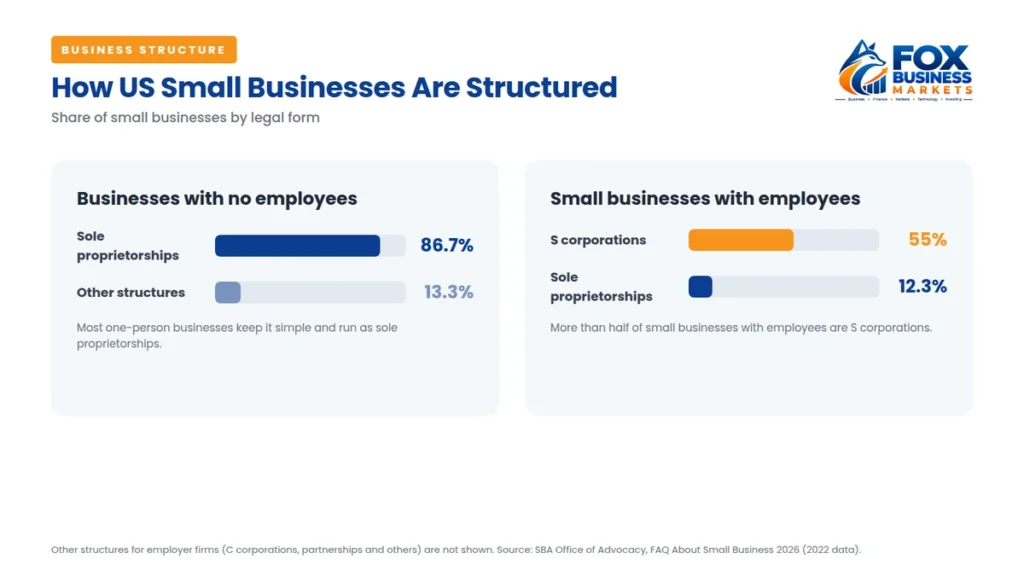
Sole proprietorships are the most common choice for one-person businesses: 86.7% of small businesses without employees are sole proprietorships, according to the SBA’s Office of Advocacy. Among partnerships, LLCs dominate, making up 72.7% of partnership tax returns for tax year 2023 (IRS). An accountant can help you pick the right structure for your situation.
If you’re starting with a partner, agree on ownership in writing. Our business ownership calculator can help you find a fair split.
6. Choose and Protect Your Business Name
Pick a name that’s easy to remember and not already used in your state. Search your state’s business name database, check for federal trademarks, and see if a matching website domain is available. If you’ll operate under a name that’s different from your legal name or your company’s registered name, you may need to file a “doing business as” (DBA) name with your state or county.
7. Register Your Business
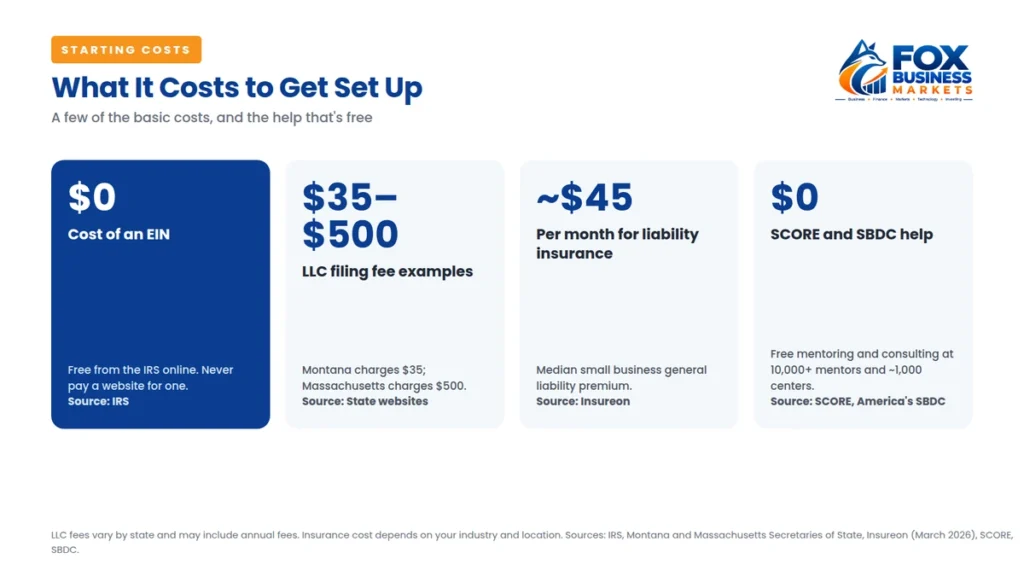
Sole proprietors and partnerships may not need to register with the state beyond a DBA. LLCs and corporations must file formation documents with the state, usually the Secretary of State. Fees vary widely. For example, forming an LLC costs $35 in Montana (Montana Secretary of State) and $500 in Massachusetts (Mass.gov). Some states also charge annual fees or require yearly reports.
8. Get Your Federal and State Tax IDs
An Employer Identification Number (EIN) is like a Social Security number for your business. You’ll need one to hire employees, open many business bank accounts, and file certain taxes. The IRS says you can get an EIN “directly from the IRS in minutes for free,” and “you never have to pay a fee for an EIN” (IRS). Many states also require a separate state tax ID, for example to collect sales tax or pay state payroll taxes.
9. Apply for Licenses and Permits
Licenses depend on your industry, state, and city. A restaurant may need health permits, a contractor may need a state license, and many businesses need a general city or county business license. Check your state’s business portal and your city or county office before you open.
One rule that changed: In August 2026, FinCEN finalized a rule under which “U.S. companies are exempt from the Beneficial Ownership Information (BOI) reporting requirements” (FinCEN). If you form a US company now, you generally don’t need to file a BOI report.
10. Open a Business Bank Account and Get Insurance
Keep business and personal money separate from day one. A business bank account makes bookkeeping and taxes easier, and it helps protect the liability shield of an LLC or corporation. You’ll usually need your EIN and formation documents to open one.
Next, get insured. General liability insurance covers claims such as customer injuries or property damage. Small businesses pay a median of about $45 a month for it, according to Insureon, which bases the figure on its customers, most with fewer than five employees (Insureon). You may also need professional liability or property insurance, and most states require workers’ compensation once you have employees.
After You Open: Win Your First Customers
Once the paperwork is done, focus on sales. Tell everyone you know, set up a free Google Business Profile, ask happy customers for reviews, and set up simple bookkeeping software early. Our entrepreneur salary calculator can help you work that out.
Common Mistakes to Avoid
Learning how to start a small business also means learning what not to do:
- Underestimating costs. Many businesses run out of cash before they find enough customers. Keep a cushion.
- Skipping market research. Opening before you know there’s demand is the most expensive mistake.
- Mixing personal and business money. It makes taxes harder and can weaken your liability protection.
- Pricing too low. Make sure every sale covers its costs and a share of your fixed expenses.
About 22% of new US business locations close within their first year, and about half within five years, according to the Bureau of Labor Statistics. Our guide on why small businesses fail explains the warning signs.
Where to Get Free Help
You don’t have to figure out how to start a small business alone:
- SCORE has “more than 10,000 volunteer mentors,” and its “mentoring is always free, for the life of your business” (SCORE).
- Small Business Development Centers (SBDCs) offer free consulting and low-cost training at nearly 1,000 local centers (America’s SBDC).
- The SBA’s website has free guides on planning, funding, and launching a business (SBA).
Frequently Asked Questions
How to start a small business with no money?
Start with a service business that uses skills you already have, such as consulting, cleaning, tutoring, or freelancing, so you need little equipment or inventory. Work from home, get your EIN for free, and reinvest your first profits. Free help from SCORE and SBDCs can save you money on advice.
What are the first steps to start a small business?
Pick an idea and test demand, write a simple business plan, and estimate your costs. Then choose a business structure, register your business, get an EIN, apply for any licenses, and open a business bank account.
Do I need an LLC to start a small business?
No. You can operate as a sole proprietor without forming an LLC. But an LLC can help protect your personal assets if the business is sued or can’t pay its debts, which is why many owners choose one.
How much does it cost to start a small business?
It depends on the business. Some home-based service businesses start with a few hundred dollars, while a restaurant or retail store can cost far more. The SBA suggests planning for at least one year of monthly expenses.
Is an EIN free?
Yes. The IRS issues EINs for free, and you can apply online in minutes. Avoid websites that charge a fee to get an EIN for you.
How long does it take to start a small business?
You can register a business and get an EIN in days. Licenses, a location, and a first customer base can take weeks or months, depending on your industry and state.
Final Takeaway
Knowing how to start a small business is about doing the basics well and in the right order. Test your idea, plan your costs, set up the legal and tax essentials, and protect yourself with a business bank account and insurance. Then focus on what keeps every small business alive: customers who pay more than it costs to serve them.