What is a startup? A startup is a young company built to grow very fast, usually by finding a repeatable way to sell a product to a very large market. That focus on rapid growth is what separates a startup from a typical small business, which aims to be steady and profitable rather than to grow tenfold. A new coffee shop is a small business. A new company building software that every coffee shop could use is a startup.
The difference shapes almost everything: how the company is funded, how fast it hires, how much risk the founders take, and how it hopes to end. This guide explains what a startup is, how it differs from a small business, and how to tell which one you’re building.
Key Takeaways
- A startup is defined by its goal of fast, scalable growth, not by its age, size, or industry.
- Most US businesses are small: there are about 36.2 million small businesses, 99.9% of all firms.
- Only 0.6% of new employer businesses started with venture capital, according to a Kauffman Foundation analysis of Census data.
- Neither path is better. The right choice depends on your goals, your appetite for risk, and the kind of business you want to run.
How We Researched This
To answer the question “what is a startup?” clearly, we used definitions from the people who shaped startup thinking, including Y Combinator co-founder Paul Graham and entrepreneur and educator Steve Blank. For small business data, we used the US Small Business Administration’s Office of Advocacy and the Federal Reserve’s Small Business Credit Survey. Funding figures come from Carta and the Kauffman Foundation. Every figure includes a date and a link to its source.
What Is a Startup?
There’s no legal definition of a startup. You won’t find a “startup” box on any government form. Instead, the term describes a company’s goal and how it’s built.
Two definitions are widely used:
- Paul Graham, co-founder of Y Combinator: “A startup is a company designed to grow fast” (Paul Graham). He adds that being newly founded doesn’t make a company a startup; the focus on growth does.
- Steve Blank, a Silicon Valley entrepreneur and educator: “a startup is an organization formed to search for a repeatable and scalable business model” (Steve Blank).
Put simply, a startup is still figuring out what works. It’s testing a product, a market, and a way of making money, and once it finds the right combination, it tries to grow as fast as possible.
How fast? Graham writes that “a good growth rate during YC is 5-7% a week.” At 5% a week, a company more than doubles its revenue every 15 weeks. Few small businesses aim for anything close to that.
Key Features of a Startup
When people ask what is a startup, these five features usually come up:
1. It’s Built to Grow Fast
Growth is the main goal. A startup will often spend more than it earns for years if it believes faster growth will pay off later.
2. It’s Designed to Scale
A startup’s product can usually serve far more customers without costs rising at the same rate. Software is the classic example: once it’s built, selling it to the next customer costs very little. A restaurant, by contrast, needs more space, staff, and food for every new table.
3. It’s Searching for a Business Model
Early on, a startup doesn’t know exactly who its best customers are or how it will make money. It runs experiments until it finds something repeatable.
4. It Often Relies on Outside Funding
Because they spend ahead of revenue, many startups raise money from angel investors, accelerators, or venture capital firms. Our guide to startup funding stages explains each round.
5. It Carries High Risk and High Reward
Most startups fail, but the few that succeed can become very valuable. In CB Insights’ 2026 study of failed venture-backed startups, 70% ran out of capital (CB Insights).
What Is a Small Business?
In the US, a small business is “generally defined as an independent business with fewer than 500 employees,” according to the SBA’s Office of Advocacy (SBA Office of Advocacy). For federal contracts and loans, the SBA uses size standards that “vary by industry and are generally based on the number of employees or the amount of annual receipts” (SBA).
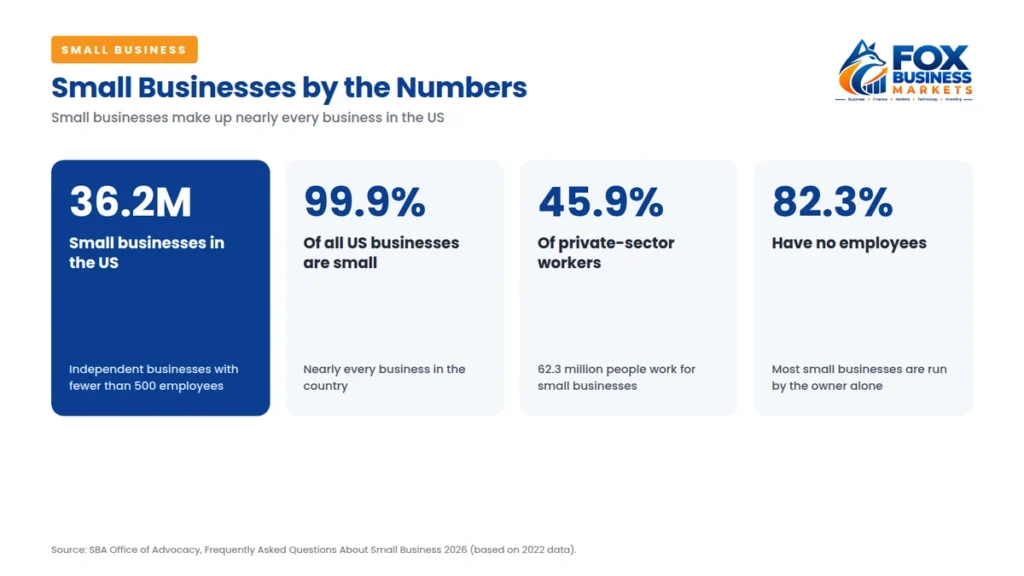
Small businesses are the backbone of the economy. According to the SBA’s 2026 report, based on 2022 data (SBA Office of Advocacy):
- There are 36,207,130 small businesses in the country.
- 9% of all businesses are small.
- Small businesses employ 3 million people, or 45.9% of private-sector workers.
- 3% of small businesses have no employees besides the owner.
By the SBA’s definition, almost every startup is also a small business at first. That’s the simplest answer to what is a startup versus a small business: the difference isn’t size. It’s the goal.
What Is a Startup Example?
A few simple comparisons make the idea clearer:
- A bakery vs. bakery software. Opening a bakery in your town is a small business. Building software that helps thousands of bakeries manage orders is a startup.
- A marketing agency vs. a marketing app. An agency grows by hiring more people for each new client. An app that automates the same work can add customers with little extra cost, which makes it a startup.
- A local clinic vs. a new medical device. A clinic serves patients in one area. A company developing a device that hospitals everywhere could buy is a startup, even if it takes years to reach the market.
In each pair, the difference isn’t the industry. It’s whether the business is designed to reach a huge market fast.
Startup vs. Small Business: Key Differences
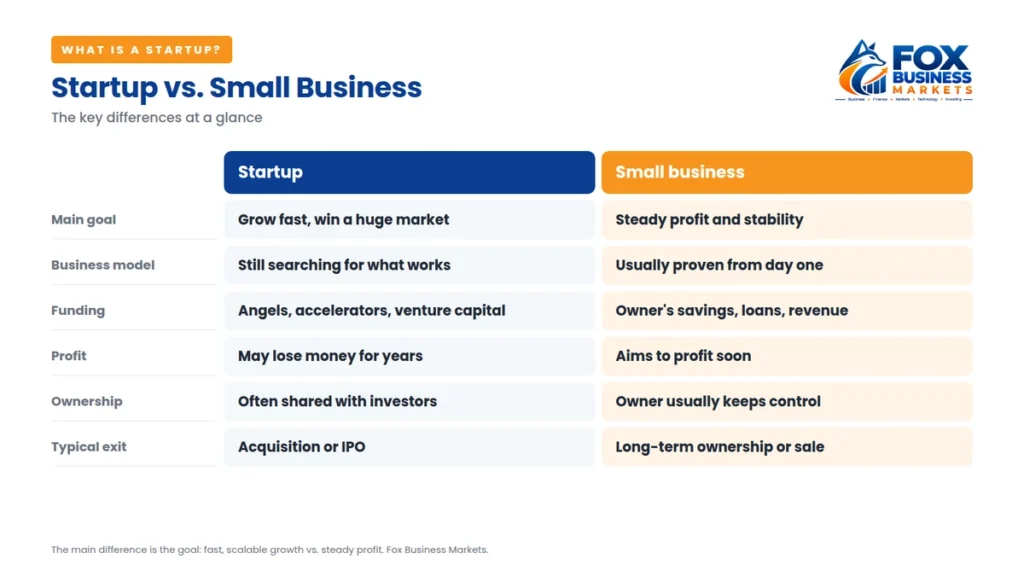
| Startup | Small business | |
| Main goal | Grow fast and capture a large market | Earn steady profit and stay stable |
| Growth target | Very fast, often doubling or more each year | Steady, often modest |
| Business model | Still searching for what works | Usually proven from day one |
| Typical funding | Founders, angels, accelerators, venture capital | Owner’s savings, bank loans, revenue |
| Profit timeline | May lose money for years | Aims to be profitable soon |
| Risk | High; most fail | Lower, but still significant |
| Ownership | Founders often give up equity to investors | Owner usually keeps full control |
| Typical exit | Acquisition or IPO | Long-term ownership, sale, or passing it on |
| Examples | A software platform, a new medical device, an app | A restaurant, a plumbing company, a local store |
Some companies start as one and become the other. A small business might find a product it can scale, or a startup might settle into steady, profitable growth without ever raising venture capital. Our list of bootstrapped companies shows how some fast-growing companies never took outside money at all.
How Startups and Small Businesses Are Funded
Understanding what is a startup also means understanding how differently it’s funded. This is where the two paths split most clearly.
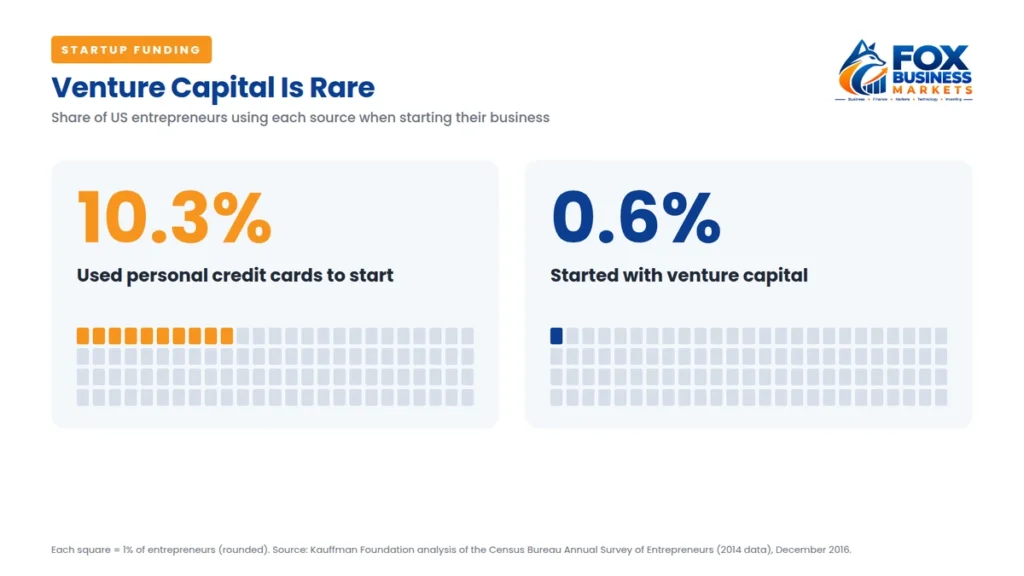
Venture capital is rare. In a Kauffman Foundation analysis of Census Bureau survey data, only 0.6% of entrepreneurs initially received venture capital, while 10.3% used personal credit cards to start their business (Kauffman Foundation).
Small businesses rely on owners and lenders. In the Federal Reserve’s survey of small employer firms, 38% applied for a loan, line of credit, or merchant cash advance in 2025 (Federal Reserve). Among firms that faced financial challenges, 54% used the owner’s personal funds (Federal Reserve via FRED).
Startups that raise venture money raise a lot. The median seed round for US software startups in 2026 was $4.1 million, and founders sold a median 18% of their company in return (Carta). That money comes with expectations: investors want the company to grow fast enough to return many times what they put in.
For more numbers, see our roundup of startup statistics.
Startup Terms You Should Know
- Unicorn: A private startup valued at $1 billion or more. Investor Aileen Lee coined the term in 2013, when she counted 39 such US software companies (TechCrunch).
- Product-market fit: The point where a product clearly meets a strong need and customers keep coming back.
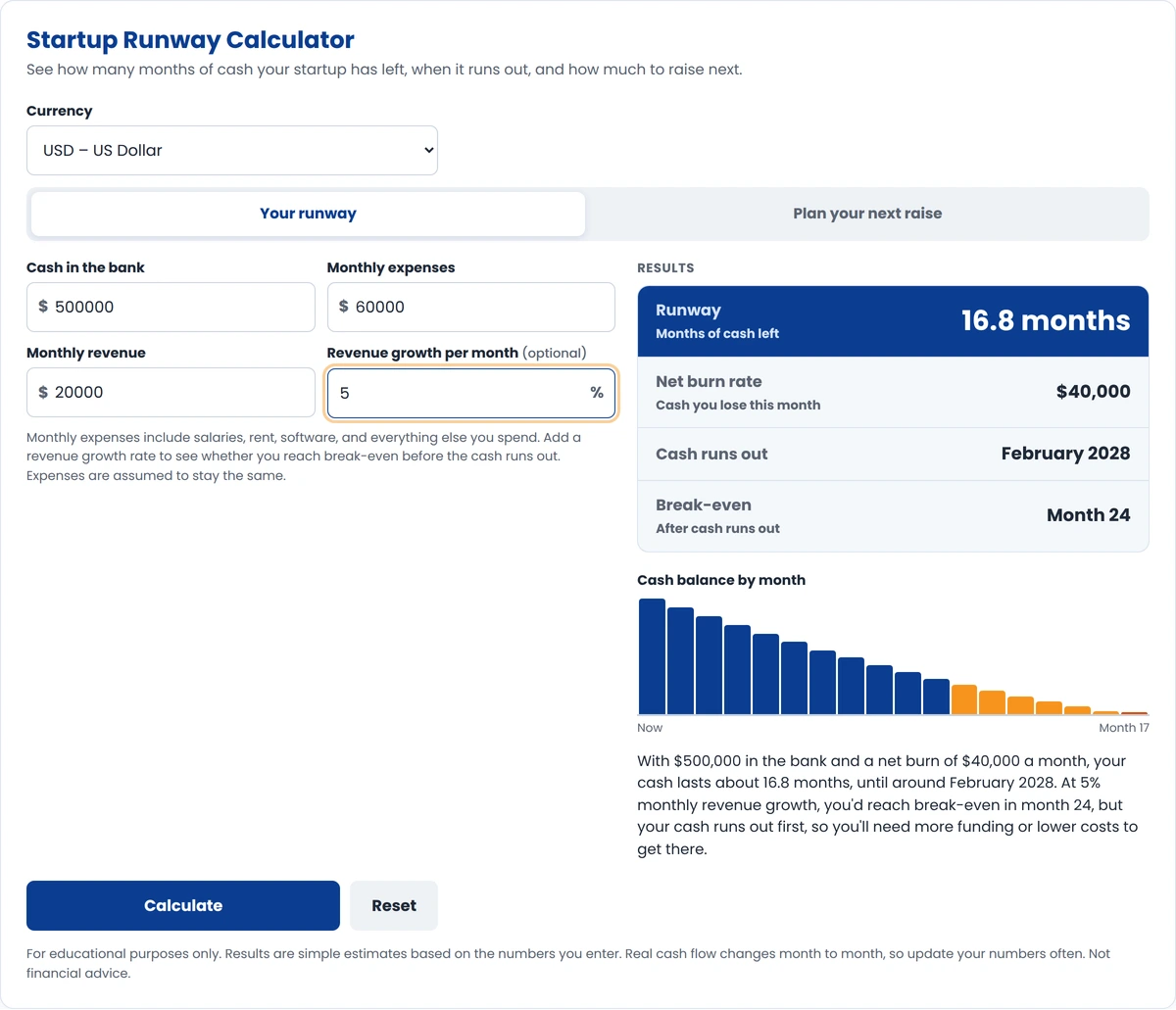
- Burn rate: How much money a startup spends each month beyond what it earns.
- Runway: How many months a startup can operate before its money runs out.
- Bootstrapping: Growing a company with the founders’ own money and customer revenue instead of outside investors.
- Seed round and Series A: Early funding rounds, usually from angel investors and venture capital firms.
Is a Startup or a Small Business Right for You?
Ask yourself these questions:
- Can your product serve millions of customers without costs rising at the same pace? If yes, it may be a startup.
- Do you want to grow as fast as possible, even if it means losing money for years? Startups require that trade-off.
- Are you willing to give up part of your company to investors? Venture-backed founders usually do.
- Would you rather have steady income and full control? A small business may be the better fit.
Neither choice is better. Small businesses employ nearly half of private-sector workers, and many owners build comfortable, lasting businesses without ever chasing hypergrowth. If you decide a startup is right for you, our step-by-step guide on how to start a startup walks you through it. If you’re leaning toward a small business, see how much it costs to start a business.
Frequently Asked Questions
What is a startup in simple words?
A startup is a new company built to grow very fast, usually by selling a product that can reach a very large market. It’s often still testing what works and may rely on investors to fund its growth.
What is the difference between a startup and a small business?
The main difference is the goal. A startup aims for fast, scalable growth and often raises outside funding. A small business usually aims for steady profit and is typically funded by the owner’s savings, loans, and revenue.
Is every new business a startup?
No. A new business is a startup only if it’s built for fast, scalable growth. A new restaurant or local service business is usually a small business, even in its first year.
How long is a company considered a startup?
There’s no fixed age limit. A company is usually considered a startup while it’s still searching for a repeatable business model and growing fast. Once it becomes stable and profitable, it’s often no longer called a startup.
Do startups need venture capital?
No. Many startups grow on their founders’ savings and customer revenue, a strategy called bootstrapping. Only 0.6% of new businesses in a Kauffman Foundation analysis started with venture capital.
Is a startup a small business?
Usually, at first. By the SBA’s definition, a business with fewer than 500 employees is small, so most startups qualify early on. What makes them different is their goal of rapid growth.
Final Takeaway
So, what is a startup? It’s a company built for speed and scale, still searching for the model that will let it grow fast. A small business, by contrast, is built for stability and steady profit. Both can be rewarding. Knowing which one you’re building helps you choose the right funding, set realistic goals, and avoid surprises along the way.