Small business loans give owners money to start, run, or grow a business, and they come in many forms: SBA-backed loans, bank term loans, lines of credit, equipment financing, microloans, and riskier options such as merchant cash advances. The right choice depends on how much you need, what it’s for, and how strong your finances are.
Approval isn’t guaranteed. In the Federal Reserve Banks’ latest survey of small employer firms, only 42% of loan, line of credit, and cash advance applicants received the full amount they asked for (Federal Reserve). This guide explains each loan type, current rates, and what lenders look for.
Key Takeaways
- The prime rate is 7.00%, and most SBA 7(a) loan rate caps are set as prime plus a spread.
- SBA 7(a) loans go up to $5 million, SBA Express loans up to $500,000, and microloans up to $50,000.
- Since March 2026, every owner of a business applying for most SBA loans must be a US citizen or national.
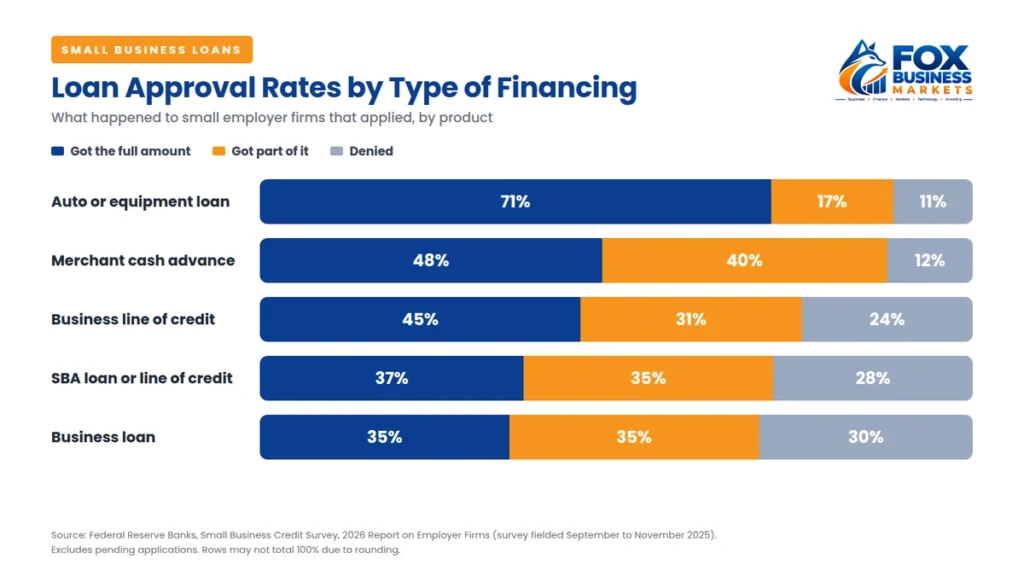
- Equipment loan applicants had the best approval odds in the Fed’s survey: 71% got the full amount.
How We Researched This
To explain small business loans accurately, we used primary sources: the US Small Business Administration (SBA), the Federal Reserve’s H.15 interest rate release, the Federal Reserve Banks’ Small Business Credit Survey, the Kansas City Fed’s Small Business Lending Survey, the Federal Register, and the Federal Trade Commission. SBA rules changed several times in 2026, so we note the effective date of each one.
Small Business Loans at a Glance
| Loan type | Typical maximum | Rate basis | Best for |
| SBA 7(a) | $5 million | Prime plus a capped spread | Working capital, buying a business, real estate, refinancing |
| SBA Express | $500,000 | Prime plus a capped spread | Faster, smaller SBA loans and credit lines |
| SBA 504 | Up to $5.5 million from the SBA portion | Tied to 10-year Treasury rates | Buildings, land, and major equipment |
| SBA microloan | $50,000 | Generally 8% to 13% | Startups and very small businesses |
| Bank term loan | Varies by lender | Set by the lender | Established businesses with good credit |
| Line of credit | Varies by lender | Usually variable | Cash flow gaps and short-term needs |
| Equipment financing | Usually up to the equipment’s value | Set by the lender | Vehicles, machinery, and technology |
| Merchant cash advance | Based on future sales | Fees, not interest | Last resort only |
Types of Small Business Loans
SBA 7(a) Loans
The 7(a) program is the SBA’s main loan program. The SBA doesn’t lend the money itself; it guarantees part of a loan made by an approved lender. Loans go up to $5 million (SBA) and can be used for working capital, equipment, buying a business, refinancing debt, or real estate. Terms run up to 10 years for working capital and equipment and up to 25 years for real estate.
The SBA caps how much lenders can charge. For variable-rate loans, the maximum is prime plus 3% to 6.5%, depending on loan size (SBA). There’s also an upfront guaranty fee, which for loans approved in fiscal year 2026 ranged from 2% to 3.75% of the guaranteed portion, depending on loan size (SBA).
The SBA approved about 77,600 7(a) loans worth $37 billion in fiscal year 2025 (SBA).
SBA Express Loans
SBA Express loans go up to $500,000, with a 50% SBA guarantee (SBA). Because the lender makes the credit decision using its own process, they’re usually faster than standard 7(a) loans.
SBA 504 Loans
504 loans finance major fixed assets, such as buildings, land, and long-lasting equipment, not working capital. A typical deal has three parts: a lender covers up to 50% of the project, a Certified Development Company (CDC) covers up to 40%, and the borrower puts in at least 10% (SBA).
The SBA lists a maximum 504 loan amount of $5.5 million, with 10-, 20-, and 25-year terms. Rates are set as “an increment above the current market rate for 10-year U.S. Treasury issues” (SBA). Since July 2026, a business can combine up to $10 million across the 7(a) and 504 programs (SBA).
SBA Microloans
Microloans go up to $50,000 and are made by nonprofit lenders. They average around $13,000, rates “generally fall between 8% and 13%,” and terms run up to seven years (SBA). Many microlenders also offer free training.
Bank Term Loans
A term loan gives you a lump sum that you repay over a set period. Banks usually reserve these small business loans for firms with a few years of history, solid revenue, and good credit. In the Kansas City Fed’s survey, the median variable rate on new small business term loans in Q2 2026 was 7% at urban banks and 6.7% at rural banks (Kansas City Fed).
Small banks stood out in the Fed’s survey: 57% of their applicants were fully approved (Federal Reserve).
Business Lines of Credit
A line of credit lets you borrow up to a set limit, repay, and borrow again, paying interest only on what you use. It’s best for uneven cash flow or seasonal inventory. In the Fed’s survey, 24% of firms applied for one.
Equipment Financing
Equipment loans pay for vehicles, machinery, or technology, and the equipment usually serves as collateral, which makes them easier to get than many other small business loans. In the Fed’s survey, 71% of auto or equipment loan applicants received the full amount, the highest of any product.
Merchant Cash Advances
A merchant cash advance (MCA) isn’t technically a loan: you get cash now in exchange for a share of future sales, plus a fee. MCAs are easy to get, with only 12% of applicants denied, but they can be very costly. Among firms that used online lenders, 60% said borrowing costs were higher than expected.
The Federal Trade Commission has acted against MCA companies over hidden fees and unauthorized withdrawals from business accounts (FTC).
Current Small Business Loan Rates
The prime rate was 7.00% in October 2026 (Federal Reserve), after the Fed raised its target rate by a quarter point on September 16, 2026, citing elevated inflation (Federal Reserve). Because many small business loans are priced off prime, that hike made borrowing more expensive.
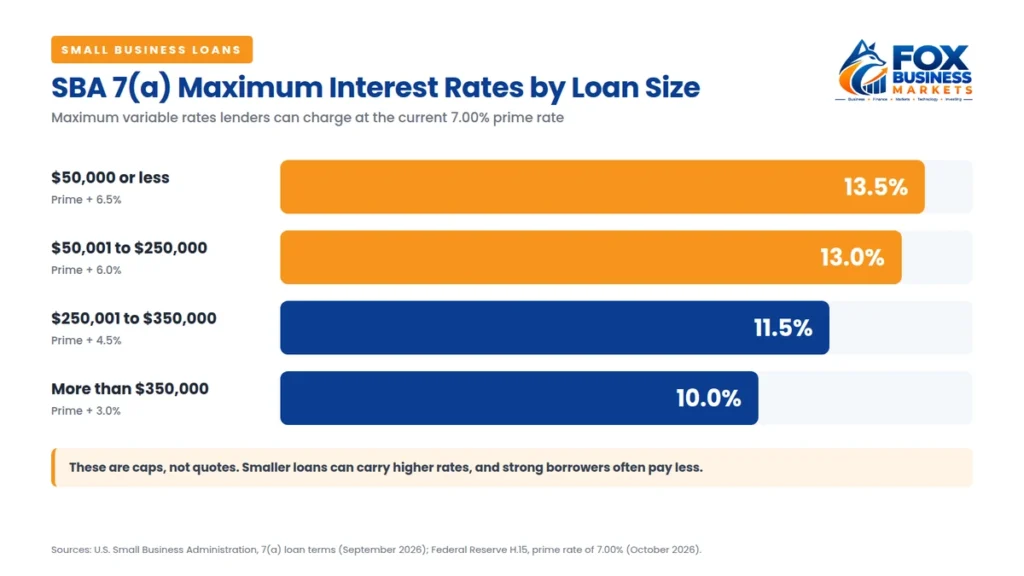
Here are the maximum variable rates lenders can charge on SBA 7(a) loans at today’s prime rate (SBA):
| Loan amount | Maximum spread | Maximum rate at 7.00% prime |
| $50,000 or less | Prime + 6.5% | 13.5% |
| $50,001 to $250,000 | Prime + 6.0% | 13.0% |
| $250,001 to $350,000 | Prime + 4.5% | 11.5% |
| More than $350,000 | Prime + 3.0% | 10.0% |
These are caps, not quotes. Since March 2026, lenders may also use other base rates, such as Treasury rates or SOFR, as long as the result stays under the prime-based cap (Federal Register).
How to Qualify for a Small Business Loan
Every lender sets its own rules, but most lenders of small business loans look at the same things:
- Credit history: your personal and business credit scores, and whether you pay on time.
- Time in business and revenue: many banks prefer at least two years of history and steady sales.
- Cash flow: whether the business earns enough to cover the payments. For many SBA loans, lenders look for cash flow of at least 1.25 times the debt payments.
- Collateral: business or personal assets the lender can claim if you don’t repay.
- A down payment: many SBA loans for startups or business purchases require at least 10% equity.
SBA Rule Changes in 2026
If you’re applying for an SBA loan, know these recent changes:
- Citizenship: Since March 1, 2026, 100% of a business’s direct and indirect owners must be US citizens or nationals living in the US for 7(a) and 504 loans. Green card holders are no longer eligible (SBA). The SBA later extended the rule to microloans (SBA).
- Stricter underwriting: Updated SBA rules that took effect October 1, 2026, require at least 10% equity for business acquisitions (SBA).
- Lower fees for some borrowers: For fiscal year 2027, the SBA waived the upfront fee on 7(a) loans of $700,000 or less to manufacturers, certain food supply businesses, and rural businesses (NAGGL).
Documents You’ll Need
Have these ready before you apply for small business loans:
- A business plan, with financial projections for newer businesses
- Personal and business tax returns, usually for the past three years
- Profit and loss statements and balance sheets
- Recent bank statements
- Business licenses, registration, and your EIN
- For SBA loans, SBA Form 1919 (the borrower information form) and SBA Form 413 (a personal financial statement) (SBA)
Why Loan Applications Get Denied
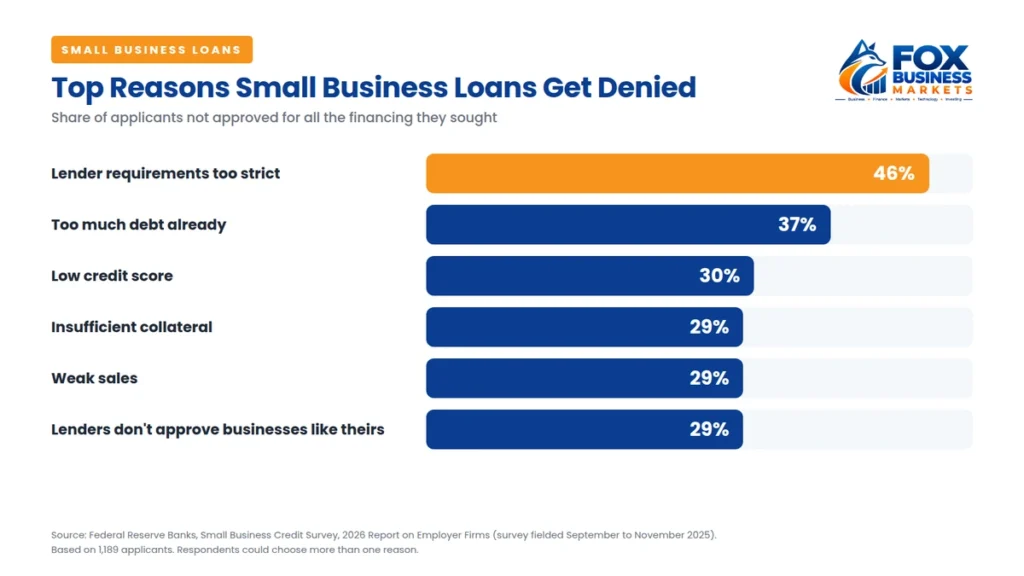
Among small employer firms that weren’t approved for all of the financing they sought, the top reasons were (Federal Reserve):
| Reason | Share of applicants |
| Lender requirements too strict | 46% |
| Too much debt already | 37% |
| Low credit score | 30% |
| Insufficient collateral | 29% |
| Weak sales | 29% |
| Lenders don’t approve businesses like theirs | 29% |
Approval odds also depend on the product. Only 37% of SBA loan applicants and 35% of business loan applicants got the full amount, compared with 45% for lines of credit and 71% for equipment loans.
To improve your chances, pay down existing debt, fix credit report errors, and apply for a realistic amount. If you’re turned down, ask why, fix the issue, and consider a microlender or a CDFI (Community Development Financial Institution).
How to Apply for a Small Business Loan
- Decide how much you need and why. Our startup cost calculator can help newer businesses.
- Check your credit and fix any errors before lenders see it.
- Compare lenders and loan types. The SBA’s free Lender Match tool takes about five minutes, and the SBA sends you a list of interested lenders within two business days (SBA).
- Compare offers by total cost, including fees and prepayment penalties.
- Read the agreement carefully, especially any personal guarantee or collateral requirements.
Frequently Asked Questions
What is the easiest small business loan to get?
Equipment loans and merchant cash advances had the highest approval rates in the Federal Reserve’s survey. But MCAs can be very expensive, so equipment financing or a microloan is usually a safer choice.
What credit score do you need for a small business loan?
There’s no single minimum. Each lender sets its own standard, and banks generally want stronger credit than online lenders. A low credit score was a reason for denial for 30% of applicants who weren’t fully approved.
What is the interest rate on an SBA loan?
SBA 7(a) rates are set by the lender but capped. At the current 7.00% prime rate, maximum variable rates range from 10% for loans over $350,000 to 13.5% for loans of $50,000 or less.
Can I get a small business loan for a startup?
Yes, but it’s harder. Microloans are a common option for new businesses, and many SBA loans for startups require at least 10% equity. Read our guide on how to start a small business for other ways to fund a new venture.
Do I need collateral for a small business loan?
Not always, but most small business loans from banks are easier to get with it. Insufficient collateral was a reason for denial for 29% of applicants who weren’t fully approved.
Can green card holders get SBA loans?
No. Since March 1, 2026, all owners of a business applying for a 7(a) or 504 loan must be US citizens or nationals, so lawful permanent residents are no longer eligible.
Final Takeaway
The best small business loans match your purpose, your timeline, and your financial strength. SBA loans offer capped rates and long terms but stricter rules, while equipment financing is often the easiest to get. Avoid costly shortcuts like merchant cash advances, and compare every offer by its total cost. For more data on how owners are borrowing, see our roundup of small business statistics.