How to Use the Startup Runway Calculator
Follow these structured steps to evaluate your burn rate, project cash runway, and map upcoming fundraising timelines:
- Select Currency: Choose your operational currency (USD, GBP, EUR, CAD, or AUD) from the currency selector.
- Cash in the Bank: Enter your total current liquid cash reserves, checking balances, and money market funds.
- Monthly Expenses: Enter your total monthly operating costs (payroll, contractor fees, cloud infrastructure, office rent, and SaaS subscriptions).
- Monthly Revenue: Enter your current baseline recurring revenue or cash collections.
- Revenue Growth per Month: Enter your historical or target month-over-month percentage revenue growth rate to model compounding expansion.
- Plan Your Next Raise: Toggle to the raise planner tab to determine how much capital to target based on your projected post-raise expense budget.
Core Formulas and Mathematical Methodology
Runway modeling evaluates how rapidly operational expenditures consume liquid capital reserves. The engine incorporates three primary financial equations:
1. Net Burn Rate Formula
Net Burn Rate = Total Monthly Expenses (Gross Burn) - Total Monthly Revenue
2. Baseline Static Runway Formula
Runway (Months) = Total Liquid Cash Reserves ÷ Net Monthly Burn Rate
3. Compounded Growth Cash Balance Simulation
Cash (Month n) = Cash (Month n-1) - [ Monthly Expenses - (Revenue × (1 + Growth Rate)^n) ]
4. Target Raise Round Sizing
Target Round Size = (Desired Runway Months + Contingency Buffer Months) × Projected Monthly Burn
Fully Worked Numerical Example
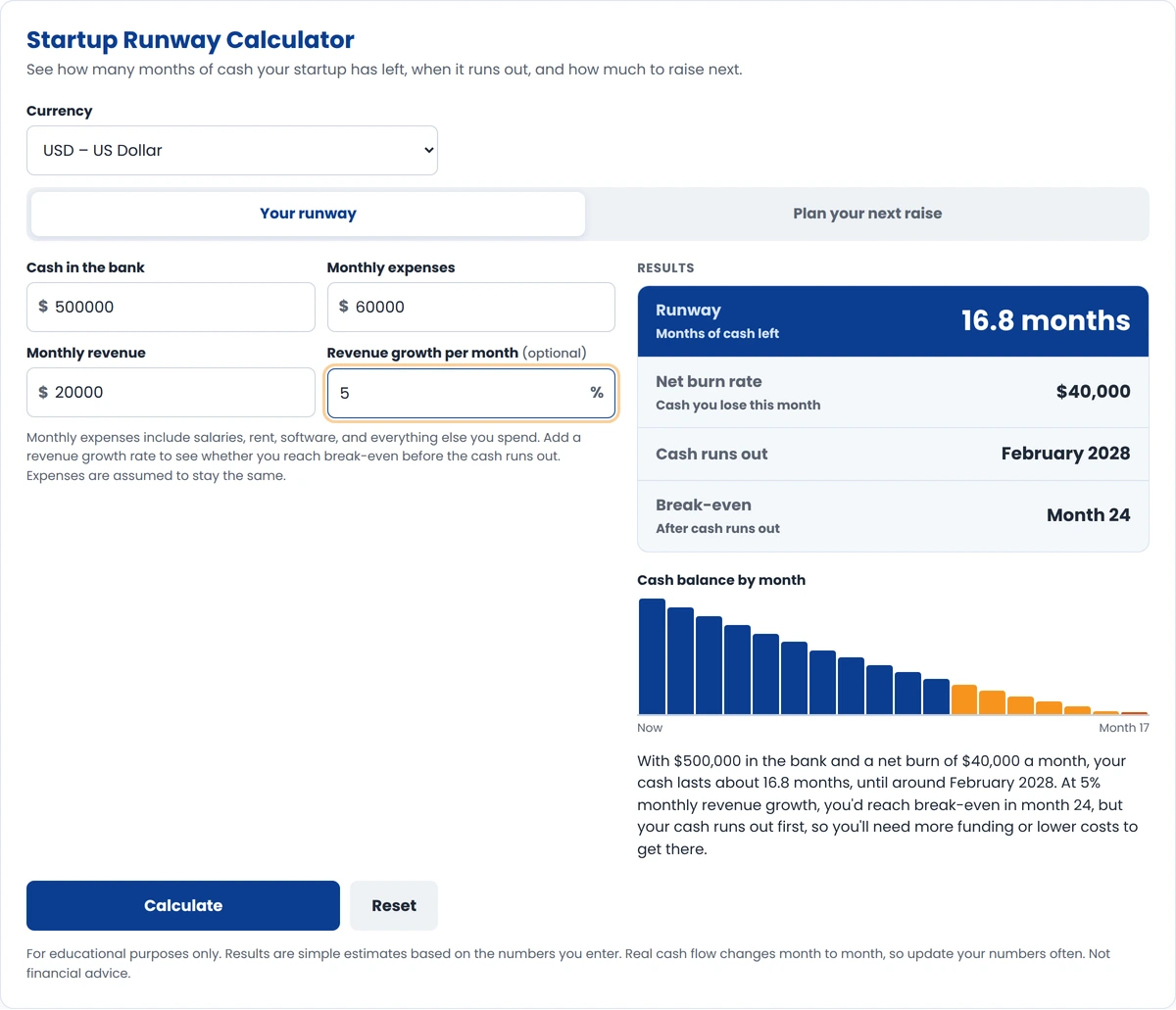
Consider a venture-backed Seed-stage SaaS company operating with the following inputs:
- Cash in Bank: $500,000
- Monthly Expenses: $60,000
- Monthly Revenue: $20,000
- Revenue Growth Rate: 5.0% Month-over-Month (MoM)
Step 1: Calculate Initial Net Burn = $60,000 - $20,000 = $40,000 per month
Step 2: Static Linear Runway = $500,000 ÷ $40,000 = 12.5 months
Step 3: Compounded Growth Extension = Factoring in a 5% monthly revenue expansion compounds revenue to $43,797 by month 16, extending total runway to 16.8 months
Step 4: Operational Break-Even Check = Monthly revenue reaches the $60,000 expenditure benchmark at Month 24. Because cash depletes at month 16.8, an interim financing round is required
Industry Benchmarks for Startup Runway by Stage
| Funding Stage | Target Runway Target | Danger Zone (Red Alert) | Fundraising Lead Time |
|---|---|---|---|
| Pre-Seed / Angel | 12 - 18 Months | < 4 Months | 3 - 5 Months |
| Seed Stage | 18 - 24 Months | < 6 Months | 4 - 6 Months |
| Series A | 21 - 30 Months | < 7 Months | 6 - 9 Months |
| Series B & Beyond | 24 - 36 Months | < 9 Months | 6 - 12 Months |
Where to Find Your Numbers
Ensure reliable inputs by pulling data from your primary accounting ledgers and our companion financial tools:
- Cash in the Bank: Check your real-time cash balances across business operating accounts in QuickBooks, Xero, or Brex.
- Monthly Expenses (Gross Burn): Pull your trailing 3-month average total debits from your Income Statement (P&L). For team cost breakdowns, utilize our Cost per Employee Calculator.
- Customer Acquisition Costs: Optimize marketing efficiency to reduce monthly cash drains using our CAC Calculator and Customer Lifetime Value (LTV) Calculator.
- Growth Benchmarks: Track your multi-period compounding expansion with our CAGR Calculator.
What This Calculator Can and Cannot Tell You
✔ What This Tool Tells You:
- Exact months of cash remaining under current burn trajectories
- Calendar date when bank balances reach zero without intervention
- Whether revenue growth can outpace expenses before cash runs out
✖ What It Does Not Cover:
- Delayed accounts receivable collections (working capital lag)
- Lumpy one-time annual software or tax expenditures
- Dynamic hiring plan expense step-ups across future quarters
Related Calculators & Resources
Cost per Employee Calculator →
Calculate fully loaded employee costs before adding headcount to your burn rate.
CAC Calculator →
Quantify how acquisition costs impact cash burn and marketing payback windows.
Growth Rate Calculator (CAGR) →
Model compound historical growth trajectories to validate break-even forecasts.
Frequently Asked Questions
What is the difference between Gross Burn and Net Burn?
Gross Burn is the absolute total amount of cash leaving your bank account every month (total operational expenditures). Net Burn subtracts monthly incoming revenue from Gross Burn. Net Burn represents the true monthly cash deficit reducing your liquid reserves.
When should a startup begin pitching investors for its next round?
Founders should formally initiate investor discussions when they have 6 to 9 months of runway remaining. Closing institutional equity rounds routinely takes 3 to 6 months; waiting until you have fewer than 4 months of runway creates critical negotiation leverage loss.
How much runway should an early-stage startup target after raising?
In current venture market conditions, founders should raise enough capital to secure 18 to 24 months of runway. This provides 12 to 15 months to execute milestones and scale traction before entering the subsequent fundraising cycle.
Authoritative References & Methodologies
- Y Combinator Startup Library: Managing Startup Cash Burn and Runway Planning
- National Venture Capital Association (NVCA): Early-Stage Financial Benchmarks and Capital Planning