Cost per Employee Calculator: Calculate Fully Loaded Labor Cost
This free cost per employee calculator determines the true, fully loaded cost of hiring and retaining staff. In addition to gross base salary, it accounts for mandatory employer payroll taxes, healthcare benefits, retirement matches, software subscriptions, equipment, and administrative overhead. This ensures hiring managers and founders budget with total financial visibility.
Who it's for: Startup founders, Chief Financial Officers (CFOs), operations directors, HR leaders, and small business owners building hiring budgets and determining client billable billing rates.
Why use it:
- Avoid the "Base Salary Trap": An employee typically costs 1.25x to 1.40x their gross base wage once statutory taxes, insurance, and fringe benefits are included.
- Establish Profitable Billable Hourly Rates: Calculate the exact fully loaded hourly cost per employee so client proposals never underprice operational labor.
- Accurately Forecast Cash Burn: Model real monthly payroll cash outflows to prevent unexpected working capital deficits before issuing job offers.
How to Use the Cost per Employee Calculator
- Enter Direct Compensation: Input the employee's gross annual base salary alongside any expected annual bonuses, commissions, or cash profit-sharing incentives.
- Set Employer Payroll Tax Rates: Input your statutory employer-side tax liability (typically 8% to 12% in the United States, including Social Security at 6.2%, Medicare at 1.45%, FUTA, state unemployment SUTA, and workers' compensation insurance).
- Input Healthcare & Insurance Premiums: Enter the annual employer-paid portion of medical, dental, life, and vision coverage (averaging $6,000 to $10,000 per single employee).
- Factor in 401(k) Retirement Matching: Specify your corporate retirement match percentage (typically 3% to 6% of base wages).
- Allocate Tools & Operating Overhead: Include software licenses (Google Workspace, Slack, Jira, Salesforce), physical hardware (laptop, monitor), and shared office square footage per seat.
- Inspect Loaded Labor Outputs: Review your all-in loaded annual expense, the loaded cost multiplier, the hourly cost across 2,080 working hours, and target client billable rates.
How It Works & Fully Loaded Cost Formulas
The total loaded cost of labor encompasses every direct and indirect liability required to sustain a productive full-time employee:
According to the U.S. Bureau of Labor Statistics (BLS), benefits and taxes routinely account for 28% to 35% of total compensation costs for private industry workers. Failing to account for this loaded multiplier leads to severe corporate cash burn.
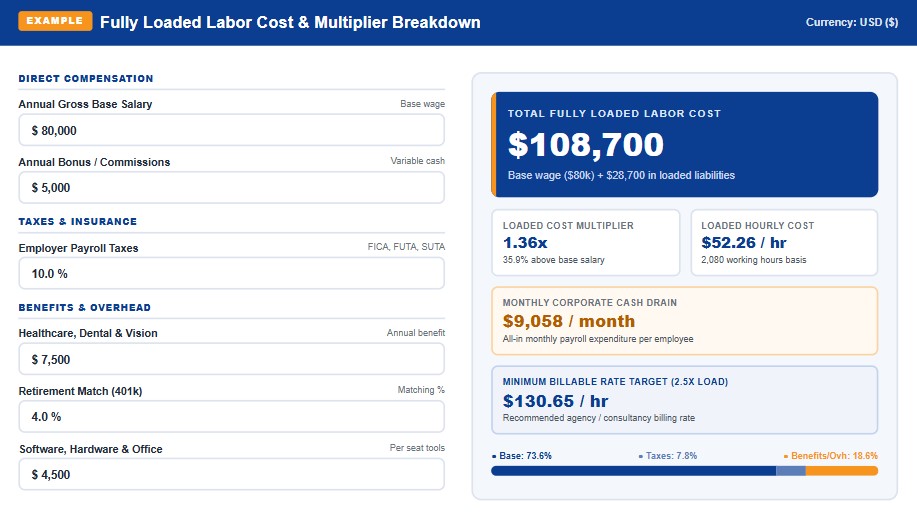
Worked Example: $80,000 Corporate Employee Breakdown
A professional services firm hires a project manager at an $80,000 annual base salary with a standard corporate benefits package:
- Base Salary: $80,000.
- Performance Bonus: $5,000 ($85,000 total cash compensation).
- Employer Payroll Taxes (10.0%): $8,500 (FICA 7.65% + FUTA/SUTA + Workers' Comp).
- Health, Dental & Vision: $7,500 annual employer contribution.
- 401(k) Retirement Match (4.0% of Base): $3,200.
- Software, Laptop & Equipment Overhead: $4,500.
The Strategic Output:
- Total Fully Loaded Annual Cost: $85,000 + $8,500 + $7,500 + $3,200 + $4,500 = $108,700 per year.
- Loaded Cost Multiplier: $108,700 ÷ $80,000 = 1.36x Multiplier (35.9% above base salary).
- Loaded Hourly Cost: $108,700 ÷ 2,080 hours = $52.26 per paid hour.
- Monthly Corporate Cash Drain: $108,700 ÷ 12 = $9,058 per month.
- Recommended Minimum Client Billable Rate (2.5x Load): $130.65 per hour to ensure corporate overhead coverage and 25%+ operating margins.
Standard Labor Load Breakdown by Category
| Cost Component | Typical Cost Range | Mandatory vs. Discretionary | Cost Driver |
|---|---|---|---|
| Employer FICA (Social Security & Medicare) | 7.65% of wages | Legally Mandatory | Federal statutory requirement. |
| FUTA & SUTA (Unemployment Taxes) | 1.0% – 4.0% | Legally Mandatory | State tax rating & historical layoff record. |
| Workers' Compensation Insurance | 0.5% – 5.0%+ | Legally Mandatory | Job hazard classification (desk job vs. roofing). |
| Health & Dental Insurance | $6,000 – $14,000 / yr | Discretionary / ACA Mandatory (50+ FTE) | Plan tier, age demographics, family vs. single. |
| 401(k) / Retirement Match | 3.0% – 6.0% of base | Discretionary | Talent attraction & corporate retention policy. |
| Software SaaS & Hardware | $2,500 – $8,000 / yr | Operational Requirement | Tech stack, security compliance, laptop upgrades. |
Where to Find Your Numbers
To construct accurate, investor-ready workforce projections for operating budgets or hiring roadmaps, source verified operational data:
- For Workforce Attrition & Hiring Costs: Model how employee departures increase recruitment and onboarding expenses with our Employee Turnover Calculator.
- For Operational Cash Flow Runway: Measure how new fully loaded hires impact your runway using our Burn Rate Calculator.
- For Unit Margin Governance: Ensure your product and service pricing covers loaded labor overhead with our Pricing Strategy Calculator.
- For Breakeven Headcount Sizing: Calculate the gross revenue required to support additional staff using our Break-Even Calculator.
- For Downside Stress Testing: Model how payroll expenses impact net margins during revenue contractions using our Business Scenario Calculator.
What This Calculator Can and Cannot Tell You
What it tells you:
- Exact fully loaded cost of an employee across annual, monthly, and hourly intervals.
- Your organization's loaded labor multiplier above headline gross compensation.
- Target billing rate minimums required to sustain agency or consulting profitability.
What it cannot tell you:
- Productivity & Output Value: It measures what an employee costs, not what they produce. An employee costing $120,000 who generates $500,000 in revenue is far cheaper to the business than an underperforming $50,000 worker.
- Initial Hiring & Onboarding Overhead: The formula reflects ongoing annual maintenance costs; it does not include one-off recruiting agency fees (typically 15%–25% of first-year salary) or initial training downtime.
- State-Specific Tax Variances: SUTA unemployment tax brackets and paid family leave mandates vary dramatically between states like California, Texas, New York, and Florida.
Related Guides and Calculators
Optimize your organizational headcount, labor economics, and financial strategy with our founder suite:
Frequently Asked Questions
The Bottom Line
Budgeting for headcount based solely on gross base salary leads directly to cash flow shortfalls. Always calculate your fully loaded labor multiplier before issuing job offers. Combine your hiring plan with our Burn Rate Calculator, monitor staff turnover with our Employee Turnover Calculator, and preserve healthy operating margins with our Pricing Strategy Calculator.
- U.S. Bureau of Labor Statistics (BLS): Employer Costs for Employee Compensation (ECEC)
- Society for Human Resource Management (SHRM): Total Compensation Architecture & Loaded Cost Models
- Internal Revenue Service (IRS): Publication 15 (Circular E): Employer's Tax Guide
- Corporate Finance Institute (CFI): Loaded Labor Rate Formula & Billable Multiplier Calculation
Disclaimer: This calculator is provided for strategic planning and educational modeling purposes only. It does not constitute formal tax advisory, legal wage-and-hour compliance, or certified payroll accounting. Verify state-specific payroll tax obligations with your CPA or payroll provider.