Break-Even Calculator: Find Out How Much You Need to Sell to Cover Your Costs
This free break-even calculator shows exactly how many units you need to sell, or how much revenue you need to bring in, to cover your fixed and variable costs each month. It also shows the sales you need to hit a profit goal and your margin of safety, so you know how far sales can fall before you start losing money.
Who it's for: Small business owners, startup founders, e-commerce sellers, and service providers who are setting prices, planning a launch, or checking whether the business can cover a new expense like rent or a hire.
Why use it:
- Two ways to calculate: Use units for product businesses or gross margin for service businesses and stores with many products.
- Goals, not just break-even: See the units or revenue needed for a target profit and your margin of safety in one place.
- Instant what-if testing: Change a price or cost and watch your break-even point update as you type.
Break-Even Calculator
Results are estimates for planning only. The currency selector changes the symbol only; it does not convert amounts.
How to Use the Break-Even Calculator
- Pick a tab. Use "By units" if you sell products with a clear price and cost per item. Use "By revenue" if you sell services or many products with different prices.
- Enter your monthly fixed costs. Add up costs you pay no matter how much you sell: rent, salaries, insurance, loan payments, software.
- Enter your price and variable cost per unit (or your gross margin percentage on the revenue tab).
- Add a target profit or expected sales if you want to see how far you are from your goal.
- Read your results. The calculator updates instantly as you type.
How It Works
The break-even point is the point at which total costs and total revenue are equal, so you earn no profit and take no loss. The U.S. Small Business Administration uses the same basic formula in its startup guide.
Contribution margin per unit = Price − Variable cost per unit
Break-even units = Fixed costs ÷ Contribution margin per unit
Contribution margin ratio = Contribution margin ÷ Price
Break-even revenue = Fixed costs ÷ Contribution margin ratio
Units for target profit = (Fixed costs + Target profit) ÷ Contribution margin per unit
Margin of safety = (Expected sales − Break-even sales) ÷ Expected sales
Break-even units are rounded up, because you can't sell part of a product. If your price is equal to or below your variable cost, every sale loses money and the calculator will tell you that break-even isn't reachable.
Worked Example
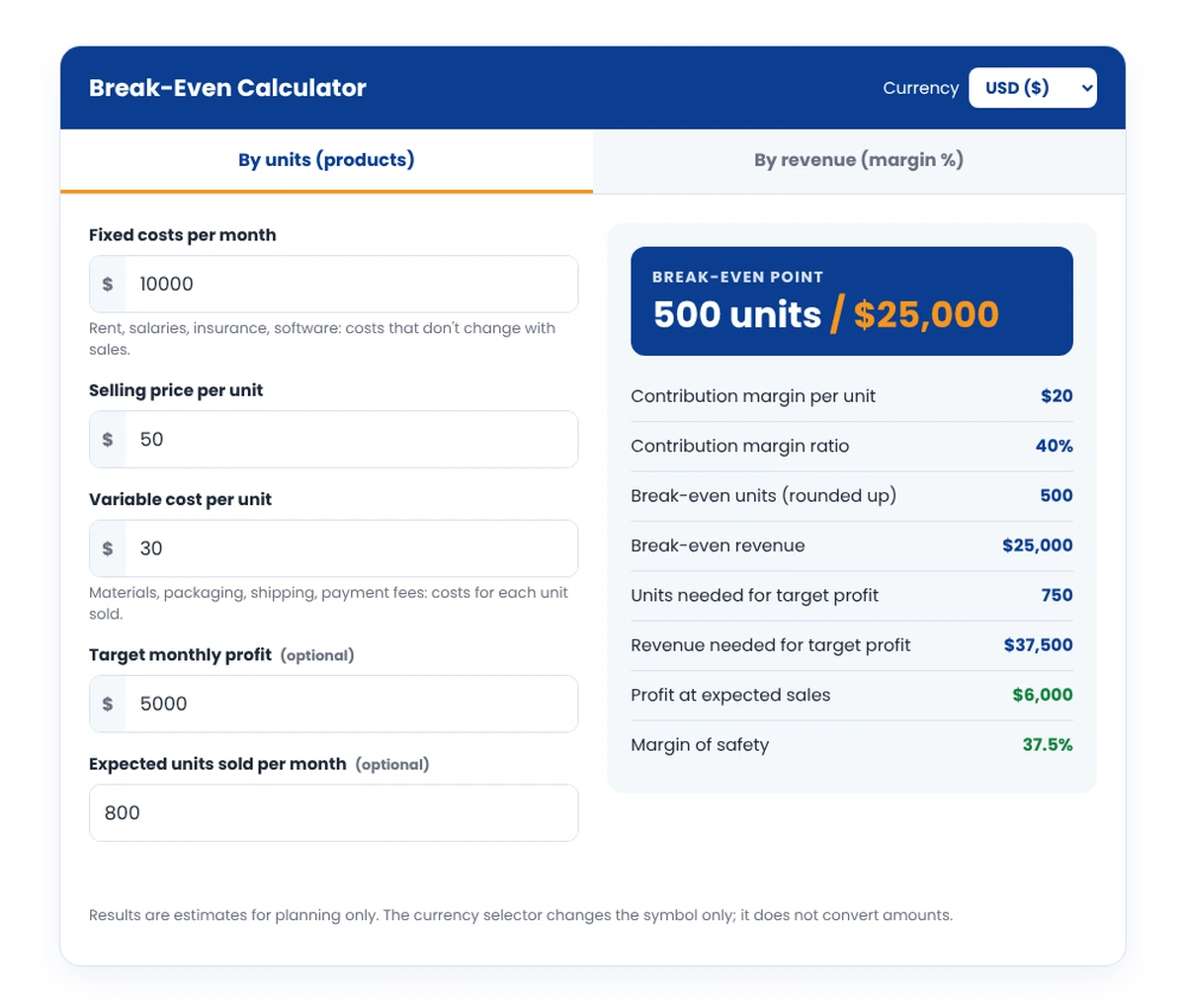
A small candle business has $10,000 in monthly fixed costs. Each candle sells for $50 and costs $30 to make, pack, and ship.
- Contribution margin: $50 − $30 = $20 per candle (40% of the price)
- Break-even: $10,000 ÷ $20 = 500 candles, or $25,000 in sales a month
- To earn $5,000 profit: ($10,000 + $5,000) ÷ $20 = 750 candles
- If the owner expects to sell 800 candles: profit = 800 × $20 − $10,000 = $6,000, and the margin of safety is (800 − 500) ÷ 800 = 37.5%
A 37.5% margin of safety means sales could fall by about a third before the business starts losing money.
Break-Even Units vs. Break-Even Revenue
| Measure | What it tells you | Best for |
|---|---|---|
| Break-even units | How many items you must sell to cover costs | Product sellers with one main price |
| Break-even revenue | How much money must come in to cover costs | Service businesses, restaurants, stores with many products |
| Units or revenue for target profit | What it takes to reach a specific profit goal | Setting sales goals and budgets |
| Margin of safety | How far sales can drop before you lose money | Judging risk before a price change or slow season |
Where to Find Your Numbers
- Fixed costs: your profit and loss statement or bank statements. Include rent, salaries, insurance, subscriptions, loan payments, and your own pay if you take a regular salary.
- Variable cost per unit: supplier invoices plus packaging, shipping, payment processing fees, and sales commissions for each sale.
- Gross margin: (revenue − cost of goods sold) ÷ revenue from your accounting software.
- Expected sales: your recent monthly average, or a realistic forecast from your business plan.
What the Calculator Can and Cannot Tell You
It can tell you
- The sales you need to stop losing money
- How a price change shifts your break-even point
- What it takes to hit a profit goal
- How much cushion you have above break-even
It cannot tell you
- Whether customers will pay your price
- When cash actually arrives (use a runway calculator for that)
- How costs change as you grow, such as hiring or a bigger space
- Taxes, which come out of profit after break-even
Frequently Asked Questions
What is a good break-even point for a small business?
There's no single number. A good break-even point is one you can reach with realistic sales in a reasonable time. If break-even requires more sales than your market or capacity allows, raise prices, lower variable costs, or trim fixed costs before you scale up.
Should I include my own salary in fixed costs?
Yes, if you plan to pay yourself regularly. Leaving out your pay makes the business look profitable sooner than it really is. Many owners run the calculator twice: once with a salary, to see true break-even, and once without, to see when the business covers its other costs.
How do I lower my break-even point?
You have three levers: raise your price, lower your variable cost per unit, or cut fixed costs. Small price increases often have the biggest effect, because every extra dollar of price goes straight to contribution margin. Test each change in the calculator before you commit to it.
What's the difference between break-even and profit?
Break-even is the point where profit is exactly zero. Every unit you sell above break-even adds its contribution margin to profit, and every unit below it adds to your loss. In the example above, each candle past the 500th adds $20 of profit before taxes.
How often should I recalculate my break-even point?
Recalculate whenever prices, supplier costs, rent, or staffing change, and at least once a year. Rising costs can quietly push your break-even point up even when sales look steady, so a quick quarterly check is a smart habit for most small businesses.
Final Takeaway
Your break-even point is the minimum your business must sell to survive. Know it before you set prices, sign a lease, or hire, and recheck it whenever your costs change. If you're still planning the business, start with our guide on how to start a small business, and if you need funding to reach break-even, compare small business loans.
Sources: U.S. Small Business Administration, "Calculate your startup costs" (break-even definition and formula). Example figures are illustrative.