Pricing Strategy Calculator: Markup, Gross Margin & Retail Pricing
This free pricing strategy calculator calculates your optimal product and service selling price based on your cost of goods sold (COGS), target gross profit margin, or required markup percentage. It lets entrepreneurs, e-commerce sellers, and enterprise operators model cost-plus pricing, value margin targets, and wholesale-to-retail pricing tiers instantly.
Who it's for: Product founders, e-commerce store owners, retailers, wholesale distributors, and commercial finance teams looking to protect gross profit margins and prevent unintentional underpricing.
Why use it:
- Distinguish Markup vs. Margin: Avoid the classic pricing mistake of confusing markup percentage on cost with true gross profit margin on revenue.
- Protect Cash Flow & Operating Profits: Ensure your unit selling price accounts for shipping, transaction fees, overhead allocation, and desired net profit.
- Structure Multi-Tier Distribution: Map wholesale margins alongside manufacturer suggested retail prices (MSRP) to maintain distributor profitability.
How to Use the Pricing Strategy Calculator
- Select Pricing Methodology:
- Choose Target Margin Strategy if you want a guaranteed percentage of your revenue retained as gross profit (standard for venture-backed and high-growth retail brands).
- Choose Cost-Plus Markup Strategy if you price goods by applying a fixed percentage on top of your production cost (standard for manufacturing and job-costing businesses).
- Enter Cost of Goods Sold (COGS): Input raw material costs, manufacturing fees, direct labor, and import duties incurred per finished item.
- Set Fulfillment & Logistics Costs: Enter unit packaging, storage, outbound courier delivery, and merchant payment processing fees.
- Input Desired Margin or Markup: Specify your target gross profit margin (e.g., 55%) or your desired markup percentage (e.g., 120%).
- Review Multi-Tier Price Recommendations: Analyze the recommended retail selling price, unit cash profit, wholesale distributor pricing, and cost-to-profit ratios.
How It Works: Markup vs. Gross Profit Margin Formulas
The single most catastrophic pricing mistake small business owners make is confusing markup percentage with profit margin:
Margin is calculated as a percentage of your final selling price (revenue), whereas markup is calculated as a percentage of your cost. A 50% markup on a $100 product results in a $150 price, which produces a 33.3% profit margin—not 50%.
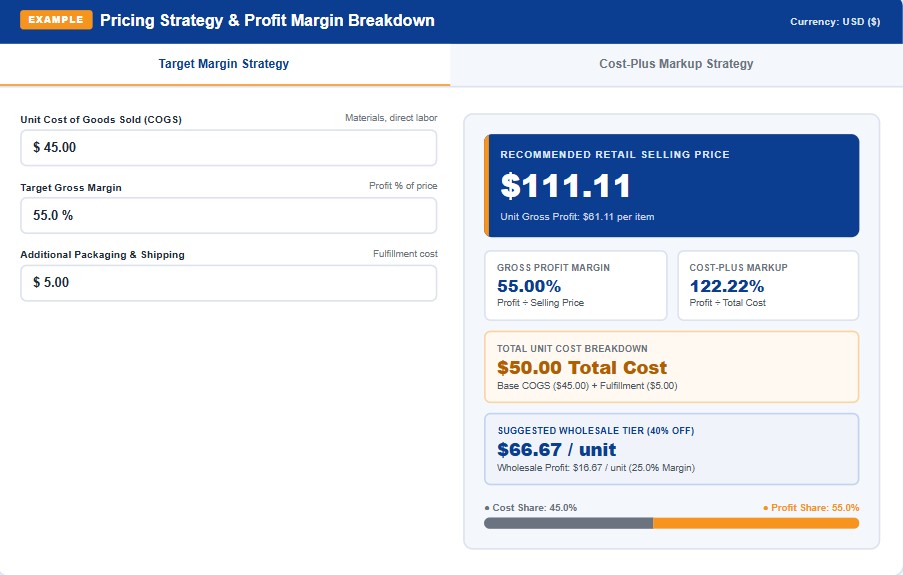
Worked Example: Consumer Product Target Margin Pricing
A direct-to-consumer brand manufactures a premium leather bag requiring a 55% gross margin to cover customer acquisition costs and operating overhead:
- Base Unit COGS: $45.00 (raw materials, stitching, hardware).
- Fulfillment & Shipping: $5.00 (packaging, postage, card processing).
- Total Unit Cost: $50.00.
The Strategic Output:
- Recommended Retail Price: $50.00 ÷ (1 − 0.55) = $111.11.
- Unit Gross Cash Profit: $111.11 − $50.00 = $61.11 per item.
- Equivalent Cost Markup: ($61.11 ÷ $50.00) × 100 = 122.22% markup.
- Wholesale Tier (40% Off Retail): $66.67 selling price ($16.67 unit profit / 25% wholesale margin).
Markup to Margin Conversion Table
Reference this quick-conversion matrix to avoid margin compression when negotiating volume pricing or vendor agreements:
| Markup on Cost | Equivalent Gross Margin | Price for $50 Cost | Unit Cash Profit |
|---|---|---|---|
| 25.0% Markup | 20.0% Margin | $62.50 | $12.50 |
| 50.0% Markup | 33.3% Margin | $75.00 | $25.00 |
| 100.0% Markup (Keystone) | 50.0% Margin | $100.00 | $50.00 |
| 150.0% Markup | 60.0% Margin | $125.00 | $75.00 |
| 200.0% Markup | 66.7% Margin | $150.00 | $100.00 |
Where to Find Your Numbers
To establish defensible pricing models that scale without triggering liquidity shortages, gather verified operational data:
- For Fixed Overhead & Unit Volume: Use our Break-Even Calculator to determine how many units at this price you need to sell each month to cover fixed rent, salaries, and software.
- For Industry Positioning: Evaluate your competitor price points and market dominance using our Market Share Calculator.
- For Cash Burn & Production Capital: Ensure initial inventory production runs do not drain your cash reserves with our Burn Rate Calculator.
- For Complete Financial Projections: Structure your cost architecture and pro forma pricing models using our guide on How to Write a Business Plan[cite: 2].
What This Calculator Can and Cannot Tell You
What it tells you:
- Exact retail and wholesale price points required to hit target gross margin thresholds.
- The accurate conversion between cost markup percentages and true gross profit margins.
- Per-unit gross contribution cash profit after accounting for fulfillment and COGS.
What it cannot tell you:
- Price Elasticity of Demand: Setting a mathematically perfect 70% margin price will not succeed if consumers find the price uncompetitive relative to market alternatives.
- Operating Overhead Allocation: Gross profit covers only product and direct fulfillment costs; it does not automatically pay for corporate overhead, software, or executive payroll unless sales volume is sufficient.
- Customer Lifetime Value (LTV): In subscription or repeat-order models, initial products can be priced at lower margins if recurring backend reorders produce high net lifetime value.
Related Guides and Calculators
Explore our strategic business toolkit to optimize profit margins, sales volume, and corporate capitalization:
Frequently Asked Questions
The Bottom Line
Price is the primary lever of business profitability. Small percentage changes in your pricing model produce disproportionately large swings in net cash flow. Always protect your gross margins, test required sales volumes with our Break-Even Calculator, and benchmark your competitive standing with our Market Share Calculator.
- Harvard Business Review: A Quick Guide to Value-Based Pricing by Utpal M. Dholakia
- American Institute of Certified Public Accountants (AICPA): Cost Accounting & Margin Standards
- MIT Sloan Management Review: How to Price and Position Differentiated Products
- U.S. Small Business Administration (SBA): Pricing Strategies for Small Business Profitability
Disclaimer: This calculator is provided for strategic modeling and educational planning purposes only. It does not constitute formal tax, accounting, or legal retail compliance advice. Verify localized sales tax and merchant fee structures with your CPA.