Burn Rate Calculator: Estimate Gross, Net Burn & Cash Runway
This free burn rate calculator calculates your startup's exact gross burn rate, net monthly cash burn, and remaining cash runway in months. It allows founders and finance teams to project when the company will run out of money based on current operating expenses, incoming revenue, and cash reserves.
Who it's for: Startup founders, seed-stage entrepreneurs, fractional CFOs, and business operators monitoring cash bleed, preparing for venture fundraising, or budgeting operational runway.
Why use it:
- Distinguish Gross vs. Net Burn: Clarify total monthly cash outflow (gross burn) versus the actual net deficit after customer collections (net burn).
- Prevent Involuntary Insolvency: Identify your exact "Zero Cash Date" well in advance so you can begin raising a new equity round 6 to 9 months before cash reaches critical levels.
- Test Expense Reduction Scenarios: Simulate headcount adjustments, cloud hosting cuts, or marketing budget pauses to see how each cut extends runway immediately.
How to Use the Burn Rate Calculator
- Select Your Calculation Mode: Use the Monthly Totals (Quick) tab if you already have aggregate monthly operating expense numbers from your bookkeeping software. Use the Expense Breakdown (Detailed) tab to itemize payroll, sales & marketing, cloud hosting, and general administrative overhead.
- Enter Your Current Cash Reserves: Input total unrestricted liquid cash (checking, money market accounts, short-term Treasuries). Exclude restricted security deposits or committed escrow funds.
- Input Monthly Cash Inflows: Enter recurring customer receipts, subscription collections, or contracted revenue actually cleared in your bank accounts. Do not count unbilled accounts receivable.
- Set Your Operating Expenses (Gross Burn): Enter your regular monthly operational outflows. If you are budgeting initial company build-out expenses, cross-reference our Startup Cost Calculator to avoid omitting early vendor commitments.
- Analyze Your Runway & Zero Cash Date: Review your estimated runway months and target fundraising deadline. The alert box will immediately notify you if your runway falls below safe institutional operating thresholds.
How It Works & Key Financial Formulas
Burn rate measures the pace at which a company consumes its cash reserves before achieving self-sustaining profitability. Venture-backed startups manage two distinct burn metrics:
Gross burn shows your total cash burn rate if revenue unexpectedly dropped to zero (such as during a platform outage or customer contract dispute). Net burn is the real deficit leaving your business bank accounts every 30 days. When net burn reaches zero or turns negative, your startup achieves default-alive status.
Worked Example: Early-Stage SaaS Cash Burn Breakdown
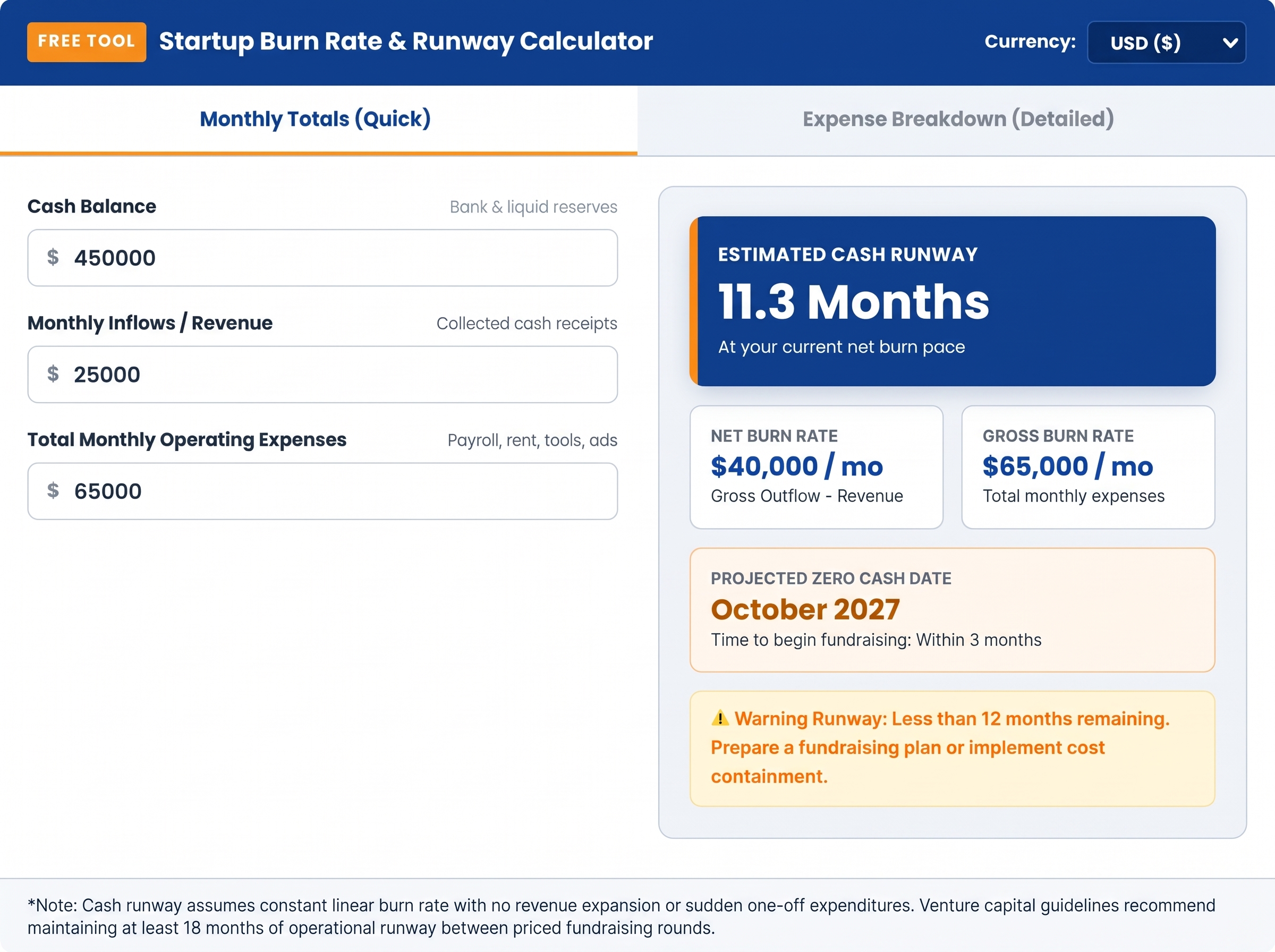
A venture-backed SaaS startup holds $450,000 in cash reserves following an angel round:
- Monthly Collections: $25,000 in monthly recurring revenue (MRR).
- Monthly Outflows: $40,000 for engineer salaries, $12,000 for marketing/ads, $8,000 for cloud infrastructure/APIs, and $5,000 for administrative/legal overhead.
The Strategic Output:
- Gross Burn Rate: $65,000 per month.
- Net Monthly Burn: $65,000 − $25,000 = $40,000 per month.
- Cash Runway: $450,000 ÷ $40,000 = 11.3 Months.
Founder Action Plan: With 11.3 months of runway remaining, the founding team must begin active investor pitch meetings within 3 to 4 months. Institutional seed rounds require an average of 4 to 6 months to close from first partner meetings to wired term sheet funds.
Startup Runway Benchmarks (By Funding Stage)
Venture investors expect companies to maintain adequate operational runway to execute growth plans without facing sudden liquidity panics:
| Funding Stage | Recommended Runway Buffer | Fundraising Trigger Point | Typical Monthly Net Burn |
|---|---|---|---|
| Pre-Seed (Product Development) | 12 – 18 Months | At 6 Months Remaining | $15,000 – $35,000 |
| Seed (Early GTM & Customers) | 18 – 24 Months | At 9 Months Remaining | $40,000 – $100,000 |
| Series A (Scaling Distribution) | 20 – 24 Months | At 9 Months Remaining | $120,000 – $350,000 |
| Series B+ (Expansion & Maturity) | 24+ Months or Default Alive | At 12 Months Remaining | $400,000 – $1,000,000+ |
Where to Find Your Numbers
Before entering numbers into the calculator, extract accurate financial metrics from your verified books:
- For Liquid Cash & Bank Balances: Pull your most recent corporate bank account statement. Exclude long-term security deposits or deferred receivables.
- For Operating Expenses & Break-Even Targets: Audit your trailing 3-month general ledger. Use our Break-Even Calculator to identify what sales volume your business needs to turn net burn into positive monthly net income.
- For Fundraising & Round Sizing: If you are raising venture capital to expand runway, model your cap table dilution and post-money valuation using our Startup Valuation Estimator.
- For Long-Term Cash Flow Modeling: Formulate full 3-year cash flow projections using our structured guide on How to Write a Business Plan.
What This Calculator Can and Cannot Tell You
What it tells you:
- Exact monthly cash bleed taking into account current operational overhead and revenue inflows.
- Your linear cash runway in months and your estimated Zero Cash Date.
- The urgency level of your capital strategy (healthy buffer vs. active fundraising window).
What it cannot tell you:
- Non-Linear Revenue Growth: The calculator assumes linear cash burn. In fast-growing businesses, rising customer revenue will lengthen runway organically over time.
- Step-Function Expense Jumps: It does not automatically model future hiring waves, planned office relocations, or annual software renewals.
- Working Capital Inefficiencies: Delayed enterprise invoice payments (Net 60/90 terms) can trigger short-term cash crunches even if accounting net burn appears manageable.
Related Guides and Calculators
Explore our complete founder toolkit to master cash management, equity dilution, and business capitalization:
Frequently Asked Questions
The Bottom Line
Runway is a startup's lifeblood. Understanding your exact net burn rate gives you the clarity to make strategic hiring decisions and avoid fatal liquidity crunches. Check your operational expenses monthly, test growth scenarios with our Break-Even Calculator, and model future fundraising dilution with our Startup Valuation Estimator to scale sustainably.
- Y Combinator: Default Alive or Default Dead Strategy by Paul Graham
- National Venture Capital Association (NVCA): Venture Monitor Capital Efficiency Standards
- Craft Ventures: The Burn Multiple: A Quantitative Framework for Capital Efficiency
- Financial Accounting Standards Board (FASB): ASC 230 — Statement of Cash Flows Standards
Disclaimer: This calculator is provided for operational planning and strategic budgeting purposes only. Actual financial longevity depends on cash collection timing, accounts receivable aging, and unexpected expenses. Always review formal balance sheets with a certified public accountant (CPA).