Quick answer: Money Invested in Business? The money you’ve invested in your business is the cash you’ve put in plus the fair market value of assets you contributed and business expenses you paid personally, minus anything you’ve taken back out. Report loans you made to the business separately, and don’t count unpaid time. Lenders and investors ask because your own money shows commitment.
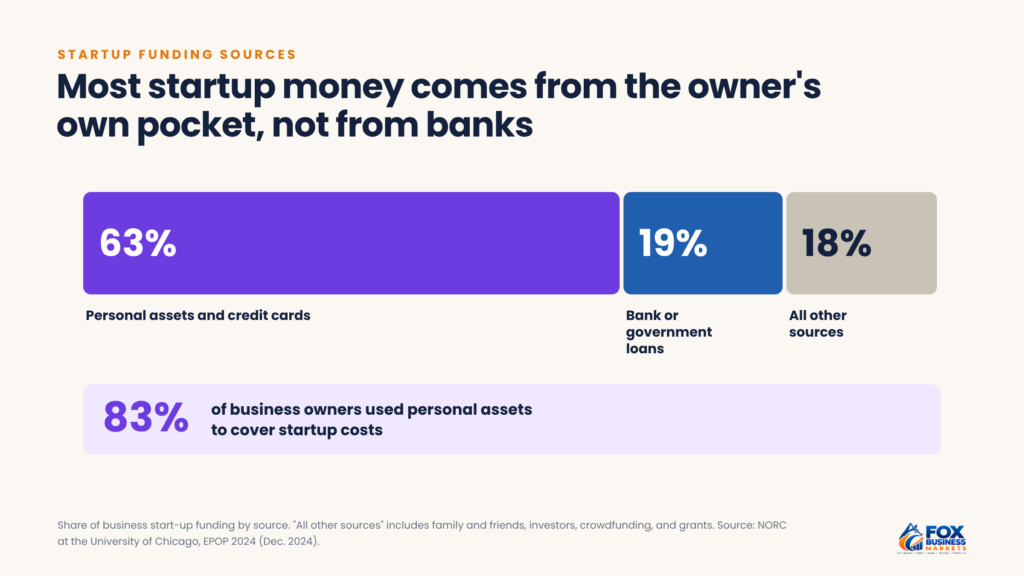
Eighty-three percent of business owners use personal assets to cover startup costs, according to NORC at the University of Chicago’s Entrepreneurship in the Population survey. Personal assets and credit cards together make up 63% of all startup funding, compared with 19% from bank or government loans.
Yet when a loan officer, investor, or grant form asks, “How much money have you invested so far in your business?”, many owners guess. Some count hours of unpaid work as dollars. Others forget the laptop, the deposit on the lease, or the supplies they bought on a personal card. A vague or inflated answer can cost you credibility, and with SBA loans, it can cost you approval.
This guide shows what counts as money invested in a business, how to calculate and document your total, how much lenders expect, and how to word your answer for a loan application, an investor pitch, or a grant form.
Why Do Lenders and Investors Ask How Much You’ve Invested?
They want to know how much of your own money is at risk. An owner who stands to lose their own money is less likely to walk away when sales dip. Lenders call this “skin in the game.”
Each type of funder reads the answer a little differently:
| Who’s asking | What they’re really checking | What a strong answer shows |
| Bank or SBA lender | Whether you meet the minimum equity requirement and can absorb losses before the lender does | A documented cash injection, with bank statements to prove it |
| Angel or venture investor | Your commitment and how far you’ve gotten with limited money | Progress per dollar: customers, revenue, or a product built on a small budget |
| Grant program or pitch competition | Whether the business is real and the founder is committed | A specific figure and what it paid for |
| Potential partner or buyer | Your capital account and what you’d expect back | Clean records of contributions and withdrawals |
What Counts as Money Invested in Your Business?
Not everything you’ve spent or done counts as money invested in the business. Sort each item into one of three groups:
| Counts as your investment (equity) | Report separately (loans and debts) | Doesn’t count as money invested |
| Cash transferred from your personal accounts to the business | Money you lent the business under a written agreement with repayment terms | Unpaid hours, sometimes called sweat equity |
| Fair market value of equipment, vehicles, or inventory you contributed | Business debts you guaranteed personally (disclose these, but they’re not your cash) | Money that came from customers or business revenue |
| Business expenses you paid personally and didn’t get reimbursed for, such as permits, a lease deposit, or a website | Card balances the business is expected to repay, even on a card in your name (if you paid the card off yourself with no repayment, count it as equity) | Loans the business took out on its own |
| Profits you left in the business (retained earnings; list on their own line) | Personal costs, such as your own living expenses while you launch |
Subtract any money you’ve taken back out of the business, such as owner’s draws or distributions, unless you’re asked specifically for total contributions.
How Do You Calculate Your Total Investment?
Work through six steps, using bank statements, receipts, and your accounting records:
- Add up cash contributions. Total every transfer from your personal accounts into the business account.
- Add the value of assets you contributed. Use fair market value on the day you contributed them, not what you originally paid. A two-year-old laptop you bought for $1,800 might be worth $900.
- Add business expenses you paid personally. Include only costs you weren’t reimbursed for.
- Note reinvested profits separately. Earnings you left in the business are retained earnings rather than contributions, and SBA lenders won’t count them toward a startup injection, so list them on their own line.
- Subtract withdrawals. Remove owner’s draws or distributions you’ve taken.
- List loans to the business separately. Note the balance, interest rate, and repayment terms.
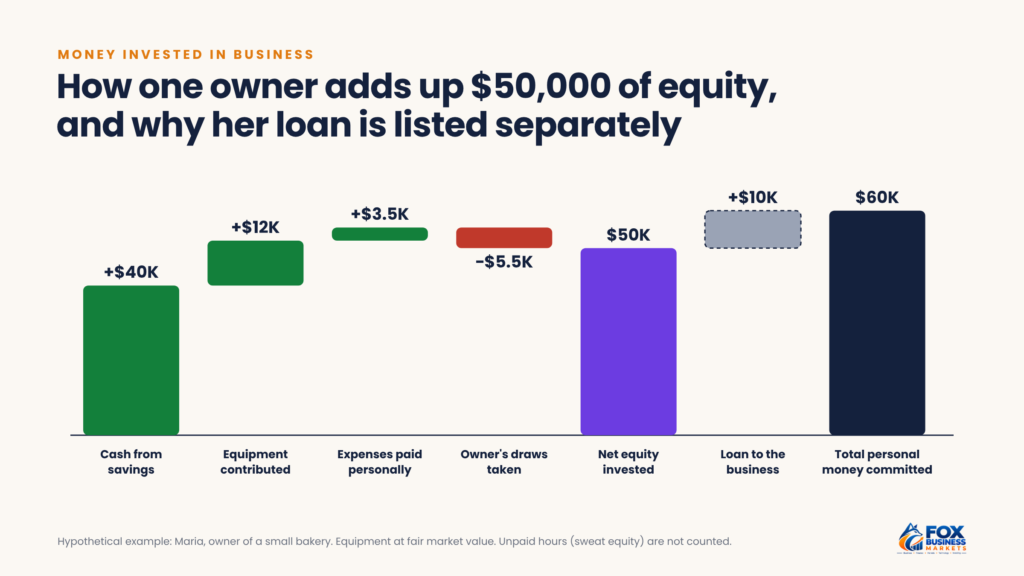
Consider Maria, a fictional owner who opened a small bakery last year:
| Item | Amount | Category |
| Cash transferred from savings | $40,000 | Equity |
| Commercial mixer and oven she already owned (fair market value) | $12,000 | Equity |
| Permits, lease deposit, and website paid on her personal card | $3,500 | Equity |
| Owner’s draws taken so far | −$5,500 | Reduces equity |
| Net equity invested | $50,000 | |
| Loan to the business from her personal account, 5% interest, 3-year term | $10,000 | Loan (reported separately) |
| Total personal money committed | $60,000 | |
| Unpaid hours during the first year | Not counted | Sweat equity |
Maria can truthfully say she has invested $50,000 in equity and lent the business another $10,000. That answer is precise, and every number has a document behind it. Our startup cost calculator can help you estimate how much more the business will need.
Where Do You Find the Number in Your Records?
If your books are in order, the figure is already there:
- Balance sheet: The owner’s equity section shows contributions, often in an account called owner’s capital, owner’s investment, or paid-in capital. Our guide to financial statements explains how to read it.
- Partnership returns, including LLCs taxed as partnerships: Each partner’s or member’s Schedule K-1 shows a capital account with contributions and distributions for the year.
- Corporations: Look for common stock and additional paid-in capital on the balance sheet.
- Bank statements: Transfers from your personal accounts to the business account are the strongest proof of cash contributions.
- Receipts and bills of sale: These support equipment you contributed and expenses you paid personally.
If you’ve mixed personal and business money or never recorded your contributions, rebuild the figure from bank and card statements before anyone asks. It’s much easier to do at your desk than in front of a loan officer.
How Should You Answer the Question?
Give one specific number, say what it covered, and be ready to prove it. Maria might answer in three common situations like this.
On a loan application:
“I have invested $50,000 of my own money as equity: $40,000 in cash and $12,000 in equipment at fair market value, plus $3,500 in startup expenses, less $5,500 in owner’s draws. I have also lent the business $10,000 at 5% interest over three years. Bank statements and receipts are attached.”
In an investor pitch:
“I’ve put $50,000 of my own money into the business. With it, we opened the shop, built wholesale accounts with four local cafés, and reached $18,000 in monthly sales in our first year.”
On a grant or competition application:
“To date, I have invested $50,000 of my own money, including $12,000 in equipment, which covered our oven and mixer, permits, the lease deposit, and our website.”
Avoid three common mistakes: rounding up, counting sweat equity as cash, and giving a total you can’t document.
What If You Haven’t Invested Much Yet?
A small number isn’t a problem if the rest of your answer shows progress. Investors judge a small figure by what it produced.
Build your answer around what the money achieved:
- State the figure plainly, even if it’s $2,000. Precision builds more trust than a vague “a significant amount.”
- Show what it bought: a prototype, a first batch of inventory, a licensed kitchen rental, or a trial marketing campaign.
- Point to traction: pre-orders, paying customers, signed letters of intent, or a waiting list.
- Mention other commitments, such as leaving a full-time job or working without a salary, as separate facts.
- Explain your plan: how much more you’ll put in, and when, alongside the money you’re asking for.
If you’re applying for an SBA loan and don’t yet have the required equity injection, ask the lender which sources count, such as a contributed asset or an eligible grant, and plan the timing so the funds sit in your account long enough to verify. Our guide to the cost to start a business can help you set a realistic target.
How Much Should You Invest in Your Own Business?
There’s no single rule, but lenders set a floor for some loans.
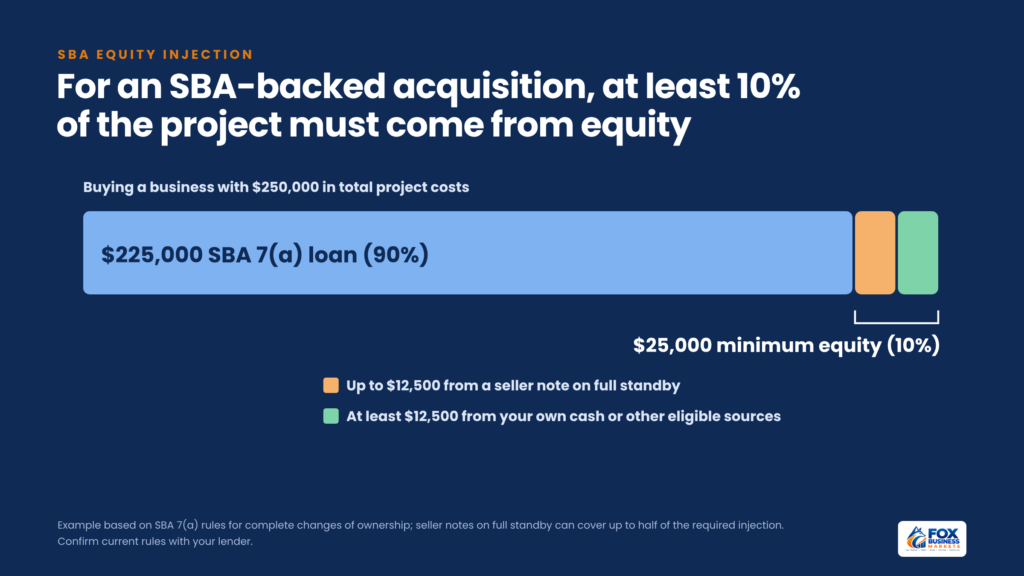
SBA 7(a) loans. The SBA generally requires an equity injection of at least 10% of total project costs for startups and for complete changes of ownership, such as buying an existing business, under its 7(a) lending rules. Lenders can require more. Acceptable sources include cash you haven’t borrowed, and in some cases assets or seller financing on full standby, meaning the seller receives no principal or interest payments for the entire term of the SBA loan. For acquisitions, seller notes and other limited sources, such as standby debt, combined can cover no more than half of the required injection.
For example, if you’re buying a business with $250,000 in total project costs:
- Minimum equity injection: $25,000 (10%)
- Maximum from a seller note on full standby: $12,500
- Minimum from your own cash or other eligible sources: $12,500
The SBA updated its 7(a) rules under SOP 50 10 8.1 for loans numbered on or after Oct. 1, 2026, so confirm the current requirement with your lender before you apply. Our guide to small business loans covers the rest of the approval process.
Conventional bank loans. Requirements vary by bank. Ask the lender for its minimum; it depends on the project’s risk and collateral.
Investors. Angel and venture investors don’t set a minimum, but they notice whether founders have taken financial risk, such as leaving a salary or investing savings, alongside them. Our guide to startup funding stages explains what investors expect at each round.
Your own limit. Decide in advance how much you can afford to lose. Keep an emergency fund for household expenses separate from anything you put into the business.
How Do Partners Track Unequal Contributions?
When two or more owners put in different amounts, each owner’s contributions belong in a separate capital account. That keeps the record clear when you split profits, bring in an investor, or one owner leaves.
| Owner | Cash contributed | Equipment contributed | Draws taken | Capital account balance |
| Owner A | $60,000 | $0 | −$8,000 | $52,000 |
| Owner B | $20,000 | $15,000 | −$4,000 | $31,000 |
Capital accounts also change each year by each owner’s share of profit or loss, so the balances on your partnership return will differ from contributions alone. Spell out in your operating or partnership agreement how future contributions affect ownership, whether owners must contribute more if the business needs cash, and how capital accounts are paid out if someone exits.
When a lender or investor asks how much “you” have invested in a business with partners, give your own figure and the total for all owners, so the answer can’t be misread.
Is Sweat Equity the Same as Money Invested?
No. Sweat equity, the unpaid time and skill you put into a business, has real value, and in a partnership or startup it can earn you ownership. But it isn’t cash, and lenders won’t count it toward an equity injection.
Sweat equity does count when you split ownership. Two co-founders might agree that one contributes $50,000 in cash while the other contributes full-time work at no salary for two years, and split the company accordingly. That arrangement belongs in a written operating or shareholder agreement. Our business ownership calculator helps model splits like these.
When someone asks how much money you’ve invested, answer in dollars, then mention the unpaid time separately if it’s relevant: “I’ve invested $50,000 and worked full time without a salary for 14 months.”
Should You Put Money In as Equity or as a Loan?
You can fund your business either way, and the choice affects taxes, your claim on the business, and how lenders see it.
| Equity (capital contribution) | Owner loan | |
| How you get it back | Distributions or sale of the business | Scheduled repayments, plus interest |
| Tax treatment of repayment | In an LLC or S corporation, distributions generally aren’t taxed until they exceed your basis; C corporation distributions are usually taxed as dividends | Principal repayment generally isn’t taxable; interest is income to you and generally deductible for the business |
| Priority if the business fails | Paid last, after all creditors | Paid alongside other unsecured creditors, unless subordinated; a bankruptcy court can treat insider loans as equity |
| How lenders see it | Counts toward equity injection | Usually must be subordinated or on standby, and may not count toward the requirement |
| Paperwork | Record in the books; update operating agreement or stock records | Written promissory note with interest rate and repayment schedule |
An owner loan without a written note, a reasonable interest rate, and actual repayments may be treated as equity by the IRS. Talk to a CPA before you choose, especially in an S corporation or a business with several owners.
How Do You Document Your Investment?
Good records turn your number into a fact:
- Use a separate business bank account and move money in by transfer, not cash, so every contribution leaves a trail.
- Record each contribution in your accounting software as owner’s capital or a loan, never as revenue.
- Keep a contribution log with the date, amount, form (cash, equipment, or expense), and supporting document.
- Get written valuations or receipts for equipment and other assets you contribute.
- Sign promissory notes for any money you lend the business.
- Update ownership records when partners contribute unequal amounts.
Clean records also make tax time easier. Our small business finance guide covers bookkeeping basics, and our step-by-step guide to starting a small business shows where these records fit in the setup process.
Frequently Asked Questions
Can I deduct the money I invest in my business?
Contributions themselves aren’t deductible, but the business can deduct qualifying costs it pays with that money. New businesses can generally deduct up to $5,000 of startup costs in their first year, reduced once total startup costs exceed $50,000, and amortize the rest over 15 years, according to the IRS. Keep receipts for every pre-opening expense so your tax preparer can claim the deduction.
What happens to my investment if the business fails?
You may be able to claim a loss on your tax return, usually limited to your basis in the business. Losses on qualifying small business corporation stock under Section 1244 can be treated as ordinary losses, up to $50,000 a year, or $100,000 on a joint return, rather than capital losses. Ask a CPA to confirm your basis before you close the business.
Does a gift from family count as my investment?
For investors, generally yes, as long as the money is yours with no strings attached. SBA lenders scrutinize gifted funds and usually need proof that the gift doesn’t have to be repaid, plus statements showing the money in your account before it goes into the business. Get a signed gift letter and deposit the funds well before you apply.
Can I use retirement savings to invest in my business?
Yes, through withdrawals, which may trigger taxes and penalties, or through a rollover as business startup (ROBS) arrangement, which lets you invest 401(k) or IRA funds in your own C corporation without an immediate tax bill. ROBS plans have strict IRS rules and ongoing compliance costs. Review the setup with a tax adviser who specializes in ROBS before you move any retirement money.
Add Up Your Investment Before Your Next Pitch
Open your bank statements and accounting software, and list every contribution, asset, and personal payment you’ve made for the business. Subtract your withdrawals, separate any loans, and write the total on one page with the supporting documents behind it. You’ll answer the question in one sentence the next time someone asks.
This article is for general information only and isn’t financial, tax, legal, or investment advice. Consider your own situation or talk to a qualified professional before making decisions.

