Quick answer: To file taxes, gather your W-2s, 1099s, and deduction records, choose your filing status, and complete Form 1040 with tax software, IRS Free File, free volunteer help, or a tax professional. Then e-file, choose direct deposit, and pay any balance. 2026 tax returns are due April 15, 2027, and most e-filed refunds arrive within 21 days.
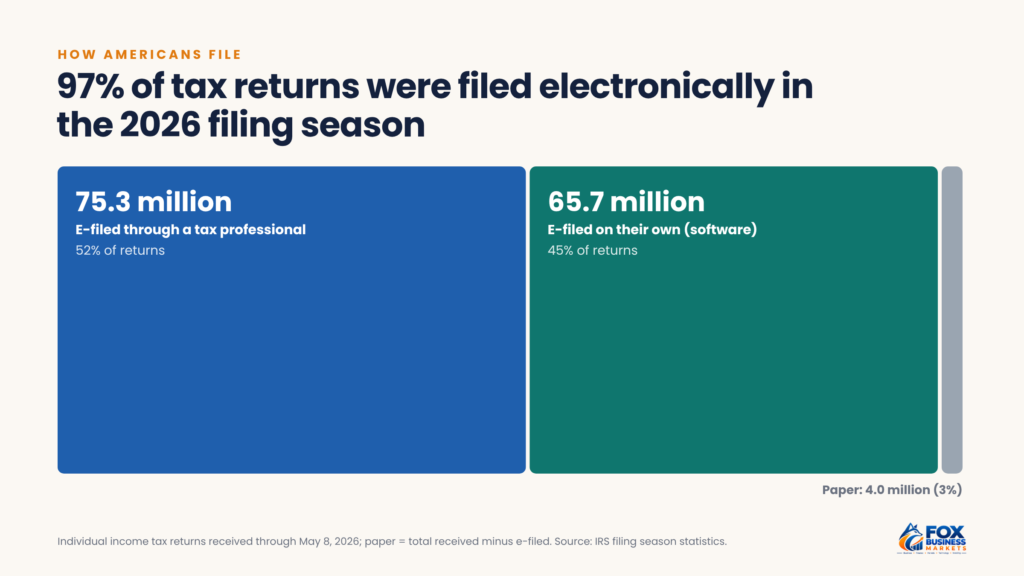
About 97% of the 145 million individual tax returns the IRS received through early May 2026 were filed electronically, according to IRS filing season statistics. Nearly half of those e-filers, 65.7 million, prepared their own returns.
Filing has changed in two big ways. The IRS ended its free Direct File program after the 2025 season, and it has been phasing out paper refund checks in favor of direct deposit. Some old habits, like mailing a paper return and waiting for a check, now mean slower refunds or extra steps.
This guide explains how to file taxes for your 2026 return, step by step: whether you need to file, what documents to gather, your free and paid options, key dates, and what to do if you owe or can’t file on time.
Do You Need to File a Tax Return?
You generally must file a federal return if your gross income is at least your standard deduction. For tax year 2026, that’s:
Filing status | Must file if gross income is at least |
| Single, under 65 | $16,100 |
| Head of household, under 65 | $24,150 |
| Married filing jointly, both under 65 | $32,200 |
| Married filing separately | $5 |
If you’re 65 or older, add $2,050 (single or head of household) or $1,650 per spouse who is 65 or older (married filing jointly). Dependents, such as teens with jobs, have their own rules: they generally must file if earned income is above $16,100 or unearned income, like interest, is above $1,350. You must also file in some cases regardless of income, including if you had $400 or more of net self-employment earnings, received advance payments of the premium tax credit for Marketplace health insurance, or owe special taxes such as tax on an early retirement account withdrawal.
File even if you don’t have to if your employer withheld income tax or you qualify for refundable credits, like the earned income tax credit or the refundable part of the child tax credit. Filing is the only way to get that money back.
How to File Taxes: What Documents Do You Need to File Taxes?
Gather these before you start:
Income documents
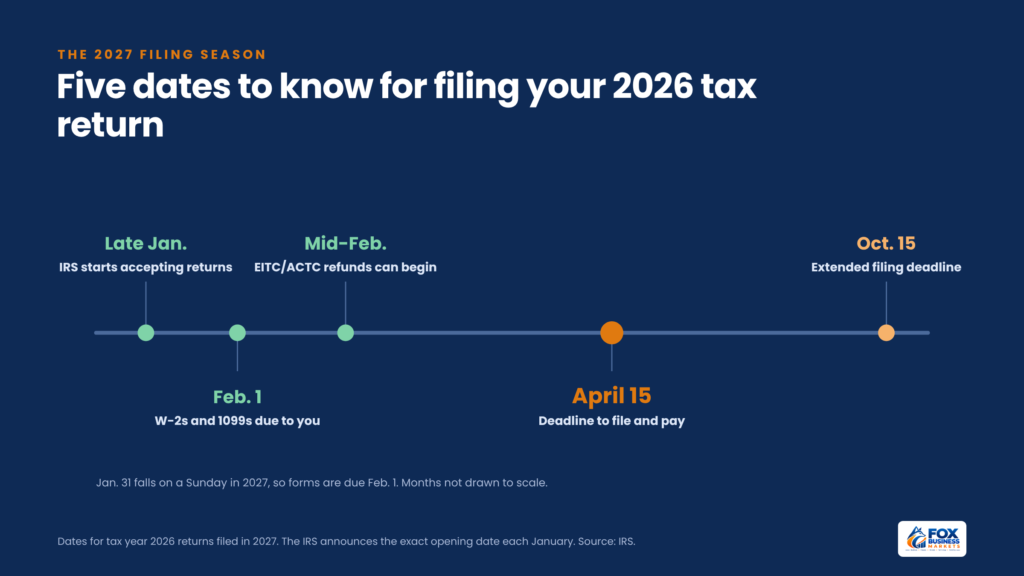
- Form W-2 from each employer, due to you by Jan. 31 (Feb. 1 in 2027)
- Form 1099-NEC or 1099-K for freelance, gig, or platform income
- Form 1099-INT and 1099-DIV for interest and dividends
- Form 1099-B for stock, fund, or crypto sales
- Form 1099-R for retirement account withdrawals and pensions
- Form SSA-1099 for Social Security benefits
- Form 1099-G for unemployment or state tax refunds
- Form 1095-A if you had Marketplace health insurance
Deduction and credit records
- Form 1098 for mortgage interest, and property tax bills
- Charitable donation receipts
- Form 1098-T for college tuition and Form 1098-E for student loan interest
- Child care costs, with the provider’s tax ID
- Records of IRA or HSA contributions
Personal information
- Social Security numbers for you, your spouse, and dependents
- Last year’s return, for reference and identity verification
- Bank routing and account numbers for direct deposit
- Your Identity Protection PIN, if the IRS issued you one
Your IRS online account shows many of the income forms the IRS has on file, which helps you check that nothing is missing.
How Do You File Taxes Step by Step?
- Confirm your filing status. Single, married filing jointly, married filing separately, head of household, or qualifying surviving spouse. Your status sets your brackets and your standard deduction.
- Report all your income. Enter every W-2 and 1099. The IRS gets copies of the same forms, so missing income is a frequent reason for IRS notices.
- Claim adjustments. These include deductible IRA and HSA contributions, student loan interest, and half of self-employment tax.
- Choose your deduction. Take the standard deduction or itemize, whichever is larger. Our guide to the standard deduction vs. itemized deductions walks through the comparison.
- Apply credits. Common ones include the child tax credit, the earned income tax credit, education credits, and the child and dependent care credit.
- Figure your tax and compare it with what you paid. Your withholding and estimated payments either cover your tax, leaving a refund, or fall short, leaving a balance due. Our guide to tax brackets shows how the tax itself is calculated.
- File your federal return, ideally electronically.
- File your state return, if your state has an income tax.
- Pay any balance or set up direct deposit for your refund.
- Save a copy of your return and supporting records.
Tax software walks you through these steps in order and does the math. If you file on paper, the Form 1040 instructions follow the same sequence.
What’s New When You File Your 2026 Return?
A few changes from the One Big Beautiful Bill Act show up on 2026 returns:
- New deductions on Schedule 1-A. Qualified tips, qualified overtime pay, interest on a loan for a new U.S.-assembled car, and the extra $6,000 deduction for people 65 and older are claimed on a separate schedule, whether or not you itemize. Your W-2 or other forms should show qualified tips and overtime separately.
- A bigger child tax credit: up to $2,200 per qualifying child.
- A charitable deduction for non-itemizers: up to $1,000 of cash gifts, or $2,000 for joint filers, starting with 2026 returns.
- A higher SALT cap of $40,400, which applies only if you itemize.
Tax software handles these automatically, but check that your forms show the amounts you expect, since mistakes on new lines are common in the first years.
What Are the Ways to File Your Taxes?
Option | Cost | Best for |
| IRS Free File (guided software from IRS partners) | Free federal return; some partners include state | People below an income limit, which was $89,000 of AGI in the 2026 season; the 2027 limit is usually announced in January |
| IRS Free File Fillable Forms | Free | People at any income who are comfortable filling out forms with little guidance |
| VITA and TCE volunteer sites | Free | Generally people earning about $69,000 or less (the 2026-season limit), people with disabilities, limited-English speakers, and people 60 and older (TCE) |
| MilTax | Free | Service members, many family members, and recent veterans |
| Commercial tax software | Free for simple returns; often $50 to $150 or more with state | People with a few forms who want guided help |
| Tax professional (CPA, enrolled agent, or preparer) | Often several hundred dollars or more | Business owners, rental property, complex investments, or major life changes |
Direct File is gone. The IRS’s own free filing tool, available in some states in 2024 and 2025, was discontinued and wasn’t offered in the 2026 season. The IRS Free File program and volunteer sites remain the main free options.
Filing on paper. If you mail your return, attach your W-2s, sign and date it (both spouses on a joint return), and send it to the address for your state listed in the Form 1040 instructions. Near the deadline, use certified mail so you have proof of the mailing date.
Choosing a preparer. Anyone paid to prepare returns must have an IRS Preparer Tax Identification Number (PTIN) and sign your return. Avoid preparers who base their fee on the size of your refund or ask you to sign a blank return. Credentials such as CPA, enrolled agent, or attorney mean the preparer can represent you before the IRS if questions come up.
When Can You File, and What Are the Key Deadlines?
For returns covering tax year 2026, filed in 2027:
Date | What happens |
| Feb. 1, 2027 (Jan. 31 falls on a Sunday) | Employers and payers must send W-2s and most 1099s |
| Late January 2027 | IRS starts accepting returns; it announces the exact date each year (Jan. 26 in 2026) |
| Mid-February 2027 | Earliest that refunds claiming the EITC or additional child tax credit can be released, under federal law |
| Jan. 15, 2027 (last 2026 payment); April 15, June 15, and Sept. 15, 2027 (2027 payments) | Quarterly estimated tax payments for self-employed people and others without enough withholding |
| April 15, 2027 | Deadline to file and pay 2026 taxes, and to make 2026 IRA and HSA contributions |
| Oct. 15, 2027 | Deadline to file if you requested an extension |
How Long Does It Take to Get a Refund?
The IRS says most refunds from e-filed returns with direct deposit arrive within 21 days. Paper returns take much longer to process, often four weeks or more just to show up in the system.
Direct deposit is now the default. Since Sept. 30, 2025, the IRS has been phasing out paper refund checks under an executive order. If you file without bank information, the IRS generally holds the refund and sends a notice asking how you want to receive it, which delays your money. If you can’t open an account, the IRS can still issue a paper check in limited cases (see the FAQ below). Give your bank details on the return, and consider sending the refund straight to a high-yield savings account.
Refunds with the EITC or additional child tax credit are held until mid-February by law; most arrive by early March for early filers using direct deposit.
Track your refund with the IRS “Where’s My Refund?” tool or the IRS2Go app, starting about 24 hours after you e-file.
Should You Wait to File If You Can’t Pay?
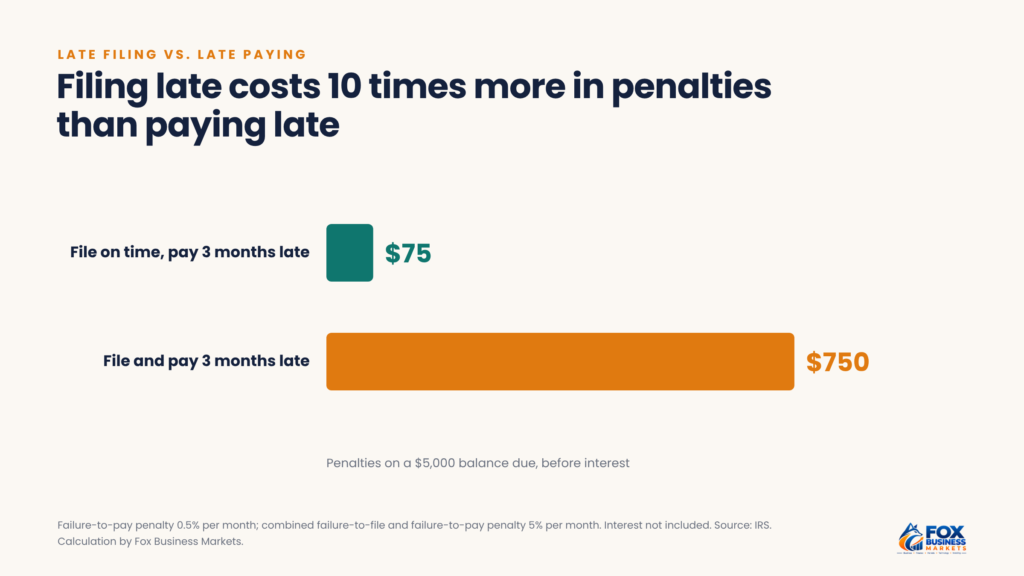
No. File on time anyway. The penalty for filing late is far larger than the penalty for paying late:
- Failure to file: 5% of the unpaid tax for each month or part of a month the return is late, up to 25%. If you file more than 60 days late, a minimum penalty applies: for returns due in 2027, it’s $535 or 100% of the tax owed, whichever is less.
- Failure to pay:5% of the unpaid tax per month, up to 25%.
- Interest is charged on unpaid tax and penalties until you pay.
If you owe $5,000 and pay three months late, filing on time keeps the penalty to about $75 plus interest. Filing and paying three months late costs about $750 plus interest.
Payment options:
- Pay in full online from your bank account through IRS Direct Pay, your IRS online account, or by debit or credit card (card processors charge a fee).
- Short-term payment plan: up to 180 days to pay.
- Long-term installment agreement: monthly payments, which many people can set up online if they owe up to $50,000 in combined tax, penalties, and interest.
If you regularly owe at tax time, see the W-4 tip in the next-steps list below.
How Do You Get a Tax Extension?
Filing Form 4868 by April 15 gives you an automatic six-month extension, to Oct. 15, 2027. You can request it through tax software, by paying part of your estimated tax and marking the payment as an extension payment, or by mailing the form.
An extension gives you more time to file, not more time to pay. Estimate what you owe and pay it by April 15, or you’ll owe the late-payment penalty and interest on the unpaid amount. If you live in an area hit by a federally declared disaster, the IRS often extends deadlines automatically.
How Do You File Taxes If You’re Self-Employed?
Freelancers, gig workers, and small-business owners file the same Form 1040, with a few extra pieces:
- Schedule C reports your business income and expenses. Your profit, not your gross receipts, is what’s taxed.
- Schedule SE figures self-employment tax of 15.3% on most net earnings, covering Social Security and Medicare. You deduct half of it as an adjustment.
- Report all income, even when no form arrives. Clients send Form 1099-NEC only for payments above a threshold, and payment apps and marketplaces send Form 1099-K generally only above $20,000 and 200 transactions.
- Pay estimated taxes quarterly on the dates in the table above, since no employer withholds for you.
- Keep records of mileage, equipment, software, and home office costs to support your deductions.
If your business is growing, a tax professional can often save you more than the fee, especially in the first year.
What Are the Most Common Tax Filing Mistakes?
These errors cause most e-file rejections and many IRS notices:
- Missing income. A forgotten 1099 from a side gig, a bank account, or a brokerage sale. The IRS matches every form it receives against your return.
- Wrong Social Security numbers or names. Names must match Social Security records exactly, including after a marriage or name change.
- Wrong filing status. Head of household has specific rules about who qualifies, and claiming it incorrectly is a common error.
- Dependent conflicts. Divorced or separated parents both claiming the same child triggers a rejection or a later notice.
- Math and transcription errors on paper returns, which software largely prevents.
- Wrong bank details, which can send your refund to the wrong place or delay it.
- Forgetting to sign a paper return, or to include both spouses’ signatures on a joint return.
With e-filing, many errors are caught automatically, and the IRS rejects the return so you can fix it instead of processing it with errors.
Does Filing Early Help You?
Usually, yes, though not always. Filing early gets your refund to you sooner, and it reduces the risk that a criminal files a fake return in your name to steal a refund. If that happens, the IRS will reject your real return as a duplicate, and sorting it out can take months.
But don’t file before you have every form. Some 1099s, especially corrected brokerage forms, arrive in February or even March. Filing without them often means filing an amended return later. A reasonable approach is to file once you have all your forms and have checked them against your IRS online account.
An Identity Protection PIN adds another layer of security. Anyone who can verify their identity can request one through their IRS online account, and the IRS issues a new PIN each year.
What Should You Do After You File?
- Check that your return was accepted. E-file software confirms acceptance, usually within a day or two.
- Keep your records. Store your return and supporting documents for at least three years, and longer for records tied to property or investments.
- Fix mistakes with Form 1040-X if you find an error or receive a corrected form. Generally you have three years from the date you filed, or two years from when you paid the tax, whichever is later, to claim a refund.
- Update your W-4 if your refund or balance due was bigger than you wanted. Our guide on how taxes work explains how withholding fits in.
Frequently Asked Questions
What if my W-2 or 1099 is missing or wrong?
Ask the employer or payer for a corrected form first. If it still hasn’t arrived by the end of February, call the IRS at 800-829-1040 and it will contact the employer for you. If the form never comes, you can file using Form 4852, a substitute W-2, built from your final pay stub. Keep that pay stub until your return is accepted.
Can I file my taxes if I haven’t filed in years?
Yes. You can file returns for past years, and if you’re owed a refund, you generally have three years from the original due date to claim it. You may owe penalties and interest on any balance. Start with the most recent year, and request a wage and income transcript from your IRS online account to find old W-2s and 1099s.
How do I get my refund if I don’t have a bank account?
Many prepaid debit cards and mobile banking apps provide a routing and account number that can receive direct deposits. If you can’t use any account, respond to the IRS notice asking how you want to be paid; the IRS can still issue a paper check in limited cases, but expect a delay. Confirm with the card provider that it accepts IRS refunds before you file.
Should I contribute to an IRA before I file?
You can make a 2026 IRA contribution until April 15, 2027, and a deductible traditional IRA contribution can lower your 2026 tax. Our comparison of a Roth IRA vs. traditional IRA explains which may fit. Tell your IRA provider which tax year the contribution is for when you make it.
Get Your Documents Together Before January
Start a folder now for the forms that will arrive in January, and note which ones you expect based on this year’s jobs, accounts, and life changes. Check whether you qualify for Free File or a volunteer site, and update your direct deposit details. If you expect a brokerage 1099-B or a K-1, set a reminder to check for corrected forms in late February before you file.
This article is for general information only and isn’t financial, tax, legal, or investment advice. Consider your own situation or talk to a qualified professional before making decisions.