
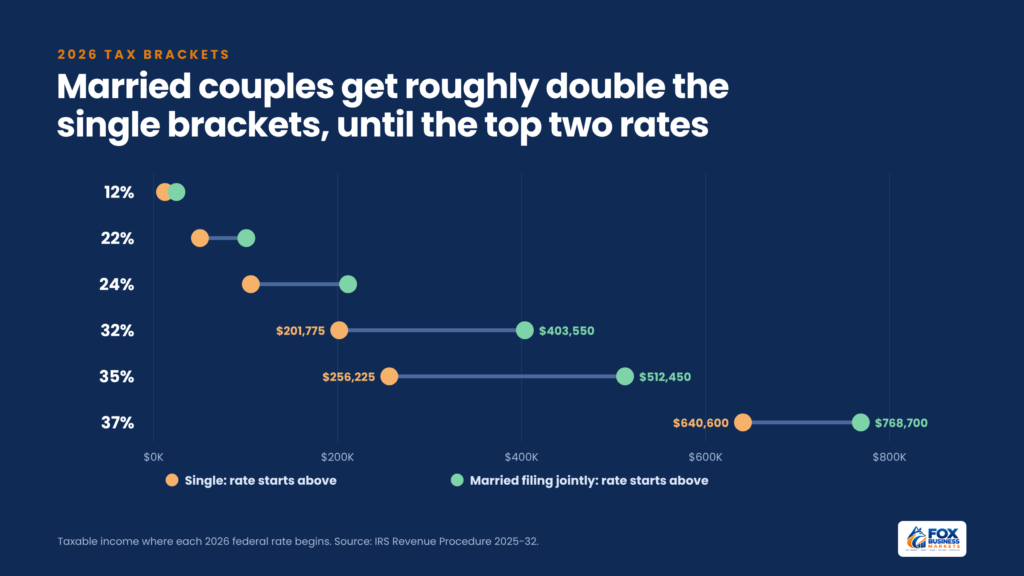
Quick answer: Federal income tax rates for 2026 range from 10% to 37%, and each rate applies only to the income inside its bracket. A single filer, for example, pays 37% only on taxable income above $640,600. Your bracket depends on your filing status and taxable income, not your salary. Official 2027 brackets aren’t out yet.
The top federal income tax rate is 37%, yet taxpayers paid an average federal income tax rate of just 14.1% in 2023, according to a Tax Foundation analysis of IRS data. Even the top 1% paid an average of 26.3%.
The gap comes from how tax brackets work, plus deductions, credits, and lower rates on investment gains. Many people believe that landing in a higher bracket means all of their income gets taxed at that rate. It doesn’t, and the standard deduction shields thousands of dollars before any rate applies.
This guide lists the official 2026 tax brackets for every filing status, what we know so far about 2027, how to find your marginal and effective rates, and legal ways to lower the rate on your next dollar of income.
What Are the 2026 Federal Tax Brackets?
These brackets apply to income you earn in 2026 and report on the return you file in early 2027. The IRS set them in Revenue Procedure 2025-32.
Single filers
Rate | Taxable income |
| 10% | $0 to $12,400 |
| 12% | $12,401 to $50,400 |
| 22% | $50,401 to $105,700 |
| 24% | $105,701 to $201,775 |
| 32% | $201,776 to $256,225 |
| 35% | $256,226 to $640,600 |
| 37% | Over $640,600 |
Married filing jointly
Rate | Taxable income |
| 10% | $0 to $24,800 |
| 12% | $24,801 to $100,800 |
| 22% | $100,801 to $211,400 |
| 24% | $211,401 to $403,550 |
| 32% | $403,551 to $512,450 |
| 35% | $512,451 to $768,700 |
| 37% | Over $768,700 |
Head of household
Rate | Taxable income |
| 10% | $0 to $17,700 |
| 12% | $17,701 to $67,450 |
| 22% | $67,451 to $105,700 |
| 24% | $105,701 to $201,750 |
| 32% | $201,751 to $256,200 |
| 35% | $256,201 to $640,600 |
| 37% | Over $640,600 |
Qualifying surviving spouses use the married-filing-jointly brackets for up to two years after the year a spouse dies, if they have a dependent child.
Married filing separately
Rate | Taxable income |
| 10% | $0 to $12,400 |
| 12% | $12,401 to $50,400 |
| 22% | $50,401 to $105,700 |
| 24% | $105,701 to $201,775 |
| 32% | $201,776 to $256,225 |
| 35% | $256,226 to $384,350 |
| 37% | Over $384,350 |
The brackets apply to taxable income, which is your income after adjustments and deductions, not your salary.
What Will the 2027 Tax Brackets Be?
The IRS hasn’t announced the official 2027 brackets yet. It usually publishes the next year’s inflation adjustments in October or November, and we’ll update this guide when it does.
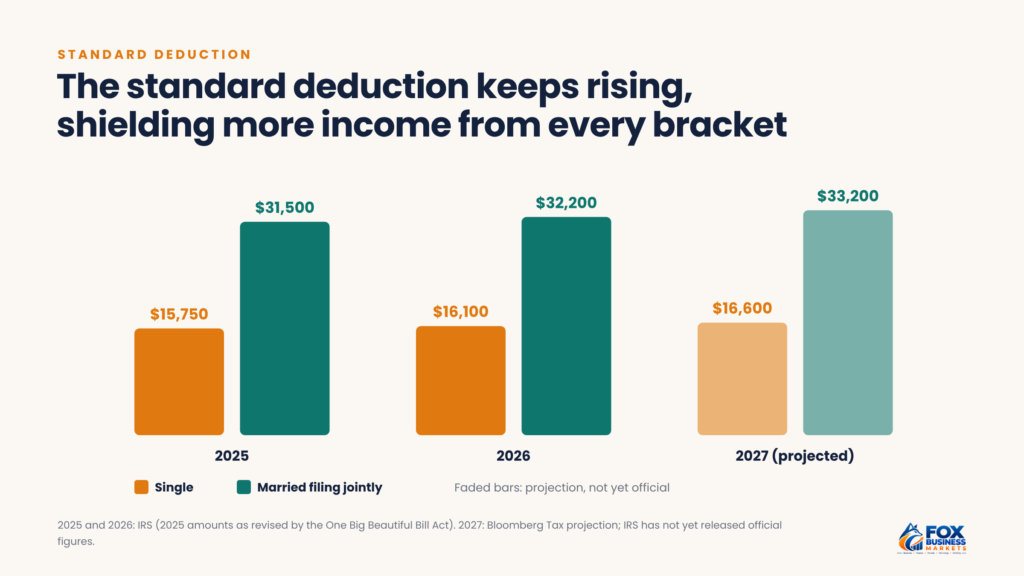
Projections give a reasonable preview. Bloomberg Tax projects these 2027 figures, as reported by CBS News:
Item | Single | Married filing jointly |
| Standard deduction | $16,600 | $33,200 |
| Top of the 10% bracket | $12,800 | $25,600 |
| Start of the 37% bracket | $661,375 | $793,650 |
The rates themselves won’t change. Only the income thresholds move, so the same income would owe slightly less tax in 2027. Treat these as estimates until the IRS confirms them.
How Do Tax Brackets Work?
The U.S. uses a progressive, or marginal, system. Your income fills the brackets from the bottom up, and each slice is taxed at its own rate.
Example: a married couple with $150,000 in wages in 2026. They take the $32,200 standard deduction, leaving $117,800 of taxable income.
- The first $24,800 is taxed at 10%: $2,480.
- The next $76,000, up to $100,800, is taxed at 12%: $9,120.
- The last $17,000 is taxed at 22%: $3,740.
Their federal income tax is $15,340 before any credits. They’re “in the 22% bracket,” but only $17,000 of their income is taxed at 22%. Their tax is about 10.2% of their $150,000 in wages.
If this couple has two children who qualify for the $2,200 child tax credit, their tax drops by another $4,400, to $10,940.
Our guide on how taxes work explains how brackets fit with payroll taxes, withholding, and refunds.
How Do You Find Your Tax Bracket?
You can work out your bracket in a few minutes:
- Estimate your total income for the year: wages, side income, interest, and other taxable income.
- Subtract pre-tax payroll contributions and adjustments, such as traditional 401(k) contributions (already left out of your W-2 wages), deductible IRA or HSA contributions, and half of any self-employment tax.
- Subtract your deduction, either the standard deduction for your filing status or your itemized total.
- Find the result in the table for your filing status. The row it lands in is your marginal bracket.
- Run the math bracket by bracket if you want your actual tax, then subtract any credits.
For last year’s figures, your Form 1040 shows taxable income on line 15. Tax software and the IRS Tax Withholding Estimator do the same math for the current year.
What’s the Difference Between Your Marginal and Effective Tax Rate?
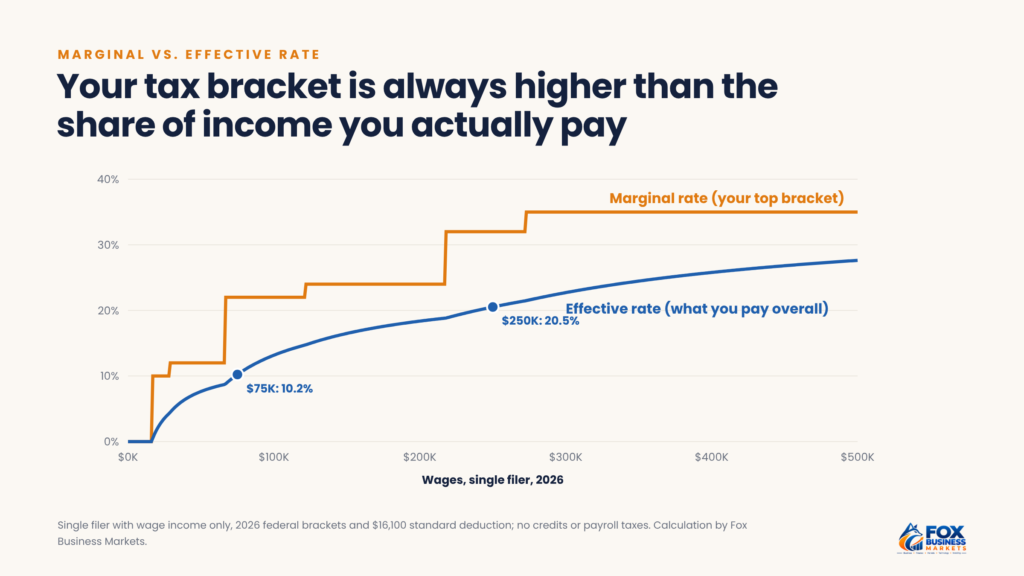
Your marginal rate is the rate on your next dollar of taxable income, which is your top bracket. Your effective rate is your total tax divided by your income, which is what you actually pay on average.
For a single filer with only wage income who takes the 2026 standard deduction, the two rates look like this:
Wages | Taxable income | Federal income tax | Marginal rate | Effective rate |
| $25,000 | $8,900 | $890 | 10% | 3.6% |
| $50,000 | $33,900 | $3,820 | 12% | 7.6% |
| $75,000 | $58,900 | $7,670 | 22% | 10.2% |
| $100,000 | $83,900 | $13,170 | 22% | 13.2% |
| $150,000 | $133,900 | $24,734 | 24% | 16.5% |
| $250,000 | $233,900 | $51,304 | 32% | 20.5% |
| $500,000 | $483,900 | $138,134 | 35% | 27.6% |
Calculations by Fox Business Markets using 2026 brackets; no credits, other deductions, or payroll taxes.
Use your marginal rate when you’re deciding whether a deduction or a pre-tax contribution is worth it, since that’s the rate it saves. Use your effective rate to compare your overall tax burden from year to year.
How Did Tax Brackets Change From 2025 to 2026?
The rates stayed the same, but every threshold rose, so the same income faces slightly less tax. The 10% and 12% brackets grew faster than the rest because the One Big Beautiful Bill Act gave them an extra inflation adjustment. For single filers:
2025 | 2026 | |
| Standard deduction | $15,750 | $16,100 |
| Top of 10% bracket | $11,925 | $12,400 |
| Top of 12% bracket | $48,475 | $50,400 |
| Top of 22% bracket | $103,350 | $105,700 |
| Start of 37% bracket | $626,350 | $640,600 |
For married couples filing jointly, the standard deduction rose from $31,500 to $32,200, and the 37% rate now starts at $768,700, up from $751,600.
Because brackets are indexed to inflation, a raise that only keeps pace with prices should push little, if any, of your income into a higher bracket. A raise that beats inflation can.
What Is Bracket Creep, and Does It Still Happen?
Bracket creep happens when inflation raises your pay but the tax brackets stay put. You’d move into higher brackets and pay a larger share of your income in tax, even though your buying power hadn’t grown.
Federal brackets have been indexed to inflation since 1985, so the thresholds rise each year. Since 2018, the IRS has used the chained consumer price index, which tends to rise a bit more slowly than the standard CPI, so brackets grow slightly more slowly than prices over time.
Some state income tax brackets aren’t indexed to inflation, so bracket creep can still raise state taxes in those places.
How Have Top Federal Tax Rates Changed Over Time?
Today’s 37% top rate is low by historical standards. The top federal income tax rate topped 90% in from 1944 through 1963, though few people paid it, and it was 70% from 1965 through 1981. The Tax Reform Act of 1986 cut it to 28%. It rose to 39.6% in the 1990s and again from 2013 through 2017, and the 2017 Tax Cuts and Jobs Act lowered it to 37% starting in 2018.
The 2017 law’s rates were set to expire after 2025. The One Big Beautiful Bill Act, signed in July 2025, made the current seven brackets permanent, so they don’t have a built-in end date. Congress can still change them in future legislation.
Which Income Is Taxed Using These Brackets?
The brackets apply to ordinary income, which includes:
- Wages, salaries, bonuses, and tips
- Self-employment and freelance profit
- Interest from savings accounts, CDs, and most bonds
- Short-term capital gains on investments held a year or less
- Traditional 401(k) and IRA withdrawals, and pensions
- Unemployment benefits and the taxable part of Social Security
Long-term capital gains and qualified dividends use separate, lower rates based on your total taxable income:
2026 rate | Single | Married filing jointly |
| 0% | Up to $49,450 | Up to $98,900 |
| 15% | $49,451 to $545,500 | $98,901 to $613,700 |
| 20% | Over $545,500 | Over $613,700 |
Higher earners may also owe the 3.8% net investment income tax on investment income above $200,000 of modified AGI for single filers or $250,000 for joint filers. Lower rates on long-term gains are one reason holding investments longer than a year can lower your tax; our guide on how to start investing covers the basics.
Interest is a common surprise. If you earn $1,000 in a high-yield savings account and you’re in the 22% bracket, about $220 goes to federal income tax.
How Do Deductions Affect Your Tax Bracket?
Deductions lower your taxable income, which can move part of your income into a lower bracket. The 2026 standard deduction is:
- Single or married filing separately: $16,100
- Married filing jointly: $32,200
- Head of household: $24,150
Older and blind filers get a larger standard deduction, people 65 and older can claim an extra deduction from 2025 through 2028, and anyone can itemize if their deductions add up to more. Our Roth IRA vs. traditional IRA comparison shows another way to cut taxable income: deductible retirement contributions.
Credits work differently. They don’t change your bracket, but they cut your tax bill dollar for dollar, which is why a $1,000 credit is worth more than a $1,000 deduction for nearly everyone.
How Can You Lower Your Tax Bracket?
You can’t change the brackets, but you can change how much of your income lands in them. The most common ways:
- Contribute to a traditional 401(k). You can put in up to $24,500 in 2026, plus an $8,000 catch-up if you’re 50 or older ($11,250 at ages 60 to 63). Starting in 2026, workers who earned more than $150,000 in FICA wages the year before must make catch-ups as Roth contributions, which don’t lower taxable income. In the 22% bracket, each $1,000 of traditional contributions cuts your federal income tax by about $220.
- Contribute to a traditional IRA. The 2026 limit is $7,500. The deduction depends on your income and whether you have a workplace plan, and a Roth IRA may be the better choice if you expect a higher bracket later.
- Use a health savings account. If you have an HSA-eligible health plan, you can contribute up to $4,400 for self-only coverage or $8,750 for family coverage in 2026, and the money comes off your taxable income.
- Claim new deductions you qualify for. From 2025 through 2028, eligible workers can deduct qualified tips (up to $25,000) and overtime premium pay (up to $12,500, or $25,000 for joint filers), with phaseouts at higher incomes.
- Time income and deductions. If you’re near the top of a bracket, pushing a bonus into January or bunching charitable gifts into one year may keep more income in the lower bracket.
- Fill a low bracket with Roth conversions. In a low-income year, converting just enough from a traditional IRA to a Roth to reach the top of your current bracket locks in today’s rate on that money.
Will a Raise Push You Into a Higher Bracket and Cut Your Take-Home Pay?
No, not through the brackets themselves. Moving into a higher bracket only raises the tax on the dollars above the threshold. If a $5,000 raise takes a single filer from $48,000 to $53,000 of taxable income, $2,400 of the raise is taxed at 12% and $2,600 at 22%. The tax on the original $48,000 doesn’t change.
There are real cases where extra income costs more than the bracket rate suggests, but they come from phaseouts, not brackets. Credits like the earned income tax credit shrink as income rises, and some benefits, such as Marketplace health insurance subsidies, depend on income too. In those ranges, part of a raise can be offset by a smaller credit or subsidy. That happens most often near Marketplace health subsidy limits or Medicare premium surcharge (IRMAA) thresholds, so check those before taking extra income late in the year.
What’s Your Real Marginal Tax Rate?
Your federal bracket isn’t the whole cost of earning one more dollar of wages. Add:
- Payroll taxes:65% for Social Security and Medicare on wages up to $184,500 in 2026, then 1.45% above that (plus 0.9% more above $200,000 for single filers).
- State income tax: from 0% in states without a wage tax to more than 10% at the top in a few states.
A worker in the 22% federal bracket who pays 7.65% in payroll taxes and 5% in state tax keeps about 65 cents of each extra dollar earned, a combined rate of roughly 35%. That’s the number to use when weighing overtime, a side job, or a pre-tax 401(k) contribution, which saves federal and state income tax but not payroll tax.
Do States Use the Same Tax Brackets?
No. Each state sets its own income tax rules. Some use several brackets, some charge one flat rate on all taxable income, and nine states don’t tax wages at all: Alaska, Florida, Nevada, New Hampshire, South Dakota, Tennessee, Texas, Washington, and Wyoming.
State brackets and deductions often differ from federal ones, so your state taxable income may not match your federal number. Check your state revenue department’s website for its current rates.
Frequently Asked Questions
What tax bracket am I in if I’m self-employed?
The same brackets apply, based on your net profit after business expenses and deductions. On top of income tax, you’ll owe self-employment tax of 15.3% on most net earnings, though half of it is deductible. Set aside roughly 25% to 30% of each payment for taxes and pay quarterly to avoid penalties.
How are bonuses taxed?
A bonus is taxed as ordinary income at your regular brackets. But employers often withhold a flat 22% federal rate on bonuses (37% on bonuses over $1 million), which can be more or less than your actual rate. The difference evens out when you file, so check your withholding if you expect a large bonus.
Is there a marriage penalty in the tax brackets?
For most couples, no. The joint brackets are exactly double the single brackets up through the 32% rate, so two similar earners pay about the same married or single. The penalty shows up at the top: joint filers hit 37% at $768,700, well below twice the single threshold of $640,600. If you’re both high earners planning a wedding near year-end, run your taxes both ways before choosing a date.
Are Social Security benefits taxed using these brackets?
Up to 85% of your benefits can count as taxable income, depending on your other income, and that portion is taxed at your ordinary bracket rates. Many retirees with little other income owe no federal tax on their benefits. Ask Social Security to withhold tax from your benefits if you expect to owe.
Find Your Bracket Before You Make Your Next Money Move
Take your expected 2026 income, subtract the standard deduction for your filing status, and match the result to the table above. That tells you your marginal rate, the rate any extra income or deduction will hit. Then set your 401(k) contributions before your last paycheck of the year; you have until April 15, 2027, to make 2026 IRA and HSA contributions. If you expect to owe more than your withholding covers, build the difference into your budget now.
This article is for general information only and isn’t financial, tax, legal, or investment advice. Consider your own situation or talk to a qualified professional before making decisions.