Business Loan Calculator: Estimate Monthly Payments & Total Costs
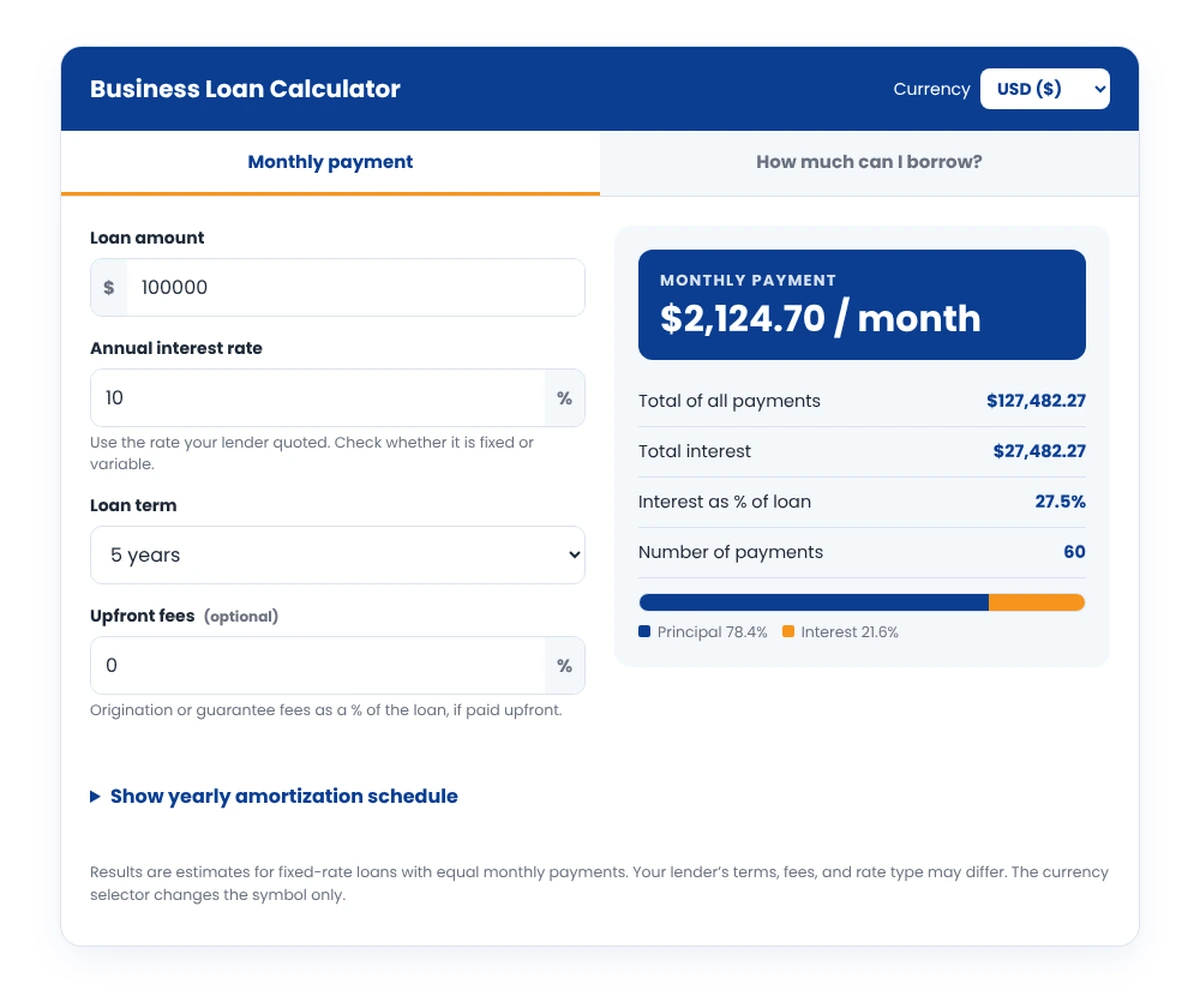
This business loan calculator estimates your exact periodic repayment, total interest, origination fees, and true annual borrowing costs across standard commercial term loans and SBA 7(a) financing. It breaks down principal versus interest balances so you can evaluate debt service capacity before submitting lender applications.
Who it's for: Small business owners, entrepreneurs, and financial officers comparing debt options, working capital lines, or equipment financing.
Why use it:
- Avoid Cash Crunch Surprises: Forecast your exact monthly or bi-weekly cash outflow to ensure your operating cash flow comfortably covers debt service coverage ratio (DSCR) benchmarks.
- Uncover True Borrowing Costs: Factor in upfront origination fees to calculate real effective APR rather than relying solely on the advertised nominal interest rate.
- Compare Loan Structures Instantly: Switch between standard commercial bank loans and SBA 7(a) working capital terms to see how extended maturities cut monthly commitments.
| Year | Beginning Balance | Principal Paid | Interest Paid | Total Payments | Ending Balance |
|---|
How to Use the Business Loan Calculator
- Select Your Financing Structure: Toggle between the Standard Commercial Term Loan tab (traditional bank and online equipment lenders) and the SBA 7(a) Small Business Loan tab (government-guaranteed loans with statutory fee caps and longer maturities).
- Enter Your Principal Borrowing Need: Input the gross loan amount required for working capital, commercial lease build-out, inventory, or machinery. If you are calculating initial capital requirements, review our Startup Cost Calculator to prevent under-borrowing.
- Input the Nominal Interest Rate: Enter the lender's stated annual percentage rate (APR). For bank loans, this is usually fixed or SOFR-pegged; for SBA 7(a), it typically floats at Wall Street Journal Prime plus a lender spread (often 2.25% to 2.75%).
- Define the Loan Term and Repayment Frequency: Specify the duration in years and months. Commercial bank loans typically range from 3 to 7 years, while SBA working capital loans extend to 10 years (or 25 years for commercial real estate). Select whether billing occurs monthly, bi-weekly, or weekly.
- Factor in Upfront Closing Fees: Enter origination, underwriting, packaging, or SBA guaranty fee percentages. The calculator automatically calculates your net cash proceeds and true Effective APR.
- Inspect the Amortization Schedule: Expand the annual schedule to see exactly how much cash goes toward reducing loan principal versus servicing non-recoverable interest each year.
How It Works & Key Financial Formulas
The calculator uses standard financial amortization mechanics to compute equal periodic payments where each billing installment pays accrued interest on the remaining balance first, with the remainder retiring principal debt.
Where P represents initial loan principal, r represents the periodic interest rate (nominal annual rate divided by payment frequency, e.g., 12 for monthly), and n represents total scheduled repayment periods over the entire term.
To verify if your business can safely afford the calculated payment, commercial underwriters measure your Debt Service Coverage Ratio (DSCR). A benchmark DSCR of 1.25x or higher is standard across regulated lenders—meaning your business generates at least $1.25 of net operating income for every $1.00 of debt service.
Worked Example: Comparing a Bank Term Loan vs. SBA 7(a)
Consider an expanding machine fabrication company taking out a $150,000 expansion facility to purchase digital CNC cutters and hire two technicians:
- Option A (Traditional Commercial Bank Loan): $150,000 principal at 9.50% interest over a standard 5-year term with a 2.0% origination fee ($3,000). The monthly debt commitment equals $3,151 per month, yielding $39,088 in total interest and an effective APR of 10.42%.
- Option B (SBA 7(a) Working Capital Loan): $150,000 principal at 10.75% interest (Prime rate spread) extended over a maximum 10-year maturity with a 2.75% SBA guaranty and packaging fee ($4,125). Even with a higher interest rate, the longer term cuts the required cash outflow to $2,044 per month.
The Strategic Decision: While Option B incurs higher cumulative lifetime interest due to the 10-year term ($95,280 vs. $39,088), it lowers the monthly cash burden by $1,107 every single month. For young companies managing cash volatility, lower monthly debt service significantly reduces default risk during seasonal sales slowdowns.
Standard Commercial Loan vs. SBA 7(a) Loan: Direct Comparison
Choosing the correct borrowing channel determines your interest burden, collateral pledges, and qualification timeline. Our comprehensive breakdown in our Guide to Small Business Loans explores each financing program in full detail.
| Loan Metric | Standard Commercial Bank Loan | SBA 7(a) Small Business Loan |
|---|---|---|
| Typical Maturity | 3 to 7 Years (Equipment up to 10 yrs) | 10 Years (Working Capital); 25 Years (Real Estate) |
| Interest Rate Structure | Fixed or Variable (Bank prime / SOFR) | Primarily Variable (WSJ Prime + 2.25% to 2.75% spread) |
| Upfront Closing Fees | 1.0% to 3.0% Origination Fee | Statutory SBA Guarantee Fee (0.25% to 3.75% tiered) |
| Approval Timeline | 2 to 4 Weeks (Fintech online: 48 hours) | 30 to 75 Days (SBA Preferred Lenders faster) |
| Personal Guarantee Required? | Yes (All 20%+ equity owners) | Yes (Mandatory by federal statute for 20%+ owners) |
| Prepayment Penalty | Often modest or sliding-scale 3-2-1% | None on terms <15 years (3-year taper on 15+ yr real estate) |
Where to Find Your Numbers
Before entering numbers into the calculator or submitting an application, collect verified figures from your official books and financial statements:
- For Principal & Capital Budgeting: Consult your formal equipment invoices or your written financial roadmap. If you are drafting formal projections for prospective lenders, see our step-by-step framework on How to Write a Business Plan.
- For Operating Affordability (DSCR): Pull your trailing twelve-month (TTM) Profit and Loss Statement (P&L). Take Net Operating Income (EBITDA) and divide by the calculator's projected annual payment to confirm your coverage stays above 1.25x.
- For Variable Costs & Margins: Run your current revenue numbers through our Break-Even Calculator to confirm how many customer transactions or unit sales you need simply to cover your new monthly loan payment.
What This Calculator Can and Cannot Tell You
What it tells you:
- Your exact periodic repayment schedule across monthly, bi-weekly, or weekly cadences.
- How much total cash will leave your business in non-tax-deductible principal repayment versus tax-deductible interest expense.
- Your true effective APR when upfront origination points, broker packaging, or guarantee fees are deducted from gross funding.
What it cannot tell you:
- Underwriting Approval Likelihood: The calculator assumes your loan is approved. Actual approval depends on personal credit scores (FICO SBSS ≥ 160 for SBA), business vintages (usually 2+ years required by banks), and existing debt obligations.
- Floating Interest Rate Adjustments: If your loan carries a variable rate pegged to the Prime rate, monthly payments will increase when central bank benchmark rates rise.
- Collateral Pledges & UCC Liens: It does not reflect blanket liens filed against business assets or second mortgages required on personal residences for large SBA loans.
Related Guides and Calculators
Optimize your capital strategy and debt service modeling with our full suite of founder tools and expert research:
Frequently Asked Questions
The Bottom Line
Debt financing is one of the most powerful levers for scaling small business revenue, but only if monthly debt service aligns with reliable cash flow. Always stress-test your business against seasonal downturns before signing promissory notes. Use this calculator alongside our Break-Even Calculator and review the complete underwriting benchmarks in our Small Business Loans Guide to ensure your borrowing builds lasting equity rather than liquidity strain.
- U.S. Small Business Administration (SBA): SOP 50 10 7.1 — Lender and Development Company Loan Programs
- Federal Reserve Board & Federal Reserve Bank of New York: Small Business Credit Survey Report on Employer Firms
- Electronic Code of Federal Regulations: 13 CFR Part 120 — Business Loans Guidelines and Maximum Interest Rate Caps
- Federal Deposit Insurance Corporation (FDIC): Risk Management Manual of Examination Policies (Commercial Lending)
Disclaimer: This calculator is provided for general planning and educational purposes only. Actual interest rates, closing points, closing documentation, and amortization schedules are subject to formal lender credit underwriting, asset appraisals, and statutory SBA approval.