Pre-Money & Post-Money Valuation Calculator
This free pre-money and post-money valuation calculator allows founders and investors to calculate company valuations bidirectionally. Whether you have an agreed pre-money valuation and need your post-financing capitalization, or you know your target equity sale and need to determine your implied pre-money valuation, this tool calculates exact ownership stakes, share values, and founder dilution instantly.
Who it's for: Startup founders, angel investors, venture capitalists, and legal advisers structuring seed rounds, priced equity financing, or convertible SAFE notes.
Why use it:
- Bidirectional Valuation Modeling: Calculate forward from pre-money valuation to post-money equity, or reverse-calculate pre-money valuation from target investor equity percentages.
- Unmask Option Pool Dilution: Factor in unallocated employee stock option pools (ESOP) to see the true effective pre-money valuation received by founders.
- Negotiate Term Sheets Confidently: Understand exactly how much company equity you surrender before signing investor commitments.
How to Use the Pre-Money & Post-Money Valuation Calculator
- Choose Your Direction:
- Use Calculate Post-Money (Given Pre-Money) when you and your prospective investors have agreed on a company valuation before investment.
- Use Calculate Pre-Money (Given Equity %) when an investor offers a specific dollar amount for a fixed percentage of your company (e.g., $1M for 20%).
- Enter the Capital Raised: Input the gross cash amount being invested in the funding round. If you need to verify how much cash you actually need, model your monthly cash drain with our Burn Rate Calculator before settling on round sizing.
- Input Valuation or Equity Target: Enter either the pre-money valuation or the target equity stake being offered to incoming investors.
- Set the Option Pool (ESOP): Enter the percentage of unallocated options required under the term sheet for future executive and engineering hires (typically 10% to 15%).
- Analyze Capitalization Results: Instantly review post-money valuation, investor percentage ownership, retained founder ownership, and cumulative dilution.
How It Works & Fundamental Valuation Formulas
The relationship between pre-money valuation, post-money valuation, and equity percentages is governed by standard venture capitalization mechanics:
Pre-money valuation represents what your company is worth immediately before new money arrives. Post-money valuation represents the enterprise value immediately after investment capital is deposited into the corporate bank account. All ownership percentages are calculated as a fraction of the post-money valuation.
Worked Example: Forward vs. Reverse Valuation Round
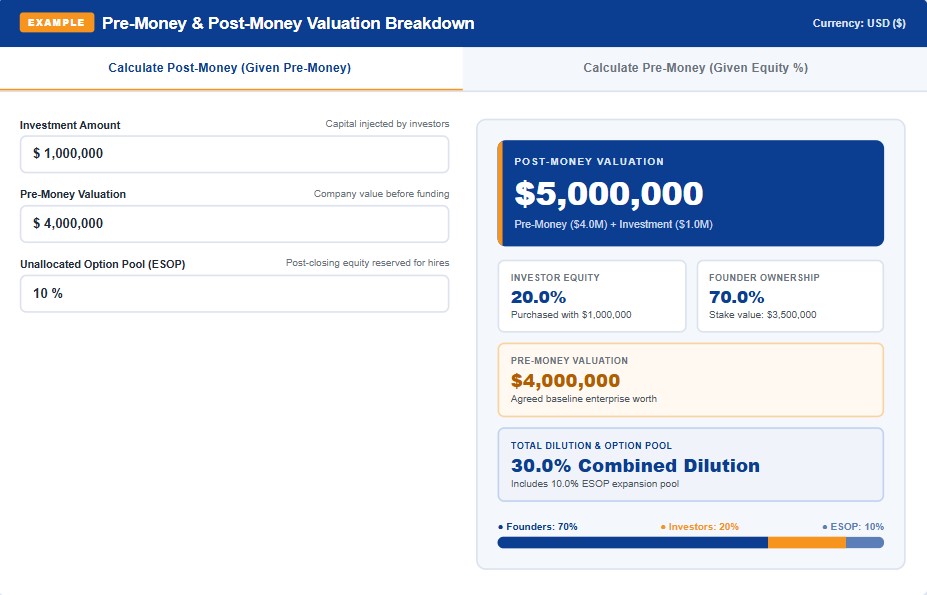
A seed-stage founder plans to raise $1,000,000 to expand their developer team with a mandated 10% ESOP pool:
- Forward Calculation (Agreed Pre-Money of $4,000,000):
Post-Money = $4,000,000 + $1,000,000 = $5,000,000.
Investor Ownership = $1,000,000 ÷ $5,000,000 = 20.0%.
Founders retain 70.0%, and the option pool holds 10.0%. - Reverse Calculation (Investor Demands 25.0% for $1,000,000):
Implied Post-Money = $1,000,000 ÷ 0.25 = $4,000,000.
Implied Pre-Money = $4,000,000 − $1,000,000 = $3,000,000.
Founders retain 65.0% (100% − 25% investor − 10% ESOP).
Strategic Lesson: Selling 25% instead of 20% drops your pre-money valuation by a massive $1,000,000 (from $4M to $3M). Using this calculator prevents founders from inadvertently conceding millions in baseline equity value.
Pre-Money vs. Post-Money Comparison Breakdown
| Financing Metric | Pre-Money Valuation Perspective | Post-Money Valuation Perspective |
|---|---|---|
| Timing | Prior to new investor capital arriving | Immediately after investor capital is deposited |
| Formula | Post-Money Valuation − Investment Amount | Pre-Money Valuation + Investment Amount |
| Equity Calculation | Used to benchmark historical value created | Denominator used for all share percentages |
| Option Pool Impact | Option pool expansion dilutes existing founders | Option pool creates fixed post-round percentages |
| SAFE Standards | Legacy YC Pre-Money SAFEs (dilution stacks) | Modern YC Post-Money SAFEs (fixed dilution caps) |
Where to Find Your Numbers
Before negotiating with angel syndicates or venture capital funds, gather verified financial numbers:
- For Burn Rate & Round Sizing: Calculate your monthly operational burn using our Burn Rate Calculator to ensure your target funding covers at least 18 to 24 months of runway.
- For Total Financial Projections: Document your hiring pipeline, revenue milestones, and pro forma income statements using our guide on How to Write a Business Plan[cite: 2].
- For Cap Table Ownership & Vesting: Model equity splits between co-founders and early advisors with our Business Ownership Calculator[cite: 2].
What This Calculator Can and Cannot Tell You
What it tells you:
- Exact mathematical post-money capitalization resulting from any pre-money valuation and cash injection.
- Implied pre-money valuation when an investor offers a fixed check for a set percentage of the company.
- Founder equity retention and dilution after accounting for employee stock option pool (ESOP) expansion.
What it cannot tell you:
- Investor Preference Overhang: It does not reflect senior liquidation preferences (1x non-participating vs. participating preferred shares) that dictate who gets paid first in an acquisition.
- SAFE Stacking Dilution: If you have multiple post-money SAFEs converting simultaneously at different valuation caps, you must model their simultaneous conversion on a dedicated capitalization table.
- Market Willingness: A spreadsheet valuation does not guarantee investor demand. Macro venture market liquidity dictates what multiple investors will actually pay.
Related Guides and Calculators
Explore our complete founder suite for startup financing, cash management, and valuation:
Frequently Asked Questions
The Bottom Line
Mastering pre-money versus post-money valuation is fundamental to protecting founder equity. Before entering investor negotiations, know your target dilution, model your runway with our Burn Rate Calculator, and test both forward and reverse equity scenarios to ensure your term sheet reflects true enterprise value.
- National Venture Capital Association (NVCA): Model Legal Documents for Seed & Series A Financing
- Y Combinator: Post-Money SAFE Primer & Cap Table Dilution Framework
- SEC Regulation D: Rules Governing Private Placement Equity Offerings
- PitchBook & NVCA: Venture Monitor Early-Stage Valuation & Dilution Benchmarks
Disclaimer: This calculator is provided for strategic modeling and educational purposes only. It does not constitute formal legal, securities, or financial valuation advisory. Always consult certified startup counsel and a registered CPA before executing term sheets or issuing equity shares.