Employee Cost Calculator: Find the True Cost of a New Hire
This free employee cost calculator shows what an employee really costs your business each year, month, and hour. It adds 2026 employer payroll taxes (Social Security, Medicare, FUTA, and state unemployment) plus health insurance, retirement contributions, workers' comp, and overhead to the employee's pay.
Who it's for: Small business owners planning a first or next hire, managers building a staffing budget, and service businesses that need a true hourly cost to price their work.
Why use it:
- Current tax rules: Uses the 2026 Social Security wage base of $184,500 and federal FUTA rules.
- Salaried or hourly: Calculate either type of employee with your own hours and weeks.
- Price with confidence: See the true cost per paid hour and the multiplier over wages.
Employee Cost Calculator
Uses 2026 federal rates: Social Security 6.2% on wages up to $184,500 and Medicare 1.45% on all wages (SSA); FUTA on the first $7,000 (IRS). State rates and benefits vary. Estimates only, not tax advice. The currency selector changes the symbol only.
How to Use the Employee Cost Calculator
- Pick salaried or hourly. For hourly staff, enter the wage, weekly hours, and paid weeks.
- Enter your state unemployment (SUTA) rate and wage base from your state rate notice.
- Check the FUTA rate. Most employers pay a net 0.6%; it's higher in credit reduction states.
- Add benefits such as health insurance, retirement match, and workers' comp.
- Add other costs like equipment, software, and training.
How It Works
An employee costs more than their paycheck. Employers pay their own share of payroll taxes, plus benefits and overhead. The calculator uses 2026 federal rules from the Social Security Administration and the IRS.
Social Security = 6.2% × wages, up to $184,500 (2026)
Medicare = 1.45% × all wages
FUTA = Net FUTA rate × first $7,000 of wages
SUTA = State rate × wages up to your state's wage base
Total cost = Wages + Employer taxes + Benefits + Other costs
True hourly cost = Total cost ÷ Paid hours per year
The 6.2% Social Security and 1.45% Medicare shown here are the employer's share only; the employee pays a matching share from their paycheck. Salaried staff are assumed to work 2,080 paid hours a year.
Worked Example
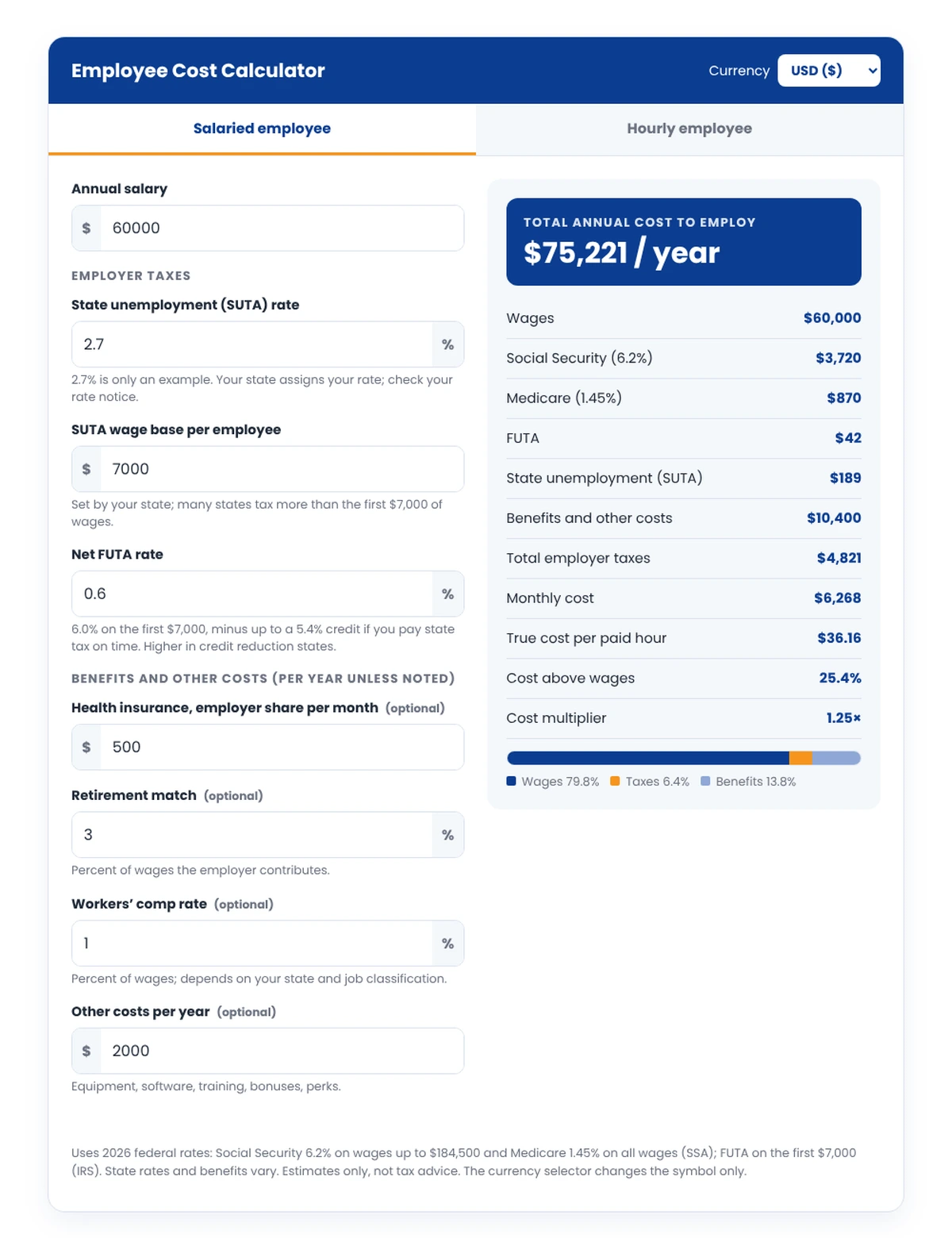
A small business hires an employee at $60,000 a year.
- Employer payroll taxes: Social Security $3,720, Medicare $870, FUTA $42, SUTA at 2.7% on $7,000 $189
- Benefits and other costs: health insurance $6,000, 3% retirement match $1,800, workers' comp $600, equipment and software $2,000
- Total annual cost: $75,221, or about $6,268 a month
- True cost per paid hour: $36.16, compared with a $28.85 hourly wage equivalent
This employee costs about 25% more than their salary. That's the number to use when you price your services or plan a hire.
Employer Payroll Taxes at a Glance
| Cost | Who sets it | 2026 rate or range |
|---|---|---|
| Social Security | Federal law (SSA) | 6.2% of wages up to $184,500 |
| Medicare | Federal law | 1.45% of all wages |
| FUTA | Federal law (IRS) | 6.0% on first $7,000; net 0.6% with full state credit |
| SUTA | Your state | Varies by state and employer history |
| Workers' comp | Your insurer and state | Varies by job classification |
Where to Find Your Numbers
- Salary or wage: your offer letter or job posting.
- SUTA rate and wage base: your state unemployment agency's annual rate notice.
- Health insurance: your plan's monthly premium times the share you pay.
- Workers' comp: your policy's rate for the employee's job class.
- Other costs: laptops, software seats, training, and bonuses you plan to give.
What the Calculator Can and Cannot Tell You
It can tell you
- The full yearly and monthly cost of a hire
- Your employer payroll tax bill
- The true hourly cost to price your work
- How benefits change the cost of a role
It cannot tell you
- Your exact state tax rate or local taxes
- Overtime, commissions, or variable bonuses
- Costs for independent contractors
- Tax credits that could lower your cost
Frequently Asked Questions
How much does an employee really cost?
Usually much more than their wages, depending on benefits and your state. In our example, a $60,000 employee cost $75,221 a year, about 25% more. Employer payroll taxes alone added about $4,800; health insurance and other benefits made up the rest.
What payroll taxes does an employer pay?
Employers pay 6.2% Social Security on wages up to $184,500 in 2026, 1.45% Medicare on all wages, federal unemployment tax (FUTA) on the first $7,000, and state unemployment tax (SUTA). Some states and cities add their own payroll taxes, such as paid leave or disability programs, so check your state's rules too.
Why is my FUTA rate 0.6% instead of 6%?
The FUTA rate is 6.0%, but employers who pay their state unemployment taxes in full and on time can claim a credit of up to 5.4%, bringing the net rate to 0.6%. Employers in credit reduction states get a smaller credit and pay more.
Does this include the employee's share of taxes?
No. The calculator shows what the employer pays. Employees also pay 6.2% Social Security and 1.45% Medicare from their paychecks, plus income tax withholding. Those amounts come out of the employee's wages and don't add to your cost, but you are responsible for withholding and depositing them on time.
Is an employee or a contractor cheaper?
A contractor usually costs less in taxes and benefits, but you can't simply choose. Worker classification depends on how much control you have over the work. Misclassifying an employee as a contractor can lead to back taxes and penalties, so check IRS guidance or an advisor.
Final Takeaway
Price every hire at its full cost, not just its salary. Use the true hourly cost when you set prices or bid on work. If you're planning your first hires, our guides on how to be a good manager and how to motivate employees can help you get the most from them.
Sources: Social Security Administration, contribution and benefit base; IRS Topic No. 759, Form 940 and FUTA tax (updated September 2026). Estimates only, not tax advice.