A shop owner has a great quarter and decides to share it. Everyone gets a $500 bonus and a team dinner. For about two weeks, the mood is great. Then it slips back to where it was: the same people doing the minimum, the same quiet frustration in the back room. The owner can’t understand it. Didn’t they just prove they care?
They did. But money and a nice night out aren’t what keep people motivated day after day, and the research on this is surprisingly consistent. If you want to know how to motivate employees, start with what decades of studies actually show, not what feels generous in the moment.
Most Managers Get Motivation Backwards
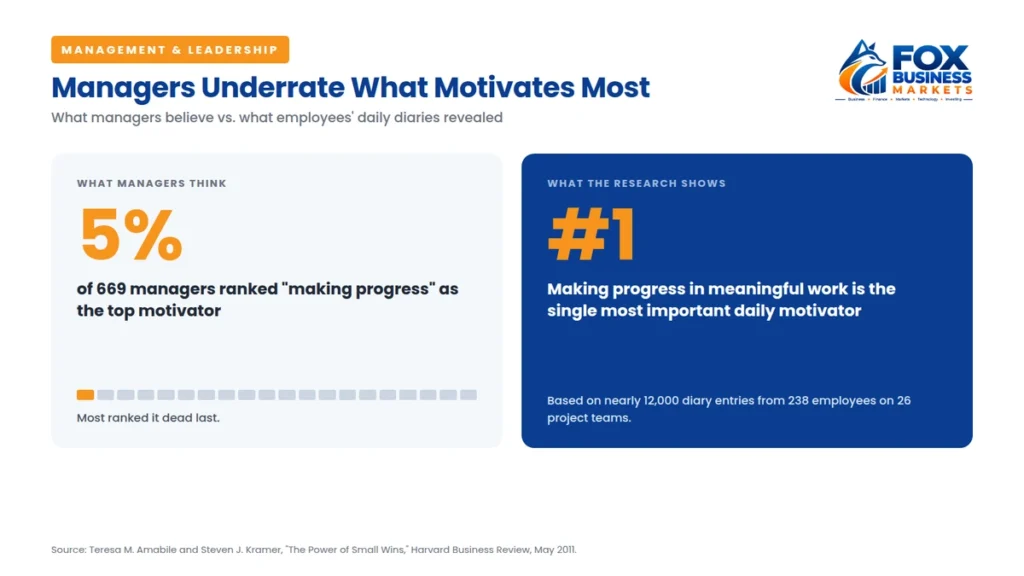
Harvard researchers Teresa Amabile and Steven Kramer asked 238 employees on 26 project teams to keep a daily diary of their work lives. The result was nearly 12,000 diary entries. Their conclusion: “Of all the things that can boost emotions, motivation, and perceptions during a workday, the single most important is making progress in meaningful work” (Harvard Business Review, via HBR’s Must Reads).
Then they asked 669 managers to rank what motivates employees. Only 35 of them, “a mere 5%,” put progress first. Most ranked it dead last. Managers tended to bet on recognition, incentives, and clear goals instead.
That gap explains why so many attempts at figuring out how to motivate employees fall flat. Managers spend energy on perks while their team’s real frustration is simpler: they can’t get anything done.
Pay Matters, but Not the Way You Think
In 1968, psychologist Frederick Herzberg published one of the most-read articles in Harvard Business Review’s history, “One More Time: How Do You Motivate Employees?” His big idea was that the things that make people unhappy at work aren’t the opposite of the things that make them motivated. In his words: “The opposite of job satisfaction is not job dissatisfaction but, rather, no job satisfaction” (Herzberg, HBR reprint).
Herzberg split workplace factors into two groups:
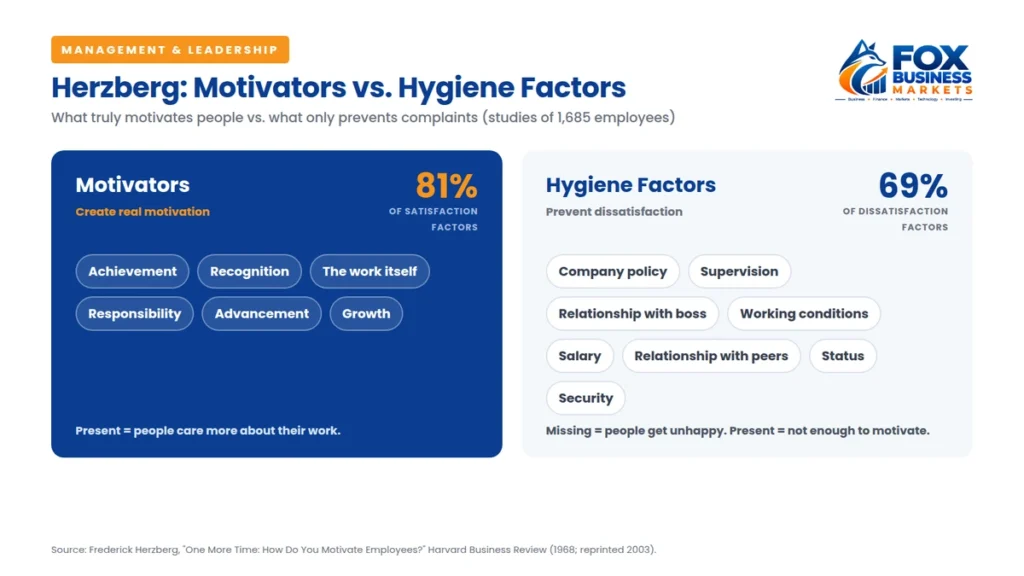
- Motivators: achievement, recognition, the work itself, responsibility, and growth or advancement.
- Hygiene factors: company policy, supervision, working conditions, salary, status, and security.
Across studies of 1,685 employees, 81% of the factors behind job satisfaction were motivators, while 69% of the factors behind dissatisfaction were hygiene factors. In plain terms: underpay people and they’ll be unhappy. Pay them well, and you’ve removed a problem, but you haven’t given them a reason to care. When it comes to how to motivate employees, pay is the floor, not the engine.
Modern data backs this up. Gallup’s research on why people quit found that “pay/benefits” was the most common single reason, but it came up only 16% of the time. Broader issues of “engagement and culture” (37%) and “wellbeing and work-life balance” (31%) were the most common themes (Gallup).
How to Motivate Employees: 8 Things That Actually Work
1. Clear the Path to Progress
If progress is the strongest daily motivator, your most important job is removing what blocks it. Ask your team a simple question once a week: “What’s slowing you down?” Then fix one thing. A missing approval, a broken tool, a vague request from another department. These small fixes feel minor to you and enormous to the person stuck behind them.
Make progress visible, too. Amabile and Kramer found that even small wins had a strong effect on how people felt about their work. Close out a project with a quick note on what got done. Celebrate the finished thing, not just the big launch.
2. Show People Who Their Work Helps
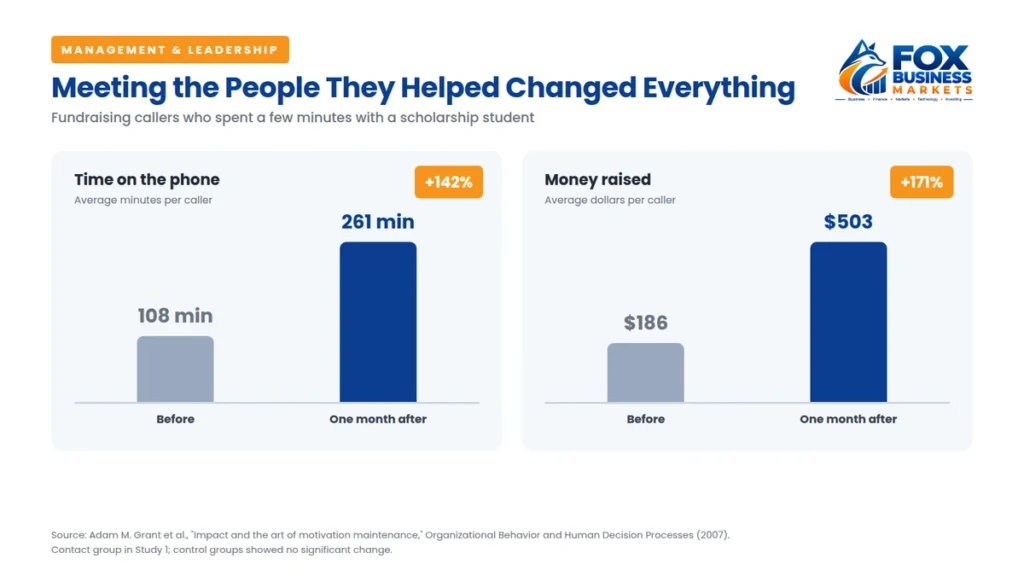
In one of the most striking studies on workplace motivation, psychologist Adam Grant and his colleagues worked with callers raising money for university scholarships. Some callers spent a few minutes with a student whose scholarship came from their fundraising. A month later, that group showed “142% more phone time” and raised “171% more money,” while the control groups didn’t change (Grant et al., Organizational Behavior and Human Decision Processes, 2007).
The lesson is cheap to apply. Share customer thank-you notes with the people who did the work. Invite a happy client to talk to your team. Tell the warehouse crew which order saved a customer’s big event. People work harder when they can see a real person on the other end.
3. Give Real Autonomy
Self-determination theory, developed by psychologists Edward Deci and Richard Ryan, holds that people have three basic needs at work: autonomy, competence, and relatedness. Autonomy, in their terms, is “the experience of volition and willingness,” the feeling that your actions are your own (Self-Determination Theory).
You don’t have to give up control of the goals. Give up control of the method. “Here’s what we need by Thursday, and here’s why it matters. How you get there is up to you” is one of the most motivating sentences a manager can say.
4. Help Them Get Better at Something
The second need, competence, is about “effectiveness and mastery.” People stay motivated when they feel themselves improving. Ask each person what skill they want to build this year, then give them work that stretches it: a new type of client, a small project to lead, a course you’ll pay for. Our guide on how to be a good manager covers how to turn weekly one-on-ones into real coaching.
5. Make People Feel They Belong
The third need, relatedness, is “the experience of warmth, bonding, and care.” Belonging also means feeling heard. Gallup found that “just three in 10 U.S. workers strongly agree that at work, their opinions seem to count.” It estimates that raising that to six in 10 could mean a 27% reduction in turnover and a 12% increase in productivity (Gallup).
The fix starts small. Ask for input before decisions, then close the loop: “We went with option B. Here’s why, and here’s the part of your idea we used.”
6. Recognize Specific Work, the Way They Like It
“Great job, everyone” is easy to say and easy to forget. Specific praise lands: “The way you handled that angry customer on Tuesday kept a $10,000 account.” In their landmark review, Deci and his colleagues found that positive feedback increased people’s intrinsic motivation (Deci, Koestner, and Ryan, Psychological Bulletin, 1999).
Also, ask people how they like to be recognized. Some want a public shout-out. Others would much rather get a quiet word or an afternoon off.
7. Pay Fairly, Then Stop Leaning on Money
Fair pay is the floor. With private-sector wages and salaries up 3.1% in the year to June 2026, according to the Bureau of Labor Statistics, people notice quickly when their pay falls behind (BLS). Check that your pay is competitive for your area and industry.
But be careful about using rewards as your main motivation tool. That same 1999 review, which pulled together 128 studies, found that tangible rewards tied to doing a task “significantly undermined free-choice intrinsic motivation.” When people start working for the prize, they can lose interest in the work itself. Bonuses work best as a thank-you for results, not as the reason to show up.
8. Offer Flexibility Where You Can
Flexibility is one of the most valued benefits you can offer, and it often costs nothing. In a large experiment at travel company Trip.com, published in Nature in 2024, letting employees work from home two days a week “improved job satisfaction and reduced quit rates by one-third,” with no effect on performance reviews or promotions (Bloom, Han, and Liang, Nature).
Not every job can be done remotely. But most jobs have some flexibility to offer: shift swaps, a later start on school days, or a four-day schedule during a slow season.
What Doesn’t Work
Some popular ideas about how to motivate employees don’t hold up. Contests that pit coworkers against each other usually create a few winners and a lot of resentment. Surprise bonuses with no clear link to results feel nice but fade fast, as the shop owner learned. And pizza parties during a crisis can feel insulting if the real problem, like understaffing or broken tools, never gets fixed.
The common thread: these are things done to employees, not with them. Motivation grows from the work itself, the people around it, and a manager who clears the way.
A Quick Self-Check for Managers
Before you try a new idea for how to motivate employees, ask yourself honestly:
- Does each person on my team know what progress looks like this week?
- Have they heard directly from a customer or someone their work helped recently?
- Do they decide how to do their work, or do I?
- When did I last praise someone for something specific?
- If my best employee quit tomorrow, would I know why?
If you can’t answer the last one, ask them before someone else gives them a better reason to leave. Your management approach matters here too. Our guide to leadership styles explains how to match how you lead to what each person needs.
Frequently Asked Questions
How to motivate employees without money?
Help them make visible progress, show them who their work helps, give them control over how they do it, recognize specific contributions, and offer flexibility where you can. Research shows these often motivate more than cash.
What is the best way to motivate employees?
According to research by Teresa Amabile and Steven Kramer, the single most important daily motivator is making progress in meaningful work. Your main job is to remove obstacles and make that progress visible.
Does money motivate employees?
Fair pay prevents dissatisfaction, but it rarely creates lasting motivation on its own. Research on tangible rewards suggests they can even reduce people’s natural interest in their work.
How do you motivate a team that’s lost its drive?
Start by asking what’s blocking them, then fix one problem quickly. Reconnect the team to who their work helps, and recognize specific progress as it happens.
What are the three needs behind motivation?
Self-determination theory identifies autonomy (control over your work), competence (getting better at it), and relatedness (feeling connected to others) as the three basic needs.
How to motivate employees in a small business?
Small businesses have an advantage: employees can see their impact directly. Share customer feedback, involve people in decisions, give them room to grow, and keep pay fair for your area.
The Bottom Line
Knowing how to motivate employees has less to do with what you give people and more to do with what you remove: the obstacles, the confusion, and the distance between their work and the people it helps. Pay fairly, then put your energy where the research points. The shop owner’s $500 bonus faded in two weeks. Fixing the thing that slows everyone down every single day lasts much longer.