Quick answer: A financial plan is a written roadmap that connects your goals to your money. To create one, set specific goals, calculate your net worth, budget, build an emergency fund, pay off high-interest debt, get insurance, invest for retirement and other goals, plan for taxes, and set up a will. Review it every year.
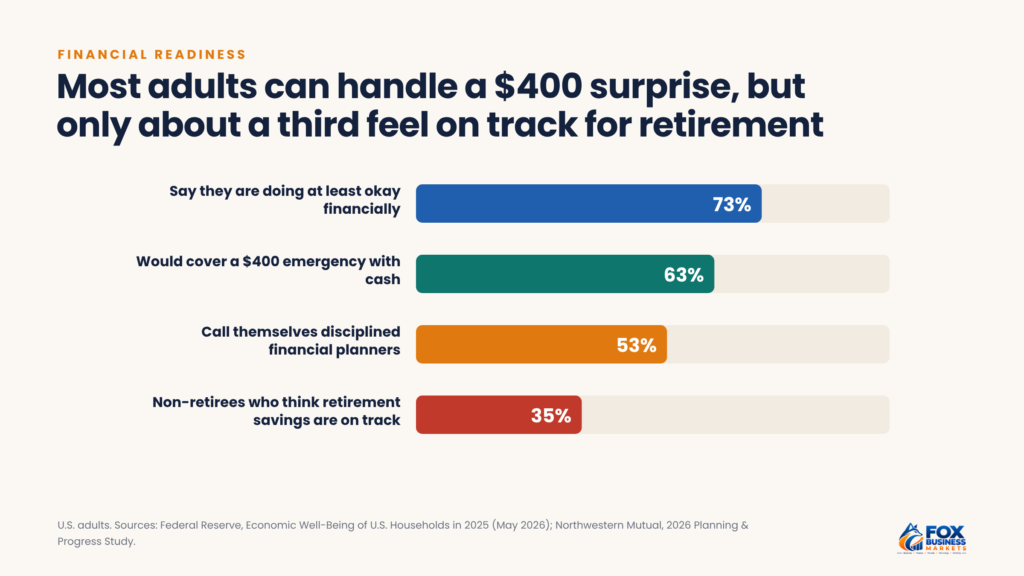
Sixty-three percent of U.S. adults would cover a $400 emergency expense with cash or its equivalent, a share unchanged since 2022, according to the Federal Reserve’s Economic Well-Being of U.S. Households in 2025 report. Only 35% of non-retirees think their retirement savings are on track.
Most people don’t lack income so much as direction. Money goes to whatever is urgent this month, while long-term goals such as retirement, a home, or a child’s education get whatever is left. A financial plan flips that order by deciding in advance where each dollar should go.
This guide walks through how to create a financial plan in 10 steps, shows a sample one-page plan, explains which goals to tackle first, and lists what your plan should cover at each stage of life.
What Is a Financial Plan?
A financial plan is a written picture of where you are, where you want to be, and the steps that will get you there. It doesn’t need to be long; many good plans fit on one or two pages. It should cover these 10 areas:
Area | Key question | Where to start |
| Goals | What do I want my money to do? | List goals with amounts and dates |
| Net worth | Where am I today? | Assets minus debts |
| Cash flow | Where does my money go each month? | A monthly budget |
| Emergency savings | Can I handle a surprise expense? | $1,000 first, then three to six months of expenses |
| Debt | What am I paying in interest? | A payoff plan, highest rate first |
| Insurance | What would a disaster cost me? | Health, auto, home or renters, life, disability |
| Retirement | Will I have enough to stop working? | Workplace plan and IRAs |
| Investing | How will other long-term goals be funded? | Diversified, low-cost funds |
| Taxes | Am I paying more than I need to? | Tax-advantaged accounts and deductions |
| Estate | Who gets what, and who decides if I can’t? | Will, beneficiaries, powers of attorney |
If you’re new to the basics, our guide on what personal finance is covers the building blocks behind each area.
Why Do You Need a Financial Plan?
A plan turns vague worries into specific, manageable steps. It helps you:
- Make trade-offs on purpose. You can see whether a new car payment would delay a home purchase or retirement.
- Avoid expensive mistakes, such as carrying credit card debt while holding cash in a low-yield account.
- Use time and compounding. Investing $300 a month from age 25 to 65 at a 7% average annual return grows to about $787,000. Waiting until 35 and investing $600 a month reaches about $732,000, even though you’d contribute $72,000 more.
- Stay steady during setbacks. An emergency fund and the right insurance keep a job loss or medical bill from becoming a debt spiral.
People who plan also tend to feel more secure. In Northwestern Mutual’s 2026 Planning & Progress Study, 53% of U.S. adults described themselves as disciplined financial planners, up from 49% in 2025 and a low of 45% in 2024, and 71% of people who work with a financial advisor said they feel financially secure, compared with 50% of all adults.
How Do You Create a Financial Plan?
These 10 steps cover every part of a plan. Work through them roughly in order, and when goals compete for the same dollars, use the priority list further down to decide what gets funded first.
1. Set Specific Goals
Write down what you want your money to do, with a dollar amount and a target date for each goal. “Save more” isn’t a goal; “Save $30,000 for a home down payment by June 2031” is.
Time frame | Examples |
| Short term (under 2 years) | Emergency fund, paying off a credit card, a vacation |
| Medium term (2 to 10 years) | Home down payment, new car, starting a business |
| Long term (10+ years) | Retirement, a child’s college, paying off a mortgage |
Rank your goals. You’ll rarely be able to fund all of them at once, and the ranking tells you where extra money goes.
2. Calculate Your Net Worth
Net worth is everything you own minus everything you owe. It’s your financial starting point, and tracking it once or twice a year shows whether your plan is working. Our guide to net worth explains how to calculate it and how yours compares by age.
3. Build a Budget
A budget shows where your money goes and how much is left for your goals. Track your spending for a month or two, then set targets by category. Our guide on how to make a budget walks through popular methods, including the 50/30/20 approach.
4. Build an Emergency Fund
Aim for three to six months of necessary expenses in a separate, easy-to-reach savings account. Start with a smaller target, such as $1,000 or one month of expenses, so a surprise bill doesn’t land on a credit card. Our emergency fund guide covers how much you need and where to keep it, such as a high-yield savings account.
5. Pay Off High-Interest Debt
Credit card debt often costs more than 20% a year; the average rate on accounts charged interest was 22.15% in the second quarter of 2026, according to the Federal Reserve, which beats almost any investment return you could expect. List your debts by interest rate and send extra payments to the highest-rate balance first while paying the minimum on the rest. Our step-by-step plan on how to pay off debt compares the avalanche and snowball methods.
6. Protect Yourself With Insurance
Insurance keeps one bad event from undoing years of progress. Most plans need health insurance, auto insurance if you drive, homeowners or renters insurance, and disability insurance if you depend on a paycheck. Add life insurance if anyone relies on your income. Our overview of types of insurance explains each one.
7. Save for Retirement
Retirement is usually your largest long-term goal. Contribute at least enough to your workplace plan to get the full employer match, then build from there. For 2026, you can contribute up to $24,500 to a 401(k) and $7,500 to an IRA, plus catch-up contributions of $8,000 to a 401(k) from age 50, $11,250 at ages 60 to 63, and $1,100 to an IRA. The IRS typically announces the next year’s limits in October or November. Our guide to retirement planning covers how much you need, and our comparison of Roth vs. traditional IRAs helps you choose an account.
8. Invest for Other Long-Term Goals
For goals more than about five years away, investing usually beats saving. Low-cost, diversified funds such as index funds are a common starting point. Keep money for goals less than five years away in high-yield savings, CDs, or Treasury bills. Our guide on how to start investing explains accounts, fees, and asset allocation.
9. Plan for Taxes
Tax-advantaged accounts cut your bill directly: a $6,000 traditional 401(k) contribution saves someone in the 22% bracket $1,320 in federal income tax. Use tax-advantaged accounts, such as 401(k)s, IRAs, and health savings accounts, check your withholding each year, and claim the credits and deductions you qualify for. Our guide to how taxes work covers the basics.
10. Cover Estate Basics
Even with modest assets, you need a will, up-to-date beneficiaries on retirement accounts and life insurance, a financial power of attorney, and a health care directive. Beneficiary designations generally override a will, so review them after every major life change.
What Does a Simple One-Page Financial Plan Look Like?
Consider Jordan, a fictional 34-year-old earning $72,000 a year. After taxes and a 10% 401(k) contribution, Jordan takes home about $4,250 a month. Necessary expenses, including minimum debt payments, run $3,000 a month. Jordan has $6,000 in emergency savings and a $5,500 credit card balance at 22% interest, and decides to put $900 a month toward goals, keeping the rest for flexible spending.
Goal | Target | Monthly amount | When |
| 401(k) | 10% of pay, including enough to capture the full employer match | $600 (pre-tax, from each paycheck) | Ongoing |
| Credit card payoff | $0 balance | $500 above the minimum | Now; paid off in about 9 months |
| Emergency fund | $12,000 (four months of necessary expenses) | $400 | Now; full in about 15 months |
| Roth IRA | Build tax-free retirement savings | $250 | Starts after the card is paid off |
| Home down payment | $30,000 | $250, rising to $650 once the emergency fund is full | About 5 years |
| Insurance | Renters, disability through work, term life once married | Varies | Review yearly |
| Estate | Will, beneficiaries, powers of attorney | One-time | This year |
Jordan’s plan fits on one page, ties every dollar to a goal, and follows the order below: high-interest debt and the emergency fund come first, and the money freed up by each finished goal rolls into the next one.
In What Order Should You Tackle Financial Goals?
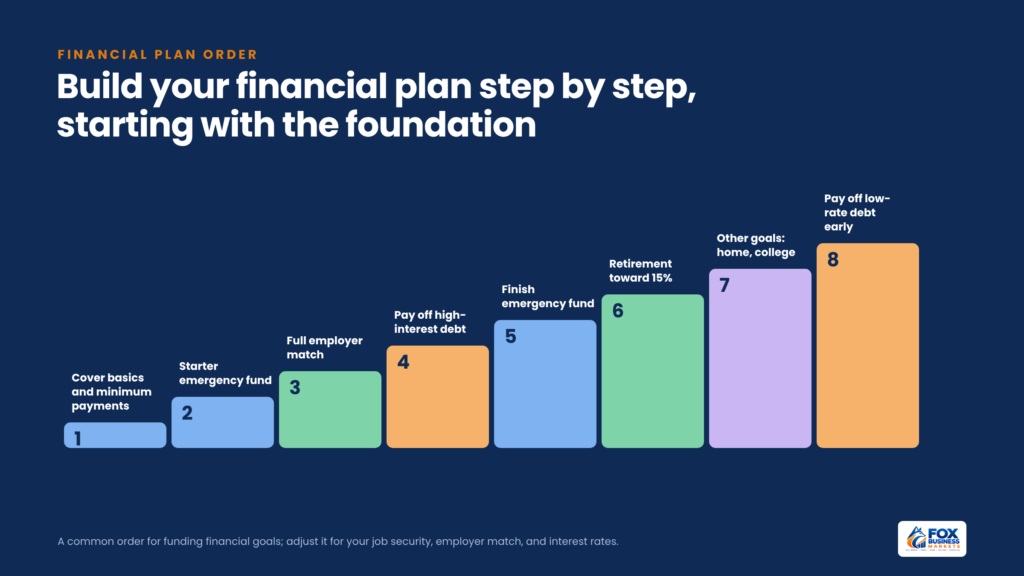
When money is limited, fund goals in this order:
- Cover basic living costs and minimum payments on all debts.
- Save a starter emergency fund, about $1,000 or one month of expenses.
- Get your full employer retirement match. It’s an immediate return you can’t get elsewhere.
- Pay off high-interest debt, such as credit cards.
- Finish your emergency fund of three to six months of expenses.
- Increase retirement saving toward 15% of income, including any match.
- Save and invest for other goals, such as a home or college.
- Pay down low-interest debt early if you still have room.
Adjust the order for your situation. If your job is unstable, a larger emergency fund may come before extra retirement saving. If your employer offers no match, high-interest debt may come first.
What Should Your Financial Plan Cover at Each Age?
Life stage | Priorities |
| 20s | Build a budget, start an emergency fund, avoid credit card debt, start retirement saving, build credit |
| 30s | Finish the emergency fund, save for a home, add life and disability insurance as responsibilities grow, raise retirement contributions |
| 40s | Increase retirement saving, plan for children’s education, review insurance and estate documents, keep debt in check |
| 50s | Use catch-up contributions, estimate retirement income, pay down the mortgage, plan for health costs |
| 60s and beyond | Decide when to claim Social Security, plan withdrawals and taxes, review Medicare, update estate plans |
Each stage builds on the one before it. The earlier you start, the more time your savings have to grow; our explainer on compound interest shows how much difference time makes.
Do You Need to Be Wealthy to Have a Financial Plan?
No. Many people assume planning is only for those with large investment accounts. In fact, it helps most when money is tight, because there’s less room for mistakes.
A plan for someone just starting out might cover only a budget, a starter emergency fund, and a debt payoff schedule. That’s still a financial plan. As income grows, the plan adds retirement, investing, insurance, and estate steps.
You also don’t need a professional to start. Free tools, a spreadsheet, and the steps above are enough for most people to build a first plan.
Should You Make a Plan Yourself or Hire a Financial Advisor?
Many people can build and maintain a plan on their own. A professional can help when your situation gets complicated, such as with a business, stock compensation, an inheritance, a divorce, or retirement income planning.
Option | Typical cost structure | Best for |
| Do it yourself | Free or low cost | Straightforward finances and people who enjoy managing money |
| Robo-advisor | Typically 0.25% to 0.50% of assets a year | Hands-off investing with automated rebalancing |
| Flat-fee or hourly planner | A one-time or hourly fee | A plan or second opinion without ongoing management |
| Full-service advisor | Often around 1% of assets a year | Complex situations and people who want ongoing help |
If you hire someone, ask whether they’re a fiduciary, legally required to act in your best interest, and exactly how they’re paid. Our guide to choosing a financial advisor covers credentials, fees, and questions to ask.
What Financial Planning Mistakes Should You Avoid?
Even a good plan can stall. Watch for these common mistakes:
- Setting goals without numbers or dates. Without a target, you can’t tell whether you’re on track.
- Skipping the emergency fund to invest faster. A surprise expense then lands on a credit card at a high rate, wiping out investment gains.
- Letting raises disappear into spending. Send at least half of every raise to your goals before you adjust your lifestyle.
- Ignoring insurance gaps, especially disability coverage, which protects the income your whole plan depends on.
- Forgetting about inflation. A goal set in today’s dollars needs more money in the future; raise targets each year.
- Investing money you’ll need soon. Funds for a home purchase in two years usually belong in savings, not stocks.
- Never updating beneficiaries. An outdated form can send money to an ex-spouse or leave a new child out.
- Making it too complicated. A simple plan you follow beats a detailed one you abandon.
How Often Should You Review Your Financial Plan?
Review your plan at least once a year, and again after any major life event:
- Marriage, divorce, or a new child
- A new job, raise, or job loss
- Buying or selling a home
- Starting a business
- An inheritance or large windfall
- A major illness or the death of a family member
An annual review can be short: update your net worth, check progress on each goal, rebalance investments, review insurance and beneficiaries, and set targets for the coming year.
How Do Americans’ Finances Compare?
National data can help you see where you stand:
- Net worth: Median family net worth was $215,900 in 2025, up 2% from 2022 after inflation, according to the Federal Reserve’s 2025 Survey of Consumer Finances, released Oct. 9, 2026. The mean was $1.24 million, pulled up by the wealthiest households.
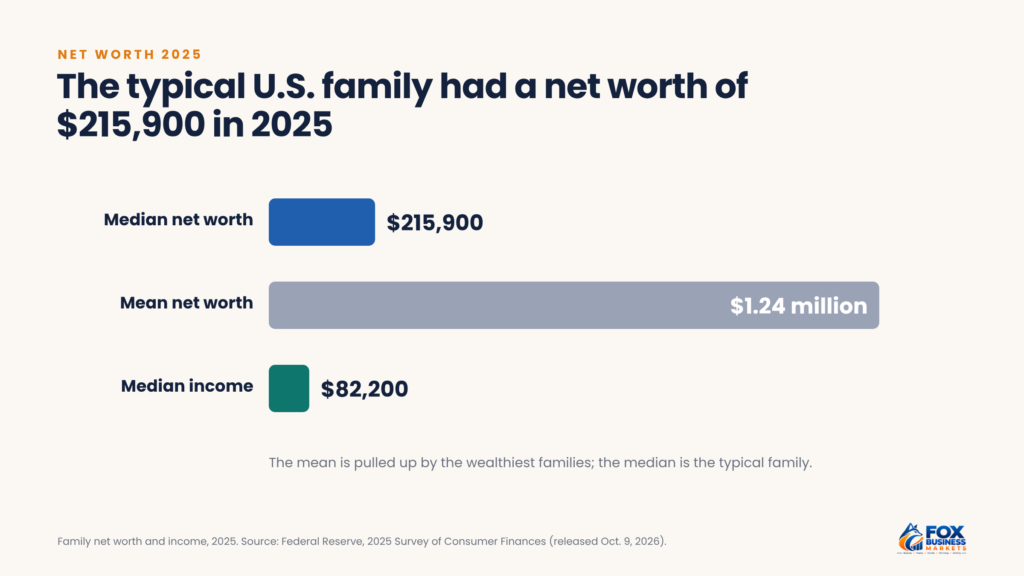
- Income: Median family income was $82,200, up 7% from 2022 after inflation.
- Retirement plans: About 65% of families had a retirement plan, including workplace plans, IRAs, and pensions.
- Retirement target: Americans said they’d need $1.46 million to retire comfortably in Northwestern Mutual’s 2026 study, up from $1.26 million a year earlier.
Our retirement statistics and personal finance statistics roundups have more data.
Frequently Asked Questions
How do you make a financial plan with irregular income?
Base your budget on your lowest-earning month from the past year, not your average. In good months, move the extra into a separate account and pay yourself a fixed monthly amount from it. Keep a larger emergency fund, closer to six months of expenses, to cover slow stretches.
What is a sinking fund?
A sinking fund is money you set aside each month for a known future expense, such as car repairs, holiday gifts, or an annual insurance premium. It keeps predictable costs from draining your emergency fund. Divide each expected bill by the number of months until it’s due, and automate that transfer.
Should couples have one financial plan or two?
Most couples benefit from one shared plan that covers joint goals, plus room for each partner’s personal goals and spending. The plan should spell out how you’ll split expenses and who handles which accounts. Schedule a money meeting once a month to review progress together.
What documents should you keep with your financial plan?
Keep copies of your budget, recent account statements, insurance policies, beneficiary designations, tax returns, and estate documents in one secure place, either a fireproof box or encrypted digital storage. Make sure a trusted person knows where to find them, and update the folder during your annual review.
Write Your One-Page Plan This Weekend
Set aside two hours. List your goals with amounts and dates, calculate your net worth, and write down how much you’ll put toward each goal every month. Automate the transfers on payday, put your annual review on the calendar, and adjust as your life changes.
This article is for general information only and isn’t financial, tax, legal, or investment advice. Consider your own situation or talk to a qualified professional before making decisions.

