Quick answer: Retirement Plannings means estimating the income you’ll need, figuring out how much Social Security and other sources will cover, and saving enough to fill the gap. A common approach is to save about 15% of pay, including any employer match, in tax-advantaged accounts such as a 401(k) and IRA, and invest it for long-term growth.
Americans think they’ll need $1.46 million to retire comfortably, up from $1.26 million a year earlier, according to Northwestern Mutual’s 2026 Planning & Progress Study. Yet the median 401(k) balance at Vanguard was $44,115 at the end of 2025.
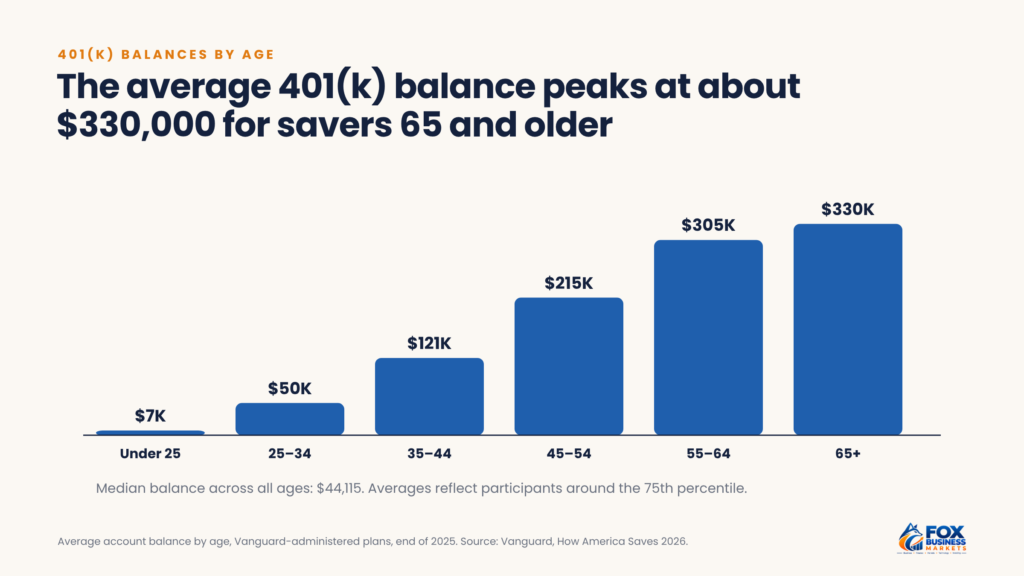
Only 35% of non-retirees think their retirement savings are on track, according to the Federal Reserve. The right number for you depends on your spending, your Social Security benefit, and when you plan to stop working, not on a national headline.
This Retirement Plannings guide shows how to estimate what you’ll need, how much to save at each age, which accounts to use, how Social Security fits in, and how to turn savings into income once you retire.
What Is Retirement Plannings?
Retirement Plannings is the process of deciding when you want to stop working, estimating what that life will cost, and building the savings and income to pay for it. It’s one part of a broader financial plan, and for most people it’s the largest long-term goal.
A retirement plan answers five questions:
- When do you want to retire?
- How much will you spend each year in retirement?
- How much income will Social Security, pensions, or part-time work provide?
- How much do you need saved to cover the rest?
- How will you invest and withdraw that money?
How Much Money Do You Need to Retire?
Start with spending, not a round number. A common rule of thumb is 70% to 80% of your pre-retirement income, but your own budget is a better guide. Some costs fall in retirement, such as commuting and retirement contributions, while others, such as health care and travel, often rise.
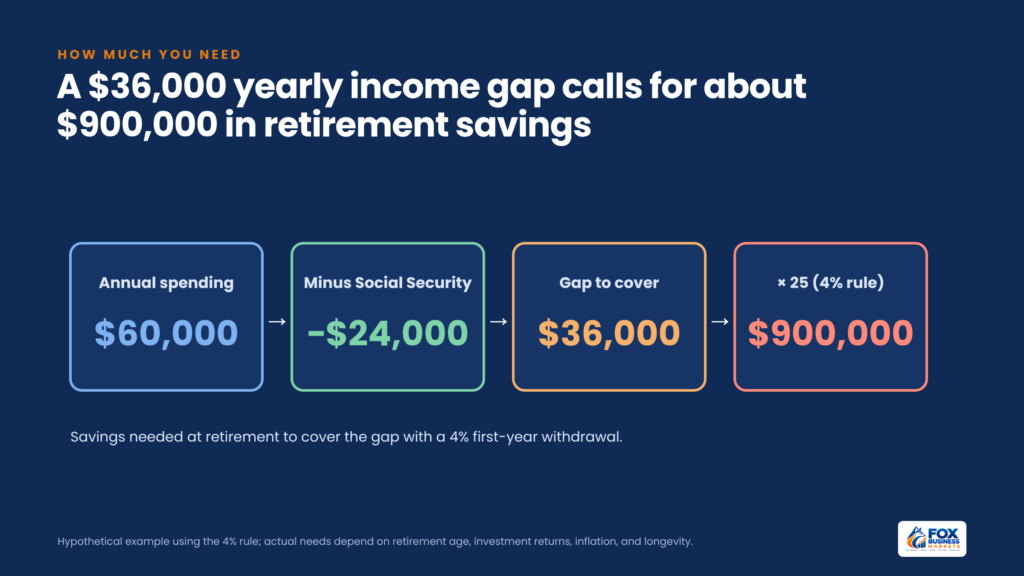
Then subtract guaranteed income and multiply the gap by 25. That shortcut comes from the 4% rule, a guideline that suggests withdrawing about 4% of your savings in the first year of retirement and adjusting for inflation after that.
Example: You expect to spend $60,000 a year in retirement, and Social Security will pay about $24,000.
Step | Amount |
| Annual spending in retirement | $60,000 |
| Minus Social Security | −$24,000 |
| Gap your savings must cover | $36,000 |
| Savings needed (gap × 25) | $900,000 |
The 4% rule is a starting point, not a guarantee. Retiring early, retiring into a market downturn, or living into your late 90s may call for a lower withdrawal rate and more savings. Our guide to compound interest shows why starting early makes this target easier to reach.
How Much Should You Save for Retirement?
A common guideline is to save 15% of your pre-tax income each year, including any employer match, starting in your 20s. Vanguard recommends a total contribution rate of 12% to 15%, including the employer’s share. If you start later, you’ll need to save more.
Fidelity suggests these savings milestones, measured as a multiple of your pre-retirement income and assuming you save 15% a year from age 25:
By age | Savings target |
| 30 | 1× your salary |
| 40 | 3× your salary |
| 50 | 6× your salary |
| 60 | 8× your salary |
| 67 | 10× your salary |
These are rough benchmarks that assume you retire at 67 and maintain your lifestyle. If you’re behind, focus on raising your savings rate a little each year, especially when you get a raise.
Which Retirement Accounts Should You Use?
Tax-advantaged accounts shelter your savings from yearly taxes on dividends and gains, so more of each year’s return stays invested. The main options and their 2026 limits are:
Account | Who can use it | 2026 contribution limit | Key feature |
| 401(k), 403(b), or governmental 457 | Employees with a workplace plan | $24,500, plus $8,000 catch-up at 50+ ($11,250 at ages 60 to 63) | Employer match; traditional or Roth options |
| Traditional IRA | Anyone with earned income | $7,500, plus $1,100 catch-up at 50+ | Possible tax deduction now; taxed later |
| Roth IRA | Earners under income limits | $7,500, plus $1,100 catch-up at 50+ | No deduction now; tax-free withdrawals later |
| SEP IRA | Self-employed and small business owners | Up to 25% of compensation, capped at $72,000 | Simple setup, employer contributions only |
| Solo 401(k) | Self-employed with no employees besides a spouse | Employee and employer contributions combined | Highest limits for many self-employed |
| Health savings account (HSA) | People with a qualifying high-deductible health plan | $4,400 self-only, $8,750 family, plus $1,000 catch-up at 55+ (rising to $4,500 and $9,000 in 2027) | Tax-free for medical costs; can serve as retirement savings |
The IRS typically announces the next year’s limits in October or November. Starting in 2026, workers whose prior-year FICA wages exceeded $150,000 must make 401(k) catch-up contributions to that employer’s plan as Roth contributions.
A practical order: contribute enough to your 401(k) to get the full employer match, then fund an IRA, then go back to the 401(k) or an HSA. Our comparison of Roth vs. traditional IRAs explains which tax treatment fits your situation.
How Does Social Security Fit Into Retirement Plannings?
Social Security replaces part of your income, and for many retirees it’s the largest single source. Beneficiaries will get a 3.6% cost-of-living adjustment starting in January 2027, raising average retirement benefits by about $75 a month, according to the Social Security Administration.
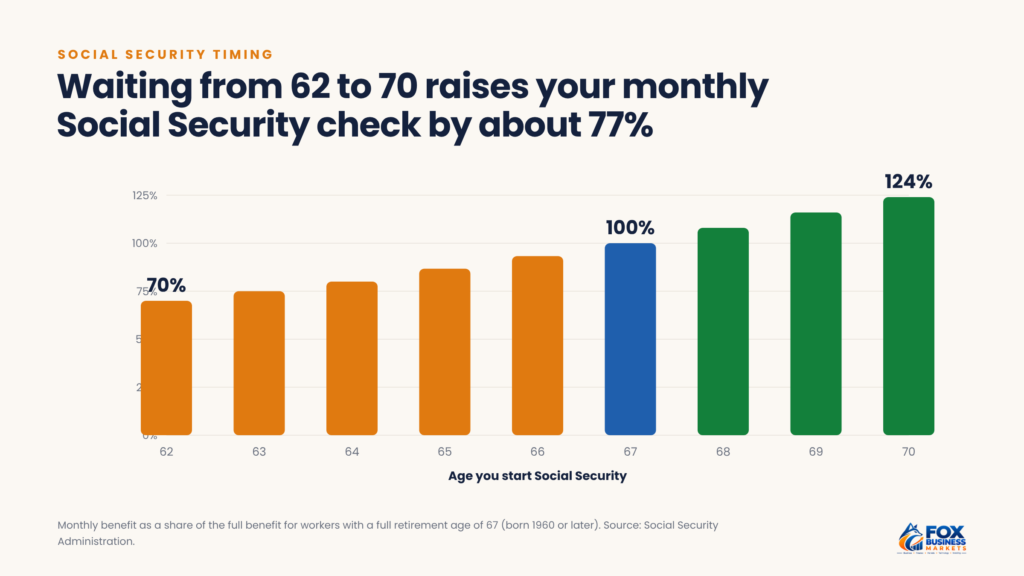
Claiming at 70 instead of 62 raises your monthly check by about 77%:
Claiming age | Monthly benefit, if your full retirement age is 67 |
| 62 (earliest) | About 70% of your full benefit |
| 67 (full retirement age) | 100% |
| 70 (latest increase) | About 124% |
Your full retirement age is 67 if you were born in 1960 or later. Each year you delay past full retirement age, up to 70, raises your benefit by 8%.
If you claim before full retirement age and keep working, the earnings test applies: in 2027, $1 in benefits is withheld for every $2 you earn above $25,560.
Create a free account at ssa.gov to see your personal benefit estimates at different ages, and use those numbers in your plan instead of national averages.
How Should You Invest Your Retirement Savings?
Retirement money usually needs to grow for decades, so most of it typically goes into stocks when you’re young, shifting gradually toward bonds and cash as retirement nears.
- Target-date funds handle this shift automatically. You pick the fund closest to your expected retirement year, and it rebalances for you.
- Low-cost index funds let you build your own mix at a low cost. Our guide to index funds explains how they work.
- Keep fees low. At a 7% return, $100,000 grows to about $761,000 in 30 years. At 6%, after an extra 1 percentage point in fees, it grows to about $574,000, roughly $187,000 less.
- Rebalance once a year to keep your mix in line with your target.
If you’re starting from scratch, our guide on how to start investing covers accounts, fees, and asset allocation.
Is It Too Late to Start Saving for Retirement at 50?
No. It’s a common belief that if you haven’t saved by 50, retirement is out of reach, but people in their 50s have several advantages:
- Catch-up contributions. In 2026, workers 50 and older can put up to $32,500 into a 401(k) and $8,600 into an IRA. Those aged 60 to 63 can contribute up to $35,750 to a 401(k).
- Peak earning years. Many people earn the most in their 50s, and children may be financially independent.
- Time to work longer. Delaying retirement by even two or three years adds contributions, gives investments more time to grow, and increases Social Security benefits.
- Flexibility in retirement. Part-time work, downsizing, or relocating can close a remaining gap.
A 50-year-old who saves $2,000 a month for 17 years, earning a 6% average annual return, would have about $706,000 at 67. Using the 4% rule, that supports about $28,000 a year in withdrawals, on top of Social Security.
How Do You Turn Savings Into Retirement Income?
Saving is half of Retirement Plannings. The other half is drawing down money in a way that lasts and keeps taxes low.
- Set a sustainable withdrawal rate. Use the 4% rule above as a starting point, then trim withdrawals after a bad market year and raise them after a strong one.
- Plan required minimum distributions (RMDs). You generally must start withdrawing from traditional 401(k)s and IRAs at age 73, or 75 if you were born in 1960 or later. Roth IRAs, and Roth 401(k)s since 2024, have no RMDs for the original owner.
- Choose a withdrawal order. One standard order is taxable accounts first, then tax-deferred accounts, then Roth accounts, though the best order depends on your tax brackets each year.
- Keep one to two years of spending in cash so you don’t have to sell investments during a downturn.
- Consider guaranteed income, such as a pension or an annuity, to cover basic expenses alongside Social Security.
Because withdrawal planning involves taxes, Social Security timing, and investment risk all at once, consider working with a financial advisor in the years before and after retirement.
How Do Inflation and a Long Life Change Your Target?
Two forces quietly raise the amount you need: rising prices and a long retirement.
Inflation. At 3% a year, prices roughly double in 24 years. If you need $60,000 a year in today’s dollars and retire in 20 years, you’d need about $108,000 a year at retirement to buy the same things. Social Security adjusts for inflation each year, but most private pensions don’t, and your savings must keep up on their own.
Longevity. A 65-year-old today has a good chance of living into their late 80s, and many will reach their 90s. Planning to age 95 is a common way to avoid outliving your money, especially for couples, where the odds that at least one spouse lives a long time are higher.
To account for both:
- Run your numbers in today’s dollars, then raise the target each year by inflation.
- Keep a meaningful share of your portfolio in stocks even after you retire, so growth can offset inflation over a 25- or 30-year retirement.
- Delay Social Security if you can, since a larger inflation-adjusted check works like longevity insurance.
- Revisit your plan every year, rather than relying on a single projection made decades in advance.
How Should Married Couples Plan for Retirement?
Couples plan for two lifetimes, two sets of benefits, and often two different retirement dates.
- Spousal IRA. A spouse with little or no earned income can still contribute to an IRA, up to the annual limit, based on the working spouse’s income, as long as the couple files jointly.
- Spousal Social Security benefits. A spouse can receive up to 50% of the other spouse’s full retirement benefit if that’s more than their own benefit, though claiming early reduces it.
- Survivor benefits. When one spouse dies, the survivor generally keeps the larger of the two Social Security checks. That’s one reason the higher earner often benefits from delaying to 70.
- Coordinated withdrawals. Planning which accounts each spouse draws from, and when, can keep the household in a lower tax bracket.
- Name your spouse, or another person you choose, as beneficiary on every retirement account, and review those forms after major life events.
When Do Roth Conversions Make Sense?
A Roth conversion moves money from a traditional IRA or 401(k) into a Roth IRA. You pay income tax on the amount converted now, and qualified withdrawals later are tax-free, with no required minimum distributions for the original owner.
Conversions often make the most sense in low-income years, such as:
- The years between retiring and starting Social Security and RMDs, when taxable income may be unusually low.
- A year with a job loss, a sabbatical, or large business deductions.
- Years when you expect your tax rate to be higher later, because of RMDs, a larger pension, or a spouse’s death moving the survivor to single filing.
Convert only what keeps you within your target tax bracket, pay the tax from money outside the account if possible, and remember that higher income can raise Medicare premiums two years later. Converted amounts must generally stay in the Roth for five years to avoid a penalty on early withdrawals before 59½.
What About Health Care Costs in Retirement?
Health care is one of the largest and least predictable retirement expenses. Medicare eligibility starts at 65, so anyone retiring earlier needs coverage until then, through a spouse’s plan, COBRA, or the Health Insurance Marketplace.
Medicare doesn’t cover everything. Plan for premiums for Part B, Part D, and a Medicare Supplement or Medicare Advantage plan, along with deductibles, copays, dental, vision, and hearing costs. Long-term care, such as a nursing home or in-home help, is generally not covered by Medicare at all.
An HSA can help. Contributions are tax-deductible, growth is tax-free, and withdrawals for qualified medical expenses are tax-free, making it one of the most tax-efficient ways to save for health care in retirement.
What Should Retirement Plannings Look Like at Each Age?
Age | Focus |
| 20s | Start contributing, get the full employer match, choose low-cost funds, build an emergency fund |
| 30s | Raise contributions toward 15%, open an IRA, keep old 401(k)s invested when changing jobs |
| 40s | Check progress against savings milestones, increase savings as income grows, review your investment mix |
| 50s | Use catch-up contributions, estimate retirement spending, pay down debt, check your Social Security estimate |
| 60s | Set a retirement date, plan health coverage until Medicare, decide when to claim Social Security, build a withdrawal plan |
Track your progress by updating your net worth once or twice a year. Our retirement statistics roundup shows how Americans’ savings compare by age.
Frequently Asked Questions
Can you retire early and access your retirement savings?
Yes, with planning. Withdrawals from 401(k)s and IRAs before 59½ usually carry a 10% penalty, but exceptions exist, such as the rule of 55 for workplace plans when you leave a job in or after the year you turn 55, and a series of substantially equal periodic payments. Confirm which exceptions apply to your accounts with a tax professional before you withdraw.
What happens to your 401(k) when you change jobs?
You can usually leave it in your former employer’s plan, roll it into your new employer’s plan, roll it into an IRA, or cash it out. Cashing out typically triggers income taxes and possibly a 10% penalty, and it sets your savings back years. Request a direct rollover so the money moves without tax withholding.
Should you pay off your mortgage before you retire?
It depends on your interest rate, savings, and peace of mind. Paying off a low-rate mortgage can tie up cash that might earn more invested, but eliminating the payment lowers the income you need in retirement. Compare your mortgage rate with your expected after-tax investment return before you make extra payments.
How do you plan for retirement if you’re self-employed?
Without an employer plan, you set up your own: you choose between the SEP IRA and solo 401(k) in the table above; a solo 401(k) often lets you save more at lower incomes because you contribute as both employee and employer. Because your income may vary, set contributions as a percentage of profit rather than a fixed dollar amount. Check deadlines before you file: a SEP IRA can be opened and funded up to your tax-filing deadline, including extensions; a solo 401(k) can also be set up after year-end, but if you already have one, make your salary-deferral election by Dec. 31.
Raise Your Contribution Rate by 1 Point This Month
Log in to your retirement account and raise your contribution by one percentage point, or set it to increase automatically each year. Then check your Social Security estimate at ssa.gov and plug it into the savings formula above. Small increases now compound into a much larger nest egg by the time you retire.
This article is for general information only and isn’t financial, tax, legal, or investment advice. Consider your own situation or talk to a qualified professional before making decisions.

